1
/
of
10
Zuiun Chawan with Relief Cloud Motifs — Nangado, Signed, Tomobako
Zuiun Chawan with Relief Cloud Motifs — Nangado, Signed, Tomobako
Regular price
Dhs. 529.00 AED
Regular price
Sale price
Dhs. 529.00 AED
Taxes included.
Shipping calculated at checkout.
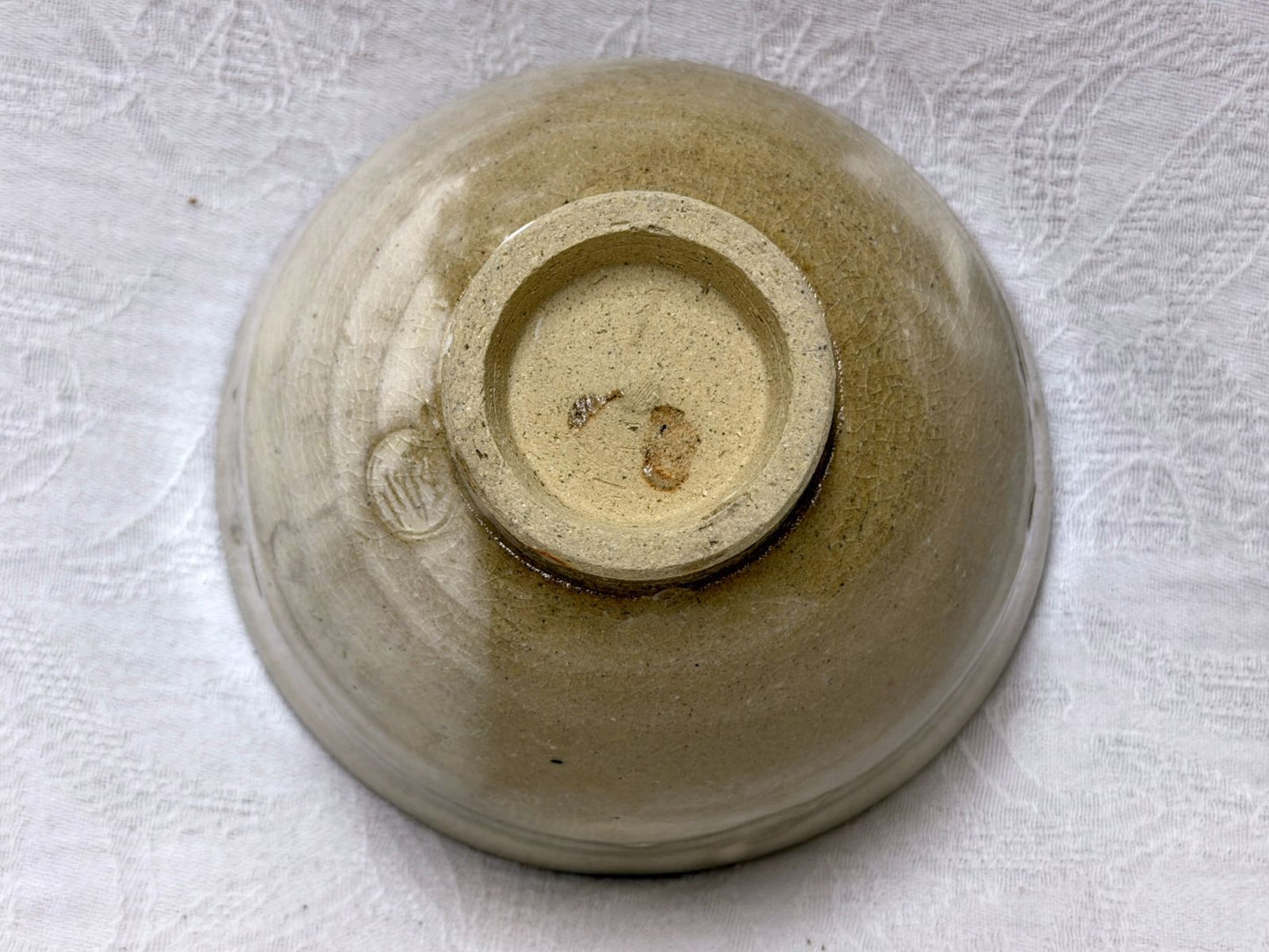
A stoneware matcha bowl carrying the name Zuiun — auspicious clouds. The body is dressed in a pale ash-grey glaze with fine kan'nyū crackle throughout; relief-pressed trefoil cloud forms circle the mid-body in quiet procession, rising from the clay beneath the glaze rather than painted upon it. The foot ring reveals warm ochre-red stoneware at its edge. The bowl comes with its original artist-inscribed wooden tomobako, calligraphed and sealed.
🔹 [ BASIC DETAILS ]
• Artist: Nangado (南画陶) — signed on box lid with red seal
• Technique: Relief-stamped cloud motifs (zuiun-mon) under ash-grey crackle glaze (kan'nyū)
• Style: Bunjin-suki (literati taste) — scholarly, restrained, quietly auspicious
• Era: Late Showa – Heisei (estimated 1970s–2000s)
• Origin: Japan
• Dimensions: Diameter approx. 12.0 cm, Height approx. 7.5 cm
• Box: Original tomobako (signed wooden box) included; yellow fukusa cloth included
• Condition: No chips, cracks, or repairs. Glaze crackle is inherent to the piece.
🔹 [ CULTURAL & ARTISTIC INSIGHT ]
Zuiun — 瑞雲, auspicious clouds — is one of the oldest decorative vocabularies in East Asian art, traveling from Tang-dynasty China into Heian court culture and eventually settling into the lexicon of Japanese ceramic decoration. As a motif on a chawan, it carries a double valence: the cloud as weather, as something passing, and the cloud as portent, as something arriving. The bowl does not resolve this tension. It holds it.
The relief-pressing technique — stamping motifs into the clay body before glazing — belongs to a quieter register than painted decoration. The images are discovered rather than announced. Under the pale crackled glaze, the clouds appear to breathe inside the surface, visible only when the light falls at an angle. This is the aesthetic condition known in Japanese ceramics as fukumi — "containment" or "depth held within."
The bunjin-suki tradition, the taste of the literati, valued exactly this kind of understated intention. Scholar-painters and poets of the Edo and Meiji periods cultivated ceramics that spoke the language of ink painting — reduction, restraint, the white of the silk around the brushstroke. A chawan in this mode is not a statement. It is a disposition.
POETIC LINE: "The clouds do not move across the bowl. They have always been there, waiting for the right light to make them visible."
🔹 [ DEEP-DIVE COMMENTARY ]
The zuiun motif has survived for over a millennium precisely because it refuses single meaning. In Buddhist iconography, clouds carry bodhisattvas; in Shinto contexts, they signal divine presence; in the secular bunjin tradition, they evoke the weather of the scholar's mind — changeable, free, never fully captured. A chawan that wears this motif enters tea ceremony not as decoration but as meditation prompt.
Kan'nyū — the fine crackle glaze — is both technical outcome and aesthetic philosophy. When a glaze cools at a different rate than its clay body, it fractures in controlled networks of hairline fissures. Left untreated, these lines remain pale. When used in service, they receive tea and time, darkening gradually into the record of the bowl's life. The crackle is not a flaw. It is the surface's willingness to change.
The tomobako — the artist-inscribed wooden box — is more than packaging. In the world of Japanese tea ceramics, the box inscription (hakogaki) is part of the work's authentication and, often, part of its meaning. The calligraphy on this lid extends the visual world of the piece: bold, fluid, unhurried brushwork that rhymes with the relief marks on the clay below.
The bunjin-suki chawan occupies a specific niche in the tea ceremony tradition — distinct from the rustic wabi of Iga or Shigaraki, and distinct from the courtly refinement of Kyo-yaki. It addresses a third sensibility: the collector who reads, who paints, who would rather sit with a poem than a performance. This bowl is made for that sitter.
[ JAPANESE DESCRIPTION / 日本語解説 ]
瑞雲の名を持つ抹茶碗。胴には灰白色の貫入釉がかかり、その下から浮き彫りにされた三つ巴状の雲紋が静かに連なる。紋様は釉の上に描かれたのではなく、成形段階で土に押し込まれたもので、光の加減によってはじめてその存在を明かす。高台周辺には暖かみある赤土が顔を覗かせ、焼き締められた素地の密度を伝える。共箱は筆跡豊かな墨書と朱印で封じられており、作者の存在を静かに証明している。
【基本情報】
• 作者:南画陶(箱書・朱印あり)
• 技法:印花文(瑞雲紋)×灰白釉・貫入
• 様式:文人好み — 学者・詩人の美意識に根ざした端正な佇まい
• 年代:昭和後期〜平成(推定)
• 産地:日本
• 寸法:口径約12.0cm、高さ約7.5cm
• 付属品:共箱(墨書・朱印)、黄色の帛紗
• 状態:欠け・ヒビ・修復なし。貫入は焼成によるもので、経年の味わいを深める。
【文化・美術解説】
瑞雲は、唐代中国から日本へと渡り、平安の宮廷文化、そして茶陶の世界へと根を下ろした、最も古い吉祥紋様のひとつである。茶碗に描かれた雲は二重の意味を持つ——流れ去るものとしての雲と、何かの訪れを告げるものとしての雲。この碗はその緊張をほどかない。ただ、静かに保持している。
印花技法は、上絵に比べてより内省的な表現である。文様は表面に宣言されるのではなく、発見される。貫入釉の奥から、雲は光の角度によってのみ姿を現す。これは日本の焼物が「含み」と呼ぶ状態——深みが内側に保たれていること——の実例である。
文人好みとは、Edo・Meiji期の学者・詩人・画家たちが育んだ美意識であり、水墨画の語法——省略、抑制、筆触の周囲の余白——を焼物の世界に移植したものである。この様式の茶碗は主張をしない。姿勢を持つ。
詩的一文:「雲は碗の上を動かない。ただ、正しい光が当たる瞬間を、ずっと待っていたのだ。」
【詳細解説】
瑞雲紋が千年以上にわたって生き続けてきたのは、それが単一の意味に還元されないからである。仏教図像では菩薩を運び、神道では神意の到来を示し、文人の世界では学者の心の気象——移ろいやすく、自由で、決して完全には把握されない——を映す。この紋様をまとった茶碗は、茶席において装飾ではなく、思索の端緒となる。
貫入とは、釉薬が素地よりも早く冷える際に生じる制御された亀裂の網目である。使われるうちに茶や時間を吸い、その線は少しずつ濃くなり、やがて碗の来歴の記録となる。これは欠陥ではない。表面が変化を受け入れる意志の表れである。
共箱の箱書は、単なる梱包ではなく、作品の認証であり、意味の延長である。この蓋に書かれた筆致——大らかで流れるような墨書——は、胴に押された浮き彫りの跡と静かに呼応している。
文人好みの茶碗は、伊賀・信楽の侘びとも、京焼の雅とも異なる第三の感性に応える。読み、描き、演じるよりも座っていたいと思うような人間のための器。この碗は、そのような人のために作られた。
🔹 [ SHIPPING & PACKAGING ]
• Dispatch: Within 1-6 business days
• Carrier: Japan Post EMS / UPS / FedEx (with tracking)
• Packaging: Carefully wrapped with protective materials
🔹 [ BASIC DETAILS ]
• Artist: Nangado (南画陶) — signed on box lid with red seal
• Technique: Relief-stamped cloud motifs (zuiun-mon) under ash-grey crackle glaze (kan'nyū)
• Style: Bunjin-suki (literati taste) — scholarly, restrained, quietly auspicious
• Era: Late Showa – Heisei (estimated 1970s–2000s)
• Origin: Japan
• Dimensions: Diameter approx. 12.0 cm, Height approx. 7.5 cm
• Box: Original tomobako (signed wooden box) included; yellow fukusa cloth included
• Condition: No chips, cracks, or repairs. Glaze crackle is inherent to the piece.
🔹 [ CULTURAL & ARTISTIC INSIGHT ]
Zuiun — 瑞雲, auspicious clouds — is one of the oldest decorative vocabularies in East Asian art, traveling from Tang-dynasty China into Heian court culture and eventually settling into the lexicon of Japanese ceramic decoration. As a motif on a chawan, it carries a double valence: the cloud as weather, as something passing, and the cloud as portent, as something arriving. The bowl does not resolve this tension. It holds it.
The relief-pressing technique — stamping motifs into the clay body before glazing — belongs to a quieter register than painted decoration. The images are discovered rather than announced. Under the pale crackled glaze, the clouds appear to breathe inside the surface, visible only when the light falls at an angle. This is the aesthetic condition known in Japanese ceramics as fukumi — "containment" or "depth held within."
The bunjin-suki tradition, the taste of the literati, valued exactly this kind of understated intention. Scholar-painters and poets of the Edo and Meiji periods cultivated ceramics that spoke the language of ink painting — reduction, restraint, the white of the silk around the brushstroke. A chawan in this mode is not a statement. It is a disposition.
POETIC LINE: "The clouds do not move across the bowl. They have always been there, waiting for the right light to make them visible."
🔹 [ DEEP-DIVE COMMENTARY ]
The zuiun motif has survived for over a millennium precisely because it refuses single meaning. In Buddhist iconography, clouds carry bodhisattvas; in Shinto contexts, they signal divine presence; in the secular bunjin tradition, they evoke the weather of the scholar's mind — changeable, free, never fully captured. A chawan that wears this motif enters tea ceremony not as decoration but as meditation prompt.
Kan'nyū — the fine crackle glaze — is both technical outcome and aesthetic philosophy. When a glaze cools at a different rate than its clay body, it fractures in controlled networks of hairline fissures. Left untreated, these lines remain pale. When used in service, they receive tea and time, darkening gradually into the record of the bowl's life. The crackle is not a flaw. It is the surface's willingness to change.
The tomobako — the artist-inscribed wooden box — is more than packaging. In the world of Japanese tea ceramics, the box inscription (hakogaki) is part of the work's authentication and, often, part of its meaning. The calligraphy on this lid extends the visual world of the piece: bold, fluid, unhurried brushwork that rhymes with the relief marks on the clay below.
The bunjin-suki chawan occupies a specific niche in the tea ceremony tradition — distinct from the rustic wabi of Iga or Shigaraki, and distinct from the courtly refinement of Kyo-yaki. It addresses a third sensibility: the collector who reads, who paints, who would rather sit with a poem than a performance. This bowl is made for that sitter.
[ JAPANESE DESCRIPTION / 日本語解説 ]
瑞雲の名を持つ抹茶碗。胴には灰白色の貫入釉がかかり、その下から浮き彫りにされた三つ巴状の雲紋が静かに連なる。紋様は釉の上に描かれたのではなく、成形段階で土に押し込まれたもので、光の加減によってはじめてその存在を明かす。高台周辺には暖かみある赤土が顔を覗かせ、焼き締められた素地の密度を伝える。共箱は筆跡豊かな墨書と朱印で封じられており、作者の存在を静かに証明している。
【基本情報】
• 作者:南画陶(箱書・朱印あり)
• 技法:印花文(瑞雲紋)×灰白釉・貫入
• 様式:文人好み — 学者・詩人の美意識に根ざした端正な佇まい
• 年代:昭和後期〜平成(推定)
• 産地:日本
• 寸法:口径約12.0cm、高さ約7.5cm
• 付属品:共箱(墨書・朱印)、黄色の帛紗
• 状態:欠け・ヒビ・修復なし。貫入は焼成によるもので、経年の味わいを深める。
【文化・美術解説】
瑞雲は、唐代中国から日本へと渡り、平安の宮廷文化、そして茶陶の世界へと根を下ろした、最も古い吉祥紋様のひとつである。茶碗に描かれた雲は二重の意味を持つ——流れ去るものとしての雲と、何かの訪れを告げるものとしての雲。この碗はその緊張をほどかない。ただ、静かに保持している。
印花技法は、上絵に比べてより内省的な表現である。文様は表面に宣言されるのではなく、発見される。貫入釉の奥から、雲は光の角度によってのみ姿を現す。これは日本の焼物が「含み」と呼ぶ状態——深みが内側に保たれていること——の実例である。
文人好みとは、Edo・Meiji期の学者・詩人・画家たちが育んだ美意識であり、水墨画の語法——省略、抑制、筆触の周囲の余白——を焼物の世界に移植したものである。この様式の茶碗は主張をしない。姿勢を持つ。
詩的一文:「雲は碗の上を動かない。ただ、正しい光が当たる瞬間を、ずっと待っていたのだ。」
【詳細解説】
瑞雲紋が千年以上にわたって生き続けてきたのは、それが単一の意味に還元されないからである。仏教図像では菩薩を運び、神道では神意の到来を示し、文人の世界では学者の心の気象——移ろいやすく、自由で、決して完全には把握されない——を映す。この紋様をまとった茶碗は、茶席において装飾ではなく、思索の端緒となる。
貫入とは、釉薬が素地よりも早く冷える際に生じる制御された亀裂の網目である。使われるうちに茶や時間を吸い、その線は少しずつ濃くなり、やがて碗の来歴の記録となる。これは欠陥ではない。表面が変化を受け入れる意志の表れである。
共箱の箱書は、単なる梱包ではなく、作品の認証であり、意味の延長である。この蓋に書かれた筆致——大らかで流れるような墨書——は、胴に押された浮き彫りの跡と静かに呼応している。
文人好みの茶碗は、伊賀・信楽の侘びとも、京焼の雅とも異なる第三の感性に応える。読み、描き、演じるよりも座っていたいと思うような人間のための器。この碗は、そのような人のために作られた。
🔹 [ SHIPPING & PACKAGING ]
• Dispatch: Within 1-6 business days
• Carrier: Japan Post EMS / UPS / FedEx (with tracking)
• Packaging: Carefully wrapped with protective materials
Quantity
Couldn't load pickup availability
Low stock: 1 left
View full details