1
/
of
8
Zogan Inlay Kazari-bin Display Vase Japanese Stoneware with Tomobako Box
Zogan Inlay Kazari-bin Display Vase Japanese Stoneware with Tomobako Box
Regular price
Dhs. 509.00 AED
Regular price
Sale price
Dhs. 509.00 AED
Taxes included.
Shipping calculated at checkout.
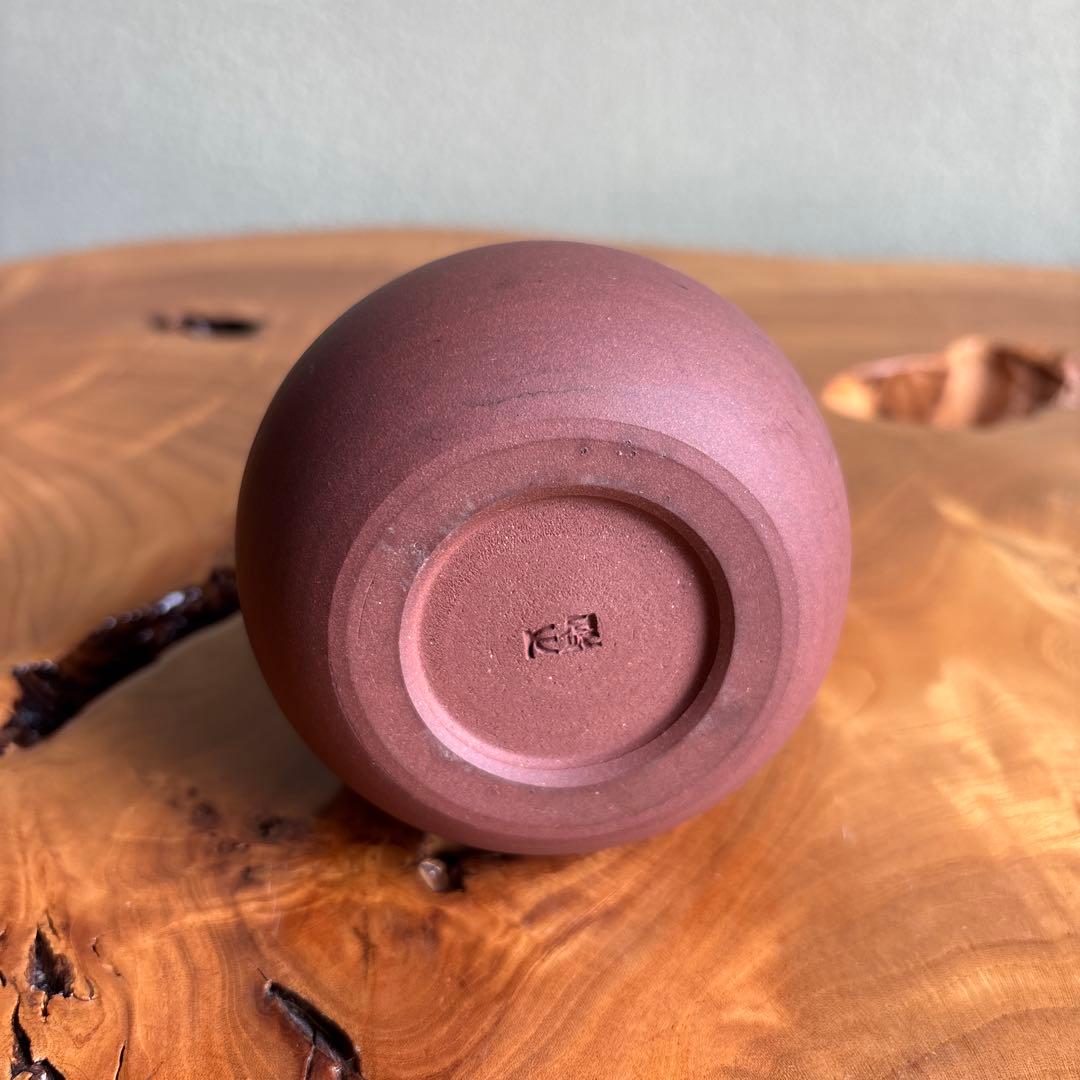
A long-necked display vase in deep burgundy iron-rich stoneware — zogan inlay scrollwork encircles the shoulder where neck meets body, grey-blue slip pressed into carved lines, smoothed flush. Small hanging loop. Original wooden box. Japan, 20th c.
🔹 [ BASIC DETAILS ]
• Form: Kazari-bin (飾瓶) — display bottle vase, bulbous spherical body, long cylindrical neck, small suspension loop at neck shoulder
• Height: approx. 18.2 cm
• Technique: Zogan (象嵌) slip inlay — grey-blue contrasting clay pressed into carved scroll motifs at the body-neck junction band
• Clay body: Deep burgundy-red unglazed iron-rich stoneware; matte surface throughout
• Decoration: Continuous arabesque / karakusa scroll band in blue-grey zogan inlay
• Box: Tomobako — original fitted wooden box with hand-brushed calligraphy inscription 象嵌飾瓶 花瓶, signed 江山 with red artist seal
• Condition: Excellent. No chips, cracks, or repairs. Minor handling wear consistent with age.
🔹 [ JAPANESE DESCRIPTION / 日本語解説 — Basic Details ]
象嵌技法を用いた飾瓶。深みのある紫赤色の無釉炻器に、胴と頸の境に巡らせた象嵌帯が静かな存在感を放つ。頸部に小さな吊り環を備え、共箱付き。
• 形状:飾瓶(球形胴・長頸・吊り環付き)
• 高さ:約18.2 cm
• 技法:象嵌(青灰色の化粧土を彫刻線に埋め込み、面一に仕上げた伝統技法)
• 素地:紫赤色無釉炻器、全面マット
• 文様:唐草文(連続スクロール文)象嵌帯
• 付属:共箱(「象嵌飾瓶 花瓶」毛筆書、「江山」朱印)
• 状態:優良。欠け・ひび・修復なし。
🔹 [ CULTURAL & ARTISTIC INSIGHT ]
Zogan — the word means "image embedded" — arrived in Japan by way of Goryeo Korea, where 12th-century celadon masters had elevated slip inlay into an art of extraordinary precision: white and black clay pressed into the carved surface of unfired porcelain, fired to reveal patterns that read less like decoration and more like breath caught in clay. Japanese potters absorbed the technique and redirected it: away from the aristocratic delicacy of celadon, toward a denser, quieter vocabulary — iron-red stoneware, grey-blue slip, continuous scroll bands that circle a vessel rather than cover it.
The kazari-bin — display bottle — carries its own grammar. The long neck is not a convenience; it is a posture. It holds a single stem above the world of the table, creating the negative space that Japanese interior culture has long understood as presence. A camellia in winter. One branch of willow. The form does not ask for arrangement. It asks for one thing placed with intention.
Poetic line: The inlay does not ornament the clay — it is a seam where two silences meet.
🔹 [ JAPANESE DESCRIPTION / 日本語解説 — Cultural & Artistic Insight ]
象嵌とは「像を埋め込む」ことを意味する。その技法は高麗青磁の名工たちによって12世紀朝鮮半島で完成され、白と黒の化粧土が素焼きの素地へと深く刻み込まれた。日本の陶工はこれを受け取り、静かに変容させた——青磁の繊細さからは離れ、鉄分豊かな炻器に青灰の象嵌帯を巡らせる、より密度の高い表現へと。
飾瓶という形式は、それ自体が一つの文法を持つ。長い頸は実用の産物ではなく、姿勢である。一輪の花茎を卓上の世界から引き上げ、日本の室内文化が長く「在ること」と呼んできた空白を生み出す——冬の椿、一枝の柳。形は「飾り方」を問わない。「何を一つ置くか」を問う。
詩的な一行:象嵌は土を飾るのではない——それは、二つの沈黙が出会う縫い目である。
🔹 [ DEEP-DIVE COMMENTARY ]
The transmission of zogan from Korean peninsular kilns to Japanese ceramic workshops followed no single path. By the Muromachi period (14th–16th centuries), Japanese potters had encountered the technique through continental trade, diplomatic exchange, and the movement of craftspeople across the Korea Strait. What they inherited was not a formula but a possibility: that contrasting clay pressed into a carved surface could survive the kiln and emerge legible. The rest — which bodies, which slips, which motifs — was translation.
In Korea, zogan had served the aesthetic ideals of Buddhist aristocracy: cranes, clouds, chrysanthemums rendered in silver-white inlay against sage-green celadon. In Japan, the technique found different homes. Tokoname, Bizen, and the iron-clay traditions of central Honshu absorbed the method into rougher, earthier ambitions. The burgundy-red body of this vase — dense, iron-saturated, fired to a temperature where the clay compresses rather than blooms — belongs to that quieter lineage. The grey-blue inlay band reads not as ornament but as boundary: the point where the spherical earth of the body becomes the ascending column of the neck.
The tomobako inscription gives us a name — 江山 — but no biographical anchor. This is not uncommon in workshop ware of the mid-20th century, where a maker might register a studio name rather than a personal lineage, or where a regional kiln affiliated with a master produced pieces under a shared seal. The box itself carries cultural weight: the act of inscribing a box, brushing the form name in confident calligraphy, sealing with a red impression, constitutes a form of authorship that Japanese ceramic culture recognizes even without a genealogy attached. The object says: someone cared enough to name this, box it, and send it forward.
The practice of ichirin-zashi — single-flower placement — that the kazari-bin form supports is inseparable from the philosophy of the tokonoma alcove. In the grammar of the traditional Japanese room, the tokonoma is not a display case; it is a threshold. The hanging scroll above, the single ceramic below, compose not a collection but a statement — one that shifts with the season, the occasion, the guest. The long-necked vase participates in this ritual not by filling space but by organizing it: the vertical line of the neck extends upward into the room's breath, and whatever is placed within it becomes, briefly, the axis of the interior world.
To own a piece like this is to accept a small, recurring obligation: to find, once in a while, the one branch or stem that belongs in it. The vase does not wait passively. It holds a question open.
🔹 [ JAPANESE DESCRIPTION / 日本語解説 — Deep-Dive Commentary ]
象嵌技法が朝鮮半島の窯場から日本の陶芸へ伝わった経路は一つではない。室町期を通じて、日本の陶工たちは大陸との交易・外交・職人の移動を通じてこの技法に出会った。彼らが引き継いだのは公式ではなく可能性だった——異なる化粧土を彫り込んだ素地に埋め込み、焼成を経て文様として読み取れるものが現れる、という可能性。素地を何にするか、どんな化粧土を使うか、どんな文様を刻むか——それは、すべて翻訳の作業だった。
朝鮮では象嵌が仏教貴族の美意識に奉仕した:青磁の鼠緑に白銀の鶴・雲・菊が輝いた。日本ではこの技法は別の場所に根を下ろした。常滑・備前・本州中央部の鉄土系窯場が、よりざらりとした、地に足のついた表現へとこれを吸収した。この飾瓶の深い紫赤色の素地は——鉄分を濃密に含み、焼成で膨らむのではなく圧縮されるほどの温度で焼かれ——その静かな系譜に属する。青灰色の象嵌帯は装飾ではなく境界として読める:球形の大地としての胴が、上昇する円柱としての頸へと変わる、その境目を刻んでいる。
共箱の墨書は「江山」という名を示す。しかし伝記的な拠り所はない。これは20世紀中期の工房作品に珍しくない——作者が個人の系譜ではなく工房名を用いる場合、あるいは師に連なる窯が共通の印章のもとで制作する場合がある。箱そのものが文化的な重さを持つ:形名を毛筆で書き、朱印を押し、それを箱に記すことは、系譜がなくても日本の陶芸文化が認める一種の署名行為である。この物は言っている——誰かがこれを名付け、箱に収め、未来へ送り出すことを、十分に大切に思ったのだと。
飾瓶という形式が支える「一輪挿し」の実践は、床の間という思想から切り離せない。伝統的な和室において床の間は展示空間ではなく、敷居である。掛け軸と一つの器が「取り合わせ」をなし、コレクションではなく一つの言葉を構成する——季節・場・客によって変わる言葉を。長頸の飾瓶はこの場に参加するとき、空間を満たすのではなく組織する:頸の垂直線が室内の息へと延び、そこに置かれたものは一時、内なる世界の軸になる。
このような器を所有するということは、小さな繰り返しの義務を受け入れることだ——ときに、この器に属する一枝か一輪を見つけるという義務を。飾瓶は受動的に待つのではない。問いを開いたまま保ちつづける。
🔹 [ SHIPPING & PACKAGING ]
• Dispatch: Within 1-6 business days
• Carrier: Japan Post EMS / UPS (with tracking)
• Packaging: Carefully wrapped with protective materials
🔹 [ BASIC DETAILS ]
• Form: Kazari-bin (飾瓶) — display bottle vase, bulbous spherical body, long cylindrical neck, small suspension loop at neck shoulder
• Height: approx. 18.2 cm
• Technique: Zogan (象嵌) slip inlay — grey-blue contrasting clay pressed into carved scroll motifs at the body-neck junction band
• Clay body: Deep burgundy-red unglazed iron-rich stoneware; matte surface throughout
• Decoration: Continuous arabesque / karakusa scroll band in blue-grey zogan inlay
• Box: Tomobako — original fitted wooden box with hand-brushed calligraphy inscription 象嵌飾瓶 花瓶, signed 江山 with red artist seal
• Condition: Excellent. No chips, cracks, or repairs. Minor handling wear consistent with age.
🔹 [ JAPANESE DESCRIPTION / 日本語解説 — Basic Details ]
象嵌技法を用いた飾瓶。深みのある紫赤色の無釉炻器に、胴と頸の境に巡らせた象嵌帯が静かな存在感を放つ。頸部に小さな吊り環を備え、共箱付き。
• 形状:飾瓶(球形胴・長頸・吊り環付き)
• 高さ:約18.2 cm
• 技法:象嵌(青灰色の化粧土を彫刻線に埋め込み、面一に仕上げた伝統技法)
• 素地:紫赤色無釉炻器、全面マット
• 文様:唐草文(連続スクロール文)象嵌帯
• 付属:共箱(「象嵌飾瓶 花瓶」毛筆書、「江山」朱印)
• 状態:優良。欠け・ひび・修復なし。
🔹 [ CULTURAL & ARTISTIC INSIGHT ]
Zogan — the word means "image embedded" — arrived in Japan by way of Goryeo Korea, where 12th-century celadon masters had elevated slip inlay into an art of extraordinary precision: white and black clay pressed into the carved surface of unfired porcelain, fired to reveal patterns that read less like decoration and more like breath caught in clay. Japanese potters absorbed the technique and redirected it: away from the aristocratic delicacy of celadon, toward a denser, quieter vocabulary — iron-red stoneware, grey-blue slip, continuous scroll bands that circle a vessel rather than cover it.
The kazari-bin — display bottle — carries its own grammar. The long neck is not a convenience; it is a posture. It holds a single stem above the world of the table, creating the negative space that Japanese interior culture has long understood as presence. A camellia in winter. One branch of willow. The form does not ask for arrangement. It asks for one thing placed with intention.
Poetic line: The inlay does not ornament the clay — it is a seam where two silences meet.
🔹 [ JAPANESE DESCRIPTION / 日本語解説 — Cultural & Artistic Insight ]
象嵌とは「像を埋め込む」ことを意味する。その技法は高麗青磁の名工たちによって12世紀朝鮮半島で完成され、白と黒の化粧土が素焼きの素地へと深く刻み込まれた。日本の陶工はこれを受け取り、静かに変容させた——青磁の繊細さからは離れ、鉄分豊かな炻器に青灰の象嵌帯を巡らせる、より密度の高い表現へと。
飾瓶という形式は、それ自体が一つの文法を持つ。長い頸は実用の産物ではなく、姿勢である。一輪の花茎を卓上の世界から引き上げ、日本の室内文化が長く「在ること」と呼んできた空白を生み出す——冬の椿、一枝の柳。形は「飾り方」を問わない。「何を一つ置くか」を問う。
詩的な一行:象嵌は土を飾るのではない——それは、二つの沈黙が出会う縫い目である。
🔹 [ DEEP-DIVE COMMENTARY ]
The transmission of zogan from Korean peninsular kilns to Japanese ceramic workshops followed no single path. By the Muromachi period (14th–16th centuries), Japanese potters had encountered the technique through continental trade, diplomatic exchange, and the movement of craftspeople across the Korea Strait. What they inherited was not a formula but a possibility: that contrasting clay pressed into a carved surface could survive the kiln and emerge legible. The rest — which bodies, which slips, which motifs — was translation.
In Korea, zogan had served the aesthetic ideals of Buddhist aristocracy: cranes, clouds, chrysanthemums rendered in silver-white inlay against sage-green celadon. In Japan, the technique found different homes. Tokoname, Bizen, and the iron-clay traditions of central Honshu absorbed the method into rougher, earthier ambitions. The burgundy-red body of this vase — dense, iron-saturated, fired to a temperature where the clay compresses rather than blooms — belongs to that quieter lineage. The grey-blue inlay band reads not as ornament but as boundary: the point where the spherical earth of the body becomes the ascending column of the neck.
The tomobako inscription gives us a name — 江山 — but no biographical anchor. This is not uncommon in workshop ware of the mid-20th century, where a maker might register a studio name rather than a personal lineage, or where a regional kiln affiliated with a master produced pieces under a shared seal. The box itself carries cultural weight: the act of inscribing a box, brushing the form name in confident calligraphy, sealing with a red impression, constitutes a form of authorship that Japanese ceramic culture recognizes even without a genealogy attached. The object says: someone cared enough to name this, box it, and send it forward.
The practice of ichirin-zashi — single-flower placement — that the kazari-bin form supports is inseparable from the philosophy of the tokonoma alcove. In the grammar of the traditional Japanese room, the tokonoma is not a display case; it is a threshold. The hanging scroll above, the single ceramic below, compose not a collection but a statement — one that shifts with the season, the occasion, the guest. The long-necked vase participates in this ritual not by filling space but by organizing it: the vertical line of the neck extends upward into the room's breath, and whatever is placed within it becomes, briefly, the axis of the interior world.
To own a piece like this is to accept a small, recurring obligation: to find, once in a while, the one branch or stem that belongs in it. The vase does not wait passively. It holds a question open.
🔹 [ JAPANESE DESCRIPTION / 日本語解説 — Deep-Dive Commentary ]
象嵌技法が朝鮮半島の窯場から日本の陶芸へ伝わった経路は一つではない。室町期を通じて、日本の陶工たちは大陸との交易・外交・職人の移動を通じてこの技法に出会った。彼らが引き継いだのは公式ではなく可能性だった——異なる化粧土を彫り込んだ素地に埋め込み、焼成を経て文様として読み取れるものが現れる、という可能性。素地を何にするか、どんな化粧土を使うか、どんな文様を刻むか——それは、すべて翻訳の作業だった。
朝鮮では象嵌が仏教貴族の美意識に奉仕した:青磁の鼠緑に白銀の鶴・雲・菊が輝いた。日本ではこの技法は別の場所に根を下ろした。常滑・備前・本州中央部の鉄土系窯場が、よりざらりとした、地に足のついた表現へとこれを吸収した。この飾瓶の深い紫赤色の素地は——鉄分を濃密に含み、焼成で膨らむのではなく圧縮されるほどの温度で焼かれ——その静かな系譜に属する。青灰色の象嵌帯は装飾ではなく境界として読める:球形の大地としての胴が、上昇する円柱としての頸へと変わる、その境目を刻んでいる。
共箱の墨書は「江山」という名を示す。しかし伝記的な拠り所はない。これは20世紀中期の工房作品に珍しくない——作者が個人の系譜ではなく工房名を用いる場合、あるいは師に連なる窯が共通の印章のもとで制作する場合がある。箱そのものが文化的な重さを持つ:形名を毛筆で書き、朱印を押し、それを箱に記すことは、系譜がなくても日本の陶芸文化が認める一種の署名行為である。この物は言っている——誰かがこれを名付け、箱に収め、未来へ送り出すことを、十分に大切に思ったのだと。
飾瓶という形式が支える「一輪挿し」の実践は、床の間という思想から切り離せない。伝統的な和室において床の間は展示空間ではなく、敷居である。掛け軸と一つの器が「取り合わせ」をなし、コレクションではなく一つの言葉を構成する——季節・場・客によって変わる言葉を。長頸の飾瓶はこの場に参加するとき、空間を満たすのではなく組織する:頸の垂直線が室内の息へと延び、そこに置かれたものは一時、内なる世界の軸になる。
このような器を所有するということは、小さな繰り返しの義務を受け入れることだ——ときに、この器に属する一枝か一輪を見つけるという義務を。飾瓶は受動的に待つのではない。問いを開いたまま保ちつづける。
🔹 [ SHIPPING & PACKAGING ]
• Dispatch: Within 1-6 business days
• Carrier: Japan Post EMS / UPS (with tracking)
• Packaging: Carefully wrapped with protective materials
Quantity
Couldn't load pickup availability
Low stock: 1 left
View full details