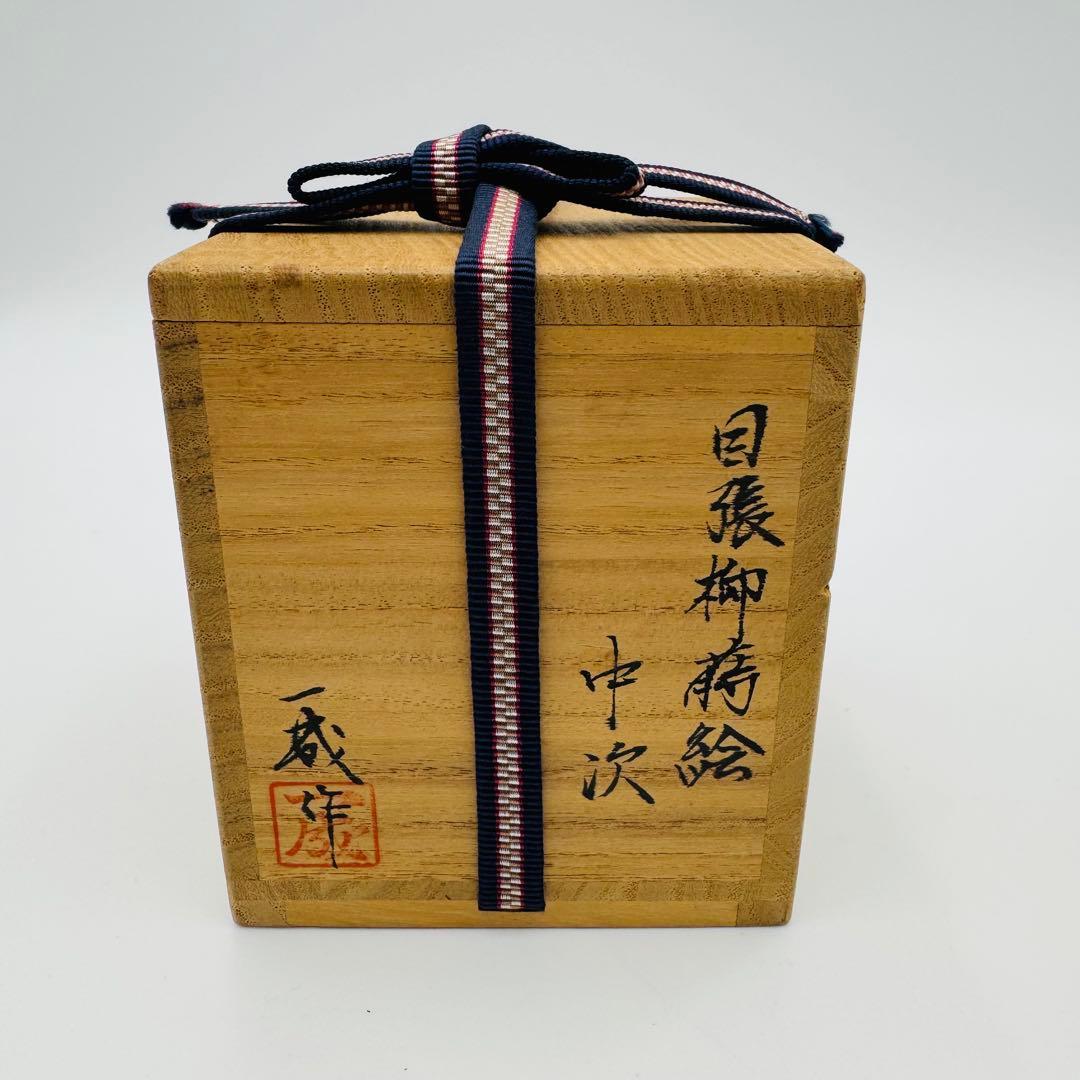
Exquisite **Willow Makie Natsume** by master **Issei**. This **Japanese Nakatsugi Caddy** featuring **Elegant Willow Art** is a superior **Ceremony Utensil** for **Tea Room Decor**. Housed in a **Signed Tomobako**, it is a **Luxury Lacquerware** piece perfect for **Zen Home Decor** and **Japanese Art Gifts** for **Matcha Lovers**.
A classic Nakatsugi (cylindrical tea caddy) by the lacquer artist Issei. The 'Mebari-Yanagi' (Sprouting Willow) motif is rendered in fine gold Makie, symbolizing flexibility, resilience, and the arrival of spring.
**Basic Details** - **Artist**: Issei (Traditional lacquer master) - **Technique**: Black lacquer (Kuro-urushi) with Willow Makie (gold/silver powder) - **Era**: Late 20th Century (Showa/Heisei Era) - **Origin**: Japan - **Dimensions**: approx. Height 7 cm, Diameter 6.5 cm - **Box**: Original Signed Wooden Box (Tomobako) - **Condition**: Excellent vintage condition
**Cultural & Artistic Insight** The 'Nakatsugi' shape is historically considered a 'noble' form of the tea caddy, characterized by its clean, cylindrical lines. The Willow (Yanagi) is a traditional motif in Japanese art, often paired with the arrival of the first tea of the season.
**Deep-Dive Commentary** **Artistry**: Note the 'Mebari' (budding) detail on the willow branches. This suggests life waking up from winter. The Makie is flat and smooth (Hira-makie), characteristic of refined Kyoto and Kanazawa styles. **Symbolism**: In Zen philosophy, the willow that bends but never breaks is a metaphor for the mind's enlightened state. This makes it a deeply appropriate utensil for serious tea practice. **Usage**: As a Nakatsugi, it stands slightly taller and more formal than a standard Natsume. It is suitable for both usucha (thin tea) and certain formal 'shoudou' (movements) in the ceremony.
*A golden branch that bows to the wind but never yields.*