1
/
of
16
White Hagi Tsutsu-Chawan with Gold Accents by Katō Shigemi — Taizan-gama, Funka Kinsai, Tomobako
White Hagi Tsutsu-Chawan with Gold Accents by Katō Shigemi — Taizan-gama, Funka Kinsai, Tomobako
Regular price
Dhs. 1,696.00 AED
Regular price
Sale price
Dhs. 1,696.00 AED
Taxes included.
Shipping calculated at checkout.
Funka Kinsai Chawan
Katō Shigemi — Taizan-gama, Hagi
The bowl arrives white.
Not the white of absence — the white of accumulation.
Funka (粉華) means powdered flower. The glaze does not coat; it settles. Katō Shigemi layers a fine white slip over Hagi's iron-rich stoneware, then fires it to the edge of maturity — where the surface holds both density and breath. What you see is not a decoration. It is a decision about silence.
At the lower shoulder, the clay body emerges from beneath the glaze — warm ochre-brown, shot through with black iron specks — as though the earth were reasserting itself. This graduated fade, from dense white at the rim to bare clay at the foot, is the central event of the piece. The kinsai (金彩) gold does not announce itself. It is absorbed into the base glaze, visible in certain light as a faint luminous presence — a contemporary gesture made in the quietest possible voice.
▸ The Form
Tsutsu (筒) — tubular — is the prescribed winter form in chanoyu. Its upright walls conserve heat; matcha cools slowly in the deeper bowl. The wall height here is generous without weight, and the slight inward cant of the rim creates a stillness at the opening that guides the whisk without instruction. Coil-building marks run horizontally beneath the glaze — not hidden, simply present, the way a breath is present in spoken language.
▸ Hagi and Its Position
The old tea hierarchy counts three: ichi-Raku, ni-Hagi, san-Karatsu — first Raku, second Hagi, third Karatsu. This ordering is not about aesthetics alone. It is about temperature: how each ware holds heat, absorbs moisture, ages alongside the practitioner. Hagi's feldspathic clay, drawn from the Ōmine mountains of Yamaguchi Prefecture, is porous enough that the bowl changes over years of use — the glaze crazes, tea oils seep into the body, and the surface grows a patina that belongs to its owner. This process is called yo-hake, the use-change of Hagi. It is not deterioration. It is participation.
Taizan-gama (泰山窯) operates within this tradition without performing nostalgia. Katō Shigemi trained in the lineage of Hagi's classical vocabulary — the white slips, the feldspathic glazes, the exposed footrim — and from that foundation developed works that hold contemporary minimalism without announcing it. The funka surface is not a revival technique. It is a living one.
▸ The Glaze Interior
The interior reveals what the exterior holds back. A quiet spiral of glaze gathers at the base — pooled, slightly thickened, the white deepening toward grey-blue at the lowest point. In the right light, this is where the kinsai lives: not as gilding but as a faint warmth, a glow that does not perform. The transition from the worked outer surface to this interior stillness is the full arc of the piece.
▸ Provenance and Condition
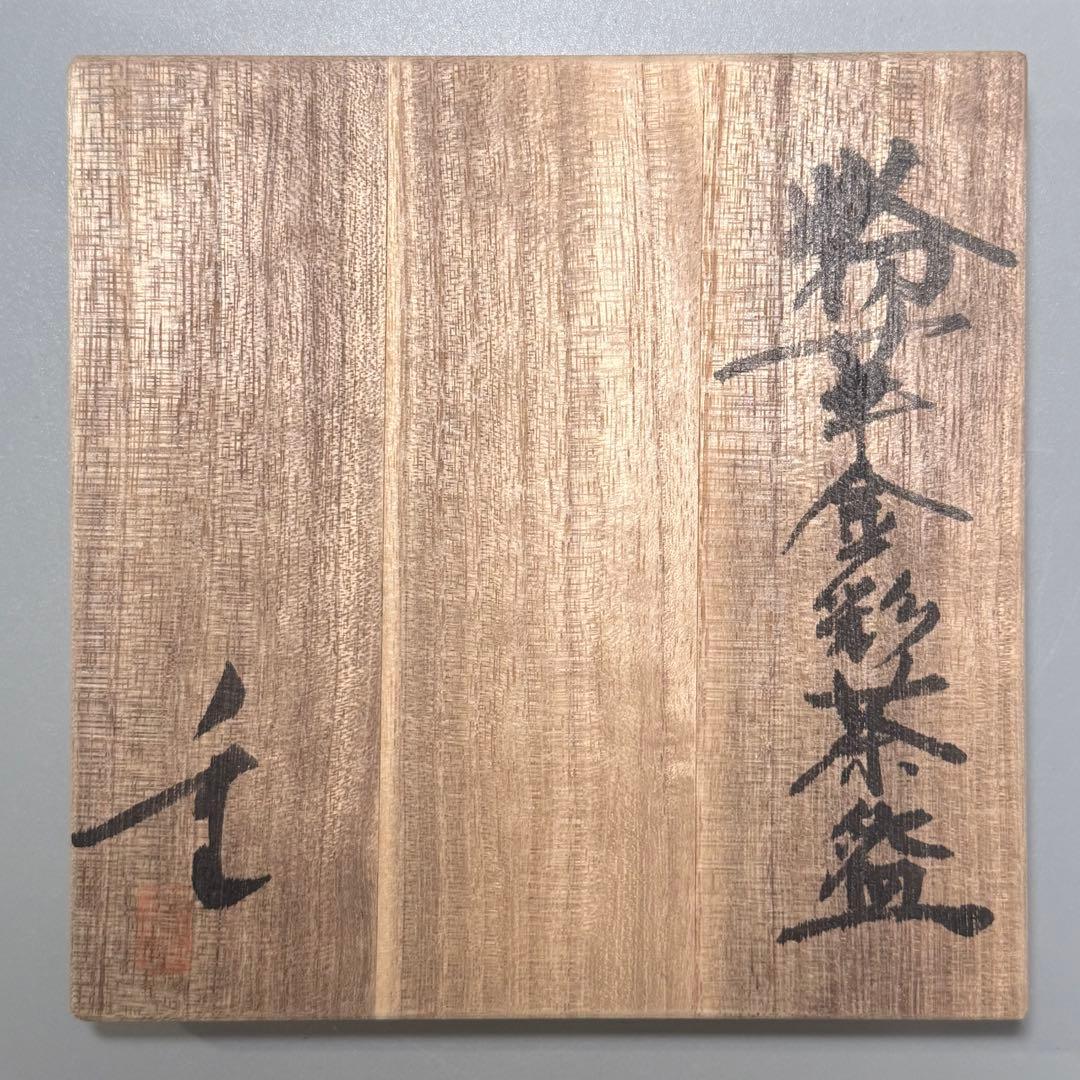
This bowl comes from an iemoto (家元) collection — a school of tea, stored with intention. It arrives with its original tomobako (共箱), the paulownia wood lid brushed by the artist in bold characters: 粉華金彩茶盌, signed 重. The tomonuno (共布) cloth bag carries the same hand. Both are intact and undamaged. The bowl itself is in excellent condition — no chips, no repairs, no restoration of any kind. The firing seam visible on the exterior wall is structural, not a flaw: a mark of how the piece was made.
Dimensions: Dia 11 cm × H 9 cm
With tomobako (artist-signed paulownia box) and tomonuno (signed cloth bag)
▸ For the Tea Practitioner
This bowl is sized and formed for winter temae — the tsutsu shape is specified in several Urasenke and Omotesenke schools for the cold months, when heat retention is a form of care. The depth of the bowl accommodates both fukusa and chakin without obstruction. It will hold its tea temperature through a full bowl of koicha.
▸ For the Collector
Katō Shigemi's works in funka glaze represent a coherent body of work within Taizan-gama's output — not transitional experiments but a sustained inquiry into what white can do in the context of Hagi's clay. The iemoto provenance adds a layer of use-history that, in the chanoyu world, carries cultural weight beyond the object itself. The complete set of tomobako and tomonuno, both artist-signed, is the documentation that a museum acquisition would require.
🔹 [ BASIC DETAILS ]
🔹 [ CULTURAL & ARTISTIC INSIGHT ]
🔹 [ DEEP-DIVE COMMENTARY ]
🔹 [ 日本語解説 ]
泰山窯・加藤重美による粉華金彩茶盌。筒形の端正な立ち姿に、粉を吹いたような白萩釉が静かに積もる。金彩は主張せず、光の角度によって底部にかすかな温もりとして現れる。下部に向けて素地の鉄分が滲み出す景色が印象的。家元収蔵品として丁寧に保存されており、作者署名入り共箱・共布が揃う。冬の稽古に向く筒茶盌として、実用と鑑賞の両方に応える一碗。
🔹 [ SHIPPING & PACKAGING ]
• Dispatch: Within 1-6 business days
• Carrier: Japan Post EMS / UPS (with tracking)
• Packaging: Carefully wrapped with protective materials
Katō Shigemi — Taizan-gama, Hagi
The bowl arrives white.
Not the white of absence — the white of accumulation.
Funka (粉華) means powdered flower. The glaze does not coat; it settles. Katō Shigemi layers a fine white slip over Hagi's iron-rich stoneware, then fires it to the edge of maturity — where the surface holds both density and breath. What you see is not a decoration. It is a decision about silence.
At the lower shoulder, the clay body emerges from beneath the glaze — warm ochre-brown, shot through with black iron specks — as though the earth were reasserting itself. This graduated fade, from dense white at the rim to bare clay at the foot, is the central event of the piece. The kinsai (金彩) gold does not announce itself. It is absorbed into the base glaze, visible in certain light as a faint luminous presence — a contemporary gesture made in the quietest possible voice.
▸ The Form
Tsutsu (筒) — tubular — is the prescribed winter form in chanoyu. Its upright walls conserve heat; matcha cools slowly in the deeper bowl. The wall height here is generous without weight, and the slight inward cant of the rim creates a stillness at the opening that guides the whisk without instruction. Coil-building marks run horizontally beneath the glaze — not hidden, simply present, the way a breath is present in spoken language.
▸ Hagi and Its Position
The old tea hierarchy counts three: ichi-Raku, ni-Hagi, san-Karatsu — first Raku, second Hagi, third Karatsu. This ordering is not about aesthetics alone. It is about temperature: how each ware holds heat, absorbs moisture, ages alongside the practitioner. Hagi's feldspathic clay, drawn from the Ōmine mountains of Yamaguchi Prefecture, is porous enough that the bowl changes over years of use — the glaze crazes, tea oils seep into the body, and the surface grows a patina that belongs to its owner. This process is called yo-hake, the use-change of Hagi. It is not deterioration. It is participation.
Taizan-gama (泰山窯) operates within this tradition without performing nostalgia. Katō Shigemi trained in the lineage of Hagi's classical vocabulary — the white slips, the feldspathic glazes, the exposed footrim — and from that foundation developed works that hold contemporary minimalism without announcing it. The funka surface is not a revival technique. It is a living one.
▸ The Glaze Interior
The interior reveals what the exterior holds back. A quiet spiral of glaze gathers at the base — pooled, slightly thickened, the white deepening toward grey-blue at the lowest point. In the right light, this is where the kinsai lives: not as gilding but as a faint warmth, a glow that does not perform. The transition from the worked outer surface to this interior stillness is the full arc of the piece.
▸ Provenance and Condition
This bowl comes from an iemoto (家元) collection — a school of tea, stored with intention. It arrives with its original tomobako (共箱), the paulownia wood lid brushed by the artist in bold characters: 粉華金彩茶盌, signed 重. The tomonuno (共布) cloth bag carries the same hand. Both are intact and undamaged. The bowl itself is in excellent condition — no chips, no repairs, no restoration of any kind. The firing seam visible on the exterior wall is structural, not a flaw: a mark of how the piece was made.
Dimensions: Dia 11 cm × H 9 cm
With tomobako (artist-signed paulownia box) and tomonuno (signed cloth bag)
▸ For the Tea Practitioner
This bowl is sized and formed for winter temae — the tsutsu shape is specified in several Urasenke and Omotesenke schools for the cold months, when heat retention is a form of care. The depth of the bowl accommodates both fukusa and chakin without obstruction. It will hold its tea temperature through a full bowl of koicha.
▸ For the Collector
Katō Shigemi's works in funka glaze represent a coherent body of work within Taizan-gama's output — not transitional experiments but a sustained inquiry into what white can do in the context of Hagi's clay. The iemoto provenance adds a layer of use-history that, in the chanoyu world, carries cultural weight beyond the object itself. The complete set of tomobako and tomonuno, both artist-signed, is the documentation that a museum acquisition would require.
🔹 [ BASIC DETAILS ]
🔹 [ CULTURAL & ARTISTIC INSIGHT ]
🔹 [ DEEP-DIVE COMMENTARY ]
🔹 [ 日本語解説 ]
泰山窯・加藤重美による粉華金彩茶盌。筒形の端正な立ち姿に、粉を吹いたような白萩釉が静かに積もる。金彩は主張せず、光の角度によって底部にかすかな温もりとして現れる。下部に向けて素地の鉄分が滲み出す景色が印象的。家元収蔵品として丁寧に保存されており、作者署名入り共箱・共布が揃う。冬の稽古に向く筒茶盌として、実用と鑑賞の両方に応える一碗。
🔹 [ SHIPPING & PACKAGING ]
• Dispatch: Within 1-6 business days
• Carrier: Japan Post EMS / UPS (with tracking)
• Packaging: Carefully wrapped with protective materials
Quantity
Couldn't load pickup availability
Low stock: 1 left
View full details