1
/
of
7
Wajima Lacquer Pomegranate Kogo Pair by Soukei — Carved Wood Incense Box
Wajima Lacquer Pomegranate Kogo Pair by Soukei — Carved Wood Incense Box
Regular price
Dhs. 764.00 AED
Regular price
Sale price
Dhs. 764.00 AED
Taxes included.
Shipping calculated at checkout.
A pair of pomegranates, rendered in the hand of Wajima lacquer artist Soukei. This carved wood kogo incense box captures something the eye tends to find before the mind names it — the moment a fruit reaches its fullness and begins, quietly, to open. One form carries the pointed calyx crown; the other curves to its stem. Together they hold the tension between abundance and restraint that defines Wajima-nuri craftsmanship at its most considered.
For those searching for a Wajima lacquer kogo, a Japanese incense box for tea ceremony, a carved wood kogo pair, Soukei lacquerware, or pomegranate-motif Japanese craft: this piece carries the weight of all of those descriptions and sits lightly inside none of them. The pomegranate is among the oldest auspicious motifs in Japanese culture — its visible seeds a sign of continuity, its crown a mark of dignity. Here, the wood grain itself participates in the composition. The naturalistic kogo form does not imitate the fruit; it remembers it.
Each vessel is fitted with a gold-leaf circle at the base. The interior reveals red-painted seeds through the cracked body of the fruit — not damage, but intention. A small aperture of color held inside quiet wood.
[ BASIC DETAILS ]
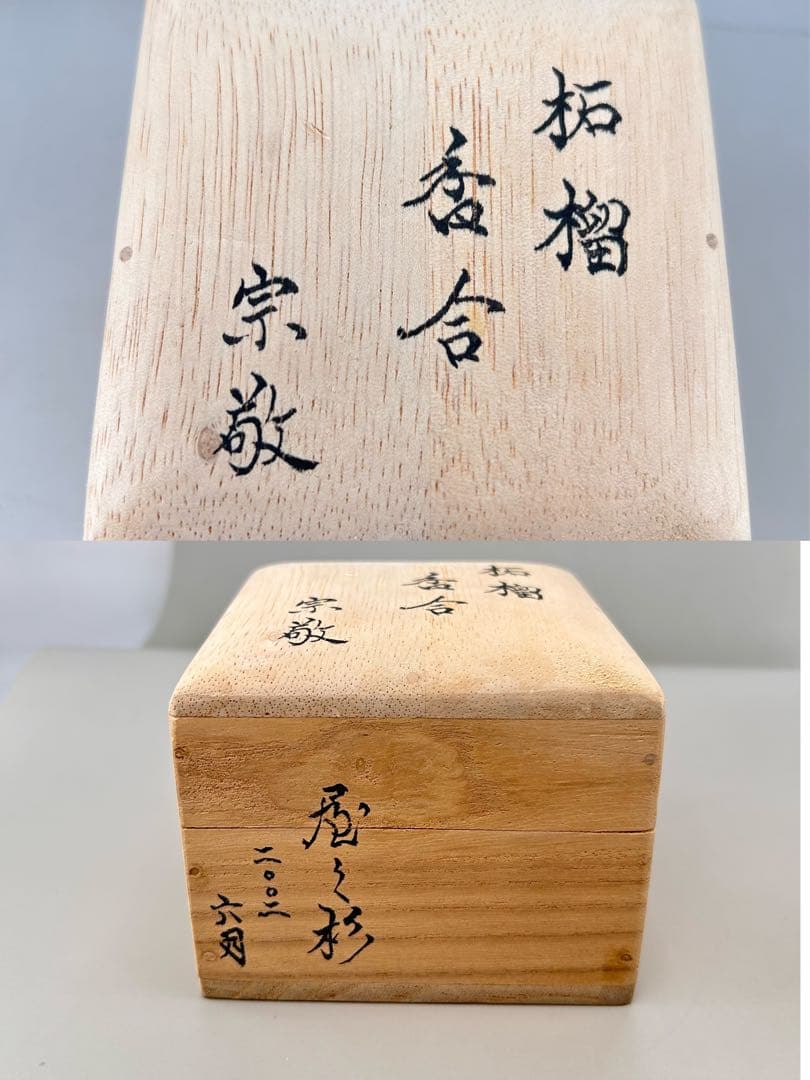
• Maker: Soukei (宗敬造)
• Technique: Wajima-nuri, carved natural wood with gold-leaf interior
• Form: Pair of pomegranate-shaped kogo (incense containers)
• Approximate diameter: 65mm each
• Condition: Excellent vintage condition
• Includes: Tomobako (artist-signed wooden box), cloth
[ CULTURAL INSIGHT ]
Wajima, on the Noto Peninsula of Ishikawa Prefecture, is Japan's most celebrated lacquerware production center. Wajima-nuri is defined by its layered urushi process — up to seventy-five coats of lacquer, each dried and polished before the next application. The carved wood kogo represents a quieter expression of this tradition: the form itself carries the artistry, and the lacquer serves as protector rather than surface decoration. Soukei's pomegranate pair belongs to a lineage of naturalistic kogo that emerged during the Meiji and Taisho periods, when tea masters sought objects whose seasonal resonance could deepen a gathering without announcing itself.
[ DEEP-DIVE ]
The pomegranate — zakuro in Japanese, derived from the Persian-Chinese transmission of the fruit — arrived in Japan via the Silk Road and the Tang court. It carried with it a complex symbolic inheritance: fertility, abundance, the sweetness held inside hardness. In the tea room, it appears most often in autumn, when its exterior has begun to weather and its interior has reached its fullness. Soukei's rendering honors this duality: the wood grain of each form is not obscured but celebrated, the natural variation of the material allowed to speak alongside the carved silhouette. The gold-leaf base, visible when the kogo is lifted, is a private gesture — a signature of quality that the guest may or may not discover.
---
【日本語説明】
輪島塗の作家・宗敬による、木彫りの柘榴香合(ペア)。天然木の木目が美しく生きた作品で、一方は萼(がく)を、もう一方は蔓を持つ、対となる柘榴の形を表現しています。割れ目から覗く赤い実の描写が印象的。底面には金箔の円が施されています。輪島塗の精緻な技術と、柘榴がもつ豊穣・子孫繁栄の吉祥意匠が静かに融合した、茶席の取り合わせに相応しい逸品です。共箱・布付き。
🔹 [ SHIPPING & PACKAGING ]
• Dispatch: Within 1-6 business days
• Carrier: Japan Post EMS / UPS (with tracking)
• Packaging: Carefully wrapped with protective materials
For those searching for a Wajima lacquer kogo, a Japanese incense box for tea ceremony, a carved wood kogo pair, Soukei lacquerware, or pomegranate-motif Japanese craft: this piece carries the weight of all of those descriptions and sits lightly inside none of them. The pomegranate is among the oldest auspicious motifs in Japanese culture — its visible seeds a sign of continuity, its crown a mark of dignity. Here, the wood grain itself participates in the composition. The naturalistic kogo form does not imitate the fruit; it remembers it.
Each vessel is fitted with a gold-leaf circle at the base. The interior reveals red-painted seeds through the cracked body of the fruit — not damage, but intention. A small aperture of color held inside quiet wood.
[ BASIC DETAILS ]
• Maker: Soukei (宗敬造)
• Technique: Wajima-nuri, carved natural wood with gold-leaf interior
• Form: Pair of pomegranate-shaped kogo (incense containers)
• Approximate diameter: 65mm each
• Condition: Excellent vintage condition
• Includes: Tomobako (artist-signed wooden box), cloth
[ CULTURAL INSIGHT ]
Wajima, on the Noto Peninsula of Ishikawa Prefecture, is Japan's most celebrated lacquerware production center. Wajima-nuri is defined by its layered urushi process — up to seventy-five coats of lacquer, each dried and polished before the next application. The carved wood kogo represents a quieter expression of this tradition: the form itself carries the artistry, and the lacquer serves as protector rather than surface decoration. Soukei's pomegranate pair belongs to a lineage of naturalistic kogo that emerged during the Meiji and Taisho periods, when tea masters sought objects whose seasonal resonance could deepen a gathering without announcing itself.
[ DEEP-DIVE ]
The pomegranate — zakuro in Japanese, derived from the Persian-Chinese transmission of the fruit — arrived in Japan via the Silk Road and the Tang court. It carried with it a complex symbolic inheritance: fertility, abundance, the sweetness held inside hardness. In the tea room, it appears most often in autumn, when its exterior has begun to weather and its interior has reached its fullness. Soukei's rendering honors this duality: the wood grain of each form is not obscured but celebrated, the natural variation of the material allowed to speak alongside the carved silhouette. The gold-leaf base, visible when the kogo is lifted, is a private gesture — a signature of quality that the guest may or may not discover.
---
【日本語説明】
輪島塗の作家・宗敬による、木彫りの柘榴香合(ペア)。天然木の木目が美しく生きた作品で、一方は萼(がく)を、もう一方は蔓を持つ、対となる柘榴の形を表現しています。割れ目から覗く赤い実の描写が印象的。底面には金箔の円が施されています。輪島塗の精緻な技術と、柘榴がもつ豊穣・子孫繁栄の吉祥意匠が静かに融合した、茶席の取り合わせに相応しい逸品です。共箱・布付き。
🔹 [ SHIPPING & PACKAGING ]
• Dispatch: Within 1-6 business days
• Carrier: Japan Post EMS / UPS (with tracking)
• Packaging: Carefully wrapped with protective materials
Quantity
Couldn't load pickup availability
Low stock: 1 left
View full details