1
/
of
18
Wajima Lacquer Natsume Tea Caddy — Kikukiri Maki-e with Raden Inlay | Mokudai Soho | Tomobako
Wajima Lacquer Natsume Tea Caddy — Kikukiri Maki-e with Raden Inlay | Mokudai Soho | Tomobako
Regular price
Dhs. 1,350.00 AED
Regular price
Sale price
Dhs. 1,350.00 AED
Taxes included.
Shipping calculated at checkout.
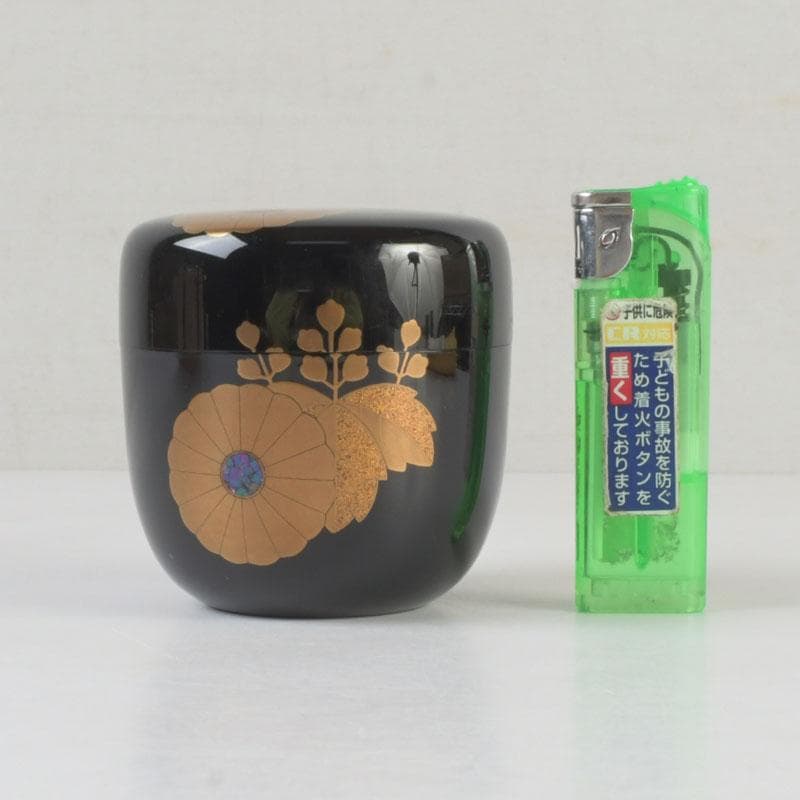
A deep black ground holds the weight of two imperial motifs — chrysanthemum and paulownia — rendered in gold maki-e across the curved body of this Wajima lacquer natsume. At the center of each chrysanthemum bloom, a fragment of raden catches the light: iridescent green, violet, blue shifting with every angle.
🔹 [ BASIC DETAILS ]
• Artist: Mokudai Soho
• Origin: Wajima, Ishikawa, Japan
• Material: Wajima lacquer with gold maki-e and raden inlay
• Motif: Chrysanthemum and Paulownia (Kikukiri)
• Era: 1990_2000
• Box: Tomobako (artist's wooden presentation box)
• Condition: Good, carefully inspected
🔹 [ Cultural & Artistic Insight ]
This is not ornament. In Japanese ceremonial culture, kiku (chrysanthemum) carries imperial dignity; kiri (paulownia) marks the crest of governance and auspicious occasion. Together on a tea caddy, they speak of ceremony held with intention.
The lacquerwork is by Mokudai Soho, a craftsman working within the Wajima tradition — one of Japan's designated traditional craft regions in Ishikawa Prefecture, where the layered urushi process and its exacting standards have been refined over centuries. The maki-e here shows the hallmarks of Wajima discipline: even gold dust application, clean line separation between motifs, and a body lacquer that reflects without glare.
[ DETAILS ]
Height: approx. 7 cm / 2.8 in
Diameter: approx. 7.4 cm / 2.9 in
Weight: approx. 69 g
Maker: Mokudai Soho
Origin: Wajima, Ishikawa Prefecture, Japan
Technique: Wajima lacquer (urushi) with gold maki-e and raden (mother-of-pearl) inlay
Motif: Chrysanthemum (kiku) and Paulownia (kiri) — auspicious imperial pairing
Condition: Excellent — no chips, no repairs, lacquer surface intact
Includes: Original wooden tomobako (artist-signed storage box) and matching fukusa cloth (gold and white)
[ CULTURAL & ARTISTIC INSIGHT ]
The natsume is the standard tea caddy used in thin-tea (usucha) practice across all major schools of Japanese tea ceremony. Its rounded form — lidded, palm-sized — is designed to be held, turned, and seen from every direction during the ritual. A natsume with both kiku and kiri motifs would have been commissioned for auspicious events: New Year ceremonies, weddings, formal gatherings of rank.
🔹 [ Deep-Dive Commentary ]
Raden inlay at the chrysanthemum center is a refinement that goes beyond standard maki-e. The iridescence of mother-of-pearl within the gold composition creates a depth that flat gold alone cannot achieve — a technique associated with formal, high-occasion pieces.
Wajima lacquerware follows a production process involving over 120 steps, using local diatomite (jinoko) as a base filler unique to the region. The result is exceptional durability alongside a surface quality that can be repaired and restored across generations. A piece in this condition, with tomobako intact and lacquer surface uncompromised, represents a completed object — one that has been preserved with care.
[ DEEP-DIVE COMMENTARY ]
The pairing of kiku and kiri on a single lacquer object reflects a compositional logic rooted in Heian-period court aesthetics. Chrysanthemum, adopted as the imperial seal of the Japanese imperial family, appears here in full bloom with radiating petals and the characteristic circular center now set with raden. Paulownia — the kiri — accompanies it as the crest of the Toyotomi clan and later the symbol of the Japanese Prime Minister's office; its three-leafed spray of rounded foliage rises above the chrysanthemum in a compositional hierarchy that is deliberate, not decorative.
For the tea ceremony collector, this natsume sits at the intersection of lacquer craft and iconographic authority. It can be used in formal practice or displayed as a study object for the paired motif tradition.
[ PROVENANCE & STORAGE ]
Stored in its original tomobako, with the maker's inscription visible on the lid face. The fukusa (protective cloth) in gold and white accompanies the piece. No repairs. No restoration. The lacquer surface shows no crazing or lifting.
🔹 [ 日本語解説 ]
輪島塗の正統な仕事。漆黒地に金蒔絵で菊と桐を配し、菊の中心には螺鈿を埋め込んだ格調ある棗です。菊は皇室の紋章、桐は慶事を象徴する文様であり、この二つを合わせた意匠は正式な茶会に相応しい格を持ちます。目代宗芳による蒔絵は金粉の均一な撒き、文様の輪郭の明確さ、漆面の光沢いずれも輪島の技術水準を示しています。共箱・共布付きで保存状態は美品。
🔹 [ SHIPPING & PACKAGING ]
• Dispatch: Within 1-6 business days
• Carrier: Japan Post EMS / UPS (with tracking)
• Packaging: Carefully wrapped with protective materials
🔹 [ BASIC DETAILS ]
• Artist: Mokudai Soho
• Origin: Wajima, Ishikawa, Japan
• Material: Wajima lacquer with gold maki-e and raden inlay
• Motif: Chrysanthemum and Paulownia (Kikukiri)
• Era: 1990_2000
• Box: Tomobako (artist's wooden presentation box)
• Condition: Good, carefully inspected
🔹 [ Cultural & Artistic Insight ]
This is not ornament. In Japanese ceremonial culture, kiku (chrysanthemum) carries imperial dignity; kiri (paulownia) marks the crest of governance and auspicious occasion. Together on a tea caddy, they speak of ceremony held with intention.
The lacquerwork is by Mokudai Soho, a craftsman working within the Wajima tradition — one of Japan's designated traditional craft regions in Ishikawa Prefecture, where the layered urushi process and its exacting standards have been refined over centuries. The maki-e here shows the hallmarks of Wajima discipline: even gold dust application, clean line separation between motifs, and a body lacquer that reflects without glare.
[ DETAILS ]
Height: approx. 7 cm / 2.8 in
Diameter: approx. 7.4 cm / 2.9 in
Weight: approx. 69 g
Maker: Mokudai Soho
Origin: Wajima, Ishikawa Prefecture, Japan
Technique: Wajima lacquer (urushi) with gold maki-e and raden (mother-of-pearl) inlay
Motif: Chrysanthemum (kiku) and Paulownia (kiri) — auspicious imperial pairing
Condition: Excellent — no chips, no repairs, lacquer surface intact
Includes: Original wooden tomobako (artist-signed storage box) and matching fukusa cloth (gold and white)
[ CULTURAL & ARTISTIC INSIGHT ]
The natsume is the standard tea caddy used in thin-tea (usucha) practice across all major schools of Japanese tea ceremony. Its rounded form — lidded, palm-sized — is designed to be held, turned, and seen from every direction during the ritual. A natsume with both kiku and kiri motifs would have been commissioned for auspicious events: New Year ceremonies, weddings, formal gatherings of rank.
🔹 [ Deep-Dive Commentary ]
Raden inlay at the chrysanthemum center is a refinement that goes beyond standard maki-e. The iridescence of mother-of-pearl within the gold composition creates a depth that flat gold alone cannot achieve — a technique associated with formal, high-occasion pieces.
Wajima lacquerware follows a production process involving over 120 steps, using local diatomite (jinoko) as a base filler unique to the region. The result is exceptional durability alongside a surface quality that can be repaired and restored across generations. A piece in this condition, with tomobako intact and lacquer surface uncompromised, represents a completed object — one that has been preserved with care.
[ DEEP-DIVE COMMENTARY ]
The pairing of kiku and kiri on a single lacquer object reflects a compositional logic rooted in Heian-period court aesthetics. Chrysanthemum, adopted as the imperial seal of the Japanese imperial family, appears here in full bloom with radiating petals and the characteristic circular center now set with raden. Paulownia — the kiri — accompanies it as the crest of the Toyotomi clan and later the symbol of the Japanese Prime Minister's office; its three-leafed spray of rounded foliage rises above the chrysanthemum in a compositional hierarchy that is deliberate, not decorative.
For the tea ceremony collector, this natsume sits at the intersection of lacquer craft and iconographic authority. It can be used in formal practice or displayed as a study object for the paired motif tradition.
[ PROVENANCE & STORAGE ]
Stored in its original tomobako, with the maker's inscription visible on the lid face. The fukusa (protective cloth) in gold and white accompanies the piece. No repairs. No restoration. The lacquer surface shows no crazing or lifting.
🔹 [ 日本語解説 ]
輪島塗の正統な仕事。漆黒地に金蒔絵で菊と桐を配し、菊の中心には螺鈿を埋め込んだ格調ある棗です。菊は皇室の紋章、桐は慶事を象徴する文様であり、この二つを合わせた意匠は正式な茶会に相応しい格を持ちます。目代宗芳による蒔絵は金粉の均一な撒き、文様の輪郭の明確さ、漆面の光沢いずれも輪島の技術水準を示しています。共箱・共布付きで保存状態は美品。
🔹 [ SHIPPING & PACKAGING ]
• Dispatch: Within 1-6 business days
• Carrier: Japan Post EMS / UPS (with tracking)
• Packaging: Carefully wrapped with protective materials
Quantity
Couldn't load pickup availability
Low stock: 1 left
View full details