1
/
of
19
Wajima Lacquer Natsume — Kiku-Kiri Maki-e by Sōhō Mokushiro | Japanese Tea Ceremony
Wajima Lacquer Natsume — Kiku-Kiri Maki-e by Sōhō Mokushiro | Japanese Tea Ceremony
Regular price
Dhs. 2,911.00 AED
Regular price
Sale price
Dhs. 2,911.00 AED
Taxes included.
Shipping calculated at checkout.
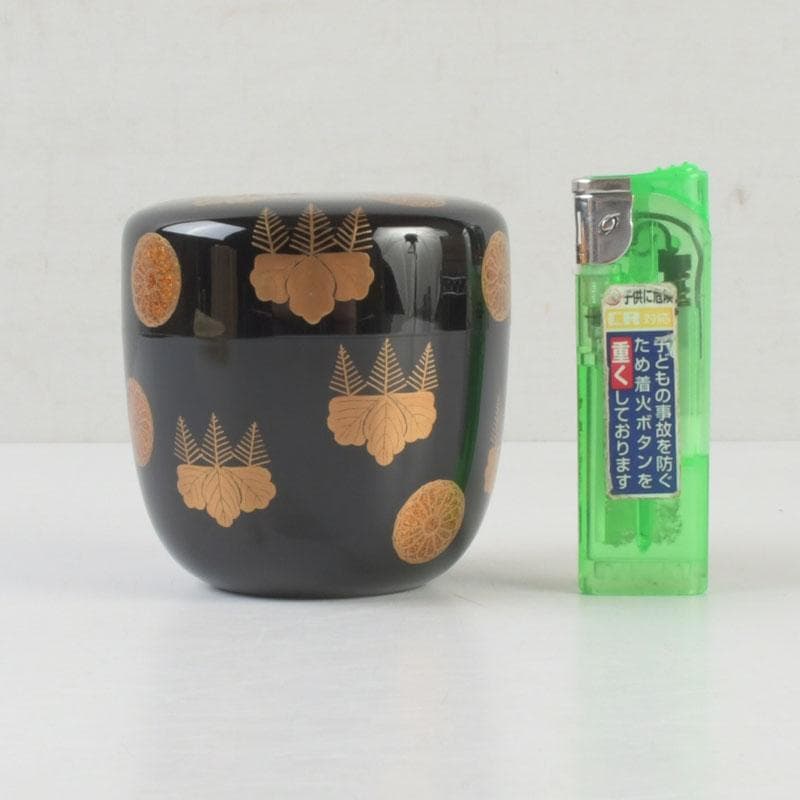
Experience Authentic Japan Art with this Wajima Lacquer Natsume, a Maki-e Tea Caddy bearing Kiku-Kiri Maki-e across its deep black ground. This Japanese Tea Ceremony vessel functions as a Gold Maki-e Natsume and Lacquer Tea Container, featuring Chrysanthemum Paulownia Motif and Wajima Urushi Lacquer — a work of sustained authorship for any Art Collector drawn to the cultural weight of imperial heraldry rendered in gold.
🔹 [ BASIC DETAILS ]
• Artist: Sōhō Mokushiro (目代宗芳), with personal seal
• Technique: Taka-maki-e and togidashi-maki-e on black urushi lacquer (Wajima-nuri)
• Era: 1990s
• Origin: Wajima, Ishikawa, Japan
• Dimensions: Height approx. 7 cm, Diameter approx. 7.4 cm
• Weight: 73 g
• Box: Tomobako (signed wooden box) with calligraphic inscription 菊桐棗 and red artist seal; accompanied by original cloth (共布)
• Condition: Pristine — mirror-grade lacquer surface intact, no chips or abrasions; lid seats flush with no play
🔹 [ CULTURAL & ARTISTIC INSIGHT ]
The chrysanthemum and paulownia together form one of Japan's most historically charged pairings. The chrysanthemum — kiku — is the crest of the imperial family, its sixteen-petal roundel appearing on the throne and on passports. The paulownia — kiri — is the crest of the government, used by prime ministers and the cabinet seal. Scattered across the natsume's black ground not as power symbols but as seasonal presences, these motifs shed their political weight and become something quieter: an acknowledgment that beauty and authority share the same grammar. The lacquer artist working in Wajima understood this transfer of meaning, using two distinct gold techniques to give each motif its own register — the kiku rendered with a granular raised surface that catches light like hammered gold, the kiri brushed in flat maki-e strokes that absorb it. The tension between those two textures is not decorative accident. It is the density of intention that separates craft from authorship.
Sōhō Mokushiro trained within the Wajima tradition at the moment when living national treasure lineages were consolidating their methods. His work on this natsume demonstrates the compositional confidence of an artist who has internalized the grammar of scattered motif — tobichirashi — without defaulting to its most symmetrical solutions. The lid reads as a loose radial composition when viewed from above; the body continues the scatter without repeating it. The eye moves, then settles.
🔹 [ DEEP-DIVE COMMENTARY ]
Wajima-nuri is the most structurally rigorous of Japan's lacquer traditions. Its distinction lies in the ground preparation: multiple layers of raw urushi mixed with diatomaceous earth (jinoko) are applied, dried, and polished between each coat, creating a substrate capable of surviving centuries of use without delaminating. The black surface of this natsume carries that foundation — its depth is not paint but accumulated geological patience.
Maki-e, literally "sprinkled picture," encompasses a family of techniques distinguished by when and how metallic powders are introduced into the lacquer film. On this natsume, at least two approaches are visible. The chrysanthemum roundels show a raised, granular surface consistent with taka-maki-e, in which successive layers of lacquer are built up to create relief before gold is applied; this gives the kiku their textured, almost cellular appearance. The paulownia sprigs, by contrast, read as togidashi or flat hira-maki-e — gold powder set into wet lacquer, then polished to a smooth plane that blends with the surrounding ground, creating a silhouette without shadow.
For collectors, the presence of a personal artist seal alongside the tomobako inscription is significant. It establishes a chain of authorship that survives the object's transfer between hands. The tomobako carries the title 菊桐棗 in the artist's own calligraphy, the red seal functions as a colophon — together they make this natsume a documented work rather than an anonymous piece.
The natsume is the container for thin matcha (usucha) in the Urasenke and Omotesenke traditions of chado. Its proportions — slightly taller than wide, with a rounded dome lid — correspond to the standard form that allows the chakin cloth to wipe the rim cleanly during temae. This is a working object as much as a display one: the lacquer was built for handling, the lid fit calibrated for the practitioner's fingers.
Contemporary Wajima lacquer of this caliber circulates primarily within Japan's tea ceremony supply network and at auction houses specializing in chado utensils. Work carrying a named artist's seal and tomobako, in undamaged condition, represents the kind of object that enters a collector's permanent rotation rather than passing through it.
[ JAPANESE DESCRIPTION / 日本語解説 ]
輪島塗の黒漆地に、菊と桐を金蒔絵で散らした棗です。目代宗芳の落款・印章を備え、共箱・共布が完存する、状態極上の一点です。
菊は皇室の紋章、桐は政府の紋章として知られますが、茶道具の上ではその格式を脱ぎ捨て、季節の草花としての静けさをまといます。黒漆という無の地の上に金で描かれることで、この二つの文様は政治的意味合いではなく、日本の美意識における「間」の問いとして立ち現れます。
技法の面では、菊の丸紋に高蒔絵ないし截金風の粒立った金の質感が用いられ、光を受けて浮き上がる立体感を生んでいます。一方の桐は平蒔絵あるいは研ぎ出しに近い手法で処理され、漆面に溶け込む輪郭として描かれています。この二つの質感の対話が、職人仕事と作家性の境界線を引いています。
輪島塗の特徴は、珪藻土(地の粉)を混ぜた下地を何層にも重ねて研ぎ出す、堅牢な下地工程にあります。数百年の使用に耐える構造的な厚みが、この棗の黒の深さに表れています。
作者の目代宗芳は輪島の伝統の中で育った蒔絵師で、飛び散らし構成を対称に逃げず、蓋上と胴で異なるリズムを与えています。俯瞰すると緩やかな放射状、側面では視線が流れ、やがて落ち着く——その運動感が、この棗の持ち味です。
棗は表千家・裏千家の薄茶点前において抹茶を入れる器であり、蓋の縁の拭き取りに支障のない高さ・径の均衡が求められます。本品の形状はその条件を満たしており、飾り物としてだけでなく、点前に供せる実用の道具でもあります。
🔹 [ SHIPPING & PACKAGING ]
• Dispatch: Within 1-6 business days
• Carrier: Japan Post EMS / UPS (with tracking)
• Packaging: Carefully wrapped with protective materials
🔹 [ BASIC DETAILS ]
• Artist: Sōhō Mokushiro (目代宗芳), with personal seal
• Technique: Taka-maki-e and togidashi-maki-e on black urushi lacquer (Wajima-nuri)
• Era: 1990s
• Origin: Wajima, Ishikawa, Japan
• Dimensions: Height approx. 7 cm, Diameter approx. 7.4 cm
• Weight: 73 g
• Box: Tomobako (signed wooden box) with calligraphic inscription 菊桐棗 and red artist seal; accompanied by original cloth (共布)
• Condition: Pristine — mirror-grade lacquer surface intact, no chips or abrasions; lid seats flush with no play
🔹 [ CULTURAL & ARTISTIC INSIGHT ]
The chrysanthemum and paulownia together form one of Japan's most historically charged pairings. The chrysanthemum — kiku — is the crest of the imperial family, its sixteen-petal roundel appearing on the throne and on passports. The paulownia — kiri — is the crest of the government, used by prime ministers and the cabinet seal. Scattered across the natsume's black ground not as power symbols but as seasonal presences, these motifs shed their political weight and become something quieter: an acknowledgment that beauty and authority share the same grammar. The lacquer artist working in Wajima understood this transfer of meaning, using two distinct gold techniques to give each motif its own register — the kiku rendered with a granular raised surface that catches light like hammered gold, the kiri brushed in flat maki-e strokes that absorb it. The tension between those two textures is not decorative accident. It is the density of intention that separates craft from authorship.
Sōhō Mokushiro trained within the Wajima tradition at the moment when living national treasure lineages were consolidating their methods. His work on this natsume demonstrates the compositional confidence of an artist who has internalized the grammar of scattered motif — tobichirashi — without defaulting to its most symmetrical solutions. The lid reads as a loose radial composition when viewed from above; the body continues the scatter without repeating it. The eye moves, then settles.
🔹 [ DEEP-DIVE COMMENTARY ]
Wajima-nuri is the most structurally rigorous of Japan's lacquer traditions. Its distinction lies in the ground preparation: multiple layers of raw urushi mixed with diatomaceous earth (jinoko) are applied, dried, and polished between each coat, creating a substrate capable of surviving centuries of use without delaminating. The black surface of this natsume carries that foundation — its depth is not paint but accumulated geological patience.
Maki-e, literally "sprinkled picture," encompasses a family of techniques distinguished by when and how metallic powders are introduced into the lacquer film. On this natsume, at least two approaches are visible. The chrysanthemum roundels show a raised, granular surface consistent with taka-maki-e, in which successive layers of lacquer are built up to create relief before gold is applied; this gives the kiku their textured, almost cellular appearance. The paulownia sprigs, by contrast, read as togidashi or flat hira-maki-e — gold powder set into wet lacquer, then polished to a smooth plane that blends with the surrounding ground, creating a silhouette without shadow.
For collectors, the presence of a personal artist seal alongside the tomobako inscription is significant. It establishes a chain of authorship that survives the object's transfer between hands. The tomobako carries the title 菊桐棗 in the artist's own calligraphy, the red seal functions as a colophon — together they make this natsume a documented work rather than an anonymous piece.
The natsume is the container for thin matcha (usucha) in the Urasenke and Omotesenke traditions of chado. Its proportions — slightly taller than wide, with a rounded dome lid — correspond to the standard form that allows the chakin cloth to wipe the rim cleanly during temae. This is a working object as much as a display one: the lacquer was built for handling, the lid fit calibrated for the practitioner's fingers.
Contemporary Wajima lacquer of this caliber circulates primarily within Japan's tea ceremony supply network and at auction houses specializing in chado utensils. Work carrying a named artist's seal and tomobako, in undamaged condition, represents the kind of object that enters a collector's permanent rotation rather than passing through it.
[ JAPANESE DESCRIPTION / 日本語解説 ]
輪島塗の黒漆地に、菊と桐を金蒔絵で散らした棗です。目代宗芳の落款・印章を備え、共箱・共布が完存する、状態極上の一点です。
菊は皇室の紋章、桐は政府の紋章として知られますが、茶道具の上ではその格式を脱ぎ捨て、季節の草花としての静けさをまといます。黒漆という無の地の上に金で描かれることで、この二つの文様は政治的意味合いではなく、日本の美意識における「間」の問いとして立ち現れます。
技法の面では、菊の丸紋に高蒔絵ないし截金風の粒立った金の質感が用いられ、光を受けて浮き上がる立体感を生んでいます。一方の桐は平蒔絵あるいは研ぎ出しに近い手法で処理され、漆面に溶け込む輪郭として描かれています。この二つの質感の対話が、職人仕事と作家性の境界線を引いています。
輪島塗の特徴は、珪藻土(地の粉)を混ぜた下地を何層にも重ねて研ぎ出す、堅牢な下地工程にあります。数百年の使用に耐える構造的な厚みが、この棗の黒の深さに表れています。
作者の目代宗芳は輪島の伝統の中で育った蒔絵師で、飛び散らし構成を対称に逃げず、蓋上と胴で異なるリズムを与えています。俯瞰すると緩やかな放射状、側面では視線が流れ、やがて落ち着く——その運動感が、この棗の持ち味です。
棗は表千家・裏千家の薄茶点前において抹茶を入れる器であり、蓋の縁の拭き取りに支障のない高さ・径の均衡が求められます。本品の形状はその条件を満たしており、飾り物としてだけでなく、点前に供せる実用の道具でもあります。
🔹 [ SHIPPING & PACKAGING ]
• Dispatch: Within 1-6 business days
• Carrier: Japan Post EMS / UPS (with tracking)
• Packaging: Carefully wrapped with protective materials
Quantity
Couldn't load pickup availability
Low stock: 1 left
View full details