1
/
of
10
Taniguchi Osamu Chawan — Ash-Glaze Tea Bowl with Banded Slip, Signed Tomobako
Taniguchi Osamu Chawan — Ash-Glaze Tea Bowl with Banded Slip, Signed Tomobako
Regular price
Dhs. 548.00 AED
Regular price
Sale price
Dhs. 548.00 AED
Taxes included.
Shipping calculated at checkout.
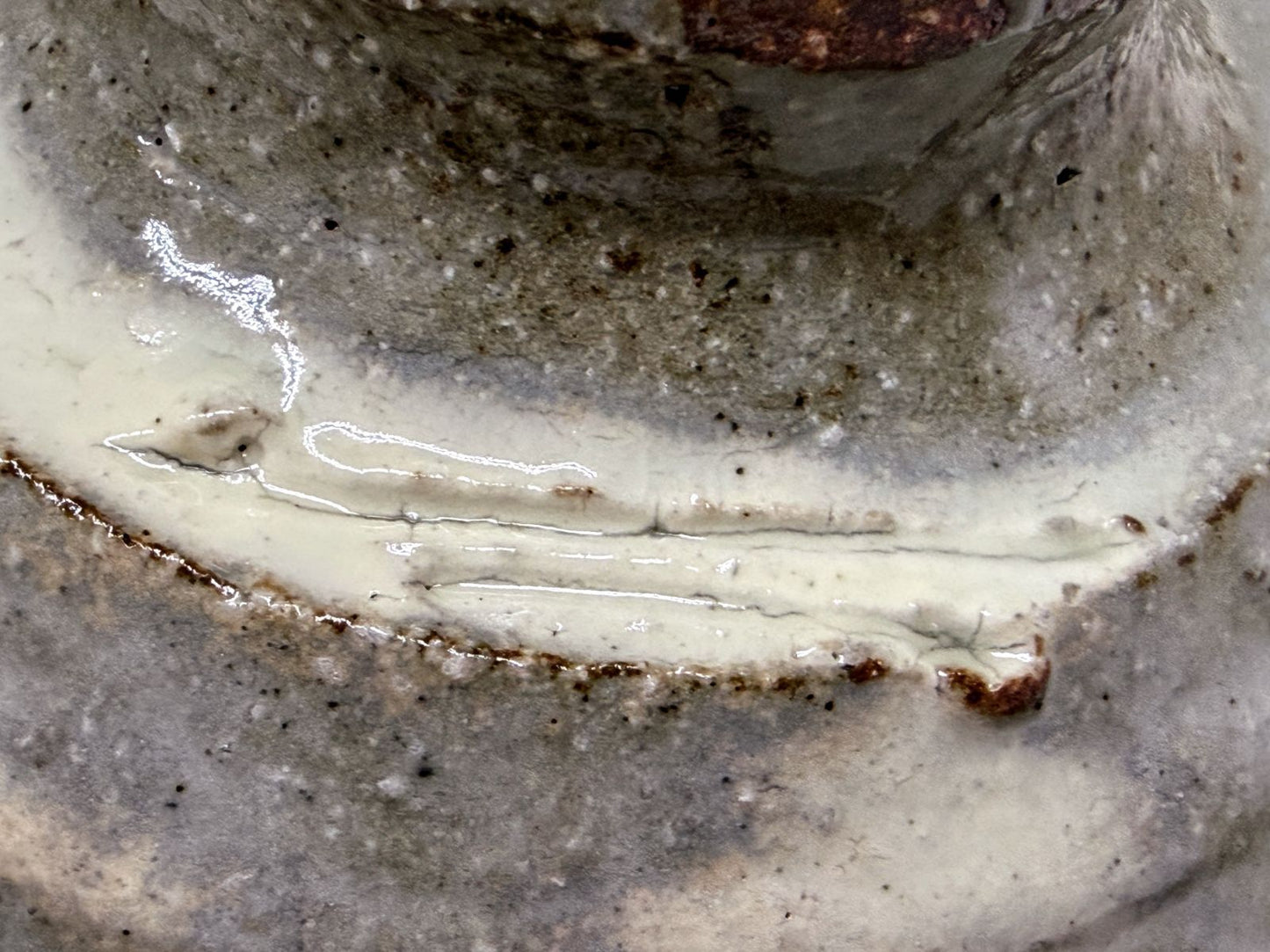
A chawan by Taniguchi Osamu (谷口治) — the body thrown open and wide, its walls rising in a gentle funnel. Ash-white slip is swept in loose horizontal bands across a dark, iron-rich clay body; where the glaze thins, the grey stone beneath shows through. The interior carries that same banded weather into the well. The foot is wide, unglazed, coarse-grained — left as the earth gave it.
🔹 [ BASIC DETAILS ]
• Artist: Taniguchi Osamu (谷口治)
• Technique: Ash glaze (hai-yu) over dark stoneware clay; brushed slip banding
• Era: Late 20th–early 21st century
• Origin: Japan
• Dimensions: Diameter approx. 13.7 cm, Height approx. 6.5 cm
• Box: Tomobako (signed wooden box) with artist's brushed signature and red seal
• Condition: No visible chips, cracks, or repairs; no significant wear
🔹 [ CULTURAL & ARTISTIC INSIGHT ]
The brushed-slip technique Taniguchi employs belongs to a long vernacular tradition within Japanese folk ceramics — mingei-adjacent in its directness, yet the execution carries the considered hand of a studio potter. Ash glaze (hai-yu) is produced by applying wood-ash slurry or glaze to the surface; in the kiln, the alkaline silica in the ash melts and flows, producing the characteristic blue-grey softness that pools at lower edges and thins to near-transparency on raised surfaces. The sweeping horizontal bands here are not decorative in a conventional sense — they record the motion of application, preserving gesture as surface. Where the slip gathers thick, it reads white and matte; where it runs thin, the dark clay asserts itself. The interplay between covered and exposed, white and stone-grey, is the formal argument of the piece.
The interior lip is thickened and slightly irregular — not from imprecision, but from a hand that understood that an open chawan this size must hold without slipping. The wide, unglazed foot is cut simply and sits firm.
Poetic line: A surface of weather — ash white over iron grey, as a winter sky lays itself over stone.
🔹 [ DEEP-DIVE COMMENTARY ]
Hai-yu (ash glaze) is among the oldest glaze traditions in Japanese ceramics, traceable to Sue ware of the Kofun and Nara periods, when natural ash deposits from wood firing fused accidentally onto clay surfaces. Contemporary studio potters working in this tradition intentionally mix and apply ash slurries — layering wood types, adjusting silica content, and controlling kiln atmosphere — to replicate and refine what ancient kilns discovered by accident.
The brushed-slip banding technique used here draws a distinction between hai-yu as a pooled, dipped glaze and as a gestural mark. By applying ash slip with a wide brush in horizontal strokes before firing, Taniguchi introduces directionality into the surface — the glaze records its own making. This is philosophically resonant in the context of chanoyu (tea ceremony), where the history of the object's formation is considered part of its presence in the tea room.
For collectors, the tomobako carries specific weight. A signed and sealed box by the artist (共箱, tomobako) is the primary documentation of authenticity in Japanese ceramics tradition; it functions simultaneously as provenance record, gift wrapper, and art object in its own right. The brushed character on the lid — 治, part of the artist's given name — and the accompanying red seal together constitute the standard authentication format for signed works.
The open, funnel-form body (hiragata-style) is well-suited to koicha (thick tea) presentation, where a wide interior allows the chasen (tea whisk) to move freely and the thick green of the matcha to pool naturally at the well. The ash glaze on such a form ages gracefully — the surface absorbs trace oils from hands and tea over years, developing the patina (yo no iri) that is the particular goal of regular use.
[ JAPANESE DESCRIPTION / 日本語解説 ]
谷口治による抹茶碗。大きく開いた漏斗形の器形。暗色の鉄分豊かな石器質土に、灰釉の白い刷毛目が横方向に大きく流れ、釉の薄いところから石の灰色が滲み出る。高台は広く、無釉のまま、土の粗さを残している。内側は同じ刷毛目の景色が茶だまりへと続く。
基本情報
• 作家:谷口治
• 技法:灰釉(はいゆ)、刷毛目掛け分け
• 時代:20世紀後半〜21世紀初頭
• 産地:日本
• 寸法:口径 約13.7cm、高さ 約6.5cm
• 付属品:共箱(作家自署・落款印あり)
• 状態:目立った傷・欠け・修復の痕なし
文化的解説
谷口が用いる刷毛目技法は、日本の民芸的陶芸の長い伝統に連なるものでありながら、その手の運びには工芸作家としての意図が宿る。灰釉は、木灰スラリーを素地に掛けて焼成することで生まれる釉薬で、灰中のアルカリ珪酸が熔けて流れ、特有の青みがかった柔らかい白灰色を形成する。厚く溜まった部分では白くマットになり、薄れるところでは土の色が透けて見える。この覆いと露出、白と石灰色の対話こそがこの作品の造形的な論点である。
詩的一言:冬空が石の上に横たわるように、灰白色が鉄灰の上に静かに寝る。
深層解説
灰釉(はいゆ)は日本陶芸最古の釉薬伝統のひとつであり、古墳・奈良時代の須恵器にまで遡る。木灰が焼成中に偶発的に素地と融合したことが起源とされ、現代の工芸作家はその灰釉を意図的に調合・施釉することで、古代の窯が偶然に見出した美を精緻に再現している。
刷毛目の横方向掛けは、灰釉を素地に流しかけるのではなく、幅広の刷毛で直接塗ることで釉面に方向性を与える技法である。焼成前の刷毛の動きが釉面に記録され、器自体が「作られた過程」を携えて茶室に在る。これは茶道の美学において、器の成り立ちを「景色」として鑑賞するという考え方に深く響く。
共箱は日本陶芸において作家の自署と落款(赤い判子)が記された木箱であり、真作証明の一次資料として機能する。箱に書かれた「治」の文字と赤い印は、作家签名作品の標準的な認証形式である。
広口の平形茶碗は濃茶に適した形で、広い内側が茶筅の動きを受け入れ、抹茶が自然に茶だまりに集まる。灰釉はこうした形において年月をかけて手の油と茶の成分を吸収し、使い込みによる「よの入り」と呼ばれる独自の景色を育てていく。
🔹 [ SHIPPING & PACKAGING ]
• Dispatch: Within 1-6 business days
• Carrier: Japan Post EMS / UPS / FedEx (with tracking)
• Packaging: Carefully wrapped with protective materials
🔹 [ BASIC DETAILS ]
• Artist: Taniguchi Osamu (谷口治)
• Technique: Ash glaze (hai-yu) over dark stoneware clay; brushed slip banding
• Era: Late 20th–early 21st century
• Origin: Japan
• Dimensions: Diameter approx. 13.7 cm, Height approx. 6.5 cm
• Box: Tomobako (signed wooden box) with artist's brushed signature and red seal
• Condition: No visible chips, cracks, or repairs; no significant wear
🔹 [ CULTURAL & ARTISTIC INSIGHT ]
The brushed-slip technique Taniguchi employs belongs to a long vernacular tradition within Japanese folk ceramics — mingei-adjacent in its directness, yet the execution carries the considered hand of a studio potter. Ash glaze (hai-yu) is produced by applying wood-ash slurry or glaze to the surface; in the kiln, the alkaline silica in the ash melts and flows, producing the characteristic blue-grey softness that pools at lower edges and thins to near-transparency on raised surfaces. The sweeping horizontal bands here are not decorative in a conventional sense — they record the motion of application, preserving gesture as surface. Where the slip gathers thick, it reads white and matte; where it runs thin, the dark clay asserts itself. The interplay between covered and exposed, white and stone-grey, is the formal argument of the piece.
The interior lip is thickened and slightly irregular — not from imprecision, but from a hand that understood that an open chawan this size must hold without slipping. The wide, unglazed foot is cut simply and sits firm.
Poetic line: A surface of weather — ash white over iron grey, as a winter sky lays itself over stone.
🔹 [ DEEP-DIVE COMMENTARY ]
Hai-yu (ash glaze) is among the oldest glaze traditions in Japanese ceramics, traceable to Sue ware of the Kofun and Nara periods, when natural ash deposits from wood firing fused accidentally onto clay surfaces. Contemporary studio potters working in this tradition intentionally mix and apply ash slurries — layering wood types, adjusting silica content, and controlling kiln atmosphere — to replicate and refine what ancient kilns discovered by accident.
The brushed-slip banding technique used here draws a distinction between hai-yu as a pooled, dipped glaze and as a gestural mark. By applying ash slip with a wide brush in horizontal strokes before firing, Taniguchi introduces directionality into the surface — the glaze records its own making. This is philosophically resonant in the context of chanoyu (tea ceremony), where the history of the object's formation is considered part of its presence in the tea room.
For collectors, the tomobako carries specific weight. A signed and sealed box by the artist (共箱, tomobako) is the primary documentation of authenticity in Japanese ceramics tradition; it functions simultaneously as provenance record, gift wrapper, and art object in its own right. The brushed character on the lid — 治, part of the artist's given name — and the accompanying red seal together constitute the standard authentication format for signed works.
The open, funnel-form body (hiragata-style) is well-suited to koicha (thick tea) presentation, where a wide interior allows the chasen (tea whisk) to move freely and the thick green of the matcha to pool naturally at the well. The ash glaze on such a form ages gracefully — the surface absorbs trace oils from hands and tea over years, developing the patina (yo no iri) that is the particular goal of regular use.
[ JAPANESE DESCRIPTION / 日本語解説 ]
谷口治による抹茶碗。大きく開いた漏斗形の器形。暗色の鉄分豊かな石器質土に、灰釉の白い刷毛目が横方向に大きく流れ、釉の薄いところから石の灰色が滲み出る。高台は広く、無釉のまま、土の粗さを残している。内側は同じ刷毛目の景色が茶だまりへと続く。
基本情報
• 作家:谷口治
• 技法:灰釉(はいゆ)、刷毛目掛け分け
• 時代:20世紀後半〜21世紀初頭
• 産地:日本
• 寸法:口径 約13.7cm、高さ 約6.5cm
• 付属品:共箱(作家自署・落款印あり)
• 状態:目立った傷・欠け・修復の痕なし
文化的解説
谷口が用いる刷毛目技法は、日本の民芸的陶芸の長い伝統に連なるものでありながら、その手の運びには工芸作家としての意図が宿る。灰釉は、木灰スラリーを素地に掛けて焼成することで生まれる釉薬で、灰中のアルカリ珪酸が熔けて流れ、特有の青みがかった柔らかい白灰色を形成する。厚く溜まった部分では白くマットになり、薄れるところでは土の色が透けて見える。この覆いと露出、白と石灰色の対話こそがこの作品の造形的な論点である。
詩的一言:冬空が石の上に横たわるように、灰白色が鉄灰の上に静かに寝る。
深層解説
灰釉(はいゆ)は日本陶芸最古の釉薬伝統のひとつであり、古墳・奈良時代の須恵器にまで遡る。木灰が焼成中に偶発的に素地と融合したことが起源とされ、現代の工芸作家はその灰釉を意図的に調合・施釉することで、古代の窯が偶然に見出した美を精緻に再現している。
刷毛目の横方向掛けは、灰釉を素地に流しかけるのではなく、幅広の刷毛で直接塗ることで釉面に方向性を与える技法である。焼成前の刷毛の動きが釉面に記録され、器自体が「作られた過程」を携えて茶室に在る。これは茶道の美学において、器の成り立ちを「景色」として鑑賞するという考え方に深く響く。
共箱は日本陶芸において作家の自署と落款(赤い判子)が記された木箱であり、真作証明の一次資料として機能する。箱に書かれた「治」の文字と赤い印は、作家签名作品の標準的な認証形式である。
広口の平形茶碗は濃茶に適した形で、広い内側が茶筅の動きを受け入れ、抹茶が自然に茶だまりに集まる。灰釉はこうした形において年月をかけて手の油と茶の成分を吸収し、使い込みによる「よの入り」と呼ばれる独自の景色を育てていく。
🔹 [ SHIPPING & PACKAGING ]
• Dispatch: Within 1-6 business days
• Carrier: Japan Post EMS / UPS / FedEx (with tracking)
• Packaging: Carefully wrapped with protective materials
Quantity
Couldn't load pickup availability
Low stock: 1 left
View full details