1
/
of
10
Shino Chawan by Sato Kayu — Iron-Painted Mino Matcha Bowl, Signed Box
Shino Chawan by Sato Kayu — Iron-Painted Mino Matcha Bowl, Signed Box
Regular price
Dhs. 730.00 AED
Regular price
Sale price
Dhs. 730.00 AED
Taxes included.
Shipping calculated at checkout.
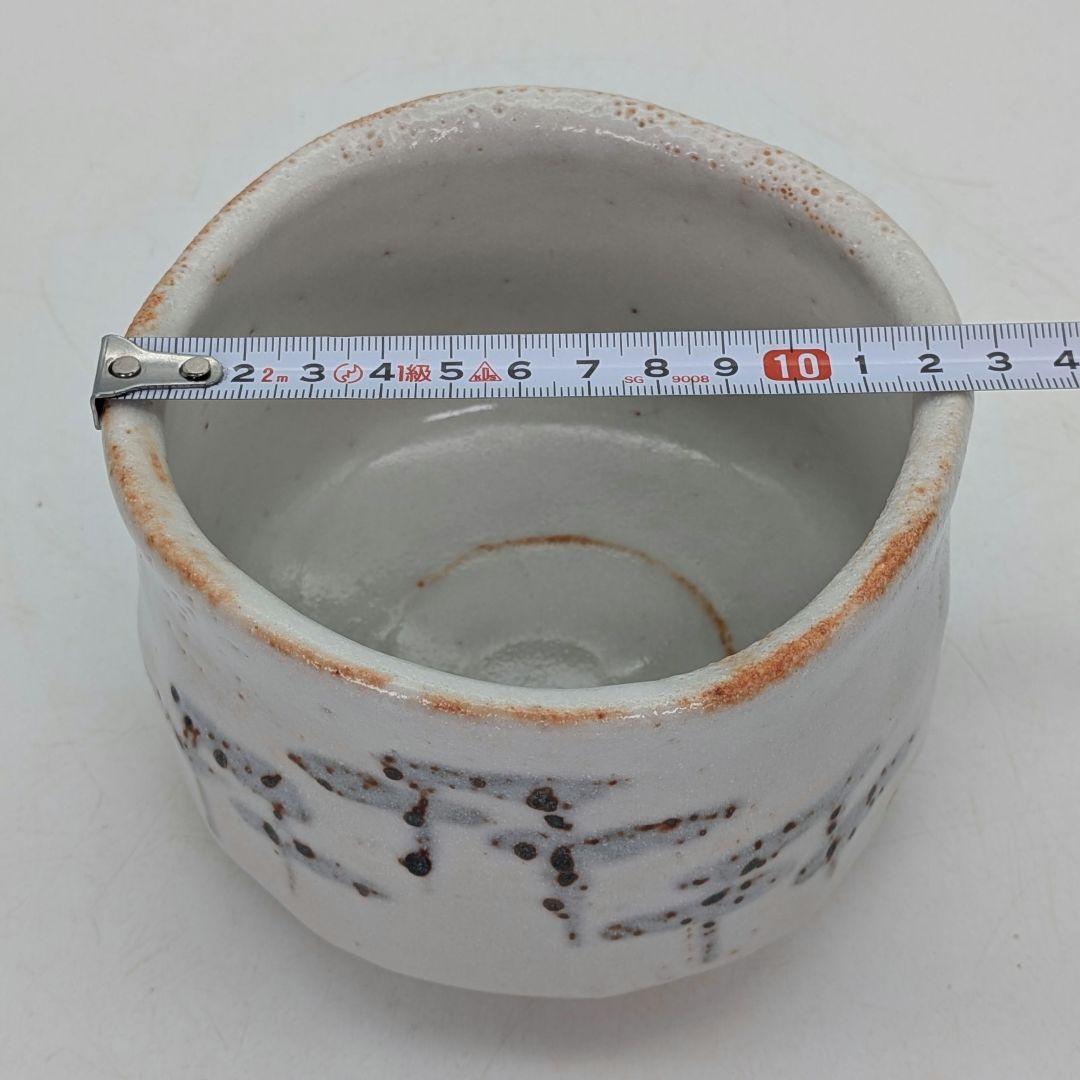
A Shino chawan by Sato Kayu of Mino — the thick white glaze pooled and pocked across the body, iron brushwork tracing a spare branch or grass stem through the milky field. Where the glaze thins at the foot and rim, rust-orange hi-iro emerges: the fire's signature, unplanned and unrepeatable. The crazing runs fine throughout, each hairline a quiet record of contraction. This is the Mino tradition witnessed in a single object.
🔹 [ BASIC DETAILS ]
• Artist: Sato Kayu (佐藤嘉祐), Mino ceramicist
• Technique: Shino-yaki (志野焼) — thick feldspathic white glaze over iron-painted stoneware body
• Motif: Iron-painted grass or branch (kusa-e / pine motif), iron-dot accents
• Origin: Mino, Gifu Prefecture, Japan
• Dimensions: Height approx. 8.5 cm, Diameter (mouth) approx. 11–12 cm
• Box: Original signed wooden box (tomobako) — lid inscribed 志野茶盌 嘉祐作 with artist seal
• Cloth: Original fukusa (共布) included — saffron gold
• Condition: Good. No chips, cracks, or repairs. Natural hi-iro and crazing throughout — inherent to the firing.
🔹 [ CULTURAL & ARTISTIC INSIGHT ]
Shino is among the oldest and most revered of Japanese tea glazes — originating in Mino (present-day Gifu Prefecture) during the late Muromachi and Momoyama periods, when tea masters were reshaping aesthetic values away from Chinese ideals of perfection toward something rawer, more grounded in Japanese soil. The glaze itself is composed primarily of feldspar (chōseki), applied thickly so it blisters, pools, and pinholes during firing in a wood or gas kiln. The resulting white carries depth — neither uniform nor pure, but alive with texture.
Iron painting (tetsu-e) on Shino is applied beneath the glaze before firing: iron oxide brushwork that bleeds and softens as the thick white glaze flows over it, leaving forms that are half-submerged, half-present. The motif here — an angular branch or grass drawn with deliberate, spare strokes — reads as a moment captured mid-gesture. It does not explain itself.
The hi-iro (緋色, flame blush) appearing at the rim and foot ring is the kiln's own contribution: where the glaze is thinnest or absent, reduction firing scorches the clay body to warm orange-red. No two bowls share the same fire signature. The unglazed foot (kodai) reveals the raw coarse stoneware clay of Mino, grey-buff and gritty — the material speaking plainly.
Philosophical reflection: The white field of Shino is not absence — it holds. The iron line moves across it the way a branch holds snow: briefly, and without argument.
🔹 [ DEEP-DIVE COMMENTARY ]
Shino-yaki emerged in Mino during the late 16th century, shaped in part by the aesthetic demands of wabi-cha tea practice as codified by Sen no Rikyu and his circle. Unlike the Chinese-influenced tenmoku bowls that preceded it, Shino was valued precisely for its imperfections: the thick uneven glaze, the fire marks, the casual asymmetry of hand-formed rims. It was, in a sense, the first distinctly Japanese ceramic aesthetic for tea.
The glaze chemistry of Shino is unique. High-feldspar glazes applied at considerable thickness — sometimes 3–5mm — require careful kiln management. During firing, the feldspar melts unevenly, creating the characteristic pinholes (小穴, ko-ana) and glaze bubbles that give Shino its skin-like texture. The crazing (貫入, kan'nyū) that develops as the glaze cools at a different rate from the clay body is not a flaw but a structural feature, contributing to both visual interest and the way the bowl holds warmth in hand.
Iron underpainting on Shino occupies a distinct category from iron overpainting on other wares. Because the iron is applied before the thick glaze coat, it is filtered through several millimetres of milky white — the resulting forms are softened, their edges uncertain. The brushstroke does not arrive fully; it surfaces. This quality of partial emergence is central to the aesthetic appeal of e-Shino (絵志野, painted Shino).
Sato Kayu works in the Mino tradition, a lineage that has produced some of the most collected contemporary ceramic work in Japan. The signed tomobako and personal seal confirm the work's authorship — an important factor for collectors building documented provenance. The saffron fukusa cloth included with this piece is a further marker of care: the object has been held as something worth protecting.
For collectors, a signed e-Shino chawan with complete tomobako and fukusa represents a fully documented acquisition. The hi-iro, the motif placement, the foot treatment — each element can be read independently and against the whole. This is a piece that rewards time.
[ JAPANESE DESCRIPTION / 日本語解説 ]
佐藤嘉祐による志野茶碗。厚く白い志野釉が胴全体に広がり、鉄絵の筆跡がその乳白の野を横切る。草か松の枝を思わせる線描は、簡潔でありながら意志的だ。釉の薄くなる口縁と高台際には橙色の緋色が現れ、これは窯の火が刻んだ、この一碗だけの景色である。全体に走る貫入は釉と土の収縮の記録であり、志野という焼き物の身体そのものを語っている。
🔹 [ 基本情報 ]
• 作家: 佐藤嘉祐(美濃の陶芸家)
• 技法: 志野焼(長石釉の厚掛け、鉄絵装飾)
• 文様: 草文・松文風の鉄絵、鉄点散らし
• 産地: 岐阜県美濃
• 寸法: 高さ約8.5cm、口径約11〜12cm
• 箱: 共箱(桐)。蓋表「志野茶盌 嘉祐作」箱書き+落款印
• 布: 共布(黄橙色)付属
• 状態: 良好。欠け・ひび・金継ぎなし。緋色・貫入は焼成による自然の景色。
🔹 [ 文化・芸術的背景 ]
志野焼は、室町末期から桃山期にかけて美濃(現・岐阜県)で生まれた、日本を代表する茶陶のひとつである。中国陶磁への憧憬から離れ、侘び茶の美学が求めた「不完全さの中の深み」に応える器として、長石を主体とする厚い白釉が開発された。釉は不均一に溶け、小穴を生じ、肌は生き物のように呼吸する。
鉄絵志野では、釉掛けの前に鉄釉で文様を描く。厚い白釉越しに滲み出る鉄の線は、完全には現れず、半ば埋もれたまま浮かび上がる。この「半出現」の感覚が絵志野の核心であり、見る者に余白を残す。
緋色は釉の薄い部分が窯の炎に直接触れることで生じる赤橙の発色であり、制御できない窯変である。同じ景色の碗は二つとない。高台の土見せには美濃の荒い素地が露わになり、素材の正直さが伝わってくる。
詩的な一文: 志野の白は空白ではない——それは、何かをそっと抱えている野原だ。
🔹 [ 上級コレクター向け解説 ]
志野焼は16世紀末の美濃に生まれ、千利休らが形にした侘び茶の美意識と深く結びついている。天目茶碗が中国的完成を追ったのに対し、志野は日本固有の「景色」——火の跡、歪み、不均一な釉——を価値の中心に据えた、最初の純粋に日本的な茶陶と言えるかもしれない。
志野釉の厚みは時に3〜5mmに達する。窯の中で長石が不均一に溶け、冷却過程で釉と素地の収縮差から貫入が走る。これらはすべて設計外の現象であり、作家が窯に委ねた部分である。その余白が志野の品格を作る。
鉄絵を白釉で覆う技法は、絵のかたちを曖昧にする。線は届き切らない。それが絵志野の詩情だ。佐藤嘉祐はその美濃の伝統を継ぐ作家であり、本作の共箱・落款・共布は、作品の出所を明確に文書化している。コレクションに加える際の根拠として十全である。
緋色の景色、鉄絵の配置、高台の造形——それぞれが独立した読み方を持ち、同時に全体として一つの静寂を成している。時間をかけて向き合う価値のある一碗だ。
🔹 [ SHIPPING & PACKAGING ]
• Dispatch: Within 1-6 business days
• Carrier: Japan Post EMS / UPS / FedEx (with tracking)
• Packaging: Carefully wrapped with protective materials
🔹 [ BASIC DETAILS ]
• Artist: Sato Kayu (佐藤嘉祐), Mino ceramicist
• Technique: Shino-yaki (志野焼) — thick feldspathic white glaze over iron-painted stoneware body
• Motif: Iron-painted grass or branch (kusa-e / pine motif), iron-dot accents
• Origin: Mino, Gifu Prefecture, Japan
• Dimensions: Height approx. 8.5 cm, Diameter (mouth) approx. 11–12 cm
• Box: Original signed wooden box (tomobako) — lid inscribed 志野茶盌 嘉祐作 with artist seal
• Cloth: Original fukusa (共布) included — saffron gold
• Condition: Good. No chips, cracks, or repairs. Natural hi-iro and crazing throughout — inherent to the firing.
🔹 [ CULTURAL & ARTISTIC INSIGHT ]
Shino is among the oldest and most revered of Japanese tea glazes — originating in Mino (present-day Gifu Prefecture) during the late Muromachi and Momoyama periods, when tea masters were reshaping aesthetic values away from Chinese ideals of perfection toward something rawer, more grounded in Japanese soil. The glaze itself is composed primarily of feldspar (chōseki), applied thickly so it blisters, pools, and pinholes during firing in a wood or gas kiln. The resulting white carries depth — neither uniform nor pure, but alive with texture.
Iron painting (tetsu-e) on Shino is applied beneath the glaze before firing: iron oxide brushwork that bleeds and softens as the thick white glaze flows over it, leaving forms that are half-submerged, half-present. The motif here — an angular branch or grass drawn with deliberate, spare strokes — reads as a moment captured mid-gesture. It does not explain itself.
The hi-iro (緋色, flame blush) appearing at the rim and foot ring is the kiln's own contribution: where the glaze is thinnest or absent, reduction firing scorches the clay body to warm orange-red. No two bowls share the same fire signature. The unglazed foot (kodai) reveals the raw coarse stoneware clay of Mino, grey-buff and gritty — the material speaking plainly.
Philosophical reflection: The white field of Shino is not absence — it holds. The iron line moves across it the way a branch holds snow: briefly, and without argument.
🔹 [ DEEP-DIVE COMMENTARY ]
Shino-yaki emerged in Mino during the late 16th century, shaped in part by the aesthetic demands of wabi-cha tea practice as codified by Sen no Rikyu and his circle. Unlike the Chinese-influenced tenmoku bowls that preceded it, Shino was valued precisely for its imperfections: the thick uneven glaze, the fire marks, the casual asymmetry of hand-formed rims. It was, in a sense, the first distinctly Japanese ceramic aesthetic for tea.
The glaze chemistry of Shino is unique. High-feldspar glazes applied at considerable thickness — sometimes 3–5mm — require careful kiln management. During firing, the feldspar melts unevenly, creating the characteristic pinholes (小穴, ko-ana) and glaze bubbles that give Shino its skin-like texture. The crazing (貫入, kan'nyū) that develops as the glaze cools at a different rate from the clay body is not a flaw but a structural feature, contributing to both visual interest and the way the bowl holds warmth in hand.
Iron underpainting on Shino occupies a distinct category from iron overpainting on other wares. Because the iron is applied before the thick glaze coat, it is filtered through several millimetres of milky white — the resulting forms are softened, their edges uncertain. The brushstroke does not arrive fully; it surfaces. This quality of partial emergence is central to the aesthetic appeal of e-Shino (絵志野, painted Shino).
Sato Kayu works in the Mino tradition, a lineage that has produced some of the most collected contemporary ceramic work in Japan. The signed tomobako and personal seal confirm the work's authorship — an important factor for collectors building documented provenance. The saffron fukusa cloth included with this piece is a further marker of care: the object has been held as something worth protecting.
For collectors, a signed e-Shino chawan with complete tomobako and fukusa represents a fully documented acquisition. The hi-iro, the motif placement, the foot treatment — each element can be read independently and against the whole. This is a piece that rewards time.
[ JAPANESE DESCRIPTION / 日本語解説 ]
佐藤嘉祐による志野茶碗。厚く白い志野釉が胴全体に広がり、鉄絵の筆跡がその乳白の野を横切る。草か松の枝を思わせる線描は、簡潔でありながら意志的だ。釉の薄くなる口縁と高台際には橙色の緋色が現れ、これは窯の火が刻んだ、この一碗だけの景色である。全体に走る貫入は釉と土の収縮の記録であり、志野という焼き物の身体そのものを語っている。
🔹 [ 基本情報 ]
• 作家: 佐藤嘉祐(美濃の陶芸家)
• 技法: 志野焼(長石釉の厚掛け、鉄絵装飾)
• 文様: 草文・松文風の鉄絵、鉄点散らし
• 産地: 岐阜県美濃
• 寸法: 高さ約8.5cm、口径約11〜12cm
• 箱: 共箱(桐)。蓋表「志野茶盌 嘉祐作」箱書き+落款印
• 布: 共布(黄橙色)付属
• 状態: 良好。欠け・ひび・金継ぎなし。緋色・貫入は焼成による自然の景色。
🔹 [ 文化・芸術的背景 ]
志野焼は、室町末期から桃山期にかけて美濃(現・岐阜県)で生まれた、日本を代表する茶陶のひとつである。中国陶磁への憧憬から離れ、侘び茶の美学が求めた「不完全さの中の深み」に応える器として、長石を主体とする厚い白釉が開発された。釉は不均一に溶け、小穴を生じ、肌は生き物のように呼吸する。
鉄絵志野では、釉掛けの前に鉄釉で文様を描く。厚い白釉越しに滲み出る鉄の線は、完全には現れず、半ば埋もれたまま浮かび上がる。この「半出現」の感覚が絵志野の核心であり、見る者に余白を残す。
緋色は釉の薄い部分が窯の炎に直接触れることで生じる赤橙の発色であり、制御できない窯変である。同じ景色の碗は二つとない。高台の土見せには美濃の荒い素地が露わになり、素材の正直さが伝わってくる。
詩的な一文: 志野の白は空白ではない——それは、何かをそっと抱えている野原だ。
🔹 [ 上級コレクター向け解説 ]
志野焼は16世紀末の美濃に生まれ、千利休らが形にした侘び茶の美意識と深く結びついている。天目茶碗が中国的完成を追ったのに対し、志野は日本固有の「景色」——火の跡、歪み、不均一な釉——を価値の中心に据えた、最初の純粋に日本的な茶陶と言えるかもしれない。
志野釉の厚みは時に3〜5mmに達する。窯の中で長石が不均一に溶け、冷却過程で釉と素地の収縮差から貫入が走る。これらはすべて設計外の現象であり、作家が窯に委ねた部分である。その余白が志野の品格を作る。
鉄絵を白釉で覆う技法は、絵のかたちを曖昧にする。線は届き切らない。それが絵志野の詩情だ。佐藤嘉祐はその美濃の伝統を継ぐ作家であり、本作の共箱・落款・共布は、作品の出所を明確に文書化している。コレクションに加える際の根拠として十全である。
緋色の景色、鉄絵の配置、高台の造形——それぞれが独立した読み方を持ち、同時に全体として一つの静寂を成している。時間をかけて向き合う価値のある一碗だ。
🔹 [ SHIPPING & PACKAGING ]
• Dispatch: Within 1-6 business days
• Carrier: Japan Post EMS / UPS / FedEx (with tracking)
• Packaging: Carefully wrapped with protective materials
Quantity
Couldn't load pickup availability
Low stock: 1 left
View full details