1
/
of
10
Seto Hakeme Matcha Chawan by Kamei Masaru — Nitten Artist, Tomobako
Seto Hakeme Matcha Chawan by Kamei Masaru — Nitten Artist, Tomobako
Regular price
Dhs. 619.00 AED
Regular price
Sale price
Dhs. 619.00 AED
Taxes included.
Shipping calculated at checkout.
A hakeme chawan from Seto, made by Kamei Masaru — a Nitten exhibition artist whose work appears in Japan's national public art survey. Two or three wide cream-yellow bands of brushed slip move horizontally across a dark iron-brown Seto body, the haké marks still readable as individual strokes. The rim turns inward with quiet discipline; the foot ring is left unglazed, warm terracotta against a gray-brown ground. This bowl has never been used.
🔹 [ BASIC DETAILS ]
• Artist: Kamei Masaru (亀井勝)
• Exhibition record: Nitten (日展) — Japan's national art exhibition
• Technique: Hakeme (刷毛目) — brushed-slip decoration over Seto stoneware
• Origin: Seto, Aichi Prefecture, Japan (瀬戸焼)
• Dimensions: Height approx. 7.8 cm, Diameter approx. 11.7 cm
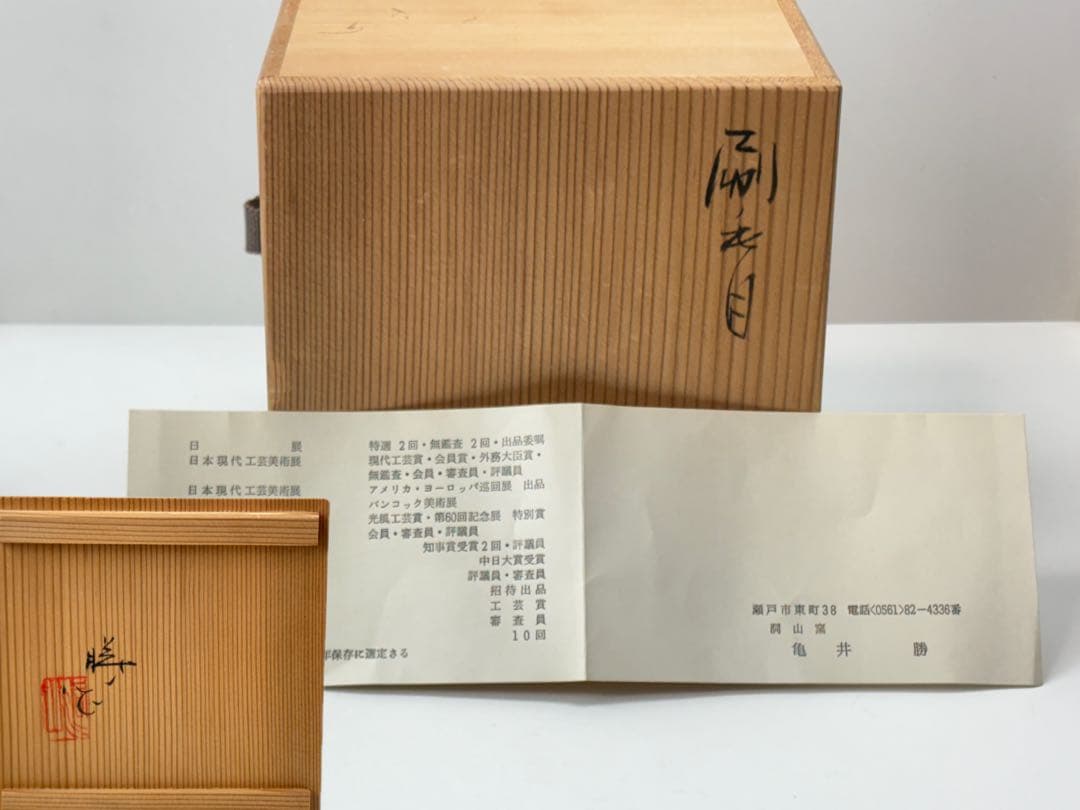
• Box: Artist-signed paulownia tomobako (共箱) with certificate slip (栞)
• Condition: Unused (未使用); no chips, no cracks, no repairs; maker's impressed seal visible on foot
🔹 [ CULTURAL & ARTISTIC INSIGHT ]
Hakeme — the act of sweeping white or cream slip across a clay body with a wide brush — arrived in Japan from Korean Joseon-dynasty pottery and found a permanent home in the aesthetics of wabi-cha. Where Korean originals carried a utilitarian directness, Japanese potters absorbed the gesture into a more self-conscious vocabulary: the marks were preserved, not refined away. In Seto-ware, one of Japan's oldest ceramic centers, the dark iron-rich clay provides the ground against which those cream brushstrokes read with particular clarity — earth and slip, density against lightness.
Kamei Masaru's hakeme here is neither elaborate nor tentative. The bands wrap the bowl's shoulder in two or three broad horizontal passes, visible in the images as distinct cream streaks that thin and thicken as the brush moved. The interior is glazed in a warm brown-amber that deepens toward the well — a quietly hospitable surface for matcha. The unglazed foot ring, showing raw terracotta, completes a form that holds no excess.
The Nitten credential places Kamei within a lineage of formally recognized contemporary ceramic artists in Japan — not a folk tradition but a deliberate art-historical position, where craft discipline and aesthetic intention are held together.
Poetic line: The brush passed once, left its mark, and moved on — a stroke that is also a silence.
🔹 [ DEEP-DIVE COMMENTARY ]
Seto (瀬戸) is the oldest continuous ceramic production center in Japan, active since at least the Kamakura period. Its iron-rich clay, mined from the Seto Basin in Aichi Prefecture, has historically produced a wide range of glazed wares — from the early Chinese-influenced koseto through Edo-period daily-use ceramics to contemporary art pottery. The Nitten (日本美術展覧会) was established in 1907 and remains Japan's largest juried art exhibition, encompassing painting, sculpture, craft arts, and calligraphy. Ceramic artists selected for Nitten have passed institutional review and are recognized within the Japanese art establishment as practitioners of intentional, technically grounded work.
Hakeme (刷毛目) is achieved by loading a wide, coarse brush with white or cream slip — typically a mixture of clay and water at a consistency slightly thicker than paint — and drawing it across the leather-hard body in a single, pressured stroke. The individual bristle marks remain visible after firing. When the body clay beneath is dark (as with iron-rich Seto clay), the slip contrast creates a graphic mark that is simultaneously energetic and controlled. Firing temperature, kiln atmosphere, and slip chemistry all affect how the cream tones develop: in this bowl, the slip has fired to a warm pale yellow-cream, sitting cleanly against the dark brown-gray ground.
For collectors, a hakeme chawan in unused condition with a Nitten artist's tomobako represents a specific category: a contemporary work made with full technical intention, documented by the artist, never entered into the patina of use. Collectors who prefer to inaugurate a piece themselves, or who hold pieces as objects of contemplation alongside their tea practice, find this condition meaningful. The hakeme tradition also connects directly to wabi-cha aesthetics — the appreciation of asymmetry, visible process, and material honesty — making this a bowl that carries philosophical resonance beyond its function.
Seto-ware in the post-war period developed two currents: the industrial (mass-produced tableware) and the artistic (individual studio work by named potters). Kamei Masaru's work belongs entirely to the second current, with Nitten participation as a formal marker of that positioning.
[ JAPANESE DESCRIPTION / 日本語解説 ]
瀬戸焼の刷毛目茶碗。亀井勝による作品で、日展に出品した作家の手による一碗。鉄分を含む瀬戸の暗褐色の土の上に、幅広い刷毛で掃いた白化粧(刷毛目)が二、三条の帯をなして横走する。刷毛の痕跡はそのまま残り、一筆の動きが焼成後もはっきりと読み取れる。口縁はわずかに内に傾き、高台は無釉でテラコッタの素地が現れる。未使用品。
作家:亀井勝(かめいまさる)/日展出品作家
技法:刷毛目(瀬戸焼)
産地:愛知県瀬戸市
寸法:高さ約7.8cm、口径約11.7cm
付属:共箱(作家署名入り)、栞付き
状態:未使用。欠け・割れ・金継ぎなし。高台に作家の印あり
刷毛目は、朝鮮・李朝の陶芸から日本に伝わった技法であり、侘び茶の美意識の中に深く根を下ろした。白化粧を刷毛で勢いよく塗り付けるその動作は、「偶然と意図のあわい」に宿る美を体現する。瀬戸の鉄質の土は、その白い刷毛目を際立たせる背景となる。亀井の作では、刷毛の通りが二、三本の帯として胴に横たわり、厚薄の変化がそのまま残された。内部は温かみのある褐色の釉薬で覆われ、茶だまり(茶が溜まる底部)に向かって深みを増す。
日展(日本美術展覧会)は1907年創設の国内最大規模の公募美術展であり、陶芸部門への入選は、作家としての技術的・美学的水準を公的に認められたことを意味する。亀井勝はその水準に立つ作家として、機能と美の両立を一碗に刻んでいる。
刷毛目の技法は、皮革硬度まで乾いた素地に、白化粧土を含ませた幅広い刷毛を一気に走らせることで成立する。刷毛の毛先の痕跡が焼成後も読み取れることが求められる技法であり、その「痕跡としての美」が侘び茶の美学と深く共鳴する。未使用・共箱付きという状態は、使い手が自らその器に最初の時間を与えるという意味を持つ。歴史的な連続性と個人の所作が交わる一碗として、この茶碗は収蔵にふさわしい。
🔹 [ SHIPPING & PACKAGING ]
• Dispatch: Within 1-6 business days
• Carrier: Japan Post EMS / UPS (with tracking)
• Packaging: Carefully wrapped with protective materials
🔹 [ BASIC DETAILS ]
• Artist: Kamei Masaru (亀井勝)
• Exhibition record: Nitten (日展) — Japan's national art exhibition
• Technique: Hakeme (刷毛目) — brushed-slip decoration over Seto stoneware
• Origin: Seto, Aichi Prefecture, Japan (瀬戸焼)
• Dimensions: Height approx. 7.8 cm, Diameter approx. 11.7 cm
• Box: Artist-signed paulownia tomobako (共箱) with certificate slip (栞)
• Condition: Unused (未使用); no chips, no cracks, no repairs; maker's impressed seal visible on foot
🔹 [ CULTURAL & ARTISTIC INSIGHT ]
Hakeme — the act of sweeping white or cream slip across a clay body with a wide brush — arrived in Japan from Korean Joseon-dynasty pottery and found a permanent home in the aesthetics of wabi-cha. Where Korean originals carried a utilitarian directness, Japanese potters absorbed the gesture into a more self-conscious vocabulary: the marks were preserved, not refined away. In Seto-ware, one of Japan's oldest ceramic centers, the dark iron-rich clay provides the ground against which those cream brushstrokes read with particular clarity — earth and slip, density against lightness.
Kamei Masaru's hakeme here is neither elaborate nor tentative. The bands wrap the bowl's shoulder in two or three broad horizontal passes, visible in the images as distinct cream streaks that thin and thicken as the brush moved. The interior is glazed in a warm brown-amber that deepens toward the well — a quietly hospitable surface for matcha. The unglazed foot ring, showing raw terracotta, completes a form that holds no excess.
The Nitten credential places Kamei within a lineage of formally recognized contemporary ceramic artists in Japan — not a folk tradition but a deliberate art-historical position, where craft discipline and aesthetic intention are held together.
Poetic line: The brush passed once, left its mark, and moved on — a stroke that is also a silence.
🔹 [ DEEP-DIVE COMMENTARY ]
Seto (瀬戸) is the oldest continuous ceramic production center in Japan, active since at least the Kamakura period. Its iron-rich clay, mined from the Seto Basin in Aichi Prefecture, has historically produced a wide range of glazed wares — from the early Chinese-influenced koseto through Edo-period daily-use ceramics to contemporary art pottery. The Nitten (日本美術展覧会) was established in 1907 and remains Japan's largest juried art exhibition, encompassing painting, sculpture, craft arts, and calligraphy. Ceramic artists selected for Nitten have passed institutional review and are recognized within the Japanese art establishment as practitioners of intentional, technically grounded work.
Hakeme (刷毛目) is achieved by loading a wide, coarse brush with white or cream slip — typically a mixture of clay and water at a consistency slightly thicker than paint — and drawing it across the leather-hard body in a single, pressured stroke. The individual bristle marks remain visible after firing. When the body clay beneath is dark (as with iron-rich Seto clay), the slip contrast creates a graphic mark that is simultaneously energetic and controlled. Firing temperature, kiln atmosphere, and slip chemistry all affect how the cream tones develop: in this bowl, the slip has fired to a warm pale yellow-cream, sitting cleanly against the dark brown-gray ground.
For collectors, a hakeme chawan in unused condition with a Nitten artist's tomobako represents a specific category: a contemporary work made with full technical intention, documented by the artist, never entered into the patina of use. Collectors who prefer to inaugurate a piece themselves, or who hold pieces as objects of contemplation alongside their tea practice, find this condition meaningful. The hakeme tradition also connects directly to wabi-cha aesthetics — the appreciation of asymmetry, visible process, and material honesty — making this a bowl that carries philosophical resonance beyond its function.
Seto-ware in the post-war period developed two currents: the industrial (mass-produced tableware) and the artistic (individual studio work by named potters). Kamei Masaru's work belongs entirely to the second current, with Nitten participation as a formal marker of that positioning.
[ JAPANESE DESCRIPTION / 日本語解説 ]
瀬戸焼の刷毛目茶碗。亀井勝による作品で、日展に出品した作家の手による一碗。鉄分を含む瀬戸の暗褐色の土の上に、幅広い刷毛で掃いた白化粧(刷毛目)が二、三条の帯をなして横走する。刷毛の痕跡はそのまま残り、一筆の動きが焼成後もはっきりと読み取れる。口縁はわずかに内に傾き、高台は無釉でテラコッタの素地が現れる。未使用品。
作家:亀井勝(かめいまさる)/日展出品作家
技法:刷毛目(瀬戸焼)
産地:愛知県瀬戸市
寸法:高さ約7.8cm、口径約11.7cm
付属:共箱(作家署名入り)、栞付き
状態:未使用。欠け・割れ・金継ぎなし。高台に作家の印あり
刷毛目は、朝鮮・李朝の陶芸から日本に伝わった技法であり、侘び茶の美意識の中に深く根を下ろした。白化粧を刷毛で勢いよく塗り付けるその動作は、「偶然と意図のあわい」に宿る美を体現する。瀬戸の鉄質の土は、その白い刷毛目を際立たせる背景となる。亀井の作では、刷毛の通りが二、三本の帯として胴に横たわり、厚薄の変化がそのまま残された。内部は温かみのある褐色の釉薬で覆われ、茶だまり(茶が溜まる底部)に向かって深みを増す。
日展(日本美術展覧会)は1907年創設の国内最大規模の公募美術展であり、陶芸部門への入選は、作家としての技術的・美学的水準を公的に認められたことを意味する。亀井勝はその水準に立つ作家として、機能と美の両立を一碗に刻んでいる。
刷毛目の技法は、皮革硬度まで乾いた素地に、白化粧土を含ませた幅広い刷毛を一気に走らせることで成立する。刷毛の毛先の痕跡が焼成後も読み取れることが求められる技法であり、その「痕跡としての美」が侘び茶の美学と深く共鳴する。未使用・共箱付きという状態は、使い手が自らその器に最初の時間を与えるという意味を持つ。歴史的な連続性と個人の所作が交わる一碗として、この茶碗は収蔵にふさわしい。
🔹 [ SHIPPING & PACKAGING ]
• Dispatch: Within 1-6 business days
• Carrier: Japan Post EMS / UPS (with tracking)
• Packaging: Carefully wrapped with protective materials
Quantity
Couldn't load pickup availability
Low stock: 1 left
View full details