1
/
of
10
Seto-Glaze Matcha Bowl by Eiraku Zengoro — Senke Jisshoku Hereditary Kyoto Master
Seto-Glaze Matcha Bowl by Eiraku Zengoro — Senke Jisshoku Hereditary Kyoto Master
Regular price
Dhs. 3,915.00 AED
Regular price
Sale price
Dhs. 3,915.00 AED
Taxes included.
Shipping calculated at checkout.
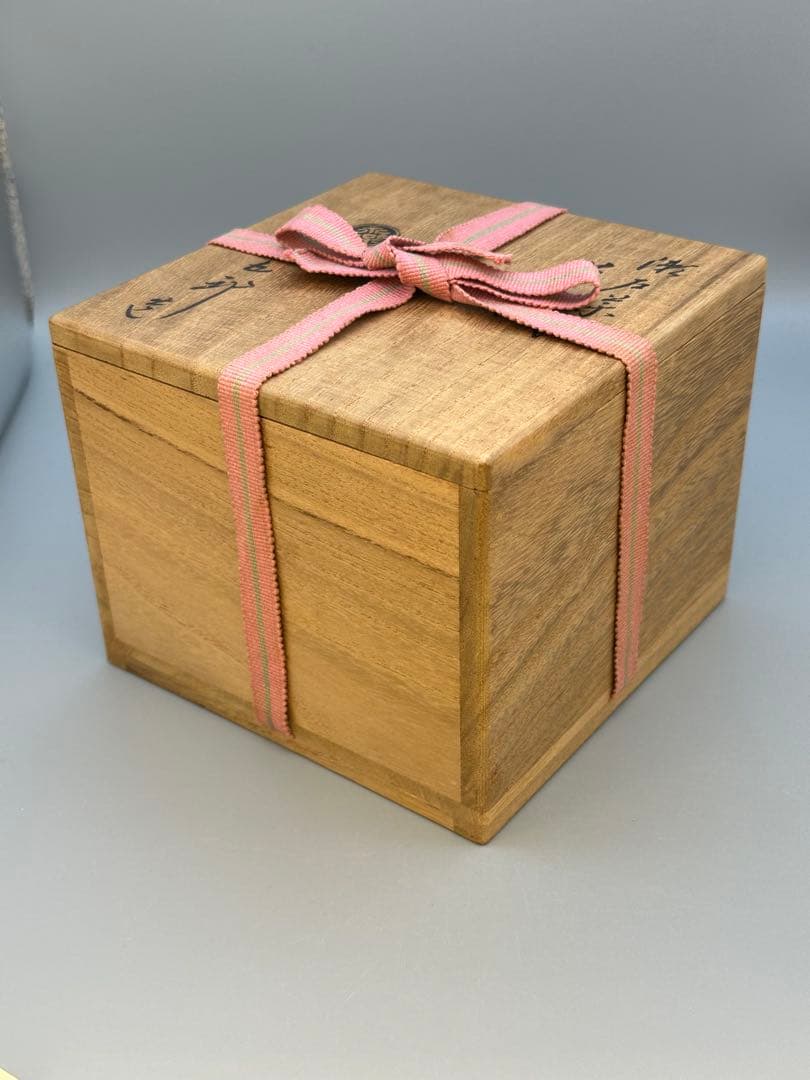
A Seto-glaze matcha bowl by Eiraku Zengoro — the hereditary ceramic master of the Senke Jisshoku, the Ten Designated Craftsmen of Japan's Sen family tea lineage. Amber iron glaze pours from rim to foot in vertical streaks, revealing the pale Kyoto stoneware body. Presented in its original paulownia tomobako signed in the master's own hand and stamped with the Eiraku 菊桐 chrysanthemum-paulownia seal. A Kyoto chawan, Eiraku kiln, Seto-gusuri amber glaze, Senke Jisshoku hereditary lineage, tea ceremony utensil, tomobako signed, chrysanthemum-paulownia seal, museum-grade Japanese tea ceramic.
🔹 [ BASIC DETAILS ]
• Artist: 永楽善五郎 Eiraku Zengoro — Senke Jisshoku hereditary ceramic master
• Style: 瀬戸釉 Seto-gusuri amber iron-glaze chawan
• Dimensions: Height approx. 8.2 cm / Diameter approx. 12.7 cm
• Box: Original paulownia tomobako, lid inscribed "瀬戸釉 茶碗 善五郎" in the master's hand, with the Eiraku 菊桐 chrysanthemum-paulownia seal in vermilion
• Origin: Kyoto — Eiraku kiln
• Condition: Excellent. No notable damage or staining. Clean, quiet, ready for use.
🔹 [ CULTURAL & ARTISTIC INSIGHT ]
The Eiraku family is one of the 千家十職 (Senke Jisshoku) — the Ten Designated Craftsman Houses that have served the three Sen family tea schools (Omotesenke, Urasenke, Mushakojisenke) for generations. Each house holds the hereditary monopoly on one specific craft essential to the tea ceremony: Raku for the tea bowl, Nakamura Sotetsu for lacquer, Nakagawa Joeki for metalwork, Komazawa Risai for woodwork — and among them, Eiraku Zengoro for ceramic tea utensils.
The Eiraku house is celebrated for four signature registers: 金襴手 kinrande gold-and-red overglaze porcelain, 交趾 Kochi lead-glazed wares in the Cochin tradition, 仁清写 Ninsei-utsushi faithful copies of Nonomura Ninsei, and — as here — 瀬戸釉 Seto-gusuri classical iron-amber glazes. The hereditary name 善五郎 passes from father to son, or to an adopted successor, across generations; the current is the seventeenth Zengoro.
The 菊桐 (chrysanthemum-paulownia) seal on the tomobako lid is no ordinary kiln mark. It derives from historical imperial and Toyotomi clan grants, and its use by the Eiraku house establishes a status almost without parallel among Kyoto craftsmen — a visible trace of court patronage carried forward into the modern era. When a Sen family tea master selects an Eiraku chawan for a significant gathering, the bowl is not a decoration of the tea but a direct participant in the Sen lineage itself.
The amber glaze here holds light the way honey holds it — inwardly, slowly, without surface.
🔹 [ DEEP-DIVE COMMENTARY ]
The Senke Jisshoku system was formally codified during the middle Edo period, when the Sen family tea schools consolidated the ten craft houses whose work the Sen tea masters endorsed and whose products could be used in the schools' tea gatherings. The distinction between a Senke Jisshoku craftsman and an ordinary Kyoto artisan is absolute. A Jisshoku house works within a closed relationship to the tea tradition: its productions are shaped by centuries of direct dialogue with the tea schools' iemoto, and its tools are understood not as objects of art in the modern Western sense but as instruments of a living ritual.
The Eiraku lineage's own origins reach back further still, to Nishimura Zengoro in the sixteenth century, a founder of the unglazed earthenware braziers (doburo) used in tea. Over generations the house expanded into glazed wares, and by the early nineteenth century — under the tenth and eleventh generations, with the patronage of the Kii Tokugawa lord — received the name Eiraku and the right to use the chrysanthemum-paulownia seal that marks this tomobako. That seal is not decoration; it is a genealogical document pressed in vermilion.
Seto-gusuri as a technique belongs to the thousand-year ceramic tradition of the Seto region of central Japan, where iron-rich local clays and glazes produced the warm amber and russet surfaces of Ko-Seto and Ki-Seto wares from the medieval period onward. The color depends on iron oxide dissolved in the glass matrix and on the kiln atmosphere during firing — here, a clean oxidation that brings the iron to a luminous honey tone rather than the darker reduction browns of stoneware. Eiraku's interpretation of Seto glaze, however, is not rustic Seto. It carries the refined hand of a Kyoto master: the body is a pale, tightly-worked stoneware-porcelain; the foot is cleanly cut; the glaze is poured, not dipped, so that vertical streaks fall in deliberate asymmetry from rim to foot, leaving the unglazed buff body visible below. It is Seto vocabulary read through Kyoto grammar.
An Eiraku chawan occupies a particular position in the tea ceremony. The utensil participates in a specific gathering, selected by the host to stand in relation to the hanging scroll, the flowers, the season, and the guests. But beneath that particular encounter runs a second, slower current: the four hundred years of Sen family aesthetic memory, carried forward by the Jisshoku houses as a single continuous practice. A Senke Jisshoku piece is therefore not a standalone object but a utensil of the lineage itself — a bowl in which the guest drinks not only tea but the continuity of a tradition.
In contemporary international collecting, Eiraku ware holds a household status within the category of Japanese tea ceramic. Market recognition is steady and serious, particularly for boxed and signed pieces carrying the chrysanthemum-paulownia seal. For a collector building an entry into the Senke Jisshoku tradition, a Seto-gusuri chawan by Eiraku Zengoro is among the essential points of access: the glaze is historically deep, the form is a working chawan of proper scale and weight, and the tomobako documents the authorship without ambiguity. It is the kind of piece through which a collection begins to speak the language of the lineage it belongs to.
🔹 [ 日本語解説 ]
永楽善五郎による瀬戸釉茶碗。千家十職のうち、千家の茶の湯に仕える作陶の家・永楽家の当代による一碗で、京焼の精緻な素地に、瀬戸釉特有の飴色の鉄釉が口縁から高台へと縦に流れ下り、下部には素地の温かな肌色がわずかに覗く。高さ約8.2cm、径約12.7cm。状態は極めて良好、目立つ傷や汚れは見られない。
共箱は桐製、蓋表には「瀬戸釉 茶碗 善五郎」と当代の肉筆で箱書きされ、永楽家を示す菊桐印が朱で捺されている。菊桐印は歴史的に朝廷・豊臣家からの下賜に由来する由緒ある印であり、京焼諸家の中でも永楽家の特別な地位を静かに物語る印である。
千家十職とは、表千家・裏千家・武者小路千家の三千家に仕え、それぞれが茶道具制作のひと領域を世襲で担ってきた十家の職家を指す。楽家が茶碗を、中村宗哲が塗物を、中川浄益が金物を、そして永楽善五郎が陶磁を担う。江戸期に制度として定着したこの仕組みの中で、永楽家は金襴手・交趾・仁清写・瀬戸釉といった各様式を千家の美意識と深く結びつけて展開してきた。
瀬戸釉は愛知県瀬戸地方に千年の伝統を持つ鉄釉の系譜であり、酸化焼成によって鉄分が飴色に発色する。永楽家の瀬戸釉は、素朴な瀬戸の語彙を京焼の精緻な手で読み直したもので、轆轤の挽き、高台の削り、釉の流しに、いずれも京の規範が通っている。茶席に据えられるとき、この一碗は単なる器ではなく、四百年にわたる千家の美の連続性そのものを客人の手に渡す器となる。
千家十職の茶碗を手許に迎えるということは、作家の個性を愛でる以上に、一つの系譜そのものを受けとるということに他ならない。
🔹 [ SHIPPING & PACKAGING ]
• Dispatch: Within 1-6 business days
• Carrier: Japan Post EMS / UPS (with tracking)
• Packaging: Carefully wrapped with protective materials
🔹 [ BASIC DETAILS ]
• Artist: 永楽善五郎 Eiraku Zengoro — Senke Jisshoku hereditary ceramic master
• Style: 瀬戸釉 Seto-gusuri amber iron-glaze chawan
• Dimensions: Height approx. 8.2 cm / Diameter approx. 12.7 cm
• Box: Original paulownia tomobako, lid inscribed "瀬戸釉 茶碗 善五郎" in the master's hand, with the Eiraku 菊桐 chrysanthemum-paulownia seal in vermilion
• Origin: Kyoto — Eiraku kiln
• Condition: Excellent. No notable damage or staining. Clean, quiet, ready for use.
🔹 [ CULTURAL & ARTISTIC INSIGHT ]
The Eiraku family is one of the 千家十職 (Senke Jisshoku) — the Ten Designated Craftsman Houses that have served the three Sen family tea schools (Omotesenke, Urasenke, Mushakojisenke) for generations. Each house holds the hereditary monopoly on one specific craft essential to the tea ceremony: Raku for the tea bowl, Nakamura Sotetsu for lacquer, Nakagawa Joeki for metalwork, Komazawa Risai for woodwork — and among them, Eiraku Zengoro for ceramic tea utensils.
The Eiraku house is celebrated for four signature registers: 金襴手 kinrande gold-and-red overglaze porcelain, 交趾 Kochi lead-glazed wares in the Cochin tradition, 仁清写 Ninsei-utsushi faithful copies of Nonomura Ninsei, and — as here — 瀬戸釉 Seto-gusuri classical iron-amber glazes. The hereditary name 善五郎 passes from father to son, or to an adopted successor, across generations; the current is the seventeenth Zengoro.
The 菊桐 (chrysanthemum-paulownia) seal on the tomobako lid is no ordinary kiln mark. It derives from historical imperial and Toyotomi clan grants, and its use by the Eiraku house establishes a status almost without parallel among Kyoto craftsmen — a visible trace of court patronage carried forward into the modern era. When a Sen family tea master selects an Eiraku chawan for a significant gathering, the bowl is not a decoration of the tea but a direct participant in the Sen lineage itself.
The amber glaze here holds light the way honey holds it — inwardly, slowly, without surface.
🔹 [ DEEP-DIVE COMMENTARY ]
The Senke Jisshoku system was formally codified during the middle Edo period, when the Sen family tea schools consolidated the ten craft houses whose work the Sen tea masters endorsed and whose products could be used in the schools' tea gatherings. The distinction between a Senke Jisshoku craftsman and an ordinary Kyoto artisan is absolute. A Jisshoku house works within a closed relationship to the tea tradition: its productions are shaped by centuries of direct dialogue with the tea schools' iemoto, and its tools are understood not as objects of art in the modern Western sense but as instruments of a living ritual.
The Eiraku lineage's own origins reach back further still, to Nishimura Zengoro in the sixteenth century, a founder of the unglazed earthenware braziers (doburo) used in tea. Over generations the house expanded into glazed wares, and by the early nineteenth century — under the tenth and eleventh generations, with the patronage of the Kii Tokugawa lord — received the name Eiraku and the right to use the chrysanthemum-paulownia seal that marks this tomobako. That seal is not decoration; it is a genealogical document pressed in vermilion.
Seto-gusuri as a technique belongs to the thousand-year ceramic tradition of the Seto region of central Japan, where iron-rich local clays and glazes produced the warm amber and russet surfaces of Ko-Seto and Ki-Seto wares from the medieval period onward. The color depends on iron oxide dissolved in the glass matrix and on the kiln atmosphere during firing — here, a clean oxidation that brings the iron to a luminous honey tone rather than the darker reduction browns of stoneware. Eiraku's interpretation of Seto glaze, however, is not rustic Seto. It carries the refined hand of a Kyoto master: the body is a pale, tightly-worked stoneware-porcelain; the foot is cleanly cut; the glaze is poured, not dipped, so that vertical streaks fall in deliberate asymmetry from rim to foot, leaving the unglazed buff body visible below. It is Seto vocabulary read through Kyoto grammar.
An Eiraku chawan occupies a particular position in the tea ceremony. The utensil participates in a specific gathering, selected by the host to stand in relation to the hanging scroll, the flowers, the season, and the guests. But beneath that particular encounter runs a second, slower current: the four hundred years of Sen family aesthetic memory, carried forward by the Jisshoku houses as a single continuous practice. A Senke Jisshoku piece is therefore not a standalone object but a utensil of the lineage itself — a bowl in which the guest drinks not only tea but the continuity of a tradition.
In contemporary international collecting, Eiraku ware holds a household status within the category of Japanese tea ceramic. Market recognition is steady and serious, particularly for boxed and signed pieces carrying the chrysanthemum-paulownia seal. For a collector building an entry into the Senke Jisshoku tradition, a Seto-gusuri chawan by Eiraku Zengoro is among the essential points of access: the glaze is historically deep, the form is a working chawan of proper scale and weight, and the tomobako documents the authorship without ambiguity. It is the kind of piece through which a collection begins to speak the language of the lineage it belongs to.
🔹 [ 日本語解説 ]
永楽善五郎による瀬戸釉茶碗。千家十職のうち、千家の茶の湯に仕える作陶の家・永楽家の当代による一碗で、京焼の精緻な素地に、瀬戸釉特有の飴色の鉄釉が口縁から高台へと縦に流れ下り、下部には素地の温かな肌色がわずかに覗く。高さ約8.2cm、径約12.7cm。状態は極めて良好、目立つ傷や汚れは見られない。
共箱は桐製、蓋表には「瀬戸釉 茶碗 善五郎」と当代の肉筆で箱書きされ、永楽家を示す菊桐印が朱で捺されている。菊桐印は歴史的に朝廷・豊臣家からの下賜に由来する由緒ある印であり、京焼諸家の中でも永楽家の特別な地位を静かに物語る印である。
千家十職とは、表千家・裏千家・武者小路千家の三千家に仕え、それぞれが茶道具制作のひと領域を世襲で担ってきた十家の職家を指す。楽家が茶碗を、中村宗哲が塗物を、中川浄益が金物を、そして永楽善五郎が陶磁を担う。江戸期に制度として定着したこの仕組みの中で、永楽家は金襴手・交趾・仁清写・瀬戸釉といった各様式を千家の美意識と深く結びつけて展開してきた。
瀬戸釉は愛知県瀬戸地方に千年の伝統を持つ鉄釉の系譜であり、酸化焼成によって鉄分が飴色に発色する。永楽家の瀬戸釉は、素朴な瀬戸の語彙を京焼の精緻な手で読み直したもので、轆轤の挽き、高台の削り、釉の流しに、いずれも京の規範が通っている。茶席に据えられるとき、この一碗は単なる器ではなく、四百年にわたる千家の美の連続性そのものを客人の手に渡す器となる。
千家十職の茶碗を手許に迎えるということは、作家の個性を愛でる以上に、一つの系譜そのものを受けとるということに他ならない。
🔹 [ SHIPPING & PACKAGING ]
• Dispatch: Within 1-6 business days
• Carrier: Japan Post EMS / UPS (with tracking)
• Packaging: Carefully wrapped with protective materials
Quantity
Couldn't load pickup availability
Out of stock
View full details