1
/
of
12
Sakura Maki-e Lacquer Kogo Incense Box by Asano Shisen, Yamazaki Kiln Arashiyama — Tomobako
Sakura Maki-e Lacquer Kogo Incense Box by Asano Shisen, Yamazaki Kiln Arashiyama — Tomobako
Regular price
Dhs. 1,641.00 AED
Regular price
Sale price
Dhs. 1,641.00 AED
Taxes included.
Shipping calculated at checkout.
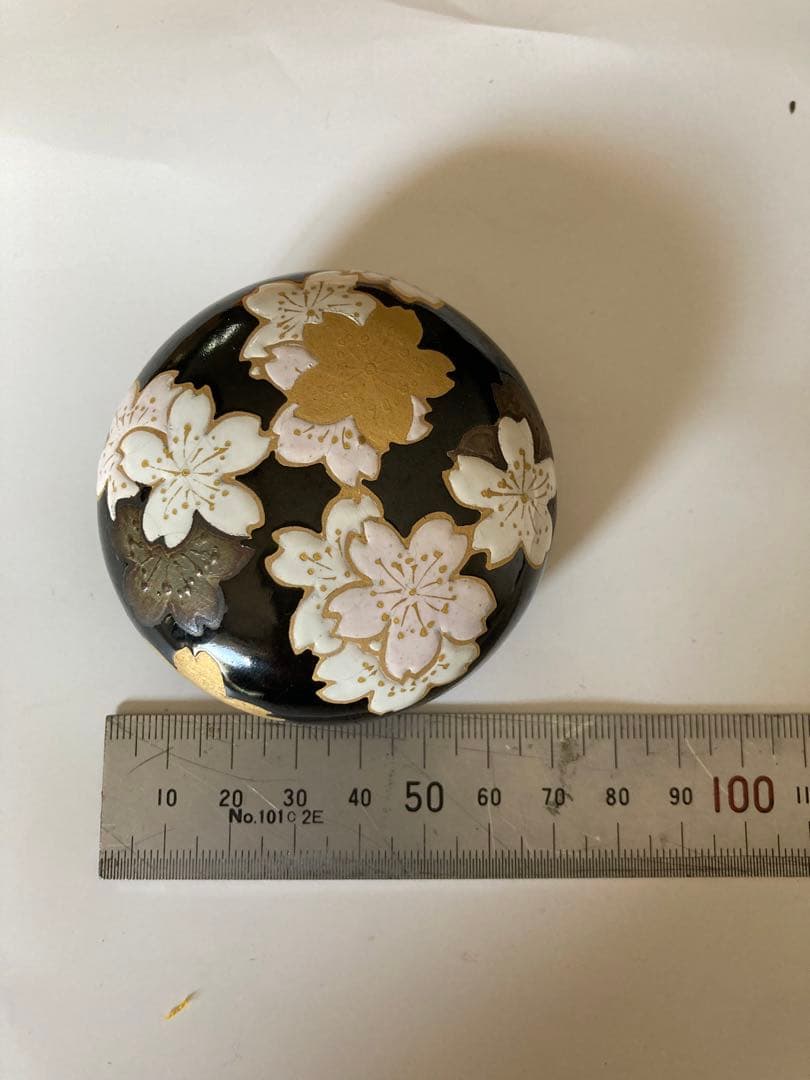
Experience Authentic Japan Art with this Japanese Lacquer Incense Box. This Sakura Maki-e Kogo serves as a Japanese Tea Ceremony Utensil and Incense Container, featuring Arashiyama Lacquerware and Gold Maki-e Decoration—a must-have for any Art Collector. This Kogo Incense Box with Original Box represents the finest of Japanese Lacquer Art, and stands as a defining example of Traditional Maki-e Lacquerware from the celebrated Yamazaki Kiln.
🔹 [ BASIC DETAILS ]
• Artist: Asano Shisen (浅野紫仙), maki-e lacquer artist of the Yamazaki Kiln, Arashiyama, Kyoto
• Technique: Polychrome maki-e on black urushi lacquer — gold, white, and blush-pink cherry blossom (sakura) motif; bokashi (gradation) petal blending; raised gold stamens
• Era: Before 2007 (estimated mid–late Showa, 20th century)
• Origin: Arashiyama, Kyoto, Japan — Yamazaki Kiln (山崎窯)
• Form: Flat oval kogo (incense container); low dome lid, seamless lacquer join
• Dimensions: Height approx. 4 cm, Diameter approx. 9 cm
• Box: Tomobako (original signed wooden box) inscribed "嵐山 山崎窯"
• Condition: Excellent — deep mirror lacquer surface intact, no chips, crazing, or loss; maki-e bright and crisp throughout
🔹 [ CULTURAL & ARTISTIC INSIGHT ]
In the compressed universe of a kogo, the entire Japanese relationship to time, season, and impermanence can be held. Asano Shisen's Arashiyama kogo does not announce itself. The lid opens slowly, as a morning in early April does — the first touch of cherry petals on black water.
Arashiyama, in western Kyoto, has for centuries been synonymous with the spectacle of sakura along the Oi River. Yamazaki Kiln occupied a position within that cultural geography not as tourist souvenir maker, but as craft atelier: producing lacquerware for the chanoyu (tea ceremony) world where every object must earn its silence. Maki-e — the art of sprinkling gold and silver powders into wet lacquer — is among the most demanding of Japanese decorative arts. On this piece, Shisen deploys three registers of color simultaneously: a fully gilded bloom in the foreground, open-petaled white flowers with gold stamens, and softer blush-pink blossoms at the periphery, each boundary softened through bokashi gradation so that the petals seem to breathe against the black ground rather than to sit upon it.
A kogo holds the incense used in chaji (formal tea gathering). The host selects both the incense and the container with the same intentionality as the bowl. The fragrance rises once; the object endures. This pairing of the transient and the lasting — the scent that dissipates and the lacquer that deepens over decades — is one of the most concise enactments of mono no aware in the tea room.
POETIC LINE: "Scattered petals on black water — the scent has already left, but the blossom remains."
🔹 [ DEEP-DIVE COMMENTARY ]
Maki-e is classified within urushi lacquer arts as a surface decoration technique in which metallic powders (gold, silver, platinum, or alloys) are applied to a wet lacquer ground using a fine brush or bamboo tube, then sealed beneath additional transparent lacquer coats. The technique emerged in the Heian period (794–1185) and reached its apotheosis during the Momoyama and Edo periods, when daimyo and shogunal patronage drove extraordinary technical elaboration. Three principal sub-techniques exist: hira maki-e (flat, single-layer), taka maki-e (raised relief built up with charcoal or lacquer paste), and togidashi maki-e (inlaid and polished flush). Shisen's work on this kogo employs hira maki-e with fine gold dust application and careful bokashi blending — a demanding approach that requires precise control of lacquer viscosity and drying time in climate-controlled conditions.
The Yamazaki Kiln (山崎窯) of Arashiyama maintained a strong connection to the Kyoto tea ceremony supply chain throughout the late Showa and Heisei periods. Its lacquerware production, distinct from the ceramics associations the word "kiln" might suggest, was rooted in the broader Kyoto urushi tradition — a tradition inseparable from the Omotesenke, Urasenke, and Mushanokoji Senke schools that have defined chanoyu practice for four centuries. Kogo produced for this market were not decorative objects in the Western sense; they were functional within a ritual where the choice of incense, its container, and even the moment of its opening were choreographed elements of hospitality.
For the collector, the significance of the tomobako (original artist-signed wooden box) cannot be overstated. In the Japanese antique and craft market, a signed tomobako functions as provenance documentation, artist attribution, and authentication simultaneously. It transforms a beautiful object into a traceable art work. Shisen's inscription "嵐山 山崎窯" on the box lid locates the work precisely within both geographic and artistic context — Arashiyama as place of origin, Yamazaki Kiln as atelier affiliation.
Kogo of this quality — polychrome maki-e, with tomobako, in excellent condition — occupy a specific position in the tea utensil collecting spectrum: accessible enough for the serious beginner, refined enough for the advanced collector. The sakura motif is universally associated with spring chaji and with the aesthetic principle of mono no aware (the pathos of passing things), making this piece appropriate for tea gatherings from late winter through late spring while functioning year-round as a display object of sustained visual resonance. The deep black lacquer ground will continue to develop patina with age and careful handling, deepening the contrast with the gold decoration over time.
[ JAPANESE DESCRIPTION / 日本語解説 ]
🔹 【基本情報】
・作家:浅野紫仙(山崎窯専属蒔絵師)
・技法:黒漆地に金・白・桃色の桜花蒔絵。ぼかし技法による花びらの濃淡表現、金による蕊の描写。
・年代:昭和後期〜平成初期(推定)
・産地:京都・嵐山 山崎窯
・形状:平円形蓋物(香合)、低いドーム状蓋、漆の継ぎ目なし
・寸法:高さ約4cm、径約9cm
・箱:共箱(蓋裏に「嵐山 山崎窯」の墨書あり)
・状態:良好——鏡面漆地に欠け・貫入なし、蒔絵の剥落もなく鮮明
🔹 【文化・美術的解説】
香合という器は、茶室という小宇宙の中で、もっとも静かに存在する道具のひとつである。炭点前においてのみ開かれ、一度香気を放てば、以後は沈黙する。浅野紫仙の嵐山香合は、その沈黙の中に春の風景を封じ込めている。
嵐山は古来、大堰川沿いの桜で知られる。山崎窯はその地にあって、観光土産ではなく、茶の湯の世界に向けた漆芸を制作してきた。蒔絵は、湿った漆の上に金銀粉を蒔いて定着させる、日本固有の加飾技術である。本作において、紫仙は三つの色調を同時に操る——前景の金一色の大輪、白地に金の蕊を持つ花、そして縁に漂う淡い桃色の花びら。それぞれの境界はぼかしによって溶け、花が黒地に「乗っている」のではなく「浮かんでいる」ように見える。
香合は、茶事において炭手前の折に開かれる。亭主はその香の種類と器を、茶碗と同じ配慮で選ぶ。香は一度立ちのぼって消える。器は残る。この、はかなきものと久しきものの並存こそ、茶室における「もの哀れ」のもっとも端的な体現である。
詩的な一文:「黒い水に花びらが散る——香はもう去ったが、花はまだここにある。」
🔹 【蒔絵と山崎窯について】
蒔絵は平安時代に端を発し、桃山・江戸期に武家の庇護のもと技術的絶頂を迎えた。主な技法には、平蒔絵・高蒔絵・研出蒔絵があり、本作は平蒔絵にぼかしを組み合わせた形式を採用している。金粉の粒度と漆の粘度、乾燥温度を厳密に管理しながら施す工程は、熟練した職人の感覚と経験に完全に依存する。
山崎窯(嵐山)は、昭和後期から平成にかけて京都の茶道具供給圏において一定の位置を占めた蒔絵漆器の工房である。その作域は、表千家・裏千家・武者小路千家といった家元文化を支える道具制作に根ざしており、観賞用よりも「使われる道具」としての完成度に重きを置いてきた。
共箱の意義は、蒐集の文脈においてきわめて大きい。作家銘の墨書が入った共箱は、来歴・作家帰属・真贋判断の根拠を同時に提供する。本作の蓋裏「嵐山 山崎窯」の記銘は、地理的文脈と工房帰属を明示するものとして機能する。
この品質の香合——多色蒔絵・共箱完備・保存状態良好——は、茶道具蒐集において間口の広い器として機能する。桜花文は晩冬から晩春の茶事に最もふさわしいが、通年の飾り物としても、深みのある視覚的余韻をたたえる。使い込まれるほどに漆は経年の艶を増し、金蒔絵との対比を深めていく。
🔹 [ SHIPPING & PACKAGING ]
• Dispatch: Within 1-6 business days
• Carrier: Japan Post EMS / UPS (with tracking)
• Packaging: Carefully wrapped with protective materials
🔹 [ BASIC DETAILS ]
• Artist: Asano Shisen (浅野紫仙), maki-e lacquer artist of the Yamazaki Kiln, Arashiyama, Kyoto
• Technique: Polychrome maki-e on black urushi lacquer — gold, white, and blush-pink cherry blossom (sakura) motif; bokashi (gradation) petal blending; raised gold stamens
• Era: Before 2007 (estimated mid–late Showa, 20th century)
• Origin: Arashiyama, Kyoto, Japan — Yamazaki Kiln (山崎窯)
• Form: Flat oval kogo (incense container); low dome lid, seamless lacquer join
• Dimensions: Height approx. 4 cm, Diameter approx. 9 cm
• Box: Tomobako (original signed wooden box) inscribed "嵐山 山崎窯"
• Condition: Excellent — deep mirror lacquer surface intact, no chips, crazing, or loss; maki-e bright and crisp throughout
🔹 [ CULTURAL & ARTISTIC INSIGHT ]
In the compressed universe of a kogo, the entire Japanese relationship to time, season, and impermanence can be held. Asano Shisen's Arashiyama kogo does not announce itself. The lid opens slowly, as a morning in early April does — the first touch of cherry petals on black water.
Arashiyama, in western Kyoto, has for centuries been synonymous with the spectacle of sakura along the Oi River. Yamazaki Kiln occupied a position within that cultural geography not as tourist souvenir maker, but as craft atelier: producing lacquerware for the chanoyu (tea ceremony) world where every object must earn its silence. Maki-e — the art of sprinkling gold and silver powders into wet lacquer — is among the most demanding of Japanese decorative arts. On this piece, Shisen deploys three registers of color simultaneously: a fully gilded bloom in the foreground, open-petaled white flowers with gold stamens, and softer blush-pink blossoms at the periphery, each boundary softened through bokashi gradation so that the petals seem to breathe against the black ground rather than to sit upon it.
A kogo holds the incense used in chaji (formal tea gathering). The host selects both the incense and the container with the same intentionality as the bowl. The fragrance rises once; the object endures. This pairing of the transient and the lasting — the scent that dissipates and the lacquer that deepens over decades — is one of the most concise enactments of mono no aware in the tea room.
POETIC LINE: "Scattered petals on black water — the scent has already left, but the blossom remains."
🔹 [ DEEP-DIVE COMMENTARY ]
Maki-e is classified within urushi lacquer arts as a surface decoration technique in which metallic powders (gold, silver, platinum, or alloys) are applied to a wet lacquer ground using a fine brush or bamboo tube, then sealed beneath additional transparent lacquer coats. The technique emerged in the Heian period (794–1185) and reached its apotheosis during the Momoyama and Edo periods, when daimyo and shogunal patronage drove extraordinary technical elaboration. Three principal sub-techniques exist: hira maki-e (flat, single-layer), taka maki-e (raised relief built up with charcoal or lacquer paste), and togidashi maki-e (inlaid and polished flush). Shisen's work on this kogo employs hira maki-e with fine gold dust application and careful bokashi blending — a demanding approach that requires precise control of lacquer viscosity and drying time in climate-controlled conditions.
The Yamazaki Kiln (山崎窯) of Arashiyama maintained a strong connection to the Kyoto tea ceremony supply chain throughout the late Showa and Heisei periods. Its lacquerware production, distinct from the ceramics associations the word "kiln" might suggest, was rooted in the broader Kyoto urushi tradition — a tradition inseparable from the Omotesenke, Urasenke, and Mushanokoji Senke schools that have defined chanoyu practice for four centuries. Kogo produced for this market were not decorative objects in the Western sense; they were functional within a ritual where the choice of incense, its container, and even the moment of its opening were choreographed elements of hospitality.
For the collector, the significance of the tomobako (original artist-signed wooden box) cannot be overstated. In the Japanese antique and craft market, a signed tomobako functions as provenance documentation, artist attribution, and authentication simultaneously. It transforms a beautiful object into a traceable art work. Shisen's inscription "嵐山 山崎窯" on the box lid locates the work precisely within both geographic and artistic context — Arashiyama as place of origin, Yamazaki Kiln as atelier affiliation.
Kogo of this quality — polychrome maki-e, with tomobako, in excellent condition — occupy a specific position in the tea utensil collecting spectrum: accessible enough for the serious beginner, refined enough for the advanced collector. The sakura motif is universally associated with spring chaji and with the aesthetic principle of mono no aware (the pathos of passing things), making this piece appropriate for tea gatherings from late winter through late spring while functioning year-round as a display object of sustained visual resonance. The deep black lacquer ground will continue to develop patina with age and careful handling, deepening the contrast with the gold decoration over time.
[ JAPANESE DESCRIPTION / 日本語解説 ]
🔹 【基本情報】
・作家:浅野紫仙(山崎窯専属蒔絵師)
・技法:黒漆地に金・白・桃色の桜花蒔絵。ぼかし技法による花びらの濃淡表現、金による蕊の描写。
・年代:昭和後期〜平成初期(推定)
・産地:京都・嵐山 山崎窯
・形状:平円形蓋物(香合)、低いドーム状蓋、漆の継ぎ目なし
・寸法:高さ約4cm、径約9cm
・箱:共箱(蓋裏に「嵐山 山崎窯」の墨書あり)
・状態:良好——鏡面漆地に欠け・貫入なし、蒔絵の剥落もなく鮮明
🔹 【文化・美術的解説】
香合という器は、茶室という小宇宙の中で、もっとも静かに存在する道具のひとつである。炭点前においてのみ開かれ、一度香気を放てば、以後は沈黙する。浅野紫仙の嵐山香合は、その沈黙の中に春の風景を封じ込めている。
嵐山は古来、大堰川沿いの桜で知られる。山崎窯はその地にあって、観光土産ではなく、茶の湯の世界に向けた漆芸を制作してきた。蒔絵は、湿った漆の上に金銀粉を蒔いて定着させる、日本固有の加飾技術である。本作において、紫仙は三つの色調を同時に操る——前景の金一色の大輪、白地に金の蕊を持つ花、そして縁に漂う淡い桃色の花びら。それぞれの境界はぼかしによって溶け、花が黒地に「乗っている」のではなく「浮かんでいる」ように見える。
香合は、茶事において炭手前の折に開かれる。亭主はその香の種類と器を、茶碗と同じ配慮で選ぶ。香は一度立ちのぼって消える。器は残る。この、はかなきものと久しきものの並存こそ、茶室における「もの哀れ」のもっとも端的な体現である。
詩的な一文:「黒い水に花びらが散る——香はもう去ったが、花はまだここにある。」
🔹 【蒔絵と山崎窯について】
蒔絵は平安時代に端を発し、桃山・江戸期に武家の庇護のもと技術的絶頂を迎えた。主な技法には、平蒔絵・高蒔絵・研出蒔絵があり、本作は平蒔絵にぼかしを組み合わせた形式を採用している。金粉の粒度と漆の粘度、乾燥温度を厳密に管理しながら施す工程は、熟練した職人の感覚と経験に完全に依存する。
山崎窯(嵐山)は、昭和後期から平成にかけて京都の茶道具供給圏において一定の位置を占めた蒔絵漆器の工房である。その作域は、表千家・裏千家・武者小路千家といった家元文化を支える道具制作に根ざしており、観賞用よりも「使われる道具」としての完成度に重きを置いてきた。
共箱の意義は、蒐集の文脈においてきわめて大きい。作家銘の墨書が入った共箱は、来歴・作家帰属・真贋判断の根拠を同時に提供する。本作の蓋裏「嵐山 山崎窯」の記銘は、地理的文脈と工房帰属を明示するものとして機能する。
この品質の香合——多色蒔絵・共箱完備・保存状態良好——は、茶道具蒐集において間口の広い器として機能する。桜花文は晩冬から晩春の茶事に最もふさわしいが、通年の飾り物としても、深みのある視覚的余韻をたたえる。使い込まれるほどに漆は経年の艶を増し、金蒔絵との対比を深めていく。
🔹 [ SHIPPING & PACKAGING ]
• Dispatch: Within 1-6 business days
• Carrier: Japan Post EMS / UPS (with tracking)
• Packaging: Carefully wrapped with protective materials
Quantity
Couldn't load pickup availability
Low stock: 1 left
View full details