1
/
of
19
Okutsu Isshinshi Firefly Maki-e Raden Natsume — Night Scene
Regular price
Dhs. 1,256.00 AED
Regular price
Sale price
Dhs. 1,256.00 AED
Taxes included.
Shipping calculated at checkout.
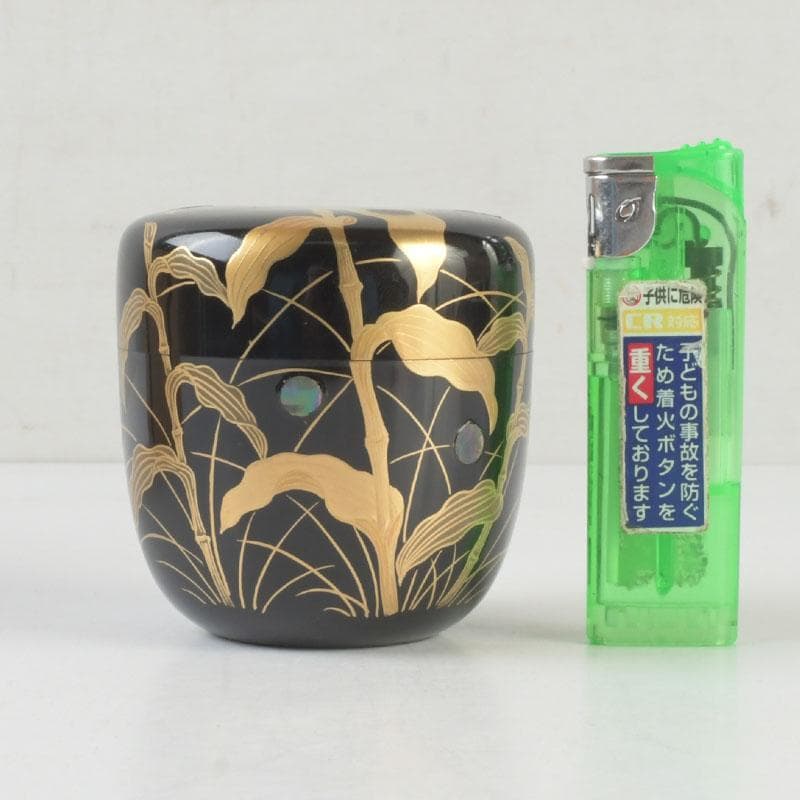
Okutsu Isshinshi combines gold maki-e and mother-of-pearl raden inlay to render a night scene of fireflies among vines — a subject that asks the eye to slow down and locate the light. Against deep black urushi, the iridescent raden fragments glow with the quality of actual bioluminescence. The cultural weight of this piece is carried not by scale but by the precision of its restraint.
🔹 [ BASIC DETAILS ]
• Artist: Okutsu Isshinshi
• Form: Natsume (tea caddy)
• Dimensions: Height approx. 6.5 cm, Width approx. 6.7 cm, Weight approx. 49 g
• Condition: No damage noted
• Box: Tomobako with artist's red seal
• Technique: Gold maki-e with mother-of-pearl (raden) inlay
• Motif: Hotaru (fireflies) among vines and leaves
🔹 [ CULTURAL INSIGHT ]
Fireflies have been a subject of Japanese poetry and visual art since the Heian period. In the chanoyu context, a hotaru motif signals summer — specific, seasonal, and emotionally precise. The use of raden to suggest the firefly's glow is not merely decorative ingenuity; it is a material decision grounded in the tradition of allowing medium and subject to become the same statement.
Raden — the technique of embedding thin mother-of-pearl shell into lacquer — originates in Tang dynasty China and was refined through centuries of Japanese craft. Its iridescence under shifting light makes it the logical material for anything that is meant to appear luminous.
🔹 [ DEEP-DIVE ]
What distinguishes this natsume is the combination of techniques in disciplined service of a single image. Gold maki-e establishes the botanical structure — the vine, the leaves, the botanical continuity of the natural world at dusk. Raden interrupts that continuity with light, the way a firefly actually does. The result is not decorative complexity; it is image construction at the level where craft becomes authorship.
Okutsu Isshinshi's tomobako bears a red seal — a mark of personal certification that ties object to maker with the directness Japanese craft documentation demands.
🔹 [ 日本語解説 ]
奥津一心斎作・螺鈿装飾蛍蒔絵棗。黒漆地に金蒔絵で蔓草(烏瓜・朝顔系)を描き、螺鈿で蛍の光を表現した複合技法による棗です。蒔絵の金と螺鈿の虹色光沢が夏の夜景を静かに現出させています。高さ約6.5cm、幅約6.7cm、重量約49g。傷なし。作者の朱印入り共箱付き。
🔹 [ SHIPPING & PACKAGING ]
• Dispatch: Within 1-6 business days
• Carrier: Japan Post EMS / UPS (with tracking)
• Packaging: Carefully wrapped with protective materials
🔹 [ BASIC DETAILS ]
• Artist: Okutsu Isshinshi
• Form: Natsume (tea caddy)
• Dimensions: Height approx. 6.5 cm, Width approx. 6.7 cm, Weight approx. 49 g
• Condition: No damage noted
• Box: Tomobako with artist's red seal
• Technique: Gold maki-e with mother-of-pearl (raden) inlay
• Motif: Hotaru (fireflies) among vines and leaves
🔹 [ CULTURAL INSIGHT ]
Fireflies have been a subject of Japanese poetry and visual art since the Heian period. In the chanoyu context, a hotaru motif signals summer — specific, seasonal, and emotionally precise. The use of raden to suggest the firefly's glow is not merely decorative ingenuity; it is a material decision grounded in the tradition of allowing medium and subject to become the same statement.
Raden — the technique of embedding thin mother-of-pearl shell into lacquer — originates in Tang dynasty China and was refined through centuries of Japanese craft. Its iridescence under shifting light makes it the logical material for anything that is meant to appear luminous.
🔹 [ DEEP-DIVE ]
What distinguishes this natsume is the combination of techniques in disciplined service of a single image. Gold maki-e establishes the botanical structure — the vine, the leaves, the botanical continuity of the natural world at dusk. Raden interrupts that continuity with light, the way a firefly actually does. The result is not decorative complexity; it is image construction at the level where craft becomes authorship.
Okutsu Isshinshi's tomobako bears a red seal — a mark of personal certification that ties object to maker with the directness Japanese craft documentation demands.
🔹 [ 日本語解説 ]
奥津一心斎作・螺鈿装飾蛍蒔絵棗。黒漆地に金蒔絵で蔓草(烏瓜・朝顔系)を描き、螺鈿で蛍の光を表現した複合技法による棗です。蒔絵の金と螺鈿の虹色光沢が夏の夜景を静かに現出させています。高さ約6.5cm、幅約6.7cm、重量約49g。傷なし。作者の朱印入り共箱付き。
🔹 [ SHIPPING & PACKAGING ]
• Dispatch: Within 1-6 business days
• Carrier: Japan Post EMS / UPS (with tracking)
• Packaging: Carefully wrapped with protective materials
Quantity
Couldn't load pickup availability
Out of stock
View full details