1
/
of
10
Ohi-Yaki Matcha Tea Bowl by Iwamura Yoshio — Ame-Yu Glaze, Signed Tomobako, Kanazawa Lineage
Ohi-Yaki Matcha Tea Bowl by Iwamura Yoshio — Ame-Yu Glaze, Signed Tomobako, Kanazawa Lineage
Regular price
Dhs. 1,082.00 AED
Regular price
Sale price
Dhs. 1,082.00 AED
Taxes included.
Shipping calculated at checkout.
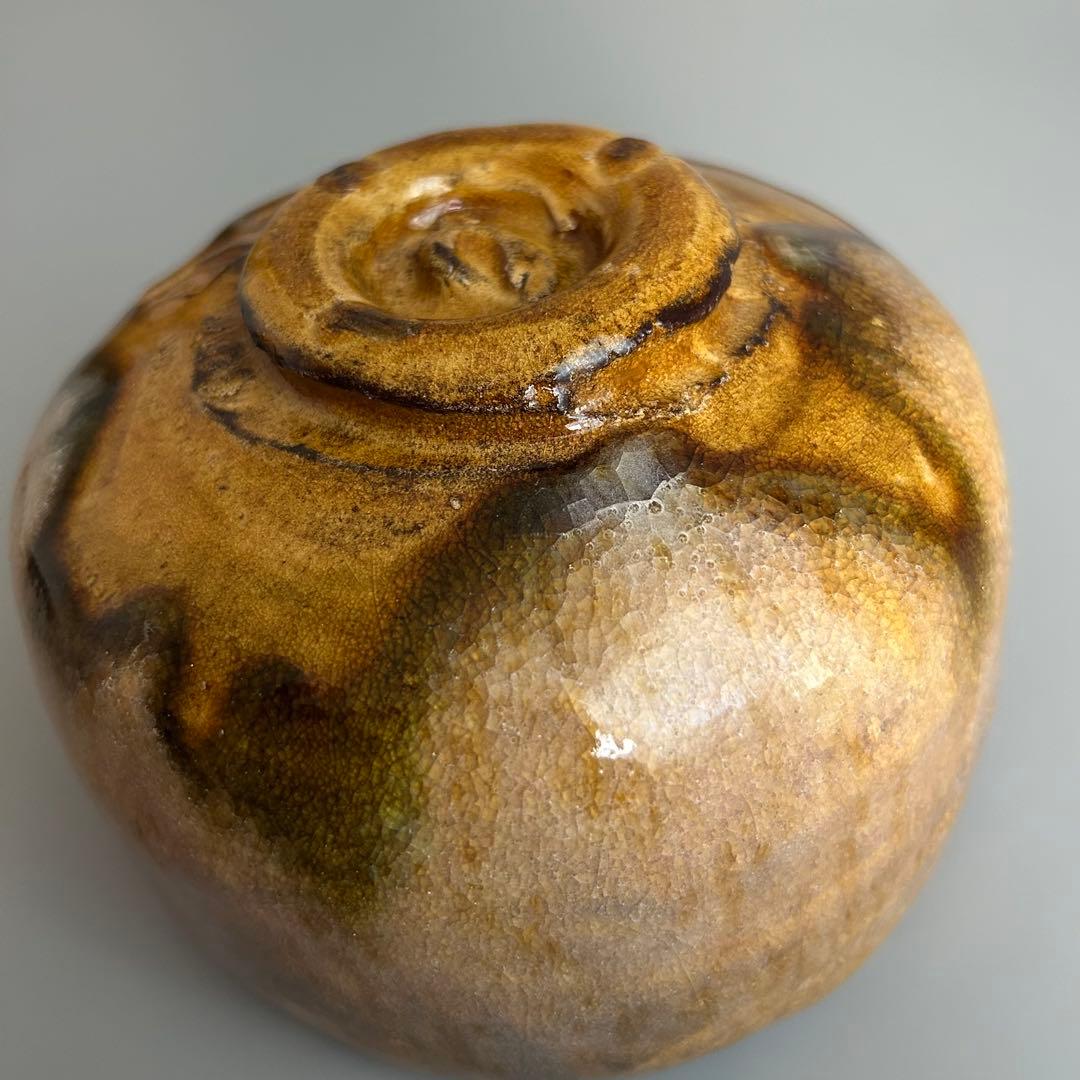
Experience Authentic Japan Art with this Ohi-Yaki Matcha Tea Bowl — a hand-shaped chawan glazed in the amber ame-yu tradition of Kanazawa's most enduring ceramic lineage. This Japanese Tea Bowl by Iwamura Yoshio carries the quiet authority of the Ohi school: an Ame Glaze Chawan whose honey-brown surface shifts through ochre, deep amber, and faint olive shadow depending on the angle of light. The form is a Handmade Ceramic Bowl shaped without a wheel, walls rising with deliberate unevenness, the rim following its own path. A Wabi Sabi Tea Bowl in the truest sense — not as aesthetic affectation, but as a description of how the material was allowed to arrive. Offered complete with original tomobako, shiori, and yellow cloth, this is a Tea Ceremony Bowl for practitioners and collectors who understand that a bowl held in both hands is already a form of attention.
🔹 [ BASIC DETAILS ]
• Artist: Iwamura Yoshio (岩村与詩夫)
• Technique: Ame-yu glaze, hand-shaped forming, Ohi-yaki tradition
• Origin: Kanazawa, Ishikawa Prefecture, Japan
• Dimensions: Diameter approx. 12 cm, Height approx. 9 cm
• Box: Original tomobako (artist-signed wooden box) with shiori (identification card) and yellow cloth
• Condition: Excellent — no chips, cracks, or restoration
🔹 [ CULTURAL & ARTISTIC INSIGHT ]
Ohi-yaki was established in the mid-seventeenth century in Kanazawa, when the Urasenke tea master Senso Soshitsu — visiting the domain of Lord Maeda — guided a local artisan named Chozaemon to produce tea bowls suited to the meditative pace of the Omotesenke and Urasenke traditions. From that single commission, the Ohi kiln became one of the few hereditary ceramic lineages in Japan, with successive generations bearing the name Ohi Chozaemon and maintaining the same low-fire technique, the same lead-free ame-yu amber glaze, and the same hand-shaping method that forbids the wheel.
Iwamura Yoshio works within the orbit of this tradition as a contemporary Ohi-school potter — not a hereditary successor to the Ohi family name, but an artist trained in the Ohi aesthetic who carries its sensibility into his own hand. This is a distinction that matters: where the Ohi family line produces bowls of near-ritual standardization, an affiliated contemporary artisan brings individual interpretation to the same formal vocabulary. The result is a bowl that reads unmistakably as Ohi-yaki in color, weight, and spirit, while bearing the maker's own decision in every contour.
The ame-yu glaze — literally "candy glaze" or "rain glaze" depending on the reading — is the chromatic signature of this tradition. Its amber register is achieved through a low-temperature lead-silicate base that has been gradually reformulated over the centuries to remove lead, the warm honey color emerging instead from iron and mineral content in the local clay. On this bowl, the glaze has pooled slightly toward the lower walls, creating a depth of color that is darker near the foot and lighter toward the rim — a natural consequence of gravity during firing that no two bowls replicate in exactly the same pattern. The interior, seen from above, descends into a darker center, a visual well that concentrates the eye precisely where the whisked matcha will gather.
The form itself is tubular-tending, with a measured height relative to the mouth diameter that places it closer to the tall, contained shape preferred for winter temae — the bowl holds warmth, draws the hands inward, slows the encounter. The hand-modeled walls carry a faint undulation across the surface, not the regularity of thrown ware but the record of palms pressing outward from within. The foot is low and compact, keeping the center of gravity close to the mat. Nothing about this bowl reaches for effect. It simply stands, and waits.
Poetic note: The amber of this glaze is the color of late-afternoon light passing through old paper screens — a warmth that does not announce itself, that one notices only after the bowl has been in the hands for some time.
🔹 [ DEEP-DIVE COMMENTARY ]
The relationship between ame-yu and the tea bowl's interior experience is one the eye alone cannot fully assess. When matcha is prepared and poured into a bowl of this coloration, the green of the tea and the amber of the glaze produce a contrast that has been valued in the tea ceremony context for centuries — the green appears more saturated, more alive, against the warm earth of the bowl. This is not coincidental. The Ohi aesthetic was developed in direct conversation with the visual requirements of the temae, and the glaze color was selected, over generations of refinement, with exactly this interaction in mind.
The tomobako accompanying this bowl is an essential component of its provenance structure. In Japanese ceramic practice, the artist-signed wooden box is not packaging — it is the primary document of attribution. The box lid bears the artist's brushwork: typically the name of the piece, the kiln name, and the potter's seal or signature. The shiori (the paper or card slipped inside) adds a secondary layer of identification, sometimes including the firing date or a short characterization of the piece by the maker. Together, box and shiori constitute the provenance chain that Japanese collectors rely on when there is no formal certificate of authentication — a system that has proven remarkably durable over four centuries of studio ceramics.
The yellow cloth (ki-fukusa or similar wrapping textile) serves both protective and ceremonial functions. In the tea world, the color and material of the wrapping cloth can signal the season and occasion for which a piece is considered appropriate — yellow and golden tones are associated with autumn display and certain formal temae contexts. Whether Iwamura chose the yellow cloth consciously within this convention or as a visual complement to the ame-yu surface, the effect is coherent: the cloth, the glaze, and the wooden box form a unified object whose every component has been considered.
This bowl sits at the juncture of tradition and individual practice that characterizes the most interesting contemporary Japanese ceramics. It does not claim the dynastic authority of the Ohi family name, but it carries the aesthetic intelligence of someone who has studied what that name means — and has chosen to work from within rather than apart from it. For a collector building around the Kanazawa ceramic tradition, or for a practitioner seeking a bowl with genuine lineage and reliable Ohi character, this piece offers both without requiring the auction-house premiums that hereditary Ohi pieces now command.
🔹 [ 日本語解説 ]
本作は、大樋焼の美意識を受け継ぐ現代陶工・岩村与詩夫による抹茶茶碗です。大樋焼は、加賀藩前田家の庇護のもと、17世紀中頃に初代大樋長左衛門が裏千家の指導を受けて始めた低火度焼成の陶芸で、飴色の透明感ある釉薬と手捏ねによる温かみのある造形が特徴です。岩村与詩夫はその伝統に連なる作家として、大樋一門の様式を自らの手で再解釈した作品を制作しています。
本作の飴釉は、金褐色から深琥珀色へと変化するグラデーションが美しく、内側は底に向かって色が深まります。手捏ねの器壁にはわずかな歪みがあり、口縁は自然なゆらぎを見せます。冬の稽古に適した筒形に近い形状で、両手で包むように持つと、その重さと温かみが伝わります。共箱・栞・黄布付きで状態は良好です。茶道の稽古碗として、またコレクション用途としても申し分のない一碗です。
🔹 [ SHIPPING & PACKAGING ]
• Dispatch: Within 1-6 business days
• Carrier: Japan Post EMS / UPS (with tracking)
• Packaging: Carefully wrapped with protective materials
🔹 [ BASIC DETAILS ]
• Artist: Iwamura Yoshio (岩村与詩夫)
• Technique: Ame-yu glaze, hand-shaped forming, Ohi-yaki tradition
• Origin: Kanazawa, Ishikawa Prefecture, Japan
• Dimensions: Diameter approx. 12 cm, Height approx. 9 cm
• Box: Original tomobako (artist-signed wooden box) with shiori (identification card) and yellow cloth
• Condition: Excellent — no chips, cracks, or restoration
🔹 [ CULTURAL & ARTISTIC INSIGHT ]
Ohi-yaki was established in the mid-seventeenth century in Kanazawa, when the Urasenke tea master Senso Soshitsu — visiting the domain of Lord Maeda — guided a local artisan named Chozaemon to produce tea bowls suited to the meditative pace of the Omotesenke and Urasenke traditions. From that single commission, the Ohi kiln became one of the few hereditary ceramic lineages in Japan, with successive generations bearing the name Ohi Chozaemon and maintaining the same low-fire technique, the same lead-free ame-yu amber glaze, and the same hand-shaping method that forbids the wheel.
Iwamura Yoshio works within the orbit of this tradition as a contemporary Ohi-school potter — not a hereditary successor to the Ohi family name, but an artist trained in the Ohi aesthetic who carries its sensibility into his own hand. This is a distinction that matters: where the Ohi family line produces bowls of near-ritual standardization, an affiliated contemporary artisan brings individual interpretation to the same formal vocabulary. The result is a bowl that reads unmistakably as Ohi-yaki in color, weight, and spirit, while bearing the maker's own decision in every contour.
The ame-yu glaze — literally "candy glaze" or "rain glaze" depending on the reading — is the chromatic signature of this tradition. Its amber register is achieved through a low-temperature lead-silicate base that has been gradually reformulated over the centuries to remove lead, the warm honey color emerging instead from iron and mineral content in the local clay. On this bowl, the glaze has pooled slightly toward the lower walls, creating a depth of color that is darker near the foot and lighter toward the rim — a natural consequence of gravity during firing that no two bowls replicate in exactly the same pattern. The interior, seen from above, descends into a darker center, a visual well that concentrates the eye precisely where the whisked matcha will gather.
The form itself is tubular-tending, with a measured height relative to the mouth diameter that places it closer to the tall, contained shape preferred for winter temae — the bowl holds warmth, draws the hands inward, slows the encounter. The hand-modeled walls carry a faint undulation across the surface, not the regularity of thrown ware but the record of palms pressing outward from within. The foot is low and compact, keeping the center of gravity close to the mat. Nothing about this bowl reaches for effect. It simply stands, and waits.
Poetic note: The amber of this glaze is the color of late-afternoon light passing through old paper screens — a warmth that does not announce itself, that one notices only after the bowl has been in the hands for some time.
🔹 [ DEEP-DIVE COMMENTARY ]
The relationship between ame-yu and the tea bowl's interior experience is one the eye alone cannot fully assess. When matcha is prepared and poured into a bowl of this coloration, the green of the tea and the amber of the glaze produce a contrast that has been valued in the tea ceremony context for centuries — the green appears more saturated, more alive, against the warm earth of the bowl. This is not coincidental. The Ohi aesthetic was developed in direct conversation with the visual requirements of the temae, and the glaze color was selected, over generations of refinement, with exactly this interaction in mind.
The tomobako accompanying this bowl is an essential component of its provenance structure. In Japanese ceramic practice, the artist-signed wooden box is not packaging — it is the primary document of attribution. The box lid bears the artist's brushwork: typically the name of the piece, the kiln name, and the potter's seal or signature. The shiori (the paper or card slipped inside) adds a secondary layer of identification, sometimes including the firing date or a short characterization of the piece by the maker. Together, box and shiori constitute the provenance chain that Japanese collectors rely on when there is no formal certificate of authentication — a system that has proven remarkably durable over four centuries of studio ceramics.
The yellow cloth (ki-fukusa or similar wrapping textile) serves both protective and ceremonial functions. In the tea world, the color and material of the wrapping cloth can signal the season and occasion for which a piece is considered appropriate — yellow and golden tones are associated with autumn display and certain formal temae contexts. Whether Iwamura chose the yellow cloth consciously within this convention or as a visual complement to the ame-yu surface, the effect is coherent: the cloth, the glaze, and the wooden box form a unified object whose every component has been considered.
This bowl sits at the juncture of tradition and individual practice that characterizes the most interesting contemporary Japanese ceramics. It does not claim the dynastic authority of the Ohi family name, but it carries the aesthetic intelligence of someone who has studied what that name means — and has chosen to work from within rather than apart from it. For a collector building around the Kanazawa ceramic tradition, or for a practitioner seeking a bowl with genuine lineage and reliable Ohi character, this piece offers both without requiring the auction-house premiums that hereditary Ohi pieces now command.
🔹 [ 日本語解説 ]
本作は、大樋焼の美意識を受け継ぐ現代陶工・岩村与詩夫による抹茶茶碗です。大樋焼は、加賀藩前田家の庇護のもと、17世紀中頃に初代大樋長左衛門が裏千家の指導を受けて始めた低火度焼成の陶芸で、飴色の透明感ある釉薬と手捏ねによる温かみのある造形が特徴です。岩村与詩夫はその伝統に連なる作家として、大樋一門の様式を自らの手で再解釈した作品を制作しています。
本作の飴釉は、金褐色から深琥珀色へと変化するグラデーションが美しく、内側は底に向かって色が深まります。手捏ねの器壁にはわずかな歪みがあり、口縁は自然なゆらぎを見せます。冬の稽古に適した筒形に近い形状で、両手で包むように持つと、その重さと温かみが伝わります。共箱・栞・黄布付きで状態は良好です。茶道の稽古碗として、またコレクション用途としても申し分のない一碗です。
🔹 [ SHIPPING & PACKAGING ]
• Dispatch: Within 1-6 business days
• Carrier: Japan Post EMS / UPS (with tracking)
• Packaging: Carefully wrapped with protective materials
Quantity
Couldn't load pickup availability
Low stock: 1 left
View full details