1
/
of
15
Ohi-yaki Ame-yu Chawan by Ohi Toshiro, 10th-Gen Chozaemon — Order of Culture Recipient, Tomobako, Kanazawa Tea Bowl
Ohi-yaki Ame-yu Chawan by Ohi Toshiro, 10th-Gen Chozaemon — Order of Culture Recipient, Tomobako, Kanazawa Tea Bowl
Regular price
Dhs. 2,200.00 AED
Regular price
Sale price
Dhs. 2,200.00 AED
Taxes included.
Shipping calculated at checkout.
A matcha chawan in ame-yū (amber glaze) by Ōhi Toshirō (b.1927), the tenth-generation Ōhi Chōzaemon. The box bears his pre-succession signature "Toshirō" (年朗), placing the work before his accession to the family name in 1987 — a moment in the lineage when the maker was still signing in his own voice, before assuming the weight of the headship.
Toshirō was honoured as a Person of Cultural Merit (文化功労者) and received the Order of Culture (文化勲章) in 2011, alongside membership in the Japan Art Academy. These distinctions sit, in the Japanese honours system, on the same shelf as — and arguably above — Living National Treasure designation. They recognise not a single technique preserved, but a lifetime's contribution to the cultural fabric of the country.
— ŌHI-YAKI: A KAGA OFFSHOOT OF RAKU —
Ōhi-yaki begins in 1666. When Senshū Sōshitsu, the fourth iemoto of Urasenke, was invited to Kanazawa by the Maeda lord of Kaga, he brought with him a young potter named Chōzaemon, a student of the Raku household in Kyoto. Chōzaemon settled in the village of Ōhi, on the outskirts of the castle town, and began firing tea bowls there. The Ōhi line has continued in unbroken father-to-son succession in Kanazawa ever since — a Raku descended kiln transplanted into Kaga soil, shaping tea ware for the cultivated samurai court of the Maeda.
From that founding moment, Ōhi developed a signature glaze that distinguished it from its Kyoto parent: ame-yū, the amber glaze. A lower-temperature, lead-rich formulation, ame-yū fires to a warm honey tone — sometimes pale and translucent at the rim, deepening into burnt amber and almost black where it pools. It is not a glaze that performs. It glows quietly, the way old lacquer glows; the way tea, held in the bowl on a winter morning, glows.
— THE BOWL —
Hand-formed and tezukune-shaped in the Raku manner, with the soft asymmetry that comes only from the palm rather than the wheel. The mouth is gently irregular — an oval rather than a circle, the lip rising and falling as the hand released it. Walls thicken toward the foot and lift into a small, deliberate kōdai.
The glaze is the heart of the piece. At the rim, the ame runs thin and translucent, catching light as honey-amber. Lower on the body, where it has pooled and overlapped, it deepens into a smoky bronze, almost iron-black in places — a depth that reveals itself slowly as the bowl is turned in the hand. The interior is a darker amber pool, mottled and quietly alive, with the kind of surface tea practitioners describe as "reading the bowl" — the matcha will sit on this glaze beautifully, the green against the amber a study in contrast.
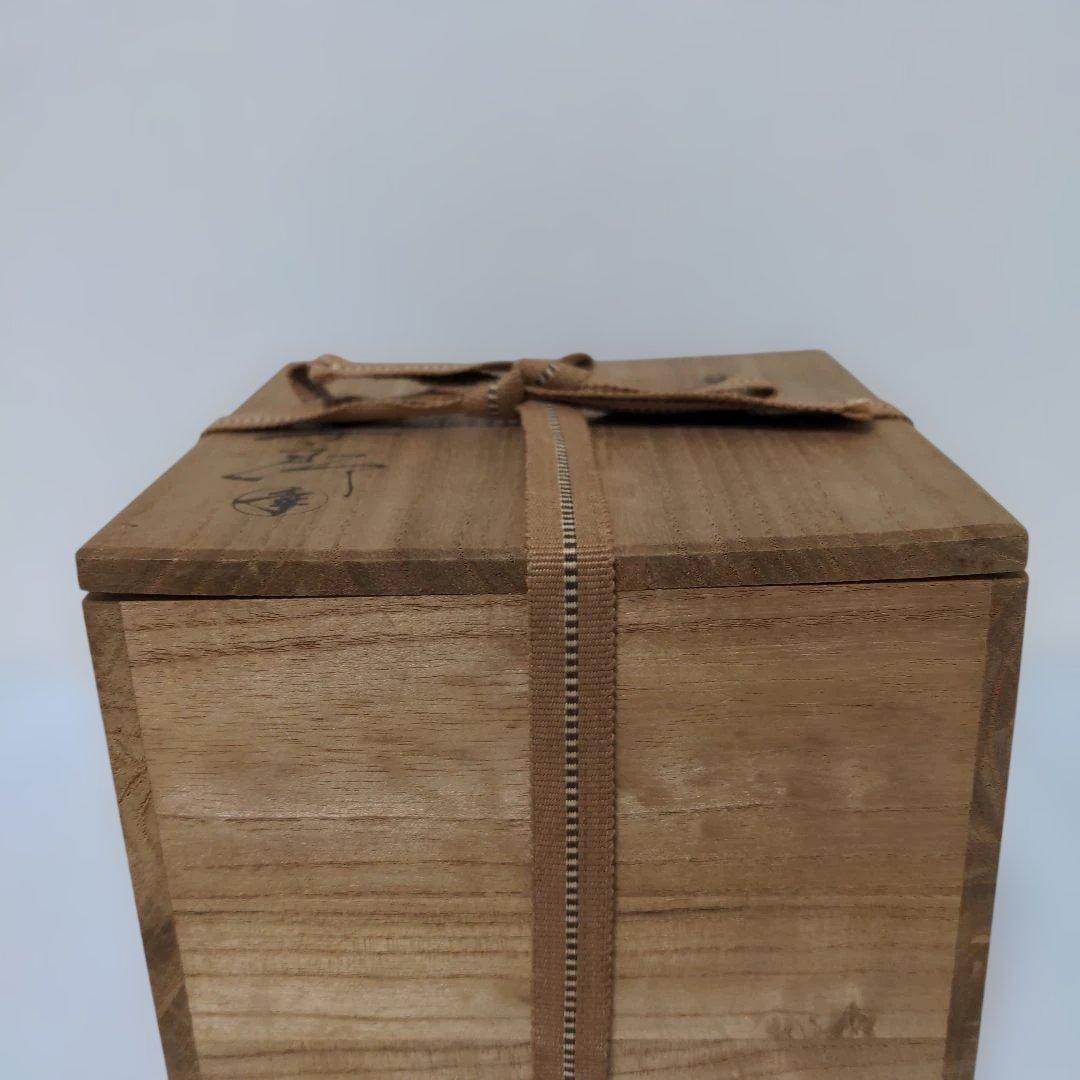
Tomobako (signed paulownia box) accompanies the work, signed and sealed by Toshirō in his pre-succession hand. The lid shows a slight bow at the edges — the box has lived. Bowl itself is in unused condition.
— BIOGRAPHICAL WEIGHT —
A work signed "Toshirō" rather than "Chōzaemon" carries a particular kind of biographical weight. It is the maker before the title — the artist while he was still the artist, not yet the institution. After 1987, every box would bear the family name. This one does not. It is, in that sense, a more personal signature than what came after.
Dimensions: Diameter 11.3 cm × Height 8.3 cm. With tomobako. Unused condition.
🔹 [ BASIC DETAILS ]
🔹 [ CULTURAL & ARTISTIC INSIGHT ]
🔹 [ DEEP-DIVE COMMENTARY ]
🔹 [ 日本語解説 ]
十代大樋長左衛門・大樋年朗による大樋焼飴釉茶碗。1987年襲名前の「年朗」銘共箱付。文化勲章受章作家。加賀・大樋焼の象徴である飴釉が、口縁の透明感ある琥珀色から胴部の濃褐へと深く流れる手づくね茶碗。径11.3×高8.3cm。共箱蓋にわずかな反り、本体は未使用。
🔹 [ SHIPPING & PACKAGING ]
• Dispatch: Within 1-6 business days
• Carrier: Japan Post EMS / UPS (with tracking)
• Packaging: Carefully wrapped with protective materials
Toshirō was honoured as a Person of Cultural Merit (文化功労者) and received the Order of Culture (文化勲章) in 2011, alongside membership in the Japan Art Academy. These distinctions sit, in the Japanese honours system, on the same shelf as — and arguably above — Living National Treasure designation. They recognise not a single technique preserved, but a lifetime's contribution to the cultural fabric of the country.
— ŌHI-YAKI: A KAGA OFFSHOOT OF RAKU —
Ōhi-yaki begins in 1666. When Senshū Sōshitsu, the fourth iemoto of Urasenke, was invited to Kanazawa by the Maeda lord of Kaga, he brought with him a young potter named Chōzaemon, a student of the Raku household in Kyoto. Chōzaemon settled in the village of Ōhi, on the outskirts of the castle town, and began firing tea bowls there. The Ōhi line has continued in unbroken father-to-son succession in Kanazawa ever since — a Raku descended kiln transplanted into Kaga soil, shaping tea ware for the cultivated samurai court of the Maeda.
From that founding moment, Ōhi developed a signature glaze that distinguished it from its Kyoto parent: ame-yū, the amber glaze. A lower-temperature, lead-rich formulation, ame-yū fires to a warm honey tone — sometimes pale and translucent at the rim, deepening into burnt amber and almost black where it pools. It is not a glaze that performs. It glows quietly, the way old lacquer glows; the way tea, held in the bowl on a winter morning, glows.
— THE BOWL —
Hand-formed and tezukune-shaped in the Raku manner, with the soft asymmetry that comes only from the palm rather than the wheel. The mouth is gently irregular — an oval rather than a circle, the lip rising and falling as the hand released it. Walls thicken toward the foot and lift into a small, deliberate kōdai.
The glaze is the heart of the piece. At the rim, the ame runs thin and translucent, catching light as honey-amber. Lower on the body, where it has pooled and overlapped, it deepens into a smoky bronze, almost iron-black in places — a depth that reveals itself slowly as the bowl is turned in the hand. The interior is a darker amber pool, mottled and quietly alive, with the kind of surface tea practitioners describe as "reading the bowl" — the matcha will sit on this glaze beautifully, the green against the amber a study in contrast.
Tomobako (signed paulownia box) accompanies the work, signed and sealed by Toshirō in his pre-succession hand. The lid shows a slight bow at the edges — the box has lived. Bowl itself is in unused condition.
— BIOGRAPHICAL WEIGHT —
A work signed "Toshirō" rather than "Chōzaemon" carries a particular kind of biographical weight. It is the maker before the title — the artist while he was still the artist, not yet the institution. After 1987, every box would bear the family name. This one does not. It is, in that sense, a more personal signature than what came after.
Dimensions: Diameter 11.3 cm × Height 8.3 cm. With tomobako. Unused condition.
🔹 [ BASIC DETAILS ]
🔹 [ CULTURAL & ARTISTIC INSIGHT ]
🔹 [ DEEP-DIVE COMMENTARY ]
🔹 [ 日本語解説 ]
十代大樋長左衛門・大樋年朗による大樋焼飴釉茶碗。1987年襲名前の「年朗」銘共箱付。文化勲章受章作家。加賀・大樋焼の象徴である飴釉が、口縁の透明感ある琥珀色から胴部の濃褐へと深く流れる手づくね茶碗。径11.3×高8.3cm。共箱蓋にわずかな反り、本体は未使用。
🔹 [ SHIPPING & PACKAGING ]
• Dispatch: Within 1-6 business days
• Carrier: Japan Post EMS / UPS (with tracking)
• Packaging: Carefully wrapped with protective materials
Quantity
Couldn't load pickup availability
Low stock: 1 left
View full details