1
/
of
12
Ninsei-Style Bamboo Grove Chawan by Kazukoichi Ueyama — Kyoto Kyo-yaki Tea Bowl, Gold Silver Enamel, Tomobako
Ninsei-Style Bamboo Grove Chawan by Kazukoichi Ueyama — Kyoto Kyo-yaki Tea Bowl, Gold Silver Enamel, Tomobako
Regular price
Dhs. 610.00 AED
Regular price
Sale price
Dhs. 610.00 AED
Taxes included.
Shipping calculated at checkout.
Experience Authentic Japanese Tea Ceremony Art with this Kyo-yaki Matcha Bowl. This Ninsei-Style Tea Bowl serves as a Japanese Ceramic Tea Bowl and Handmade Chawan, featuring Bamboo Gold Enamel Decoration and Signed Wooden Box — a must-have for any Japanese Pottery Collector, Kyo-yaki Ceramic Art enthusiast, and lover of Traditional Tea Ceremony Ware.
🔹 [ BASIC DETAILS ]
• Artist: Kazukoichi Ueyama (上山一光), Otowayama Kiln (音羽山窯)
• Technique: Kyo-yaki / Ninsei-style (仁清写) — overglaze polychrome enamel (teal, cobalt blue, gold) on cream-white ground
• Era: 2000s–2010s (contemporary Kyoto craft)
• Origin: Kyoto, Japan (Kyo-yaki tradition)
• Dimensions: Diameter approx. 12.3 cm
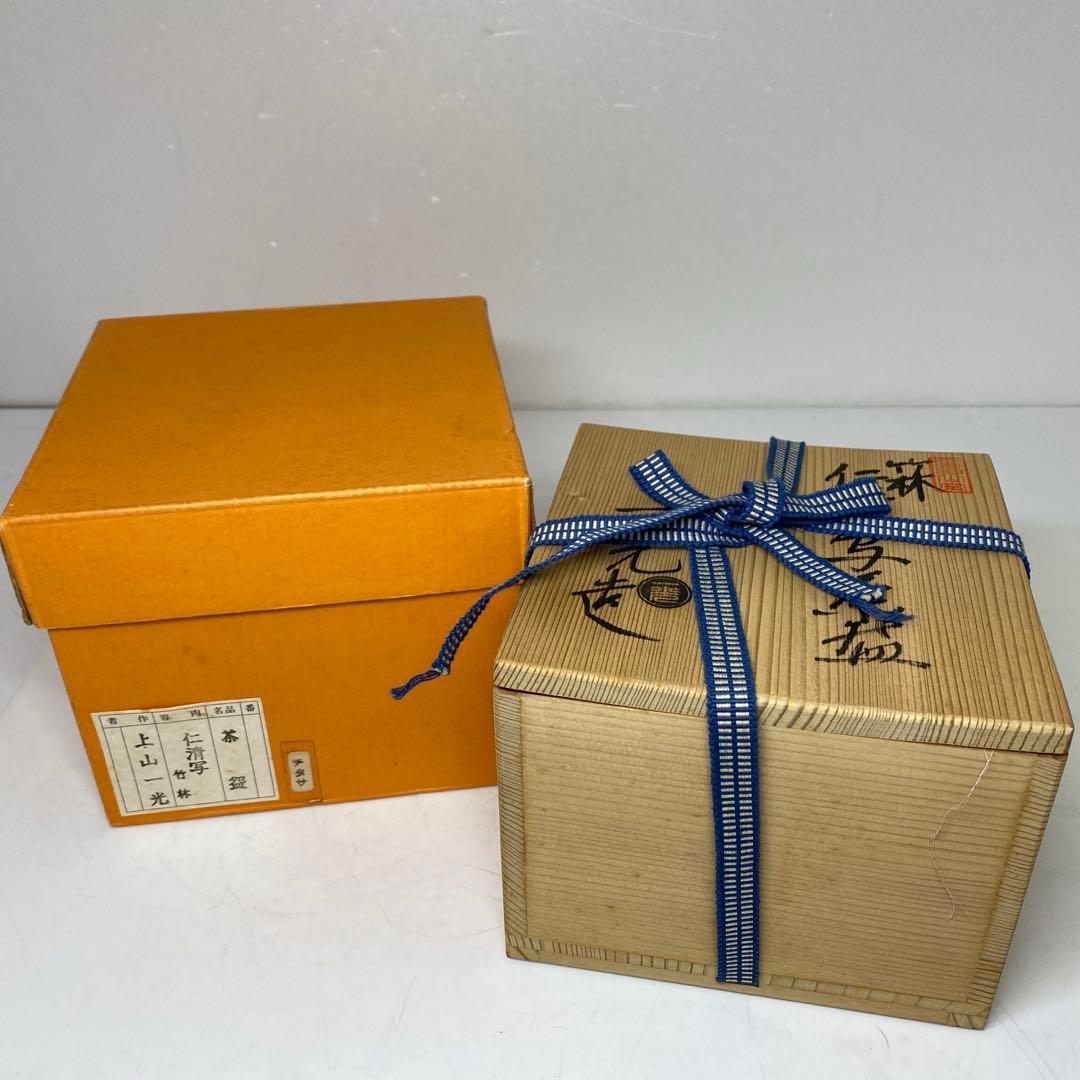
• Box: Original signed wooden box (tomobako) included — lid inscribed 竹林仁清写 / 一光造
• Condition: Excellent — no chips, cracks, or restoration
🔹 [ CULTURAL & ARTISTIC INSIGHT ]
The Ninsei tradition belongs to a lineage of deliberate splendor. When Nonomura Ninsei established his kiln in Kyoto in the mid-seventeenth century, he did not attempt to compete with the spare eloquence of wabi-cha. Instead, he answered a different question: what does a tea bowl look like when a painter's full attention is turned upon it?
Ueyama Kazukoichi works inside this answer. At Otowayama Kiln, he continues a practice of meticulous overglaze decoration on the pale, fine-grained stoneware body that identifies the Ninsei aesthetic — a body that functions less as raw earth and more as ground for image-making. This bowl carries a bamboo grove rendered in three registers of color: the culm stalks in deep teal, the leaf clusters alternating between cobalt blue and muted turquoise, and, threading through both, fine gold outlines that define each vein and each node. Scattered across the composition, two gold maple leaves hold the grove open — suggesting a season caught mid-passage, the bamboo permanent, the maple momentarily present.
The interior rim carries a narrow gold band. The foot is small, clean, and undecorated — the conventional resting point where the maker's restraint becomes audible.
*A grove that does not move, a leaf that does not stay — the bowl holds both.*
🔹 [ DEEP-DIVE COMMENTARY ]
Kyo-yaki (京焼) is the collective term for ceramics produced in and around Kyoto, the historical capital of Japan's imperial and cultural life. Unlike regional wares defined by a single clay body or firing method — Bizen's unglazed stoneware, Hagi's feldspathic softness — Kyo-yaki is defined by its clientele and its aesthetic ambition: fine materials worked with the precision of a painter rather than the directness of a vessel-maker. The tradition encompasses both the restrained and the ornate, but it is the ornate line — running from Ninsei through Ogata Kenzan and into living practitioners — that commands the deepest recognition outside Japan.
Ninsei-style (仁清写, Ninsei-utsushi) denotes work produced in deliberate homage to the visual language of Nonomura Ninsei (active c.1646–1690). Ninsei was the first potter to achieve a fully painterly surface on a tea vessel: his use of gold, silver, and polychrome overglaze enamels over a smooth, cream-colored ground created objects that belonged simultaneously to the tea room and the screen. Subsequent generations have reproduced this mode not as imitation but as continuation — a dialogue with a solved aesthetic problem.
The technical sequence for this type of decoration is demanding. The clay body is fired to bisque, then coated with a white overglaze ground — the 白地 (shirojia) — that provides the reflective surface essential to the Ninsei effect. The piece is fired a second time to set the ground. Polychrome overglaze enamels are then applied by hand in multiple, precisely controlled layers: teal first, then cobalt, each dried and sometimes fixed by a lower-temperature firing before the next color is added. Gold, the most demanding material, is applied last — painted on in liquid form and fired at the lowest temperature of all, typically around 700–750°C. A single miscalculation at any stage will cloud or crack the enamel; the final surface, if successful, has the quality of controlled depth rather than flat pigment.
Ueyama's bamboo motif carries cultural density beyond its visual appearance. Bamboo (竹, take) is one of the Three Friends of Winter (歳寒三友, saikan no sanyū) in East Asian iconography — pine, plum, and bamboo — plants that survive cold unchanged. In the tea room, bamboo imagery is associated with resilience without rigidity, and with the kind of endurance that does not announce itself. The gold maple leaves scattered through the grove introduce a counterpoint: the maple is explicitly seasonal, its gold coloring here suggesting the height of autumn. The juxtaposition — permanent grove, transient leaf — is a compact compositional argument about time, the kind of argument that has been made in the tea room for centuries.
For the collector, the tomobako (共箱) represents more than packaging. When the artist writes the piece's name and signs the lid, the box becomes documentation: it confirms authorship, establishes the piece's formal title (here, 竹林仁清写, Chikurin Ninsei-utsushi — "Bamboo Grove in the Ninsei Manner"), and provides provenance that will follow the bowl across any future transfer. A bowl without its tomobako is interpretively incomplete; a bowl with it carries its own record.
---
🔹 [ JAPANESE DESCRIPTION / 日本語解説 ]
【基本情報】
• 作家: 上山一光(音羽山窯)
• 技法: 仁清写 — 白磁地に青・コバルトブルー・金彩による上絵付け(多彩釉)
• 年代: 2000年代〜2010年代(現代京焼)
• 産地: 京都(京焼)
• 寸法: 口径約12.3cm
• 付属: 共箱(蓋裏「竹林仁清写 一光造」)
• 状態: 良好 — 欠け・ひび・修復なし
【文化的・芸術的解説】
仁清写という様式は、華やかさを意図的に選択した系譜に属している。野々村仁清が十七世紀中頃に京都に窯を開いたとき、彼は侘び茶の簡潔な美とは異なる問いに答えようとしていた。それは「絵師の全注意を茶碗に向けたとき、その形はどうなるか」という問いである。
上山一光はその答えの内側で仕事をしている。音羽山窯において、彼は仁清美学を特徴づける淡く細密な磁器質の胎土に、緻密な上絵装飾を施す実践を継承している。この茶碗には三層の色調で描かれた竹林がある。深いティールの竹幹、コバルト青と緑青を交互に使い分けた葉群、そして葉脈と節を定義する金彩の輪郭線。その構成に散る二枚の金地紅葉は、竹の永続性と、楓の一時性を対比させ、時間の中の一瞬を封じ込めている。内側のリムには細い金帯が走り、高台は小さく整然として、無装飾のまま静かに閉じる。
*動かない竹林と、とどまらない一葉——茶碗はその両方を抱いている。*
【深層解説】
京焼とは、日本の帝都・文化首都であった京都およびその周辺で生産される陶磁器の総称である。備前の無釉炻器や萩の長石質の柔らかさのように単一の土や焼成法で定義される地域窯とは異なり、京焼はその顧客層と美的野心によって定義される。材料は精選され、技法は土器師の直接性よりも絵師の精緻さに近い。この伝統には質素なものと華やかなものの両方が含まれるが、仁清から尾形乾山、そして現代の作家へと連なる華やかな系譜こそが、海外でも最も深い認知を受けている。
仁清写(仁清うつし)とは、野々村仁清(活動期c.1646–1690)の視覚言語に意識的な敬意を持って制作された作品を指す。仁清は茶器に完全に絵画的な表面を達成した最初の陶工であった。滑らかな乳白色の地に金・銀・多彩上絵を組み合わせた彼の技法は、茶室にも屏風にも属するような器物を生み出した。後世の作家たちがこの様式を継承するのは模倣ではなく、解決された美学問題との対話である。
この種の装飾の技術的工程は要求が高い。素地を素焼きした後、仁清様式に不可欠な反射性表面を持つ白釉地を施す。再焼成で下地を定着させた後、上絵具を複数回、精密に重ねて描く。ティール系を先に置き、次いでコバルト、各工程で乾燥・中間焼きを挟む。最も繊細な金彩は最後に液体金として筆描きし、700〜750°Cという最低温度で焼成する。どこか一工程でも計算を誤れば釉薬は濁るか剥落する。成功した表面は、平板な顔料ではなく制御された深みを持つ。
竹の文様は視覚的な美しさを超えた文化的密度を持つ。竹は東アジア図像学における歳寒三友(松・梅・竹)の一つであり、茶室では「剛でなく、柔でなく、ただ在る」種類の耐久性と結びついている。構成に散る金地紅葉は意識的な対位法をなす。楓は明確に季節的であり、その金色は秋の頂点を示す。永続する竹林と、とどまらぬ一葉——この対比は、茶室で幾世紀にもわたって繰り返されてきた時間についての小さな論証である。
共箱は梱包以上のものである。作家が品名を記し、蓋に署名することで、箱は文書となる。それは作者を確認し(一光造)、作品の正式名称(竹林仁清写)を確立し、将来いかなる移転においても茶碗に伴い続ける来歴記録を提供する。共箱のない茶碗は解釈として不完全である。共箱のある茶碗は、自身の記録を携えている。
---
🔹 [ SHIPPING & PACKAGING ]
• Dispatch: Within 1-6 business days
• Carrier: Japan Post EMS / UPS (with tracking)
• Packaging: Carefully wrapped with protective materials
🔹 [ BASIC DETAILS ]
• Artist: Kazukoichi Ueyama (上山一光), Otowayama Kiln (音羽山窯)
• Technique: Kyo-yaki / Ninsei-style (仁清写) — overglaze polychrome enamel (teal, cobalt blue, gold) on cream-white ground
• Era: 2000s–2010s (contemporary Kyoto craft)
• Origin: Kyoto, Japan (Kyo-yaki tradition)
• Dimensions: Diameter approx. 12.3 cm
• Box: Original signed wooden box (tomobako) included — lid inscribed 竹林仁清写 / 一光造
• Condition: Excellent — no chips, cracks, or restoration
🔹 [ CULTURAL & ARTISTIC INSIGHT ]
The Ninsei tradition belongs to a lineage of deliberate splendor. When Nonomura Ninsei established his kiln in Kyoto in the mid-seventeenth century, he did not attempt to compete with the spare eloquence of wabi-cha. Instead, he answered a different question: what does a tea bowl look like when a painter's full attention is turned upon it?
Ueyama Kazukoichi works inside this answer. At Otowayama Kiln, he continues a practice of meticulous overglaze decoration on the pale, fine-grained stoneware body that identifies the Ninsei aesthetic — a body that functions less as raw earth and more as ground for image-making. This bowl carries a bamboo grove rendered in three registers of color: the culm stalks in deep teal, the leaf clusters alternating between cobalt blue and muted turquoise, and, threading through both, fine gold outlines that define each vein and each node. Scattered across the composition, two gold maple leaves hold the grove open — suggesting a season caught mid-passage, the bamboo permanent, the maple momentarily present.
The interior rim carries a narrow gold band. The foot is small, clean, and undecorated — the conventional resting point where the maker's restraint becomes audible.
*A grove that does not move, a leaf that does not stay — the bowl holds both.*
🔹 [ DEEP-DIVE COMMENTARY ]
Kyo-yaki (京焼) is the collective term for ceramics produced in and around Kyoto, the historical capital of Japan's imperial and cultural life. Unlike regional wares defined by a single clay body or firing method — Bizen's unglazed stoneware, Hagi's feldspathic softness — Kyo-yaki is defined by its clientele and its aesthetic ambition: fine materials worked with the precision of a painter rather than the directness of a vessel-maker. The tradition encompasses both the restrained and the ornate, but it is the ornate line — running from Ninsei through Ogata Kenzan and into living practitioners — that commands the deepest recognition outside Japan.
Ninsei-style (仁清写, Ninsei-utsushi) denotes work produced in deliberate homage to the visual language of Nonomura Ninsei (active c.1646–1690). Ninsei was the first potter to achieve a fully painterly surface on a tea vessel: his use of gold, silver, and polychrome overglaze enamels over a smooth, cream-colored ground created objects that belonged simultaneously to the tea room and the screen. Subsequent generations have reproduced this mode not as imitation but as continuation — a dialogue with a solved aesthetic problem.
The technical sequence for this type of decoration is demanding. The clay body is fired to bisque, then coated with a white overglaze ground — the 白地 (shirojia) — that provides the reflective surface essential to the Ninsei effect. The piece is fired a second time to set the ground. Polychrome overglaze enamels are then applied by hand in multiple, precisely controlled layers: teal first, then cobalt, each dried and sometimes fixed by a lower-temperature firing before the next color is added. Gold, the most demanding material, is applied last — painted on in liquid form and fired at the lowest temperature of all, typically around 700–750°C. A single miscalculation at any stage will cloud or crack the enamel; the final surface, if successful, has the quality of controlled depth rather than flat pigment.
Ueyama's bamboo motif carries cultural density beyond its visual appearance. Bamboo (竹, take) is one of the Three Friends of Winter (歳寒三友, saikan no sanyū) in East Asian iconography — pine, plum, and bamboo — plants that survive cold unchanged. In the tea room, bamboo imagery is associated with resilience without rigidity, and with the kind of endurance that does not announce itself. The gold maple leaves scattered through the grove introduce a counterpoint: the maple is explicitly seasonal, its gold coloring here suggesting the height of autumn. The juxtaposition — permanent grove, transient leaf — is a compact compositional argument about time, the kind of argument that has been made in the tea room for centuries.
For the collector, the tomobako (共箱) represents more than packaging. When the artist writes the piece's name and signs the lid, the box becomes documentation: it confirms authorship, establishes the piece's formal title (here, 竹林仁清写, Chikurin Ninsei-utsushi — "Bamboo Grove in the Ninsei Manner"), and provides provenance that will follow the bowl across any future transfer. A bowl without its tomobako is interpretively incomplete; a bowl with it carries its own record.
---
🔹 [ JAPANESE DESCRIPTION / 日本語解説 ]
【基本情報】
• 作家: 上山一光(音羽山窯)
• 技法: 仁清写 — 白磁地に青・コバルトブルー・金彩による上絵付け(多彩釉)
• 年代: 2000年代〜2010年代(現代京焼)
• 産地: 京都(京焼)
• 寸法: 口径約12.3cm
• 付属: 共箱(蓋裏「竹林仁清写 一光造」)
• 状態: 良好 — 欠け・ひび・修復なし
【文化的・芸術的解説】
仁清写という様式は、華やかさを意図的に選択した系譜に属している。野々村仁清が十七世紀中頃に京都に窯を開いたとき、彼は侘び茶の簡潔な美とは異なる問いに答えようとしていた。それは「絵師の全注意を茶碗に向けたとき、その形はどうなるか」という問いである。
上山一光はその答えの内側で仕事をしている。音羽山窯において、彼は仁清美学を特徴づける淡く細密な磁器質の胎土に、緻密な上絵装飾を施す実践を継承している。この茶碗には三層の色調で描かれた竹林がある。深いティールの竹幹、コバルト青と緑青を交互に使い分けた葉群、そして葉脈と節を定義する金彩の輪郭線。その構成に散る二枚の金地紅葉は、竹の永続性と、楓の一時性を対比させ、時間の中の一瞬を封じ込めている。内側のリムには細い金帯が走り、高台は小さく整然として、無装飾のまま静かに閉じる。
*動かない竹林と、とどまらない一葉——茶碗はその両方を抱いている。*
【深層解説】
京焼とは、日本の帝都・文化首都であった京都およびその周辺で生産される陶磁器の総称である。備前の無釉炻器や萩の長石質の柔らかさのように単一の土や焼成法で定義される地域窯とは異なり、京焼はその顧客層と美的野心によって定義される。材料は精選され、技法は土器師の直接性よりも絵師の精緻さに近い。この伝統には質素なものと華やかなものの両方が含まれるが、仁清から尾形乾山、そして現代の作家へと連なる華やかな系譜こそが、海外でも最も深い認知を受けている。
仁清写(仁清うつし)とは、野々村仁清(活動期c.1646–1690)の視覚言語に意識的な敬意を持って制作された作品を指す。仁清は茶器に完全に絵画的な表面を達成した最初の陶工であった。滑らかな乳白色の地に金・銀・多彩上絵を組み合わせた彼の技法は、茶室にも屏風にも属するような器物を生み出した。後世の作家たちがこの様式を継承するのは模倣ではなく、解決された美学問題との対話である。
この種の装飾の技術的工程は要求が高い。素地を素焼きした後、仁清様式に不可欠な反射性表面を持つ白釉地を施す。再焼成で下地を定着させた後、上絵具を複数回、精密に重ねて描く。ティール系を先に置き、次いでコバルト、各工程で乾燥・中間焼きを挟む。最も繊細な金彩は最後に液体金として筆描きし、700〜750°Cという最低温度で焼成する。どこか一工程でも計算を誤れば釉薬は濁るか剥落する。成功した表面は、平板な顔料ではなく制御された深みを持つ。
竹の文様は視覚的な美しさを超えた文化的密度を持つ。竹は東アジア図像学における歳寒三友(松・梅・竹)の一つであり、茶室では「剛でなく、柔でなく、ただ在る」種類の耐久性と結びついている。構成に散る金地紅葉は意識的な対位法をなす。楓は明確に季節的であり、その金色は秋の頂点を示す。永続する竹林と、とどまらぬ一葉——この対比は、茶室で幾世紀にもわたって繰り返されてきた時間についての小さな論証である。
共箱は梱包以上のものである。作家が品名を記し、蓋に署名することで、箱は文書となる。それは作者を確認し(一光造)、作品の正式名称(竹林仁清写)を確立し、将来いかなる移転においても茶碗に伴い続ける来歴記録を提供する。共箱のない茶碗は解釈として不完全である。共箱のある茶碗は、自身の記録を携えている。
---
🔹 [ SHIPPING & PACKAGING ]
• Dispatch: Within 1-6 business days
• Carrier: Japan Post EMS / UPS (with tracking)
• Packaging: Carefully wrapped with protective materials
Quantity
Couldn't load pickup availability
Low stock: 1 left
View full details