1
/
of
14
Moon Rabbit Maki-e Kogo Incense Container – Gold Nashiji – Horiuchi Sokan – Suzuki Konyu – Japan
Moon Rabbit Maki-e Kogo Incense Container – Gold Nashiji – Horiuchi Sokan – Suzuki Konyu – Japan
Regular price
Dhs. 3,830.00 AED
Regular price
Sale price
Dhs. 3,830.00 AED
Taxes included.
Shipping calculated at checkout.
Experience Authentic Japanese Lacquer Mastery with this Moon Rabbit Maki-e Kogo. This Japanese Incense Container serves as an extraordinary Gold Nashiji Kogo and Tsuki-usagi Lacquer Art piece, featuring Maki-e Incense Container craftsmanship and Horiuchi Sokan Certified provenance—a must-have for any Tea Ceremony Collector. This Gold Lacquer Moon Rabbit masterwork by Suzuki Konyu represents the pinnacle of Japanese Kogo Art, a transcendent Urushi Incense Box Japan that embodies centuries of lacquer tradition.
🔹 [ BASIC DETAILS ]
• Artist: Suzuki Konyu (鈴木光入)
• Technique: Gold maki-e on black urushi with gold nashiji interior
• Era: Contemporary
• Origin: Kyoto, Japan
• Form: Kogo (incense container) — circular flat form
• Design: Tsuki-usagi (moon rabbit) — running rabbit beneath pine with waves
• Dimensions: Height approx. 1.9 cm, Diameter approx. 8.1 cm
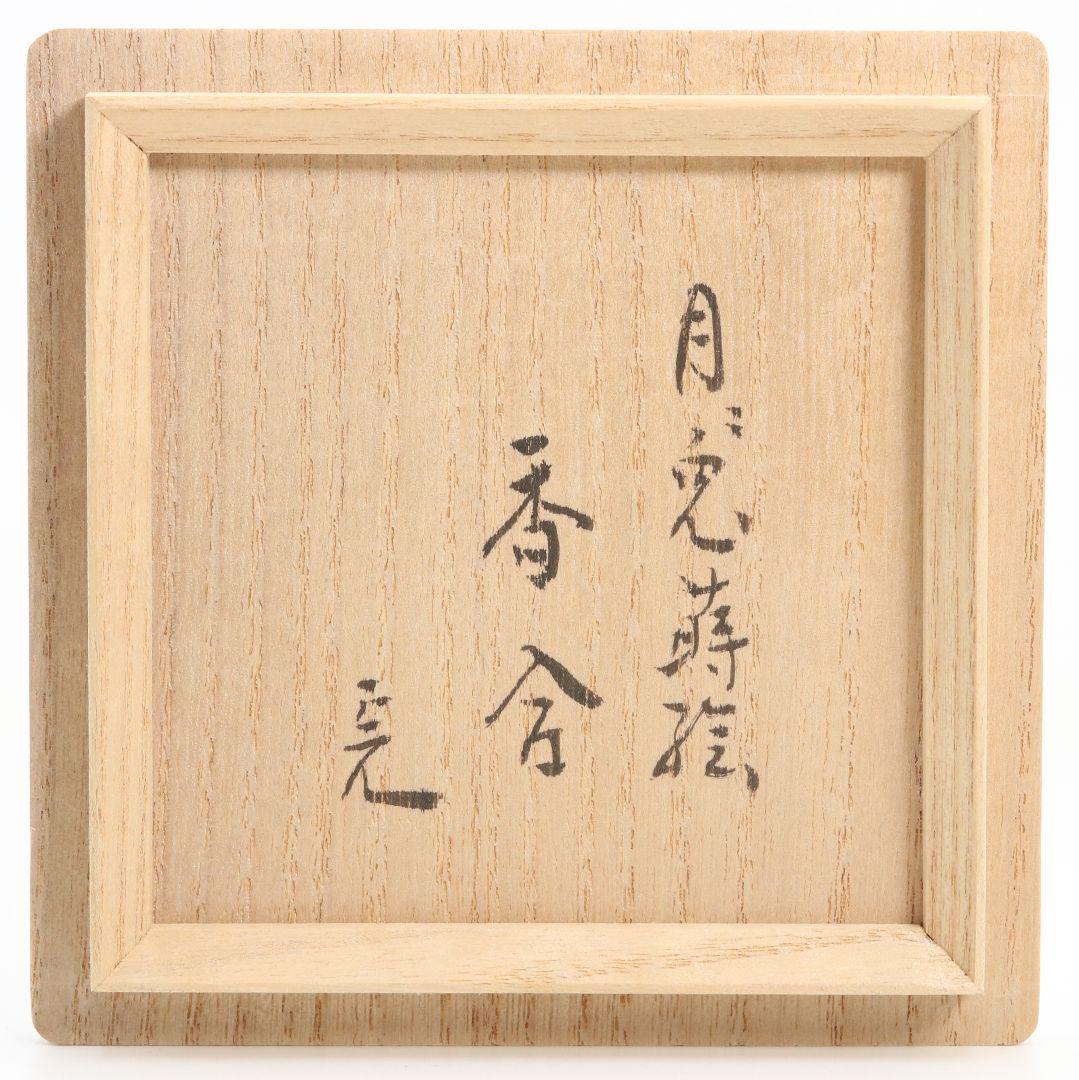
• Authentication: Horiuchi Sokan (堀内宗完) — written appraisal (書付)
• Box: Authenticated box with Horiuchi Sokan inscription
• Condition: Exceptional — flawless maki-e with luminous gold nashiji interior
🔹 [ Cultural & Artistic Insight ]
The kogo — a vessel designed solely to hold a few grams of incense — is perhaps the most intimate object in the tea ceremony. It is small enough to rest in the palm, yet it carries disproportionate cultural weight. In the ritual sequence, the kogo is one of the last objects the guest examines: after the scroll, after the flower arrangement, after the tea itself. It is the final statement — the quiet punctuation at the end of the host's aesthetic sentence.
The tsuki-usagi (moon rabbit) is one of Japan's most beloved and ancient motifs. In East Asian folklore, the markings on the moon's surface depict a rabbit pounding mochi (rice cakes) — a story that traces back through Japanese, Chinese, and Indian mythology. On this kogo, the rabbit runs beneath pine boughs over stylized waves, placing it in a complete landscape that compresses sky, forest, and sea into a circle barely eight centimeters across. This is the art of condensation — an entire world contained within the span of a hand.
The gold nashiji (pear-skin) interior transforms the act of opening the kogo into a moment of private revelation. As the lid lifts, the scattered gold flakes catch light like constellations — a sky within a sky, answering the moon rabbit on the exterior.
Horiuchi Sokan's written appraisal (kakitsuke) on the box elevates this piece beyond craft into the realm of documented tea culture. His calligraphy on the lid is itself a work of art — and his endorsement confirms that this kogo meets the aesthetic standard for use in the most formal Urasenke tea gatherings.
*The rabbit runs toward a moon it will never reach — and in that perpetual motion, the stillness of tea is born.*
🔹 [ Deep-Dive Commentary ]
The kogo occupies a unique position among tea utensils. Unlike the chawan (tea bowl) or chashaku (tea scoop), which are tools of preparation, the kogo is a vessel of anticipation. The incense it holds will be placed on the charcoal before the water boils — its fragrance prepares the room for the tea that has not yet been made. In this sense, the kogo is the first act of hospitality: invisible, atmospheric, and complete before the guest even enters.
Suzuki Konyu's maki-e on this piece demonstrates several layers of technical sophistication. The rabbit is rendered in takamaki-e (raised maki-e), giving it dimensional presence against the flat ground. The pine needles employ a finer technique — likely togidashi maki-e (burnished maki-e), where the gold design is buried under lacquer and then polished back to the surface, creating a flush, jewel-like finish. The wave patterns use yet another variation, with different densities of gold powder creating the illusion of movement and depth.
The nashiji interior is a hallmark of refined lacquer work. Created by sprinkling irregular flakes of gold into wet lacquer and then sealing them under a transparent yellow-tinted layer, nashiji achieves a depth effect that changes with viewing angle. The name literally means "pear skin" — a reference to the speckled appearance of a nashi pear's surface. On a kogo, the nashiji interior serves both aesthetic and practical purposes: it provides a luminous backdrop for the dark incense pieces and protects the lacquer from the aromatic oils in the incense.
The circular flat form of this kogo — measuring only 1.9 cm in height — presents an extreme compositional challenge for the maki-e artist. The entire narrative — rabbit, pine, waves, implied moonlight — must resolve within a disc under nine centimeters in diameter. There is no room for hesitation or revision in maki-e; each stroke of gold is final. The confidence visible in this piece — the rabbit in mid-stride, the pine boughs arching naturally, the waves flowing without crowding — speaks to an artist working at the height of their powers.
For the collector, this kogo represents a convergence of four value dimensions: the artistry of Suzuki Konyu's maki-e, the cultural depth of the tsuki-usagi motif, the prestige of Horiuchi Sokan's authentication, and the functional beauty of an object designed for the most refined moments of the tea ceremony. Pieces of this caliber — where artist, subject, authenticator, and technique align at this level — surface infrequently.
🔹 [ 日本語解説 ]
【基本情報】
• 作家:鈴木光入
• 技法:黒漆地に金蒔絵(月兎文)、内部金梨地
• 形状:香合(円形平型)
• 文様:月兎蒔絵(松下に走る兎と波)
• 寸法:高さ約1.9cm、径約8.1cm
• 書付:堀内宗完(裏千家)
• 付属:書付箱
• 状態:極めて良好。蒔絵の状態は申し分なく、金梨地の輝きも鮮明
【文化的背景と芸術的考察】
香合は、わずか数グラムの香を収めるためだけに存在する、茶の湯において最も親密な器である。点前の進行において、香合は客が最後に拝見する道具の一つであり、亭主の美意識を締めくくる静かな句読点となる。
月兎(つきうさぎ)は、日本で最も愛される古代の意匠の一つである。月の表面の模様にうさぎが餅をつく姿を見る——その物語は日本・中国・インドの神話を貫いて伝わってきた。本作では、松の下を走る兎と波が、径わずか八センチの円の中に空・森・海を凝縮した完全な風景を構成している。これは凝縮の芸術——掌に収まる一つの世界である。
金梨地の内部は、蓋を開ける行為を私的な啓示の瞬間に変える。散りばめられた金箔が星座のように光を捕らえ、外面の月兎に応答する天空を内に宿す。
堀内宗完の書付は、この香合を工芸の域を超え、記録された茶文化の領域へと高めている。箱蓋の書はそれ自体が書の作品であり、裏千家の最も格式高い茶会での使用に適うという美的判断を証するものである。
鈴木光入の蒔絵は複数の技法を重層的に用いている。兎は高蒔絵で立体感を持たせ、松葉にはより繊細な研出蒔絵を、波文には金粉の濃淡を変えることで動きと奥行きの幻を生み出している。梨地は不揃いの金箔を湿った漆の中に蒔き、透明な黄味がかった層で封じ込めることで、見る角度によって表情を変える深みのある効果を実現する。高さわずか1.9cmの円形平面という極限の構図の中に、兎・松・波・暗示される月光という物語のすべてを破綻なく収める——その迷いのない筆致は、円熟の域にある蒔絵師の仕事である。
🔹 [ SHIPPING & PACKAGING ]
• Dispatch: Within 1-6 business days
• Carrier: Japan Post EMS / UPS (with tracking)
• Packaging: Carefully wrapped with protective materials
🔹 [ BASIC DETAILS ]
• Artist: Suzuki Konyu (鈴木光入)
• Technique: Gold maki-e on black urushi with gold nashiji interior
• Era: Contemporary
• Origin: Kyoto, Japan
• Form: Kogo (incense container) — circular flat form
• Design: Tsuki-usagi (moon rabbit) — running rabbit beneath pine with waves
• Dimensions: Height approx. 1.9 cm, Diameter approx. 8.1 cm
• Authentication: Horiuchi Sokan (堀内宗完) — written appraisal (書付)
• Box: Authenticated box with Horiuchi Sokan inscription
• Condition: Exceptional — flawless maki-e with luminous gold nashiji interior
🔹 [ Cultural & Artistic Insight ]
The kogo — a vessel designed solely to hold a few grams of incense — is perhaps the most intimate object in the tea ceremony. It is small enough to rest in the palm, yet it carries disproportionate cultural weight. In the ritual sequence, the kogo is one of the last objects the guest examines: after the scroll, after the flower arrangement, after the tea itself. It is the final statement — the quiet punctuation at the end of the host's aesthetic sentence.
The tsuki-usagi (moon rabbit) is one of Japan's most beloved and ancient motifs. In East Asian folklore, the markings on the moon's surface depict a rabbit pounding mochi (rice cakes) — a story that traces back through Japanese, Chinese, and Indian mythology. On this kogo, the rabbit runs beneath pine boughs over stylized waves, placing it in a complete landscape that compresses sky, forest, and sea into a circle barely eight centimeters across. This is the art of condensation — an entire world contained within the span of a hand.
The gold nashiji (pear-skin) interior transforms the act of opening the kogo into a moment of private revelation. As the lid lifts, the scattered gold flakes catch light like constellations — a sky within a sky, answering the moon rabbit on the exterior.
Horiuchi Sokan's written appraisal (kakitsuke) on the box elevates this piece beyond craft into the realm of documented tea culture. His calligraphy on the lid is itself a work of art — and his endorsement confirms that this kogo meets the aesthetic standard for use in the most formal Urasenke tea gatherings.
*The rabbit runs toward a moon it will never reach — and in that perpetual motion, the stillness of tea is born.*
🔹 [ Deep-Dive Commentary ]
The kogo occupies a unique position among tea utensils. Unlike the chawan (tea bowl) or chashaku (tea scoop), which are tools of preparation, the kogo is a vessel of anticipation. The incense it holds will be placed on the charcoal before the water boils — its fragrance prepares the room for the tea that has not yet been made. In this sense, the kogo is the first act of hospitality: invisible, atmospheric, and complete before the guest even enters.
Suzuki Konyu's maki-e on this piece demonstrates several layers of technical sophistication. The rabbit is rendered in takamaki-e (raised maki-e), giving it dimensional presence against the flat ground. The pine needles employ a finer technique — likely togidashi maki-e (burnished maki-e), where the gold design is buried under lacquer and then polished back to the surface, creating a flush, jewel-like finish. The wave patterns use yet another variation, with different densities of gold powder creating the illusion of movement and depth.
The nashiji interior is a hallmark of refined lacquer work. Created by sprinkling irregular flakes of gold into wet lacquer and then sealing them under a transparent yellow-tinted layer, nashiji achieves a depth effect that changes with viewing angle. The name literally means "pear skin" — a reference to the speckled appearance of a nashi pear's surface. On a kogo, the nashiji interior serves both aesthetic and practical purposes: it provides a luminous backdrop for the dark incense pieces and protects the lacquer from the aromatic oils in the incense.
The circular flat form of this kogo — measuring only 1.9 cm in height — presents an extreme compositional challenge for the maki-e artist. The entire narrative — rabbit, pine, waves, implied moonlight — must resolve within a disc under nine centimeters in diameter. There is no room for hesitation or revision in maki-e; each stroke of gold is final. The confidence visible in this piece — the rabbit in mid-stride, the pine boughs arching naturally, the waves flowing without crowding — speaks to an artist working at the height of their powers.
For the collector, this kogo represents a convergence of four value dimensions: the artistry of Suzuki Konyu's maki-e, the cultural depth of the tsuki-usagi motif, the prestige of Horiuchi Sokan's authentication, and the functional beauty of an object designed for the most refined moments of the tea ceremony. Pieces of this caliber — where artist, subject, authenticator, and technique align at this level — surface infrequently.
🔹 [ 日本語解説 ]
【基本情報】
• 作家:鈴木光入
• 技法:黒漆地に金蒔絵(月兎文)、内部金梨地
• 形状:香合(円形平型)
• 文様:月兎蒔絵(松下に走る兎と波)
• 寸法:高さ約1.9cm、径約8.1cm
• 書付:堀内宗完(裏千家)
• 付属:書付箱
• 状態:極めて良好。蒔絵の状態は申し分なく、金梨地の輝きも鮮明
【文化的背景と芸術的考察】
香合は、わずか数グラムの香を収めるためだけに存在する、茶の湯において最も親密な器である。点前の進行において、香合は客が最後に拝見する道具の一つであり、亭主の美意識を締めくくる静かな句読点となる。
月兎(つきうさぎ)は、日本で最も愛される古代の意匠の一つである。月の表面の模様にうさぎが餅をつく姿を見る——その物語は日本・中国・インドの神話を貫いて伝わってきた。本作では、松の下を走る兎と波が、径わずか八センチの円の中に空・森・海を凝縮した完全な風景を構成している。これは凝縮の芸術——掌に収まる一つの世界である。
金梨地の内部は、蓋を開ける行為を私的な啓示の瞬間に変える。散りばめられた金箔が星座のように光を捕らえ、外面の月兎に応答する天空を内に宿す。
堀内宗完の書付は、この香合を工芸の域を超え、記録された茶文化の領域へと高めている。箱蓋の書はそれ自体が書の作品であり、裏千家の最も格式高い茶会での使用に適うという美的判断を証するものである。
鈴木光入の蒔絵は複数の技法を重層的に用いている。兎は高蒔絵で立体感を持たせ、松葉にはより繊細な研出蒔絵を、波文には金粉の濃淡を変えることで動きと奥行きの幻を生み出している。梨地は不揃いの金箔を湿った漆の中に蒔き、透明な黄味がかった層で封じ込めることで、見る角度によって表情を変える深みのある効果を実現する。高さわずか1.9cmの円形平面という極限の構図の中に、兎・松・波・暗示される月光という物語のすべてを破綻なく収める——その迷いのない筆致は、円熟の域にある蒔絵師の仕事である。
🔹 [ SHIPPING & PACKAGING ]
• Dispatch: Within 1-6 business days
• Carrier: Japan Post EMS / UPS (with tracking)
• Packaging: Carefully wrapped with protective materials
Quantity
Couldn't load pickup availability
Low stock: 1 left
View full details