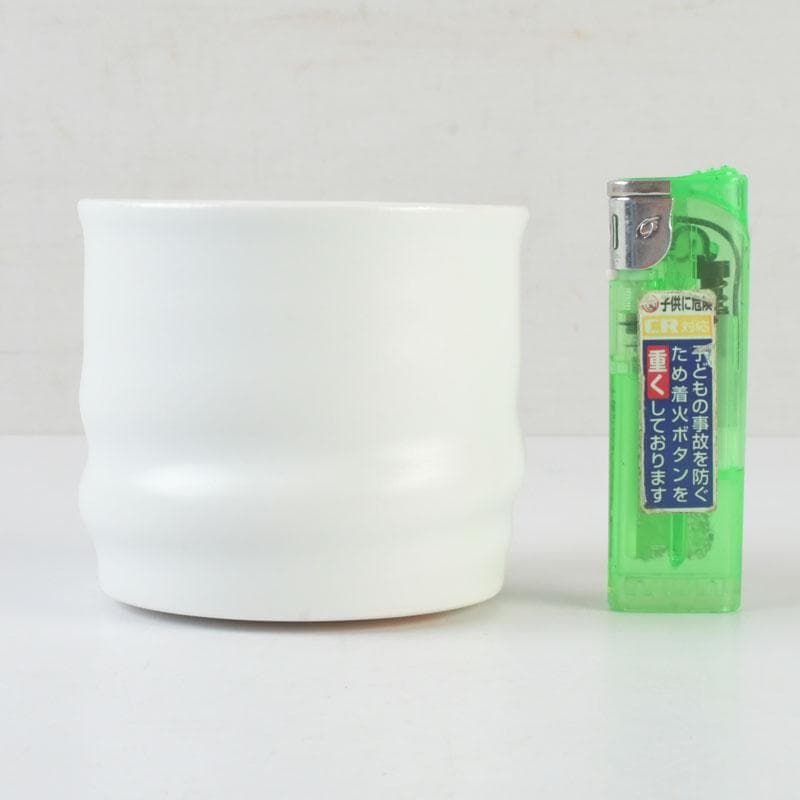
Experience Authentic Japanese Tea Ceremony Art with this Mino Ware Ceramic cup. This Shimizu Hisanobu shakuhai serves as a Japanese Tea Ceremony vessel and White Porcelain Cup, featuring Celadon Pooling and a Bamboo Form Vessel design — a compelling addition for any Chado Utensil collector seeking Contemporary Ceramics with a Signed Tomobako Box.
🔹 [ Basic Details ] • Artist: Shimizu Hisanobu (清水久伸) • Kiln: Mokugenji kiln (木欒字窯), Mino • Technique: White porcelain with celadon pooling interior • Era: Contemporary (2000–2006) • Origin: Mino, Gifu Prefecture, Japan • Dimensions: Height approx. 7.3 cm, Width approx. 8 cm, Weight approx. 185 g • Box: Signed tomobako with maker's pamphlet • Condition: Excellent — no chips, cracks, or repairs
🔹 [ Cultural & Artistic Insight ] The shakuhai traces its lineage to ancient Chinese bronze ritual vessels. In the Japanese ceramic tradition, it was reimagined as a tall cup for sake or tea — a form that carries ceremony in its proportions. Shimizu's interpretation at Mokugenji kiln distills the form to its essentials: pure white porcelain, a bamboo-node waist that interrupts the vertical, and a faint celadon pooling where the glaze gathers inside.
Mino ware — one of Japan's oldest ceramic traditions — has always prized restraint over decoration. This cup does not perform. It holds.
"The celadon that pools within this cup arrives uninvited — quiet evidence of what fire decides on its own."
🔹 [ Deep-Dive Commentary ] Mino ceramics encompass a vast range of styles — Shino, Oribe, Ki-Seto, Setoguro — but the white porcelain tradition represents Mino's dialogue with purity itself. The Mokugenji kiln maintains this conversation.
The shakuhai form demands precision in proportion. Too wide, and it loses verticality. Too narrow, and it cannot hold presence. The bamboo-node waist is both structural and symbolic: bamboo represents resilience and integrity in East Asian aesthetics.
The celadon pooling inside occurs naturally during firing as the glaze flows and settles. It is not applied — it is permitted. This is the difference between decoration and phenomenon.
🔹 [ SHIPPING & PACKAGING ] • Dispatch: Within 1-6 business days • Carrier: Japan Post EMS / UPS (with tracking) • Packaging: Carefully wrapped with protective materials