1
/
of
8
Maki-e Lacquer Tea Scoop by Yamauchi Seiji | Pine Arabesque Pattern | Gold on Black | Signed Box
Maki-e Lacquer Tea Scoop by Yamauchi Seiji | Pine Arabesque Pattern | Gold on Black | Signed Box
Regular price
Dhs. 992.00 AED
Regular price
Sale price
Dhs. 992.00 AED
Taxes included.
Shipping calculated at checkout.
Gold laid over black, pine and vine tracing the length of a single scoop — an object that refuses to be overlooked.
🔹 [ Cultural & Artistic Insight ]
The chashaku is ordinarily bamboo: plain, perishable, personal. It is among the few tea utensils that a host might carve themselves, and the many that a master might give as a named gift. That almost every chashaku in the tradition is unadorned bamboo makes this one — entirely covered in maki-e lacquer — a significant departure. Yamauchi Seiji works in the discipline of maki-e, the technique of applying gold and silver powders to wet lacquer to build patterns that catch light at varying angles. The craft requires patience of an order that is difficult to describe in functional terms.
The pattern here is matsu-karakusa-mon: pine arabesque. The pine (matsu) is one of the cardinal motifs of Japanese culture — evergreen, enduring through winter, associated with longevity and constancy. Karakusa (arabesque) is the continuous vine scroll that travels from Chinese decorative arts into Japanese lacquer, textiles, and ceramics, adapting over centuries into forms that feel both formal and organic. The combination runs the full length of the scoop on a black lacquer ground, visible only in the light that strikes it.
🔹 [ Deep-Dive Commentary ]
A lacquer chashaku is not contradictory, but it does occupy a different space than its bamboo counterpart. Where bamboo is biodegradable and personal, lacquer is durable and declarative. A piece like this belongs to formal tea — a context where the host makes deliberate choices about objects that communicate without words. The selection of a maki-e chashaku says: this occasion is one that warranted additional consideration.
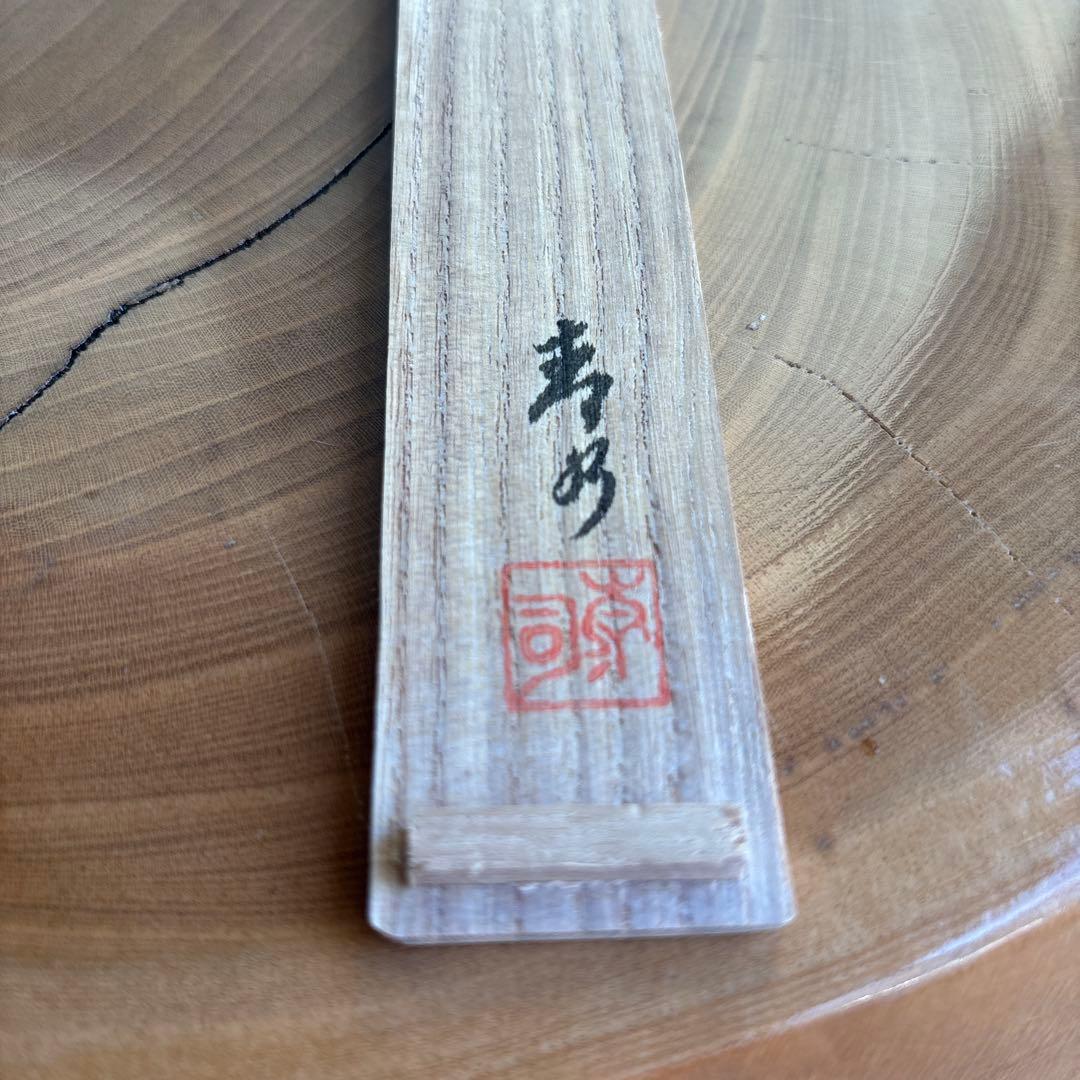
Yamauchi Seiji has applied the pine arabesque without interruption across the scoop's entire surface — the front, the reverse, the ha (blade), the koshi (waist), the tsukurikomi (shaft). There is no resting space in the design, yet it does not feel agitated. The gold against black has its own quietness at a distance; the pattern reveals itself only to those who come close. The piece is stored in its wooden box (kibako), which has been inscribed by the maker.
[ JAPANESE DESCRIPTION / 日本語解説 ]
茶杓はほとんどの場合、無地の竹でつくられます。師匠みずから削ることもある、茶道において最も個人的な道具のひとつです。その慣習の中にあって、全面に蒔絵を施したこの茶杓は、静かな異例として際立ちます。山内清司は蒔絵を専門とする漆芸家であり、乾かない漆の上に金粉・銀粉を蒔いて文様を描く、精密な工程を要する技術を扱います。
文様は松唐草文──常緑の松と連続する唐草の組み合わせです。松は長寿と不変を象徴する図像として日本文化に深く根付き、唐草は中国装飾美術に起源を持ちながら日本の漆器・染織・陶磁器の中で独自の展開を遂げてきました。黒漆地に金で描かれたその文様は、茶杓の全面を覆いながらも、近づいて初めてその細部が現れます。木箱付き、作者銘入り。
🔹 [ BASIC DETAILS ]
- Length: 18.7 cm
- Technique: Maki-e (gold lacquer on black lacquer ground)
- Pattern: Matsu-karakusa-mon (pine arabesque) applied to full surface
- Artist: Yamauchi Seiji (山内清司), lacquer specialist
- Condition: Good; decoration intact, full coverage
🔹 [ Includes ]
- Maki-e lacquer tea scoop (chashaku)
- Signed wooden storage box (kibako)
🔹 [ SHIPPING & PACKAGING ]
• Dispatch: Within 1-6 business days
• Carrier: Japan Post EMS / UPS (with tracking)
• Packaging: Carefully wrapped with protective materials
🔹 [ Cultural & Artistic Insight ]
The chashaku is ordinarily bamboo: plain, perishable, personal. It is among the few tea utensils that a host might carve themselves, and the many that a master might give as a named gift. That almost every chashaku in the tradition is unadorned bamboo makes this one — entirely covered in maki-e lacquer — a significant departure. Yamauchi Seiji works in the discipline of maki-e, the technique of applying gold and silver powders to wet lacquer to build patterns that catch light at varying angles. The craft requires patience of an order that is difficult to describe in functional terms.
The pattern here is matsu-karakusa-mon: pine arabesque. The pine (matsu) is one of the cardinal motifs of Japanese culture — evergreen, enduring through winter, associated with longevity and constancy. Karakusa (arabesque) is the continuous vine scroll that travels from Chinese decorative arts into Japanese lacquer, textiles, and ceramics, adapting over centuries into forms that feel both formal and organic. The combination runs the full length of the scoop on a black lacquer ground, visible only in the light that strikes it.
🔹 [ Deep-Dive Commentary ]
A lacquer chashaku is not contradictory, but it does occupy a different space than its bamboo counterpart. Where bamboo is biodegradable and personal, lacquer is durable and declarative. A piece like this belongs to formal tea — a context where the host makes deliberate choices about objects that communicate without words. The selection of a maki-e chashaku says: this occasion is one that warranted additional consideration.
Yamauchi Seiji has applied the pine arabesque without interruption across the scoop's entire surface — the front, the reverse, the ha (blade), the koshi (waist), the tsukurikomi (shaft). There is no resting space in the design, yet it does not feel agitated. The gold against black has its own quietness at a distance; the pattern reveals itself only to those who come close. The piece is stored in its wooden box (kibako), which has been inscribed by the maker.
[ JAPANESE DESCRIPTION / 日本語解説 ]
茶杓はほとんどの場合、無地の竹でつくられます。師匠みずから削ることもある、茶道において最も個人的な道具のひとつです。その慣習の中にあって、全面に蒔絵を施したこの茶杓は、静かな異例として際立ちます。山内清司は蒔絵を専門とする漆芸家であり、乾かない漆の上に金粉・銀粉を蒔いて文様を描く、精密な工程を要する技術を扱います。
文様は松唐草文──常緑の松と連続する唐草の組み合わせです。松は長寿と不変を象徴する図像として日本文化に深く根付き、唐草は中国装飾美術に起源を持ちながら日本の漆器・染織・陶磁器の中で独自の展開を遂げてきました。黒漆地に金で描かれたその文様は、茶杓の全面を覆いながらも、近づいて初めてその細部が現れます。木箱付き、作者銘入り。
🔹 [ BASIC DETAILS ]
- Length: 18.7 cm
- Technique: Maki-e (gold lacquer on black lacquer ground)
- Pattern: Matsu-karakusa-mon (pine arabesque) applied to full surface
- Artist: Yamauchi Seiji (山内清司), lacquer specialist
- Condition: Good; decoration intact, full coverage
🔹 [ Includes ]
- Maki-e lacquer tea scoop (chashaku)
- Signed wooden storage box (kibako)
🔹 [ SHIPPING & PACKAGING ]
• Dispatch: Within 1-6 business days
• Carrier: Japan Post EMS / UPS (with tracking)
• Packaging: Carefully wrapped with protective materials
Quantity
Couldn't load pickup availability
Low stock: 1 left
View full details