1
/
of
11
Kyoto Ninsei-style Chawan 'Haru no Michi' by Hashimoto Eihō, Wood Box
Kyoto Ninsei-style Chawan 'Haru no Michi' by Hashimoto Eihō, Wood Box
Regular price
Dhs. 773.00 AED
Regular price
Sale price
Dhs. 773.00 AED
Taxes included.
Shipping calculated at checkout.
Pine branches in gold overglaze against white porcelain — a path into spring named before the first step is taken.
🔹 [ Cultural & Artistic Insight ]
Nonomura Ninsei, the seventeenth-century Kyoto potter, changed the calculus of Japanese ceramics by insisting that the surface of a tea bowl could carry the same ambition as a painted scroll. His utsushi — pieces made in his spirit — became a tradition of their own: not forgery, not nostalgia, but a conversation across time about what refined taste looks like when rendered in clay and pigment.
Hashimoto Eihō works within that Kyō-yaki lineage, producing pieces that are understood immediately as belonging to the capital's aesthetic inheritance: white body, overglaze enamel decoration, gold applied with precision. The piece is named Haru no Michi — Spring Path — a seasonal designation that situates the bowl within the tea calendar. In chanoyu, seasonal alignment is not optional; the host's choice of implements announces the time of year, the moment of ceremony, the quality of attention.
The motif — pine branches rendered in overglaze with gold accent — carries deliberate resonance. Pine in Japanese visual culture does not represent spring exclusively, but its combination with the gold field and the named season constructs a specific register: the formality of early spring, when the ground has not yet softened, when the ceremony acknowledges the cold even as it reaches toward warmth.
🔹 [ Deep-Dive Commentary ]
Kyō-yaki chawan in the Ninsei-style occupy a distinct position within the tea world: they are hosted at formal occasions, their vivid surfaces understood as festive rather than austere, their craftsmanship read as the host's investment in the guest's experience. They are not wabi bowls — they do not suppress beauty. They present it without apology, in the manner of a host who has chosen flowers over empty space.
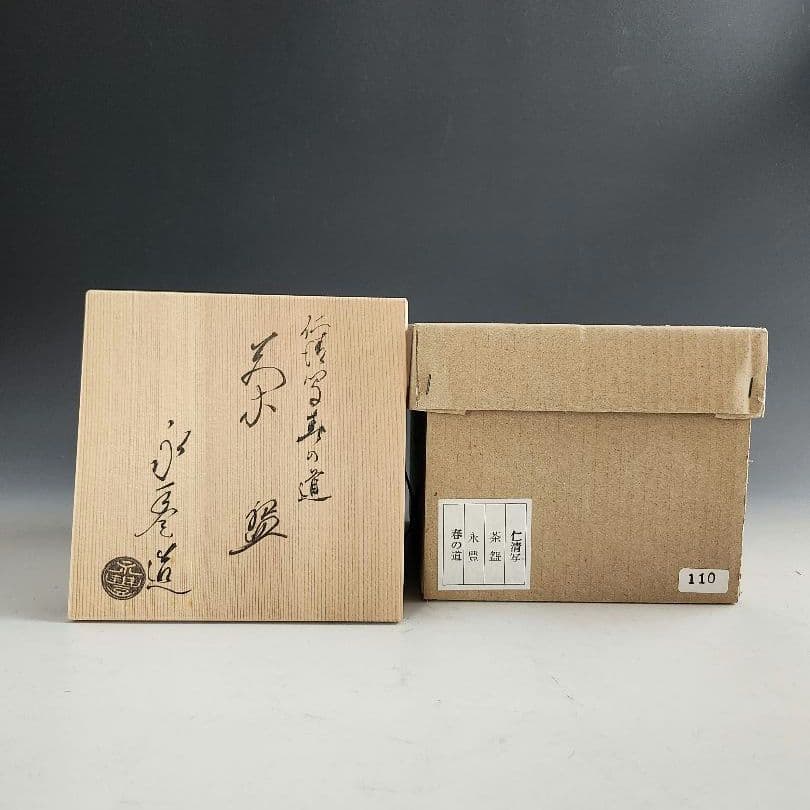
Hashimoto Eihō's execution shows the discipline that separates competent Ninsei-utsushi from the form at its best: the gold does not overwhelm, the enamel sits at the right weight, the bowl functions as a drinking vessel without compromising the surface. The kiribako (paulownia wood box) and additional paper box provide appropriate protection and appropriate framing for seasonal presentation.
[ JAPANESE DESCRIPTION / 日本語解説 ]
橋本永豊作、仁清写「春の道」茶碗。京焼の精華である白地上絵に金彩を施し、松の枝を春の訪れとともに描く。季節の茶碗として、この作品は単なる器以上の役割を持つ。亭主がこの碗を選ぶ行為そのものが、客に向けた春の挨拶となる。
野々村仁清が開いた「器の表面に絵画と同等の意欲を持ち込む」という伝統の中で、橋本永豊はその継承者として丁寧な仕事を見せる。金彩の量、上絵の重さ、飲み口の整い方——いずれも京焼の正統な語法に従いながら、同時に使い手の春の記憶に語りかけてくる。木箱・紙箱付き。
🔹 [ BASIC DETAILS ]
- Dimensions: D 11.8 cm × H 7.5 cm
- Condition: Good; overglaze enamel and gold decoration intact; no chips or cracks observed
- Style: Ninsei-utsushi (in the manner of Nonomura Ninsei)
- Ware: Kyō-yaki (Kyoto ceramic)
- Maker: Hashimoto Eihō (橋本永豊)
- Season: Spring (appropriate for spring tea gatherings)
- Motif: Pine branches with gold overglaze on white ground
🔹 [ Includes ]
- Chawan (matcha tea bowl)
- Kiribako (paulownia wood box)
- Additional paper storage box
🔹 [ SHIPPING & PACKAGING ]
• Dispatch: Within 1-6 business days
• Carrier: Japan Post EMS / UPS (with tracking)
• Packaging: Carefully wrapped with protective materials
🔹 [ Cultural & Artistic Insight ]
Nonomura Ninsei, the seventeenth-century Kyoto potter, changed the calculus of Japanese ceramics by insisting that the surface of a tea bowl could carry the same ambition as a painted scroll. His utsushi — pieces made in his spirit — became a tradition of their own: not forgery, not nostalgia, but a conversation across time about what refined taste looks like when rendered in clay and pigment.
Hashimoto Eihō works within that Kyō-yaki lineage, producing pieces that are understood immediately as belonging to the capital's aesthetic inheritance: white body, overglaze enamel decoration, gold applied with precision. The piece is named Haru no Michi — Spring Path — a seasonal designation that situates the bowl within the tea calendar. In chanoyu, seasonal alignment is not optional; the host's choice of implements announces the time of year, the moment of ceremony, the quality of attention.
The motif — pine branches rendered in overglaze with gold accent — carries deliberate resonance. Pine in Japanese visual culture does not represent spring exclusively, but its combination with the gold field and the named season constructs a specific register: the formality of early spring, when the ground has not yet softened, when the ceremony acknowledges the cold even as it reaches toward warmth.
🔹 [ Deep-Dive Commentary ]
Kyō-yaki chawan in the Ninsei-style occupy a distinct position within the tea world: they are hosted at formal occasions, their vivid surfaces understood as festive rather than austere, their craftsmanship read as the host's investment in the guest's experience. They are not wabi bowls — they do not suppress beauty. They present it without apology, in the manner of a host who has chosen flowers over empty space.
Hashimoto Eihō's execution shows the discipline that separates competent Ninsei-utsushi from the form at its best: the gold does not overwhelm, the enamel sits at the right weight, the bowl functions as a drinking vessel without compromising the surface. The kiribako (paulownia wood box) and additional paper box provide appropriate protection and appropriate framing for seasonal presentation.
[ JAPANESE DESCRIPTION / 日本語解説 ]
橋本永豊作、仁清写「春の道」茶碗。京焼の精華である白地上絵に金彩を施し、松の枝を春の訪れとともに描く。季節の茶碗として、この作品は単なる器以上の役割を持つ。亭主がこの碗を選ぶ行為そのものが、客に向けた春の挨拶となる。
野々村仁清が開いた「器の表面に絵画と同等の意欲を持ち込む」という伝統の中で、橋本永豊はその継承者として丁寧な仕事を見せる。金彩の量、上絵の重さ、飲み口の整い方——いずれも京焼の正統な語法に従いながら、同時に使い手の春の記憶に語りかけてくる。木箱・紙箱付き。
🔹 [ BASIC DETAILS ]
- Dimensions: D 11.8 cm × H 7.5 cm
- Condition: Good; overglaze enamel and gold decoration intact; no chips or cracks observed
- Style: Ninsei-utsushi (in the manner of Nonomura Ninsei)
- Ware: Kyō-yaki (Kyoto ceramic)
- Maker: Hashimoto Eihō (橋本永豊)
- Season: Spring (appropriate for spring tea gatherings)
- Motif: Pine branches with gold overglaze on white ground
🔹 [ Includes ]
- Chawan (matcha tea bowl)
- Kiribako (paulownia wood box)
- Additional paper storage box
🔹 [ SHIPPING & PACKAGING ]
• Dispatch: Within 1-6 business days
• Carrier: Japan Post EMS / UPS (with tracking)
• Packaging: Carefully wrapped with protective materials
Quantity
Couldn't load pickup availability
Low stock: 1 left
View full details