1
/
of
13
Kyō-yaki Pine-and-Plum Kinsai Chawan by Sugita Shōhei, Ōban Seal — Seikanji-gama, Kyoto
Kyō-yaki Pine-and-Plum Kinsai Chawan by Sugita Shōhei, Ōban Seal — Seikanji-gama, Kyoto
Regular price
Dhs. 2,899.00 AED
Regular price
Sale price
Dhs. 2,899.00 AED
Taxes included.
Shipping calculated at checkout.
Kyō-yaki carries within it a particular quality of attention. It is the ceramic tradition of the imperial capital — shaped over centuries by the proximity of court, temple, and the tea houses of Kyoto's chōnin merchant class. Where Raku chose silence, Kyō-yaki chose language: pictorial, gold-accented, compositionally deliberate. This chawan speaks that language with clarity.
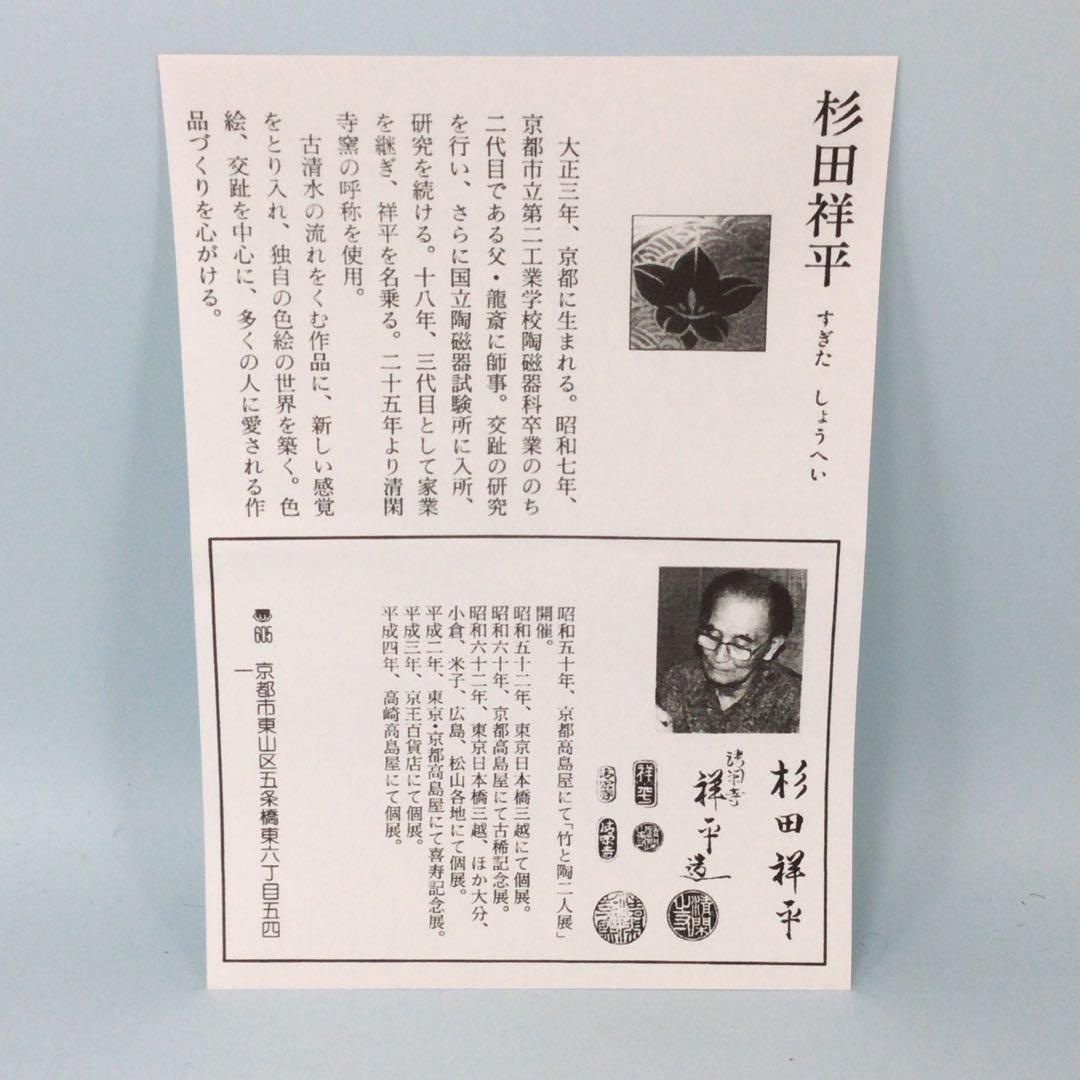
It is the work of Sugita Shōhei, a kiln master working at Seikanji-gama (清閑寺窯) in Kyoto. Seikanji-gama draws its name from the ancient temple precinct on the eastern slopes of Higashiyama — a neighborhood historically associated with refined craft, poetry, and the quiet industry of the artisan quarter. The kiln operates within the Kyō-yaki lineage established by Nonomura Ninsei and Ogata Kenzan: overglaze enamel painting on a warm ivory body, where the ground itself becomes part of the composition.
The motif here is shōbai (松梅) — pine and plum together. This pairing is among the most culturally freighted in the Japanese decorative canon. Pine (matsu) carries longevity and constancy, its evergreen needles unchanging through winter. Plum (ume) signals endurance and renewal — the first flowering before the frost has fully lifted, the announcement of spring before spring has arrived. Together, they form an auspice that moves from the New Year through the first weeks of the season: life that holds through cold, life that arrives before expected.
In this bowl, both motifs are rendered in kinsai — applied gold, fired at low temperature to fuse with the glaze surface. The pine is given body and tonal depth: teal-painted needle clusters over gold-washed branches, the trunk twisting upward with the unhurried gravity of a living form. The ume appears on the opposite face, its branches delicate in gold, blossoms suggested in red and ivory — a counterpoint in mood, where the pine is architectural, the plum is momentary.
Running between them, wrapping the lower body of the bowl, is a band of seigaiha (青海波) — the wave pattern of overlapping arcs, each one a scale of the sea. Seigaiha is one of the oldest continuous motifs in Japanese decorative arts, arriving through Tang Dynasty China and becoming deeply naturalized in court textile, lacquer, and ceramic. Its meaning is embedded in its structure: each arc overlapping the next, each wave giving way to the one that follows, the whole pattern asserting continuity without interruption. On a tea bowl, at the waterline of the composition, it grounds the sky-and-tree imagery in something older and unbroken.
The ōban (大判) seal is a designation specific to the internal hierarchy of the Seikanji workshop. Not all pieces carry it. Within the kiln's production economy, ōban designates a work of larger size and fuller compositional treatment — a piece allocated more painting time, more gold, more kiln attention. The seal does not signal a different hand so much as a different level of intentionality in the making. It is a workshop's way of marking which pieces it stands behind most fully.
The bowl is large in hand: H 7.8 cm × Dia 12.3 cm. The proportions are generous, the foot small and clean, the rim open. The ivory ground shows its crackle network — a characteristic of this body, age-deepened, not a flaw but a record. The tomobako is original, signed, and shows the kiln seal on the lid.
This is a bowl made within Kyoto's palace-adjacent decorative tradition — a tradition that understood gold not as excess but as another kind of restraint, used with precision to indicate what matters in the composition. The gold does not fill the ground. It moves across it.
🔹 [ BASIC DETAILS ]
🔹 [ CULTURAL & ARTISTIC INSIGHT ]
🔹 [ DEEP-DIVE COMMENTARY ]
🔹 [ 日本語解説 ]
清閑寺窯 杉田祥平による金彩松梅茶碗。大判の格付けを示す印あり、共箱付き。松と梅の縁起模様と青海波が金彩で丁寧に描かれた上手物の京焼抹茶碗。
🔹 [ SHIPPING & PACKAGING ]
• Dispatch: Within 1-6 business days
• Carrier: Japan Post EMS / UPS (with tracking)
• Packaging: Carefully wrapped with protective materials
It is the work of Sugita Shōhei, a kiln master working at Seikanji-gama (清閑寺窯) in Kyoto. Seikanji-gama draws its name from the ancient temple precinct on the eastern slopes of Higashiyama — a neighborhood historically associated with refined craft, poetry, and the quiet industry of the artisan quarter. The kiln operates within the Kyō-yaki lineage established by Nonomura Ninsei and Ogata Kenzan: overglaze enamel painting on a warm ivory body, where the ground itself becomes part of the composition.
The motif here is shōbai (松梅) — pine and plum together. This pairing is among the most culturally freighted in the Japanese decorative canon. Pine (matsu) carries longevity and constancy, its evergreen needles unchanging through winter. Plum (ume) signals endurance and renewal — the first flowering before the frost has fully lifted, the announcement of spring before spring has arrived. Together, they form an auspice that moves from the New Year through the first weeks of the season: life that holds through cold, life that arrives before expected.
In this bowl, both motifs are rendered in kinsai — applied gold, fired at low temperature to fuse with the glaze surface. The pine is given body and tonal depth: teal-painted needle clusters over gold-washed branches, the trunk twisting upward with the unhurried gravity of a living form. The ume appears on the opposite face, its branches delicate in gold, blossoms suggested in red and ivory — a counterpoint in mood, where the pine is architectural, the plum is momentary.
Running between them, wrapping the lower body of the bowl, is a band of seigaiha (青海波) — the wave pattern of overlapping arcs, each one a scale of the sea. Seigaiha is one of the oldest continuous motifs in Japanese decorative arts, arriving through Tang Dynasty China and becoming deeply naturalized in court textile, lacquer, and ceramic. Its meaning is embedded in its structure: each arc overlapping the next, each wave giving way to the one that follows, the whole pattern asserting continuity without interruption. On a tea bowl, at the waterline of the composition, it grounds the sky-and-tree imagery in something older and unbroken.
The ōban (大判) seal is a designation specific to the internal hierarchy of the Seikanji workshop. Not all pieces carry it. Within the kiln's production economy, ōban designates a work of larger size and fuller compositional treatment — a piece allocated more painting time, more gold, more kiln attention. The seal does not signal a different hand so much as a different level of intentionality in the making. It is a workshop's way of marking which pieces it stands behind most fully.
The bowl is large in hand: H 7.8 cm × Dia 12.3 cm. The proportions are generous, the foot small and clean, the rim open. The ivory ground shows its crackle network — a characteristic of this body, age-deepened, not a flaw but a record. The tomobako is original, signed, and shows the kiln seal on the lid.
This is a bowl made within Kyoto's palace-adjacent decorative tradition — a tradition that understood gold not as excess but as another kind of restraint, used with precision to indicate what matters in the composition. The gold does not fill the ground. It moves across it.
🔹 [ BASIC DETAILS ]
🔹 [ CULTURAL & ARTISTIC INSIGHT ]
🔹 [ DEEP-DIVE COMMENTARY ]
🔹 [ 日本語解説 ]
清閑寺窯 杉田祥平による金彩松梅茶碗。大判の格付けを示す印あり、共箱付き。松と梅の縁起模様と青海波が金彩で丁寧に描かれた上手物の京焼抹茶碗。
🔹 [ SHIPPING & PACKAGING ]
• Dispatch: Within 1-6 business days
• Carrier: Japan Post EMS / UPS (with tracking)
• Packaging: Carefully wrapped with protective materials
Quantity
Couldn't load pickup availability
Out of stock
View full details