1
/
of
12
Kutani Vase by Living National Treasure Tokuda Yasokichi III — Hekimei-yu Glaze
Kutani Vase by Living National Treasure Tokuda Yasokichi III — Hekimei-yu Glaze
Regular price
Dhs. 2,738.00 AED
Regular price
Sale price
Dhs. 2,738.00 AED
Taxes included.
Shipping calculated at checkout.
Experience Authentic Japan Art with this Kutani Ceramic Vase by Living National Treasure. This Hekimei Yosai Glaze Vase serves as a Museum Quality Ceramic and Japanese Art Collector Piece, featuring Azure Clarity Glaze Gradient and Tokuda Yasokichi Kutani Ware—a must-have for any Art Collector. There are objects that exist in the world of commerce and objects that exist in the world of art. This Kutani vase by Tokuda Yasokichi III — ningen kokuhō, Living National Treasure — belongs without question to the second category.
🔹 [ Basic Details ]
• Artist: Tokuda Yasokichi III (三代 徳田八十吉, 1933–2009), designated Living National Treasure (人間国宝) in 1997
• Technique: Yosai (耀彩) glaze — Tokuda's signature polychromatic azure-teal-purple gradient glaze
• Glaze Name: Hekimei-yu (碧明釉 — "Azure Clarity Glaze")
• Era: Late Showa – Heisei (c. 1980s–2000s)
• Origin: Kaga (Kutani ware), Ishikawa Prefecture, Japan
• Dimensions: Height approx. 19.5 cm, Diameter approx. 12.5 cm
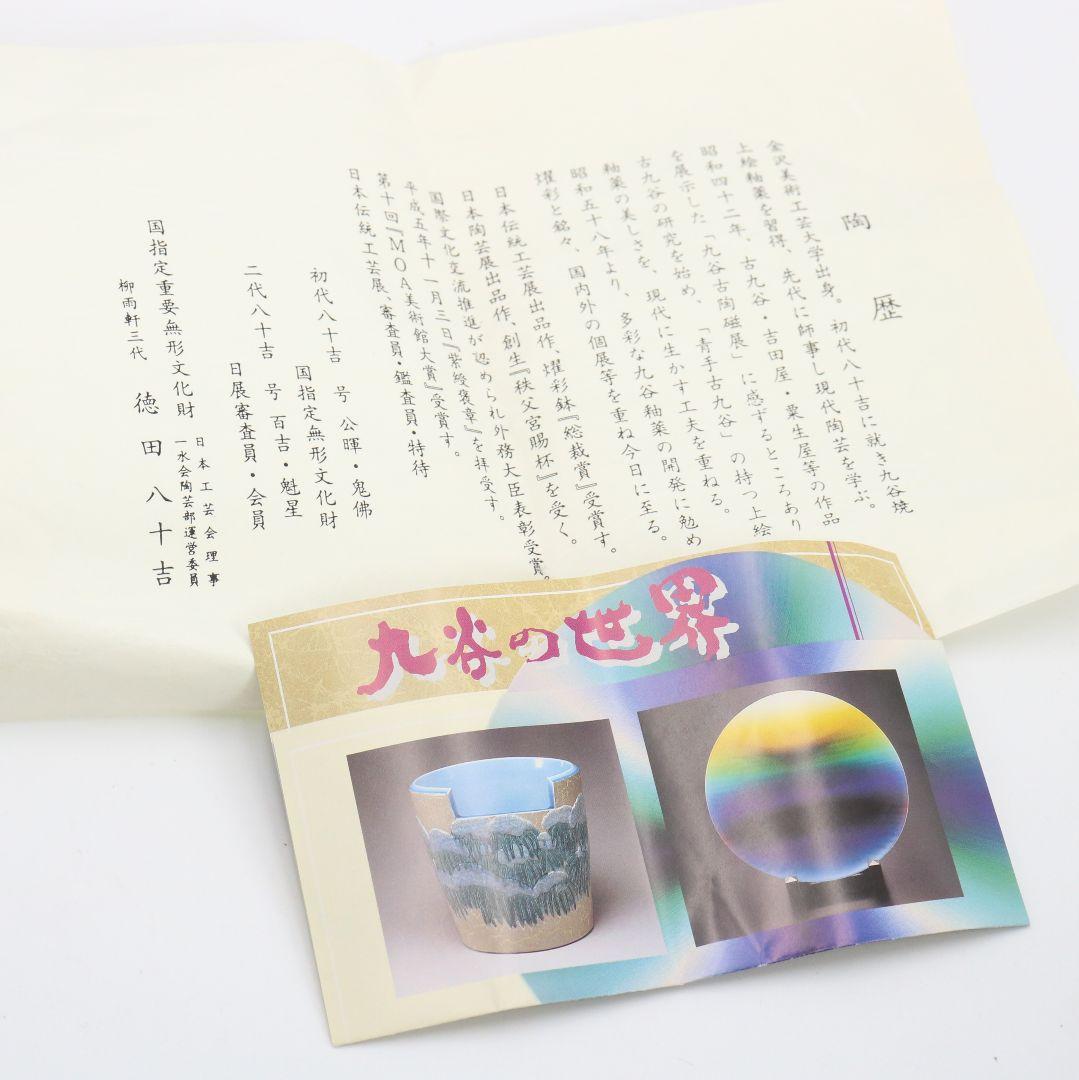
• Box: Shared wooden box with "Kutani no Sekai" label (共箱)
• Condition: Exceptional; glaze surface intact, colors vivid and luminous
🔹 [ Cultural & Artistic Insight ]
Tokuda Yasokichi III is one of the most significant ceramic artists Japan produced in the twentieth century. Designated Living National Treasure in 1997 specifically for his development of yosai (耀彩, "radiant color") glaze technique, he spent decades perfecting the ability to draw azure, teal, purple, and violet from the fire in a single, continuous field of color — a gradient that appears to shift and breathe depending on the light source and angle of view.
Hekimei-yu, the glaze employed here, translates as "Azure Clarity" — and the name is literal. The surface holds a depth that flat photography cannot capture. In hand, the glaze appears to have an interior luminosity, as though light is stored within the ceramic body itself.
Kutani ware (九谷焼) has a history stretching back to the seventeenth century, known for its bold polychromatic overglaze enamels. Tokuda Yasokichi III transformed this tradition by moving from figurative decoration toward pure color-field — an abstraction that connects Kutani to twentieth-century international painting while remaining entirely Japanese in its material origins.
POETIC LINE: "He did not paint the sky onto clay — he asked the kiln to remember what sky is, and it answered."
🔹 [ Deep-Dive Commentary ]
The Living National Treasure (人間国宝, ningen kokuhō) designation is awarded by Japan's Agency for Cultural Affairs to artists who embody and preserve intangible cultural properties of the highest order. As of the time of Tokuda Yasokichi III's death in 2009, fewer than 120 living individuals held this designation across all arts. In the domain of ceramics, Tokuda stood among the most technically innovative and historically significant.
Yosai glaze is not a single glaze — it is a system. Tokuda developed his signature technique over decades, learning to control the interaction of multiple glaze layers, kiln atmosphere, and temperature gradients to produce the signature azure-through-purple field. The effect appears effortless; the discipline behind it is total. Each piece required repeated firings, adjustments, and a willingness to accept that the kiln would make its own decisions within the range his technique established.
Hekimei-yu specifically refers to the cooler, clearer end of Tokuda's chromatic spectrum: the blue-green-aqua range that evokes both sky at high altitude and deep water. This glaze appears on pieces that Tokuda considered formally complete — the form and color in exact equilibrium.
The tsubo (壷, jar) form here is deliberately classical: broad shoulders tapering to a defined foot ring, with a narrow mouth that concentrates the color field at the top. This is not a decorative vessel designed for ikebana — it is a standalone ceramic sculpture whose function is to hold space and hold attention.
Owning a work by Tokuda Yasokichi III is not merely collecting Japanese ceramics. It is participating in the history of that tradition — holding an object that the Japanese nation itself recognized as a vessel for cultural continuity.
【日本語解説】
🔹 [ 基本情報 ]
• 作家:三代 徳田八十吉(1933–2009)、1997年人間国宝認定
• 技法:耀彩釉(ようさいゆう)— 青・青緑・紫が連続するグラデーション釉
• 釉薬名:碧明釉(へきめいゆう)
• 年代:昭和後期〜平成(1980年代〜2000年代)
• 産地:石川県加賀市(九谷焼)
• 寸法:高さ約19.5cm、径約12.5cm
• 箱:共箱(「九谷の世界」ラベル付き)
• 状態:極美。釉面完全、発色鮮明
🔹 [ 文化・芸術的背景 ]
三代徳田八十吉は、二十世紀日本が生んだ最も重要な陶芸家のひとりである。1997年、耀彩技法の開発と完成により人間国宝に認定。青から青緑、紫へと連続するグラデーションを一面の釉薬として表現する技術は、数十年の研究と無数の試作の産物である。碧明釉と命名されたこの釉薬は、高高度の空と深海の両方を想起させる静謐な青域を持ち、光源の角度によって表情が変化する。
🔹 [ 上級コレクター向け解説 ]
人間国宝制度は、日本の文化庁が無形文化財の体現者として最高水準の芸術家に付与する称号である。徳田逝去時(2009年)、全芸術分野でこの指定を受けていた存命の人物は120名未満であった。耀彩釉は単一の釉薬ではなく、複数の釉層・窯の雰囲気・温度勾配の制御により成立するシステムである。各作品は繰り返しの焼成と調整の産物であり、窯の自律性を認めた上で徳田が創出した固有の美の領域である。この壷はその完成形のひとつ。胴の肩の広がりと口部の収縮が生む緊張感が、碧明釉の色彩空間を最大限に活かしている。
🔹 [ SHIPPING & PACKAGING ]
• Dispatch: Within 1-6 business days
• Carrier: Japan Post EMS / UPS (with tracking)
• Packaging: Carefully wrapped with protective materials
🔹 [ Basic Details ]
• Artist: Tokuda Yasokichi III (三代 徳田八十吉, 1933–2009), designated Living National Treasure (人間国宝) in 1997
• Technique: Yosai (耀彩) glaze — Tokuda's signature polychromatic azure-teal-purple gradient glaze
• Glaze Name: Hekimei-yu (碧明釉 — "Azure Clarity Glaze")
• Era: Late Showa – Heisei (c. 1980s–2000s)
• Origin: Kaga (Kutani ware), Ishikawa Prefecture, Japan
• Dimensions: Height approx. 19.5 cm, Diameter approx. 12.5 cm
• Box: Shared wooden box with "Kutani no Sekai" label (共箱)
• Condition: Exceptional; glaze surface intact, colors vivid and luminous
🔹 [ Cultural & Artistic Insight ]
Tokuda Yasokichi III is one of the most significant ceramic artists Japan produced in the twentieth century. Designated Living National Treasure in 1997 specifically for his development of yosai (耀彩, "radiant color") glaze technique, he spent decades perfecting the ability to draw azure, teal, purple, and violet from the fire in a single, continuous field of color — a gradient that appears to shift and breathe depending on the light source and angle of view.
Hekimei-yu, the glaze employed here, translates as "Azure Clarity" — and the name is literal. The surface holds a depth that flat photography cannot capture. In hand, the glaze appears to have an interior luminosity, as though light is stored within the ceramic body itself.
Kutani ware (九谷焼) has a history stretching back to the seventeenth century, known for its bold polychromatic overglaze enamels. Tokuda Yasokichi III transformed this tradition by moving from figurative decoration toward pure color-field — an abstraction that connects Kutani to twentieth-century international painting while remaining entirely Japanese in its material origins.
POETIC LINE: "He did not paint the sky onto clay — he asked the kiln to remember what sky is, and it answered."
🔹 [ Deep-Dive Commentary ]
The Living National Treasure (人間国宝, ningen kokuhō) designation is awarded by Japan's Agency for Cultural Affairs to artists who embody and preserve intangible cultural properties of the highest order. As of the time of Tokuda Yasokichi III's death in 2009, fewer than 120 living individuals held this designation across all arts. In the domain of ceramics, Tokuda stood among the most technically innovative and historically significant.
Yosai glaze is not a single glaze — it is a system. Tokuda developed his signature technique over decades, learning to control the interaction of multiple glaze layers, kiln atmosphere, and temperature gradients to produce the signature azure-through-purple field. The effect appears effortless; the discipline behind it is total. Each piece required repeated firings, adjustments, and a willingness to accept that the kiln would make its own decisions within the range his technique established.
Hekimei-yu specifically refers to the cooler, clearer end of Tokuda's chromatic spectrum: the blue-green-aqua range that evokes both sky at high altitude and deep water. This glaze appears on pieces that Tokuda considered formally complete — the form and color in exact equilibrium.
The tsubo (壷, jar) form here is deliberately classical: broad shoulders tapering to a defined foot ring, with a narrow mouth that concentrates the color field at the top. This is not a decorative vessel designed for ikebana — it is a standalone ceramic sculpture whose function is to hold space and hold attention.
Owning a work by Tokuda Yasokichi III is not merely collecting Japanese ceramics. It is participating in the history of that tradition — holding an object that the Japanese nation itself recognized as a vessel for cultural continuity.
【日本語解説】
🔹 [ 基本情報 ]
• 作家:三代 徳田八十吉(1933–2009)、1997年人間国宝認定
• 技法:耀彩釉(ようさいゆう)— 青・青緑・紫が連続するグラデーション釉
• 釉薬名:碧明釉(へきめいゆう)
• 年代:昭和後期〜平成(1980年代〜2000年代)
• 産地:石川県加賀市(九谷焼)
• 寸法:高さ約19.5cm、径約12.5cm
• 箱:共箱(「九谷の世界」ラベル付き)
• 状態:極美。釉面完全、発色鮮明
🔹 [ 文化・芸術的背景 ]
三代徳田八十吉は、二十世紀日本が生んだ最も重要な陶芸家のひとりである。1997年、耀彩技法の開発と完成により人間国宝に認定。青から青緑、紫へと連続するグラデーションを一面の釉薬として表現する技術は、数十年の研究と無数の試作の産物である。碧明釉と命名されたこの釉薬は、高高度の空と深海の両方を想起させる静謐な青域を持ち、光源の角度によって表情が変化する。
🔹 [ 上級コレクター向け解説 ]
人間国宝制度は、日本の文化庁が無形文化財の体現者として最高水準の芸術家に付与する称号である。徳田逝去時(2009年)、全芸術分野でこの指定を受けていた存命の人物は120名未満であった。耀彩釉は単一の釉薬ではなく、複数の釉層・窯の雰囲気・温度勾配の制御により成立するシステムである。各作品は繰り返しの焼成と調整の産物であり、窯の自律性を認めた上で徳田が創出した固有の美の領域である。この壷はその完成形のひとつ。胴の肩の広がりと口部の収縮が生む緊張感が、碧明釉の色彩空間を最大限に活かしている。
🔹 [ SHIPPING & PACKAGING ]
• Dispatch: Within 1-6 business days
• Carrier: Japan Post EMS / UPS (with tracking)
• Packaging: Carefully wrapped with protective materials
Quantity
Couldn't load pickup availability
Out of stock
View full details