1
/
of
10
Kuro-Raku Chawan Matcha Tea Bowl by Heian Shunpo, Signed Box
Kuro-Raku Chawan Matcha Tea Bowl by Heian Shunpo, Signed Box
Regular price
Dhs. 671.00 AED
Regular price
Sale price
Dhs. 671.00 AED
Taxes included.
Shipping calculated at checkout.
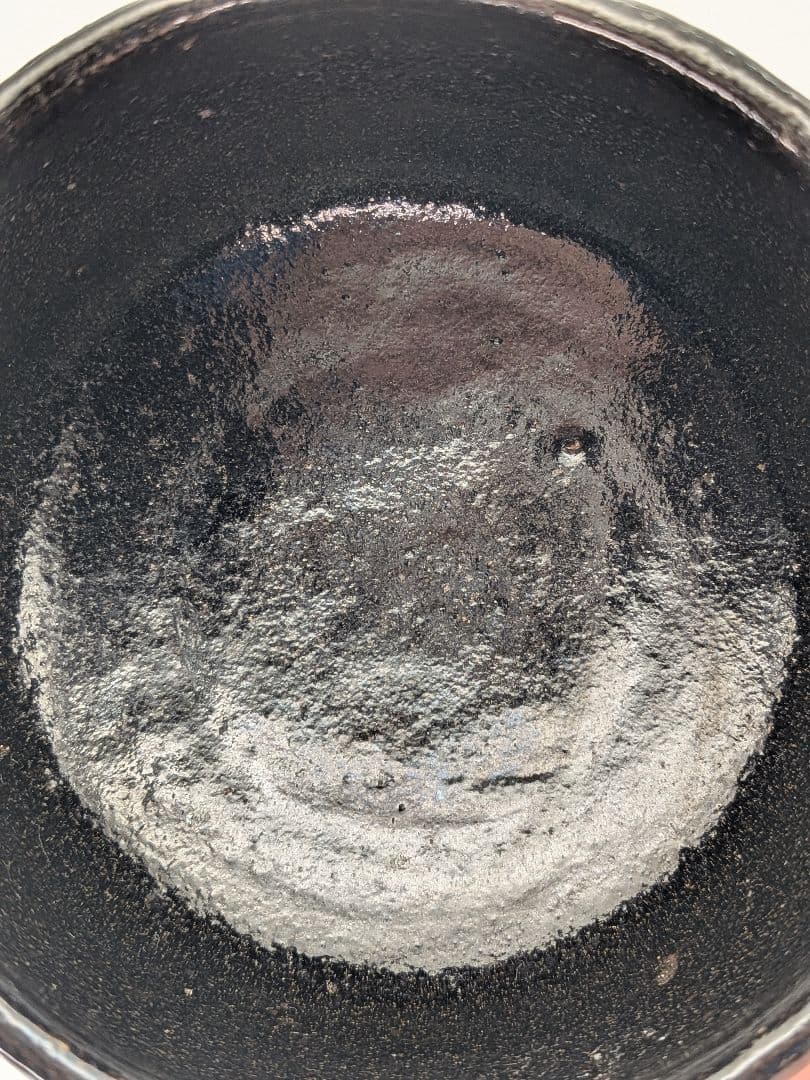
A kuro-raku chawan by Heian Shunpo (Inoue Shunpo) — hand-shaped in the raku tradition, the body drawn entirely by the maker's palms without the wheel. Black glaze pools deep at the well, and across the shoulder a tide of iron-red breaks through, unplanned, irreversible — the kiln's own authorship written into the surface.
🔹 [ BASIC DETAILS ]
• Artist: Heian Shunpo (平安春峰 / Inoue Shunpo), Kyoto raku lineage
• Technique: Kuro-raku (black raku) earthenware, hand-shaped (tezukuri / pinch/coil)
• Era: Late 20th century
• Origin: Kyoto, Japan (raku tradition)
• Dimensions: Height approx. 7.5 cm, Diameter approx. 10–10.5 cm
• Box: Original signed wooden box (tomobako) with brushwork inscription 茶盌 平安 春峰 and two red seal impressions
• Cloth: Original silk fukusa cloth (tomobuno) included — saffron-gold
• Condition: Very good. No chips, cracks, or repairs observed.
🔹 [ CULTURAL & ARTISTIC INSIGHT ]
Raku ware (楽焼) occupies a singular place in the history of Japanese tea ceramics. It was created in the 16th century by Chojiro, under the aesthetic guidance of tea master Sen no Rikyu, as a deliberate rejection of Chinese porcelain ideals then dominant in aristocratic taste. Where Chinese ware prized regularity and translucency, raku prized weight in the hand, silence in the form, and the dark interior that made a bowl of green tea appear luminous by contrast.
Kuro-raku — black raku — achieves its depth through a lead-free black glaze applied over a low-fire clay body, drawn from the kiln while still glowing and allowed to cool in the open air rather than in a reducing chamber. This rapid cooling fixes the glaze in mid-transformation: what appears as a single "black" is in fact a layered geology of blue-black, charcoal, iron-brown, and the occasional burst of red where iron in the clay body migrated upward through the glaze under heat.
The hand of Heian Shunpo is visible throughout. The rim wavers without wavering — its irregularity is intentional, shaped by pressure applied at exact moments in the clay's drying. The high shoulder that collapses gently inward toward the mouth is a silhouette that warms in the palm during use, the weight shifting as the bowl is rotated in the prescribed three turns of the chakai.
Poetic line: "The black holds everything — light, absence, the memory of fire."
🔹 [ DEEP-DIVE COMMENTARY ]
The raku tradition in Kyoto is among the most closely held in Japanese ceramics. The Raku family (楽家) has maintained continuity of technique for fifteen generations, and the aesthetic principles established under Rikyu's oversight — wabi-cha, the aesthetic of deliberate imperfection and quiet sufficiency — have never been disowned by the tradition's inheritors.
Heian Shunpo works within this lineage without being of the Raku family itself, a distinction significant to collectors. The broader category of "raku-kei" (raku-lineage) encompasses Kyoto potters who have absorbed the method — hand-building rather than wheel-throwing, low-temperature firing, glaze applied thickly and allowed to pool — while developing their own formal vocabulary. Shunpo's vocabulary favors a generous shoulder line and a deliberate asymmetry in the mouth that gives each piece a specific orientation: there is a front, a side, and a back.
The iron-red passages visible on this piece — appearing in patches across the upper body — are a kiln phenomenon referred to as "hi-iro" (fire color) or, in the broader raku context, as a form of natural yohen (kiln transformation). They are not applied; they are revealed. Their position on each piece is unique, unrepeatable, and cannot be designed in advance. Collectors of kuro-raku specifically seek pieces where the hi-iro is bold and well-placed — a quality judgment that the best examples demonstrate clearly.
For the practitioner of chado (the way of tea), the choice of bowl is itself a form of expression. A kuro-raku chawan — heavy, matte-to-the-touch where the glaze has broken, absorbing rather than reflecting light — creates a specific atmosphere in the tea room. Rikyu described it as the bowl that "disappears" in the hand, becoming part of the silence rather than an object within it. This piece carries that quality.
The tomobako (original signed box) confirms attribution and is an essential component of provenance for serious collectors. The calligraphy on the lid — 茶盌 平安 春峰, with two red seal impressions — is the maker's own hand, and the condition of the box itself (clean hinges, tight lid) reflects careful storage.
[ JAPANESE DESCRIPTION / 日本語解説 ]
平安春峰(井上春峰)による黒楽茶盌。轆轤を用いず、両の掌のみで形を立ち上げた手捏ね造り。深く落ち着いた黒釉が茶溜まりに向かって沈み込み、肩から胴にかけては緋色が一面に滲み出る——窯がひとりでに書いた、繰り返しのきかない景色である。
【基本情報】
• 作家: 平安春峰(井上春峰)京焼・楽系
• 技法: 黒楽焼、手捏ね造り
• 時代: 20世紀後半
• 産地: 京都(楽系)
• 寸法: 高さ約7.5cm、口径約10〜10.5cm
• 箱: 共箱(桐)・箱書き「茶盌 平安 春峰」落款印2顆
• 布: 橙色の共布付属
• 状態: 良好。欠け、ひび、金継ぎ等なし
【文化的背景と鑑賞のポイント】
楽焼は16世紀、千利休の指導のもと初代長次郎によって生み出された。中国磁器の均整を意図的に退け、手の重さ、沈黙する形、そして点前中に指が感じる温度を茶碗の美学とした。黒楽の深い黒は単色ではなく——青黒、炭灰、鉄錆、そして窯の温度が臨界を越えた瞬間に釉薬を突き破る緋色の重なりである。
春峰の手は作品全体に明確に宿っている。口縁の揺れは揺れながら揺れていない——乾燥の途中、正確な瞬間に加えた指圧がそのまま形に残った、意図ある不整形である。茶事において茶碗を三度回す所作のあいだ、この高い肩の稜線は掌のくぼみに収まり、重心が静かに移動する。
詩的な一文:「黒はすべてを収める——光も、不在も、火の記憶も。」
【上級コレクターのための解説】
楽家は十五代にわたって技法の連続性を保ってきた、日本陶芸史上もっとも閉じた家系のひとつである。平安春峰は楽家の直系ではなく「楽系」の作家であり、手捏ね・低温焼成・厚がけ釉という方法論を吸収しながら独自の形語を展開している。この区分はコレクターにとって重要な文脈である。
胴部に現れる緋色(火色)は施釉によるものではなく、焼成中に粘土体内の鉄分が釉薬を突き破って現れる自然窯変(陽炎)である。位置も濃度も制御不能であり、各作品に一度限りの固有性を与える。黒楽の収集において、この火色の力強さと位置の良さは重要な評価軸である。
共箱の存在は作品の来歴を確証する。蓋表の書「茶盌 平安 春峰」と二顆の落款印は作者直筆であり、箱の保存状態(蓋の嵌まり、蝶番の清潔さ)は長年の丁寧な保管を示している。
🔹 [ SHIPPING & PACKAGING ]
• Dispatch: Within 1-6 business days
• Carrier: Japan Post EMS / UPS / FedEx (with tracking)
• Packaging: Carefully wrapped with protective materials
🔹 [ BASIC DETAILS ]
• Artist: Heian Shunpo (平安春峰 / Inoue Shunpo), Kyoto raku lineage
• Technique: Kuro-raku (black raku) earthenware, hand-shaped (tezukuri / pinch/coil)
• Era: Late 20th century
• Origin: Kyoto, Japan (raku tradition)
• Dimensions: Height approx. 7.5 cm, Diameter approx. 10–10.5 cm
• Box: Original signed wooden box (tomobako) with brushwork inscription 茶盌 平安 春峰 and two red seal impressions
• Cloth: Original silk fukusa cloth (tomobuno) included — saffron-gold
• Condition: Very good. No chips, cracks, or repairs observed.
🔹 [ CULTURAL & ARTISTIC INSIGHT ]
Raku ware (楽焼) occupies a singular place in the history of Japanese tea ceramics. It was created in the 16th century by Chojiro, under the aesthetic guidance of tea master Sen no Rikyu, as a deliberate rejection of Chinese porcelain ideals then dominant in aristocratic taste. Where Chinese ware prized regularity and translucency, raku prized weight in the hand, silence in the form, and the dark interior that made a bowl of green tea appear luminous by contrast.
Kuro-raku — black raku — achieves its depth through a lead-free black glaze applied over a low-fire clay body, drawn from the kiln while still glowing and allowed to cool in the open air rather than in a reducing chamber. This rapid cooling fixes the glaze in mid-transformation: what appears as a single "black" is in fact a layered geology of blue-black, charcoal, iron-brown, and the occasional burst of red where iron in the clay body migrated upward through the glaze under heat.
The hand of Heian Shunpo is visible throughout. The rim wavers without wavering — its irregularity is intentional, shaped by pressure applied at exact moments in the clay's drying. The high shoulder that collapses gently inward toward the mouth is a silhouette that warms in the palm during use, the weight shifting as the bowl is rotated in the prescribed three turns of the chakai.
Poetic line: "The black holds everything — light, absence, the memory of fire."
🔹 [ DEEP-DIVE COMMENTARY ]
The raku tradition in Kyoto is among the most closely held in Japanese ceramics. The Raku family (楽家) has maintained continuity of technique for fifteen generations, and the aesthetic principles established under Rikyu's oversight — wabi-cha, the aesthetic of deliberate imperfection and quiet sufficiency — have never been disowned by the tradition's inheritors.
Heian Shunpo works within this lineage without being of the Raku family itself, a distinction significant to collectors. The broader category of "raku-kei" (raku-lineage) encompasses Kyoto potters who have absorbed the method — hand-building rather than wheel-throwing, low-temperature firing, glaze applied thickly and allowed to pool — while developing their own formal vocabulary. Shunpo's vocabulary favors a generous shoulder line and a deliberate asymmetry in the mouth that gives each piece a specific orientation: there is a front, a side, and a back.
The iron-red passages visible on this piece — appearing in patches across the upper body — are a kiln phenomenon referred to as "hi-iro" (fire color) or, in the broader raku context, as a form of natural yohen (kiln transformation). They are not applied; they are revealed. Their position on each piece is unique, unrepeatable, and cannot be designed in advance. Collectors of kuro-raku specifically seek pieces where the hi-iro is bold and well-placed — a quality judgment that the best examples demonstrate clearly.
For the practitioner of chado (the way of tea), the choice of bowl is itself a form of expression. A kuro-raku chawan — heavy, matte-to-the-touch where the glaze has broken, absorbing rather than reflecting light — creates a specific atmosphere in the tea room. Rikyu described it as the bowl that "disappears" in the hand, becoming part of the silence rather than an object within it. This piece carries that quality.
The tomobako (original signed box) confirms attribution and is an essential component of provenance for serious collectors. The calligraphy on the lid — 茶盌 平安 春峰, with two red seal impressions — is the maker's own hand, and the condition of the box itself (clean hinges, tight lid) reflects careful storage.
[ JAPANESE DESCRIPTION / 日本語解説 ]
平安春峰(井上春峰)による黒楽茶盌。轆轤を用いず、両の掌のみで形を立ち上げた手捏ね造り。深く落ち着いた黒釉が茶溜まりに向かって沈み込み、肩から胴にかけては緋色が一面に滲み出る——窯がひとりでに書いた、繰り返しのきかない景色である。
【基本情報】
• 作家: 平安春峰(井上春峰)京焼・楽系
• 技法: 黒楽焼、手捏ね造り
• 時代: 20世紀後半
• 産地: 京都(楽系)
• 寸法: 高さ約7.5cm、口径約10〜10.5cm
• 箱: 共箱(桐)・箱書き「茶盌 平安 春峰」落款印2顆
• 布: 橙色の共布付属
• 状態: 良好。欠け、ひび、金継ぎ等なし
【文化的背景と鑑賞のポイント】
楽焼は16世紀、千利休の指導のもと初代長次郎によって生み出された。中国磁器の均整を意図的に退け、手の重さ、沈黙する形、そして点前中に指が感じる温度を茶碗の美学とした。黒楽の深い黒は単色ではなく——青黒、炭灰、鉄錆、そして窯の温度が臨界を越えた瞬間に釉薬を突き破る緋色の重なりである。
春峰の手は作品全体に明確に宿っている。口縁の揺れは揺れながら揺れていない——乾燥の途中、正確な瞬間に加えた指圧がそのまま形に残った、意図ある不整形である。茶事において茶碗を三度回す所作のあいだ、この高い肩の稜線は掌のくぼみに収まり、重心が静かに移動する。
詩的な一文:「黒はすべてを収める——光も、不在も、火の記憶も。」
【上級コレクターのための解説】
楽家は十五代にわたって技法の連続性を保ってきた、日本陶芸史上もっとも閉じた家系のひとつである。平安春峰は楽家の直系ではなく「楽系」の作家であり、手捏ね・低温焼成・厚がけ釉という方法論を吸収しながら独自の形語を展開している。この区分はコレクターにとって重要な文脈である。
胴部に現れる緋色(火色)は施釉によるものではなく、焼成中に粘土体内の鉄分が釉薬を突き破って現れる自然窯変(陽炎)である。位置も濃度も制御不能であり、各作品に一度限りの固有性を与える。黒楽の収集において、この火色の力強さと位置の良さは重要な評価軸である。
共箱の存在は作品の来歴を確証する。蓋表の書「茶盌 平安 春峰」と二顆の落款印は作者直筆であり、箱の保存状態(蓋の嵌まり、蝶番の清潔さ)は長年の丁寧な保管を示している。
🔹 [ SHIPPING & PACKAGING ]
• Dispatch: Within 1-6 business days
• Carrier: Japan Post EMS / UPS / FedEx (with tracking)
• Packaging: Carefully wrapped with protective materials
Quantity
Couldn't load pickup availability
Low stock: 1 left
View full details