1
/
of
14
Kuro Raku Chawan 'Kokon' by Raku Seinyu XIII, Inscribed by Urasenke Hounsai - Kyoto Black Raku Tea Bowl with Tomobako
Kuro Raku Chawan 'Kokon' by Raku Seinyu XIII, Inscribed by Urasenke Hounsai - Kyoto Black Raku Tea Bowl with Tomobako
Regular price
Dhs. 4,803.00 AED
Regular price
Sale price
Dhs. 4,803.00 AED
Taxes included.
Shipping calculated at checkout.
A black Raku tea bowl (kuro raku chawan) by Raku Kichizaemon XIII, known as Seinyu (1887-1944), the thirteenth-generation head of the Raku family of Kyoto. The bowl bears the poetic name 'Kokon' (Ancient and Modern), inscribed on the tomobako by Urasenke Hounsai Soshitsu Sen XV (1923-2023), the fifteenth-generation grand master of the Urasenke school of tea, together with his kao (personal cipher). Four centuries of unbroken Raku lineage meet the authority of modern Urasenke in a single object.
🔹 [ BASIC DETAILS ]
• Artist: Raku Kichizaemon XIII (Seinyu) / Urasenke Hounsai inscription
• Origin: Kyoto, Japan
• Material: Raku ware with black (kuro) glaze
• Motif: Kokon (Ancient and Modern)
• Era: Before 1950
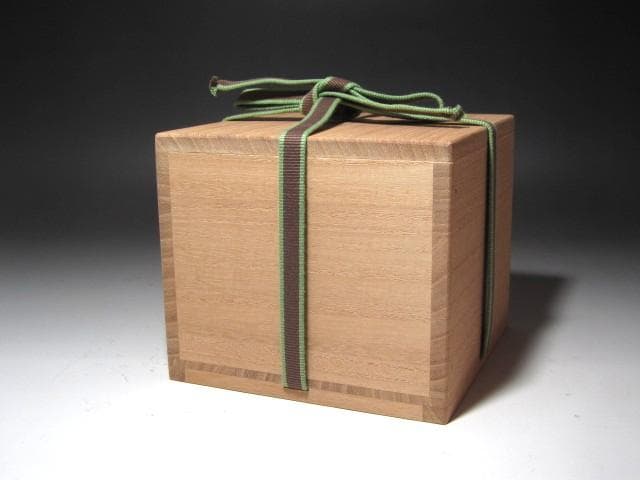
• Box: Tomobako (artist's wooden presentation box)
• Condition: Good, carefully inspected
🔹 [ Cultural & Artistic Insight ]
🔹 [ THE OBJECT ]
The form is a classic kuro raku silhouette - hand-shaped without the wheel, slightly irregular at the rim, standing on a low, quietly trimmed foot. The body is covered in the deep, matte-to-satin black glaze that defines the Raku tradition, built up in layers that hold the heat of the kiln within them. Across the upper wall, a broad band of copper-crimson breaks through the black like embers beneath ash - a natural landscape born of the low-temperature raku firing, where the glaze is pulled from the kiln at peak heat and allowed to cool in open air. The surface carries the soft tooling marks of the maker's spatula (hera) and the warmth of hands that shaped it directly from a single lump of clay.
Inside, the well deepens into quiet black, catching the green of matcha in a way that only Raku ware can. The foot ring is small and assured, the kodai cleanly carved, the overall weight light in the hand - the signature of a bowl made for drinking, not for display.
🔹 [ CULTURAL & ARTISTIC INSIGHT ]
The Raku family begins in the late sixteenth century with Chojiro, a tile-maker in Kyoto who, under the direct guidance of tea master Sen no Rikyu, created the first chawan conceived specifically for wabi-cha - the austere, inward-turning tea of Rikyu's vision. Rikyu sought a bowl stripped of ornament, stripped of the foreign glamour of imported Chinese ware, stripped even of the potter's wheel. Chojiro answered with hand-formed bowls of dark, quiet presence. From that moment, Raku ware became inseparable from the practice of tea itself, and the Raku line - passing from father to son, generation to generation - became the oldest continuous ceramic family in Japan.
Seinyu, the thirteenth generation, stood at the threshold between the old world and the modern one. He inherited the kiln in 1919, following the line of Kakukakusai, Ryonyu, Tannyu, Konyu, and Keinyu - names carried like torches through the Edo and Meiji eras. Seinyu worked through the Taisho and early Showa periods, years of upheaval in which many traditional crafts were tested by industrialisation and war. His response was to hold the center: to return, again and again, to the fundamental gesture of kuro raku - black glaze on hand-formed clay - and to let the firing speak. His bowls are known for their dense, thickly layered black glaze and for landscapes of warm red and copper where the oxidation breaks through, as it does across the rim of this piece.
The inscription on the tomobako raises the object onto a second plane of meaning. Hounsai Soshitsu Sen XV, the fifteenth grand master of Urasenke, led the largest school of Japanese tea for over half a century and carried chanoyu into the modern international world. A box signed and named by Hounsai is not a certificate of authenticity in the Western sense - it is a transmission. The master looked at the bowl, felt it in the hand, and gave it a name: 'Kokon' - ko (old) and kon (now), ancient and modern. The name turns the object into a statement. Here is a bowl made by the thirteenth Raku in a line that begins with Rikyu; here is a name given by the fifteenth Urasenke master in a line that descends from the same root. Old and now, held together in one vessel.
🔹 [ DEEP-DIVE COMMENTARY ]
To understand why a Raku bowl is made the way it is, one has to understand what it refuses. It refuses the wheel, which would make it symmetrical and fast. It refuses the high-fired stoneware kiln, which would make it hard and bright. It refuses glaze that pools and flows decoratively. What remains, after all these refusals, is the essential act: clay pressed and carved by hand, coated in lead-based black glaze, fired quickly in a small internal kiln, and lifted out while still glowing so that the glaze sets in the open air. The result is a body that is relatively soft and porous, a glaze that is matte and deep, and a surface that holds temperature gently against the palm.
🔹 [ Deep-Dive Commentary ]
For chanoyu, these qualities are not compromises. They are the reason. A Raku bowl warms slowly and cools slowly, so the drinker can hold it comfortably. The matte black absorbs light instead of reflecting it, so the bright green of whisked matcha appears against the surface like moss against wet stone. The hand-formed irregularity means no two bowls feel identical in the grip, and the bowl's orientation in the hand becomes part of the encounter. Every bowl is, in this sense, a one-person instrument.
On this bowl, the crimson band across the rim deserves particular attention. In kuro raku firing, the black glaze contains iron and manganese; when the bowl is pulled from the kiln at peak heat and exposed to oxygen, certain areas oxidise differently and flush with red, copper, or amber. The potter cannot fully control where this happens - he can only prepare the ground. Seinyu's generation inherited and refined a tradition of reading these firings almost as if they were weather: learning to coax a band of red across the rim, to leave the foot a quieter black, to let the inside remain deep. The 'landscape' (keshiki) of this bowl - a horizon of fire above a field of black - is exactly the kind of reading Hounsai would have recognised when he gave the bowl its name. Kokon: what is old about tea is the fire, what is new is the way we meet it today.
🔹 [ PROVENANCE & CONDITION ]
Accompanied by the original paulownia wood tomobako (storage box) with calligraphy and kao of Urasenke Hounsai Soshitsu Sen XV, naming the bowl 'Kokon.' A red silk shifuku-style cushion is included as pictured. The bowl itself is in fine preserved condition consistent with careful tea-ceremony storage, retaining the warmth and character of Seinyu's original firing. Please refer to the photographs as part of the description.
🔹 [ 日本語解説 ]
楽家十三代・惺入(せいにゅう、1887-1944)作の黒楽茶碗。裏千家十五代・鵬雲斎大宗匠(1923-2023)による共箱書付、銘「古今」、花押入。長次郎を祖とする四百年の楽家の宗家作と、現代裏千家の最高権威が一碗に重なります。
惺入は楽家十三代として大正八年に家督を継ぎ、大正・昭和初期の激動の中で、黒楽の根幹である手捏ね成形と低温本窯焼成を守り続けた近代楽家の中心人物です。厚く重ねられた黒釉と、口縁に走る赤銅色の景色は、惺入の黒楽が最も得意とした表情のひとつ。火中から鋏で引き出された瞬間に生まれる酸化の景色が、まさに「古今」の銘にふさわしい時間の痕跡として定着しています。
銘「古今」は、利休以来の古き心と、今この瞬間に点てる一服の茶を同時に受けとめる言葉。鵬雲斎大宗匠の箱書と花押は、この茶碗が茶の湯の現場で確かに用いられ、伝えられてきた器であることの証です。共箱・仕覆付。コレクターの方、または本格的な茶会でお使いになる方にふさわしい一碗です。
🔹 [ 日本語解説 ]
楽家十三代・惺入(1887-1944)作の黒楽茶碗。長次郎より連なる四百年の京楽家宗家作に、裏千家十五代・鵬雲斎大宗匠による銘「古今」の箱書と花押を伴う一碗です。手捏ね成形、低温本窯焼成による楽焼独特の温かな質感と、口縁に走る赤銅色の景色が惺入らしい表情を湛えています。古と今、利休以来の心と今点てる一服の茶が重なる銘にふさわしい存在感。
🔹 [ SHIPPING & PACKAGING ]
• Dispatch: Within 1-6 business days
• Carrier: Japan Post EMS / UPS (with tracking)
• Packaging: Carefully wrapped with protective materials
🔹 [ BASIC DETAILS ]
• Artist: Raku Kichizaemon XIII (Seinyu) / Urasenke Hounsai inscription
• Origin: Kyoto, Japan
• Material: Raku ware with black (kuro) glaze
• Motif: Kokon (Ancient and Modern)
• Era: Before 1950
• Box: Tomobako (artist's wooden presentation box)
• Condition: Good, carefully inspected
🔹 [ Cultural & Artistic Insight ]
🔹 [ THE OBJECT ]
The form is a classic kuro raku silhouette - hand-shaped without the wheel, slightly irregular at the rim, standing on a low, quietly trimmed foot. The body is covered in the deep, matte-to-satin black glaze that defines the Raku tradition, built up in layers that hold the heat of the kiln within them. Across the upper wall, a broad band of copper-crimson breaks through the black like embers beneath ash - a natural landscape born of the low-temperature raku firing, where the glaze is pulled from the kiln at peak heat and allowed to cool in open air. The surface carries the soft tooling marks of the maker's spatula (hera) and the warmth of hands that shaped it directly from a single lump of clay.
Inside, the well deepens into quiet black, catching the green of matcha in a way that only Raku ware can. The foot ring is small and assured, the kodai cleanly carved, the overall weight light in the hand - the signature of a bowl made for drinking, not for display.
🔹 [ CULTURAL & ARTISTIC INSIGHT ]
The Raku family begins in the late sixteenth century with Chojiro, a tile-maker in Kyoto who, under the direct guidance of tea master Sen no Rikyu, created the first chawan conceived specifically for wabi-cha - the austere, inward-turning tea of Rikyu's vision. Rikyu sought a bowl stripped of ornament, stripped of the foreign glamour of imported Chinese ware, stripped even of the potter's wheel. Chojiro answered with hand-formed bowls of dark, quiet presence. From that moment, Raku ware became inseparable from the practice of tea itself, and the Raku line - passing from father to son, generation to generation - became the oldest continuous ceramic family in Japan.
Seinyu, the thirteenth generation, stood at the threshold between the old world and the modern one. He inherited the kiln in 1919, following the line of Kakukakusai, Ryonyu, Tannyu, Konyu, and Keinyu - names carried like torches through the Edo and Meiji eras. Seinyu worked through the Taisho and early Showa periods, years of upheaval in which many traditional crafts were tested by industrialisation and war. His response was to hold the center: to return, again and again, to the fundamental gesture of kuro raku - black glaze on hand-formed clay - and to let the firing speak. His bowls are known for their dense, thickly layered black glaze and for landscapes of warm red and copper where the oxidation breaks through, as it does across the rim of this piece.
The inscription on the tomobako raises the object onto a second plane of meaning. Hounsai Soshitsu Sen XV, the fifteenth grand master of Urasenke, led the largest school of Japanese tea for over half a century and carried chanoyu into the modern international world. A box signed and named by Hounsai is not a certificate of authenticity in the Western sense - it is a transmission. The master looked at the bowl, felt it in the hand, and gave it a name: 'Kokon' - ko (old) and kon (now), ancient and modern. The name turns the object into a statement. Here is a bowl made by the thirteenth Raku in a line that begins with Rikyu; here is a name given by the fifteenth Urasenke master in a line that descends from the same root. Old and now, held together in one vessel.
🔹 [ DEEP-DIVE COMMENTARY ]
To understand why a Raku bowl is made the way it is, one has to understand what it refuses. It refuses the wheel, which would make it symmetrical and fast. It refuses the high-fired stoneware kiln, which would make it hard and bright. It refuses glaze that pools and flows decoratively. What remains, after all these refusals, is the essential act: clay pressed and carved by hand, coated in lead-based black glaze, fired quickly in a small internal kiln, and lifted out while still glowing so that the glaze sets in the open air. The result is a body that is relatively soft and porous, a glaze that is matte and deep, and a surface that holds temperature gently against the palm.
🔹 [ Deep-Dive Commentary ]
For chanoyu, these qualities are not compromises. They are the reason. A Raku bowl warms slowly and cools slowly, so the drinker can hold it comfortably. The matte black absorbs light instead of reflecting it, so the bright green of whisked matcha appears against the surface like moss against wet stone. The hand-formed irregularity means no two bowls feel identical in the grip, and the bowl's orientation in the hand becomes part of the encounter. Every bowl is, in this sense, a one-person instrument.
On this bowl, the crimson band across the rim deserves particular attention. In kuro raku firing, the black glaze contains iron and manganese; when the bowl is pulled from the kiln at peak heat and exposed to oxygen, certain areas oxidise differently and flush with red, copper, or amber. The potter cannot fully control where this happens - he can only prepare the ground. Seinyu's generation inherited and refined a tradition of reading these firings almost as if they were weather: learning to coax a band of red across the rim, to leave the foot a quieter black, to let the inside remain deep. The 'landscape' (keshiki) of this bowl - a horizon of fire above a field of black - is exactly the kind of reading Hounsai would have recognised when he gave the bowl its name. Kokon: what is old about tea is the fire, what is new is the way we meet it today.
🔹 [ PROVENANCE & CONDITION ]
Accompanied by the original paulownia wood tomobako (storage box) with calligraphy and kao of Urasenke Hounsai Soshitsu Sen XV, naming the bowl 'Kokon.' A red silk shifuku-style cushion is included as pictured. The bowl itself is in fine preserved condition consistent with careful tea-ceremony storage, retaining the warmth and character of Seinyu's original firing. Please refer to the photographs as part of the description.
🔹 [ 日本語解説 ]
楽家十三代・惺入(せいにゅう、1887-1944)作の黒楽茶碗。裏千家十五代・鵬雲斎大宗匠(1923-2023)による共箱書付、銘「古今」、花押入。長次郎を祖とする四百年の楽家の宗家作と、現代裏千家の最高権威が一碗に重なります。
惺入は楽家十三代として大正八年に家督を継ぎ、大正・昭和初期の激動の中で、黒楽の根幹である手捏ね成形と低温本窯焼成を守り続けた近代楽家の中心人物です。厚く重ねられた黒釉と、口縁に走る赤銅色の景色は、惺入の黒楽が最も得意とした表情のひとつ。火中から鋏で引き出された瞬間に生まれる酸化の景色が、まさに「古今」の銘にふさわしい時間の痕跡として定着しています。
銘「古今」は、利休以来の古き心と、今この瞬間に点てる一服の茶を同時に受けとめる言葉。鵬雲斎大宗匠の箱書と花押は、この茶碗が茶の湯の現場で確かに用いられ、伝えられてきた器であることの証です。共箱・仕覆付。コレクターの方、または本格的な茶会でお使いになる方にふさわしい一碗です。
🔹 [ 日本語解説 ]
楽家十三代・惺入(1887-1944)作の黒楽茶碗。長次郎より連なる四百年の京楽家宗家作に、裏千家十五代・鵬雲斎大宗匠による銘「古今」の箱書と花押を伴う一碗です。手捏ね成形、低温本窯焼成による楽焼独特の温かな質感と、口縁に走る赤銅色の景色が惺入らしい表情を湛えています。古と今、利休以来の心と今点てる一服の茶が重なる銘にふさわしい存在感。
🔹 [ SHIPPING & PACKAGING ]
• Dispatch: Within 1-6 business days
• Carrier: Japan Post EMS / UPS (with tracking)
• Packaging: Carefully wrapped with protective materials
Quantity
Couldn't load pickup availability
Low stock: 1 left
View full details