1
/
of
12
Kuro Raku Chawan by Sasaki Shoraku — Chonyu-Style Black Tea Bowl with Gold Flame Motif, Signed by Fukumoto Sekio of Daitoku-ji
Kuro Raku Chawan by Sasaki Shoraku — Chonyu-Style Black Tea Bowl with Gold Flame Motif, Signed by Fukumoto Sekio of Daitoku-ji
Regular price
Dhs. 772.00 AED
Regular price
Sale price
Dhs. 772.00 AED
Taxes included.
Shipping calculated at checkout.
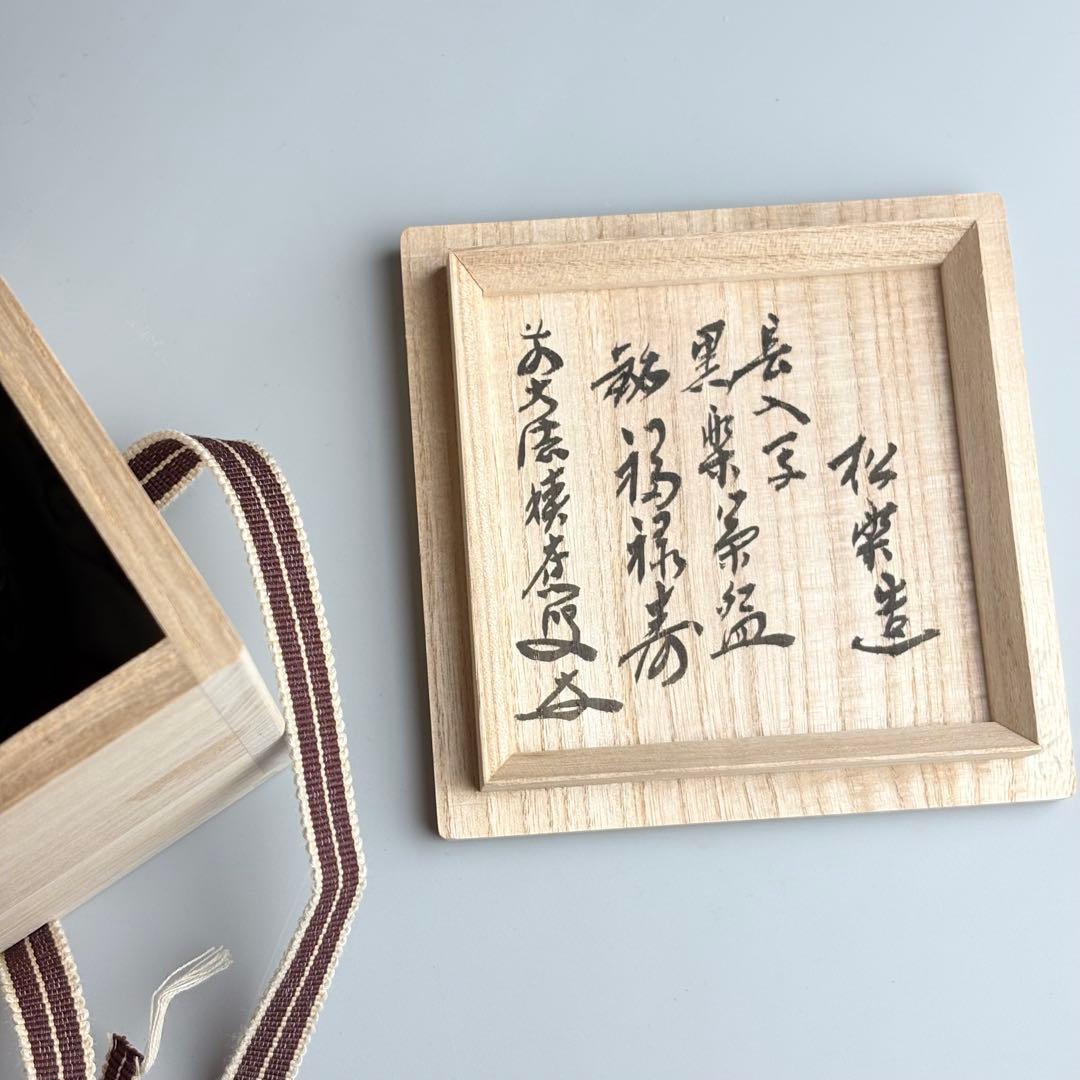
A kuro-raku chawan by Sasaki Shoraku, hand-formed in the Kyoto Raku tradition and finished in a deep tar-black glaze that carries hand-drawn gold across its face. The form follows Chonyu, the seventh-generation Raku master, in its low undulating rim and quiet weight; kinsai — painted gold — traces a rising flame and scrolling curl over the darkness, catching light only when the bowl is turned. The vessel arrives in its signed kiri-wood box, accompanied by a written attestation (hakogaki) from Fukumoto Sekio, a senior priest of Daitoku-ji.
🔹 [ BASIC DETAILS ]
• Artist: Sasaki Shoraku (佐々木松楽), Shoraku kiln, Kyoto
• Technique: Kuro-raku (black Raku) with kinsai gold overglaze painting
• Style: Chonyu-utsushi (after the 7th-generation Raku master, Chonyu)
• Attestation: Hakogaki (written box inscription) by Fukumoto Sekio (福本積應), senior priest of Daitoku-ji (前大徳)
• Era: Showa–Heisei period, 20th–21st century
• Origin: Kyoto, Japan
• Dimensions: Height approx. 8 cm, Diameter approx. 11 cm (please confirm against listing photographs)
• Box: Signed kiri (paulownia) tomobako with original cord
• Condition: Good, complete. No restoration observed; surface consistent with a lightly used or unused tea bowl
🔹 [ CULTURAL & ARTISTIC INSIGHT ]
Historical Context — Raku ware was born in 16th-century Kyoto in the workshop of Chojiro, shaped in dialogue with the tea master Sen no Rikyu. Each bowl is formed by hand rather than thrown on a wheel, then drawn from the kiln at peak heat — a method that binds the object to the moment of its making. The Shoraku kiln continues this lineage today in Kyoto.
Technique & Aesthetic — Kuro-raku, the black Raku glaze, is fired at high temperature and pulled quickly from the flames, producing the dense, tar-dark surface prized in the tea room. Against that darkness the kinsai gold reads as movement: a rising flame, a curling scroll, brushed by hand and fixed by a low secondary firing.
Philosophical Reflection — In the black bowl, the tea is a small green pool held in the dark; the gold does not decorate so much as it remembers fire.
🔹 [ DEEP-DIVE COMMENTARY ]
Chonyu (長入, 1714–1770) was the seventh head of the Raku line, remembered for generous, softly rounded forms and a warm handling of the black glaze. A Chonyu-utsushi is not an imitation but a study — a maker working through the earlier master's proportions to understand them from the inside. Sasaki Shoraku's reading here favors a low, settled body and a rim that rises and falls to the touch.
The kinsai painting sits within a long Kyoto practice of gold applied over dark Raku grounds. Because gold cannot survive the primary Raku firing, it is laid on afterward and set at low heat, which is why the line has the hesitant, hand-held quality of brushwork rather than the flatness of transfer decoration. On this bowl the gold is used sparingly, allowing the black to remain the subject.
The accompanying hakogaki carries particular weight for collectors. Fukumoto Sekio, a senior priest (前大徳, zen-daitoku) of Daitoku-ji — the Kyoto Zen temple historically bound to the way of tea — has inscribed the box in his own hand. Such a temple attestation is a mark of standing within the tea world and adds a layer of provenance that a maker's signature alone does not confer.
For the collector, the piece brings together three attributions in one object: the kiln (Shoraku), the historical model (Chonyu), and the priestly box inscription (Fukumoto Sekio). Each is legible on its own; together they place the bowl clearly within the Kyoto tea tradition.
In contemporary use, a bowl like this reaches beyond the tearoom — it holds the same presence on a shelf, in the hand, or beside a single flower, a dark form that quietly organizes the space around it.
🔹 [ 日本語解説 ]
【冒頭】
佐々木松楽による黒楽茶碗。京都・楽焼の伝統に則り手捏ねで成形され、漆黒の釉薬の上に金彩が描かれています。低くゆらぐ口縁と静かな重みは七代長入の作風を写したもの。金彩は闇の上に立ちのぼる炎と巻き紋を描き、茶碗を回したときにだけ光を返します。共箱に納められ、大徳寺の高僧・福本積應師による箱書が添えられています。
【基本情報】
・作家: 佐々木松楽(松楽窯・京都)
・技法: 黒楽 + 金彩上絵
・作風: 長入写(七代 長入に倣う)
・書付: 前大徳 福本積應師 箱書
・時代: 昭和〜平成(20〜21世紀)
・産地: 京都
・寸法: 高さ約8cm、口径約11cm(写真にてご確認ください)
・箱: 桐共箱・紐付き
・状態: 良好・完品。目立った直しは見られません
【文化的・芸術的背景】
楽焼は16世紀の京都、長次郎の工房で、茶人・千利休との対話のなかから生まれました。轆轤を使わず手で成形し、高温の窯から一碗ずつ引き出す——その手法が器を「生まれた瞬間」に結びつけます。松楽窯は今日もこの系譜を京都で受け継いでいます。黒楽は高温で焼き、炎から素早く引き出すことであの漆黒の肌を得ます。その闇の上を、金彩が炎のように流れます。黒い碗の中で、茶は暗がりに浮かぶ小さな緑の淵となり、金は装飾というより火の記憶として在ります。
【踏み込んだ解説】
長入(1714–1770)は楽家七代。ふくよかで丸みを帯びた作行きと、黒釉の温かな扱いで知られます。長入写とは模倣ではなく研究——先人の寸法を内側から理解しようとする営みです。金彩は本焼では残らないため後から低温で定着させ、その手描きの筆致が転写にはない躊躇いと温度を宿します。そして箱書。前大徳・福本積應師による自筆の箱書は、茶の湯と深く結ばれた大徳寺という寺格を背負い、作家の署名だけでは得られない来歴を加えます。窯(松楽)・写しの手本(長入)・箱書(福本積應師)——三つの拠り所が一碗に重なります。
🔹 [ SHIPPING & PACKAGING ]
• Dispatch: Within 1-6 business days
• Carrier: Japan Post EMS / UPS / FedEx (with tracking)
• Packaging: Carefully wrapped with protective materials
🔹 [ BASIC DETAILS ]
• Artist: Sasaki Shoraku (佐々木松楽), Shoraku kiln, Kyoto
• Technique: Kuro-raku (black Raku) with kinsai gold overglaze painting
• Style: Chonyu-utsushi (after the 7th-generation Raku master, Chonyu)
• Attestation: Hakogaki (written box inscription) by Fukumoto Sekio (福本積應), senior priest of Daitoku-ji (前大徳)
• Era: Showa–Heisei period, 20th–21st century
• Origin: Kyoto, Japan
• Dimensions: Height approx. 8 cm, Diameter approx. 11 cm (please confirm against listing photographs)
• Box: Signed kiri (paulownia) tomobako with original cord
• Condition: Good, complete. No restoration observed; surface consistent with a lightly used or unused tea bowl
🔹 [ CULTURAL & ARTISTIC INSIGHT ]
Historical Context — Raku ware was born in 16th-century Kyoto in the workshop of Chojiro, shaped in dialogue with the tea master Sen no Rikyu. Each bowl is formed by hand rather than thrown on a wheel, then drawn from the kiln at peak heat — a method that binds the object to the moment of its making. The Shoraku kiln continues this lineage today in Kyoto.
Technique & Aesthetic — Kuro-raku, the black Raku glaze, is fired at high temperature and pulled quickly from the flames, producing the dense, tar-dark surface prized in the tea room. Against that darkness the kinsai gold reads as movement: a rising flame, a curling scroll, brushed by hand and fixed by a low secondary firing.
Philosophical Reflection — In the black bowl, the tea is a small green pool held in the dark; the gold does not decorate so much as it remembers fire.
🔹 [ DEEP-DIVE COMMENTARY ]
Chonyu (長入, 1714–1770) was the seventh head of the Raku line, remembered for generous, softly rounded forms and a warm handling of the black glaze. A Chonyu-utsushi is not an imitation but a study — a maker working through the earlier master's proportions to understand them from the inside. Sasaki Shoraku's reading here favors a low, settled body and a rim that rises and falls to the touch.
The kinsai painting sits within a long Kyoto practice of gold applied over dark Raku grounds. Because gold cannot survive the primary Raku firing, it is laid on afterward and set at low heat, which is why the line has the hesitant, hand-held quality of brushwork rather than the flatness of transfer decoration. On this bowl the gold is used sparingly, allowing the black to remain the subject.
The accompanying hakogaki carries particular weight for collectors. Fukumoto Sekio, a senior priest (前大徳, zen-daitoku) of Daitoku-ji — the Kyoto Zen temple historically bound to the way of tea — has inscribed the box in his own hand. Such a temple attestation is a mark of standing within the tea world and adds a layer of provenance that a maker's signature alone does not confer.
For the collector, the piece brings together three attributions in one object: the kiln (Shoraku), the historical model (Chonyu), and the priestly box inscription (Fukumoto Sekio). Each is legible on its own; together they place the bowl clearly within the Kyoto tea tradition.
In contemporary use, a bowl like this reaches beyond the tearoom — it holds the same presence on a shelf, in the hand, or beside a single flower, a dark form that quietly organizes the space around it.
🔹 [ 日本語解説 ]
【冒頭】
佐々木松楽による黒楽茶碗。京都・楽焼の伝統に則り手捏ねで成形され、漆黒の釉薬の上に金彩が描かれています。低くゆらぐ口縁と静かな重みは七代長入の作風を写したもの。金彩は闇の上に立ちのぼる炎と巻き紋を描き、茶碗を回したときにだけ光を返します。共箱に納められ、大徳寺の高僧・福本積應師による箱書が添えられています。
【基本情報】
・作家: 佐々木松楽(松楽窯・京都)
・技法: 黒楽 + 金彩上絵
・作風: 長入写(七代 長入に倣う)
・書付: 前大徳 福本積應師 箱書
・時代: 昭和〜平成(20〜21世紀)
・産地: 京都
・寸法: 高さ約8cm、口径約11cm(写真にてご確認ください)
・箱: 桐共箱・紐付き
・状態: 良好・完品。目立った直しは見られません
【文化的・芸術的背景】
楽焼は16世紀の京都、長次郎の工房で、茶人・千利休との対話のなかから生まれました。轆轤を使わず手で成形し、高温の窯から一碗ずつ引き出す——その手法が器を「生まれた瞬間」に結びつけます。松楽窯は今日もこの系譜を京都で受け継いでいます。黒楽は高温で焼き、炎から素早く引き出すことであの漆黒の肌を得ます。その闇の上を、金彩が炎のように流れます。黒い碗の中で、茶は暗がりに浮かぶ小さな緑の淵となり、金は装飾というより火の記憶として在ります。
【踏み込んだ解説】
長入(1714–1770)は楽家七代。ふくよかで丸みを帯びた作行きと、黒釉の温かな扱いで知られます。長入写とは模倣ではなく研究——先人の寸法を内側から理解しようとする営みです。金彩は本焼では残らないため後から低温で定着させ、その手描きの筆致が転写にはない躊躇いと温度を宿します。そして箱書。前大徳・福本積應師による自筆の箱書は、茶の湯と深く結ばれた大徳寺という寺格を背負い、作家の署名だけでは得られない来歴を加えます。窯(松楽)・写しの手本(長入)・箱書(福本積應師)——三つの拠り所が一碗に重なります。
🔹 [ SHIPPING & PACKAGING ]
• Dispatch: Within 1-6 business days
• Carrier: Japan Post EMS / UPS / FedEx (with tracking)
• Packaging: Carefully wrapped with protective materials
Quantity
Couldn't load pickup availability
Low stock: 1 left
View full details