1
/
of
8
Kuro Oribe Matcha Bowl Michi Imperial Theme by Terada Bizan with Tomobako
Kuro Oribe Matcha Bowl Michi Imperial Theme by Terada Bizan with Tomobako
Regular price
Dhs. 509.00 AED
Regular price
Sale price
Dhs. 509.00 AED
Taxes included.
Shipping calculated at checkout.
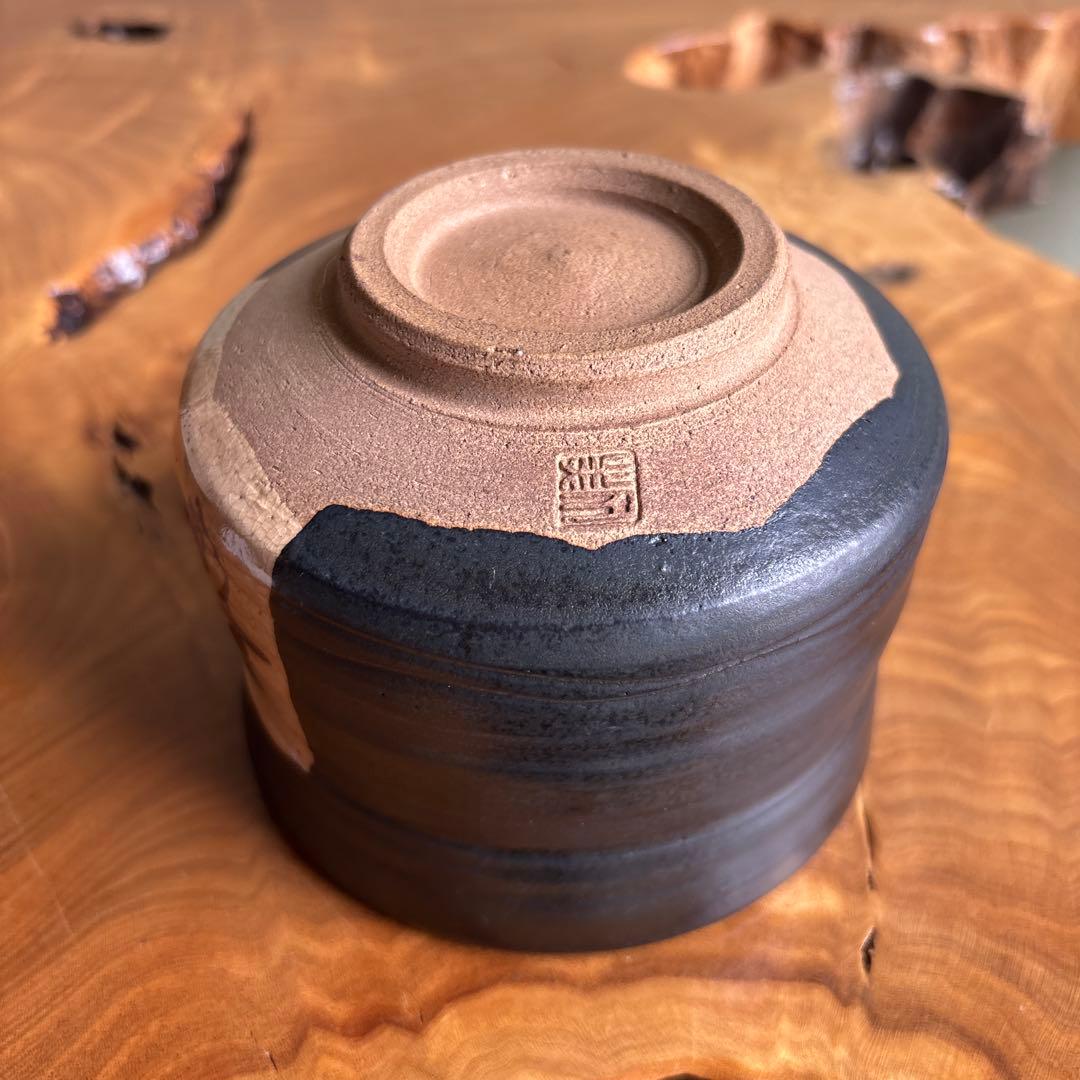
Kuro Oribe matcha bowl by Terada Bizan, made for the Imperial New Year poetry theme 「道」(Michi — The Way). Deep matte-black glaze opens to a clay-reserve window where iron-oxide brushwork traces a landscape: pine silhouettes, the suggestion of a mountain path. Signed tomobako. Approx. 11.5 cm diameter × 9 cm height. #kurooribe #matchabowl #oribeware #japaneseceramics #teaceremony #chawan #minoyaki #imperialtheme #teaset
🔹 [ BASIC DETAILS ]
• Artist: Terada Bizan (寺田美山), Mino region
• Style: Kuro Oribe (黒織部) — black-glazed Oribe ware with iron underglaze reserve
• Motif: Chokudai 「道」Michi — Imperial New Year poetry theme
• Dimensions: Approx. 11.5 cm diameter / 9 cm height
• Condition: Good vintage condition, no chips or cracks; minor age-appropriate patina
• Includes: Signed tomobako (artist's wooden storage box)
• Origin: Mino, Gifu Prefecture, Japan
🔹 [ 基本情報 ]
• 作家:寺田美山(美濃)
• 様式:黒織部(黒釉に白抜き窓・鉄絵)
• 文様:勅題「道」
• サイズ:直径約11.5cm / 高さ約9cm
• 状態:良好(欠けなし・貫入なし)
• 付属:作家銘入り共箱
• 産地:岐阜県美濃
🔹 [ CULTURAL & ARTISTIC INSIGHT ]
Oribe ware emerged from the Momoyama period (late 16th century) under the influence of tea master and daimyo Furuta Oribe (古田織部, 1544–1615), a student of Sen no Rikyu who deliberately broke from Rikyu's wabi severity toward something stranger and more willful. Where Rikyu prized restraint, Oribe invited asymmetry, bold color, painted narrative. The six Mino Oribe variations — Green Oribe, Narumi Oribe, Ao Oribe, Madara Oribe, Sōhon Oribe, and Kuro Oribe — each explore a different relationship between glaze and clay, darkness and light.
Kuro Oribe (黒織部) is arguably the most dramatic of them. The body receives a saturated iron-black glaze — dense, matte, absorbing light rather than reflecting it. Then a portion is deliberately left unglazed: the shiro-nuki (白抜き) or reserve window. In that exposed clay-colored field, the potter draws in iron oxide: figures, plants, water, mountains, a single path. The contrast is absolute — night against earth — and the painting must be confident, because there is no correcting iron on raw clay.
This bowl carries the motif of the Imperial New Year poetry theme. Each year at the 宮中歌会始 (Utakai Hajime — the Imperial Court Poetry Reading), the Emperor announces a single word as the theme for waka composition. The announced theme — 勅題 (chokudai) — becomes the subject for poets across Japan, but also for potters, lacquerware artists, calligraphers, and weavers who create commemorative objects referencing it. When the theme is 「道」— The Way, The Path — makers respond with images and forms that carry the weight of that word: a winding road, a mountain trail, the idea of passage, direction, becoming.
In the brushwork window of this bowl, pine trees stand at either side of what reads as a mountain road — perhaps the approach to a peak, perhaps a pilgrim's path. The iron lines are unhurried. Something has been walked here.
🔹 [ 文化・芸術的考察 ]
織部焼は桃山時代末期、茶人・武将である古田織部(1544〜1615)の美意識から生まれた。千利休の弟子として侘びの心を受け継ぎながらも、利休の静謐な美学に反旗を翻すように、織部は歪み・色彩・絵付けという新しい言語を陶芸に持ち込んだ。六種のオリベ変形のうち、黒織部はもっとも対比が鋭い。黒鉄釉の闇の中に、土肌の白抜き窓が開き、そこに鉄絵で松・山道・自然の息吹が描かれる。
勅題は毎年正月に宮中歌会始で天皇から発表される歌の主題であり、全国の歌人のみならず、陶芸家・漆芸家・書家も創作の指針とする。「道」という勅題を受けたとき、作家は「歩むこと」「方向」「道程」という思想を作品に込める。この茶碗の鉄絵には、松に挟まれた山道が描かれ——その静かな線描に、問いではなく、一歩が宿っている。
🔹 [ DEEP-DIVE COMMENTARY ]
The Momoyama period (roughly 1573–1615) is the hinge point of Japanese ceramic history. Before it, the dominant aesthetic in tea ceramics was Korean-inflected quietude — the natural, unforced beauty of Bizen, Shigaraki, and the early Raku bowls that Sen no Rikyu and Chojiro shaped together in Kyoto. After it — and specifically because of Furuta Oribe — the Mino kilns of Gifu Prefecture became the engine of an aesthetic revolution. Oribe did not simply prefer new styles; he actively commissioned work that violated convention, that leaned into bold geometric patterns, off-center forms, and saturated color combinations that had no precedent in Japanese ceramics.
The cultural stakes were high. Furuta Oribe was not merely a patron. He was the preeminent tea master of his era, designated by Tokugawa Ieyasu himself as the arbiter of tea taste — the head of the tea world (茶の湯の宗匠) for the early Edo period. When Oribe declared a taste, it carried the authority of both cultural and political weight. The Mino kilns — Toki, Tajimi, the area that had already produced Shino ware — responded by developing six distinct Oribe ware variations, each a different experiment in color, surface, and narrative intent.
Kuro Oribe sits at the most theatrical end of this spectrum. The black iron glaze used to coat the body required careful control of both application thickness and kiln atmosphere. Too thin and the glaze ran pale and uneven; too thick and it crawled away from edges in firing. The optimal result — which skilled Mino potters developed through decades of refinement — is a glaze that reads as an absolute: dense, light-absorbing, with a slight surface texture that catches raking light and reveals the hand of the thrower beneath. The throwing rings visible on the reverse of this bowl are not incidental; they are the fingerprint of process.
The reserve window — left unglazed before the iron coating is applied — is the technical and conceptual pivot of the form. The shiro-nuki field is raw, warm-toned Mino clay, and it must receive the iron brushwork while the clay is in its biscuit state. This is why the painting in Kuro Oribe has a particular quality: slightly absorbent, slightly rough, the iron oxide sinking into the surface rather than floating above it. The painter works quickly, without correction. What is drawn there is committed.
The annual Imperial New Year poetry theme — the chokudai — has been announced at the Utakai Hajime ceremony since the Meiji era in its modern form, though the tradition of Imperial poetry gatherings extends to the Nara period. The theme is a single word or phrase, and it reverberates outward through Japanese cultural life in January: waka poets compose and submit verses; craftspeople across disciplines respond with objects. A bowl made under the theme 「道」is not merely decorative. It is a temporal object — tied to a specific year, a specific cultural moment, an act of national poetic attention that few countries in the world have maintained with such continuity. Collectors recognize this. A chokudai piece carries a date within it, even when the date is not written.
Terada Bizan works within this tradition as a Mino region Oribe specialist. The brushwork landscape in this bowl — the abbreviated pine silhouettes, the central form suggesting a mountain or pass, the open horizon that could be the road ahead — is painted with the economy of a calligrapher who has made peace with the word. There is no excess. The mountain is not explained. The path simply exists, as paths do, before and after the walker.
For the collector of Japanese tea ceramics, a Kuro Oribe chokudai chawan with tomobako represents a convergence of formal rigor, historical tradition, and the specifically Japanese understanding that certain objects are made not for use alone, but to hold time.
🔹 [ ディープダイブ解説 ]
桃山時代(1573〜1615年頃)は日本陶芸史の転換点である。それ以前の茶陶は、備前・信楽・楽焼に代表される静謐な自然美が主流だった。古田織部の登場により、美濃の窯場——岐阜県の土岐・多治見地域——は陶芸の革命的実験場となった。織部は単なる庇護者ではなく、徳川家康から公認された茶の宗匠として、その美意識に政治的権威をも帯びていた。彼が好む様式は、端正さより動きを、静けさより緊張を、淡さより強烈な対比を選ぶものだった。
黒織部の黒鉄釉は、適切な施釉の厚みと窯内雰囲気の制御を必要とする。薄すぎれば斑になり、厚すぎれば焼成中に縮れて端部から剥離する。熟練した美濃陶芸家が何十年もかけて練り上げた最良の結果は、光を吸収し、轆轤の手跡がかすかに透けて見える、絶対的な黒の表面である。
白抜き窓——黒釉を施す前に意図的に釉薬を塗らない部分——は、技術的・概念的な要となる。土肌の温かみのある素地に、素焼き状態のまま鉄絵が描かれる。補正はない。鉄分は素地に吸い込まれ、描かれたものはそのまま定着する。
宮中歌会始は明治時代以降毎年正月に行われ、天皇が一語の勅題を発表する。「道」という主題を受けた陶芸家は、「歩むこと」「方向性」「道程」を作品に込める。勅題作品はその年と結びついた時代の証言物であり、コレクターはその歴史性を正しく認識する。共箱付きの勅題茶碗は、用と記録の両義を持つ稀少な茶道具である。
🔹 [ 日本語解説 ]
【黒織部 勅題「道」茶碗 寺田美山作 共箱】
寺田美山による黒織部抹茶碗。勅題「道」をテーマに、白抜きの窓に鉄絵で松と山道の景色が描かれています。黒釉の重厚な表情と鉄絵の静かな筆致が対比を生み出し、桃山陶芸の精神を今に伝える一碗です。共箱付き。
・直径約11.5cm・高さ約9cm。美濃産。良好なコンディション(欠けなし)。共箱に作家銘あり。東京より丁寧に梱包してお届けします。
🔹 [ SHIPPING & PACKAGING ]
• Dispatch: Within 1-6 business days
• Carrier: Japan Post EMS / UPS (with tracking)
• Packaging: Carefully wrapped with protective materials
🔹 [ BASIC DETAILS ]
• Artist: Terada Bizan (寺田美山), Mino region
• Style: Kuro Oribe (黒織部) — black-glazed Oribe ware with iron underglaze reserve
• Motif: Chokudai 「道」Michi — Imperial New Year poetry theme
• Dimensions: Approx. 11.5 cm diameter / 9 cm height
• Condition: Good vintage condition, no chips or cracks; minor age-appropriate patina
• Includes: Signed tomobako (artist's wooden storage box)
• Origin: Mino, Gifu Prefecture, Japan
🔹 [ 基本情報 ]
• 作家:寺田美山(美濃)
• 様式:黒織部(黒釉に白抜き窓・鉄絵)
• 文様:勅題「道」
• サイズ:直径約11.5cm / 高さ約9cm
• 状態:良好(欠けなし・貫入なし)
• 付属:作家銘入り共箱
• 産地:岐阜県美濃
🔹 [ CULTURAL & ARTISTIC INSIGHT ]
Oribe ware emerged from the Momoyama period (late 16th century) under the influence of tea master and daimyo Furuta Oribe (古田織部, 1544–1615), a student of Sen no Rikyu who deliberately broke from Rikyu's wabi severity toward something stranger and more willful. Where Rikyu prized restraint, Oribe invited asymmetry, bold color, painted narrative. The six Mino Oribe variations — Green Oribe, Narumi Oribe, Ao Oribe, Madara Oribe, Sōhon Oribe, and Kuro Oribe — each explore a different relationship between glaze and clay, darkness and light.
Kuro Oribe (黒織部) is arguably the most dramatic of them. The body receives a saturated iron-black glaze — dense, matte, absorbing light rather than reflecting it. Then a portion is deliberately left unglazed: the shiro-nuki (白抜き) or reserve window. In that exposed clay-colored field, the potter draws in iron oxide: figures, plants, water, mountains, a single path. The contrast is absolute — night against earth — and the painting must be confident, because there is no correcting iron on raw clay.
This bowl carries the motif of the Imperial New Year poetry theme. Each year at the 宮中歌会始 (Utakai Hajime — the Imperial Court Poetry Reading), the Emperor announces a single word as the theme for waka composition. The announced theme — 勅題 (chokudai) — becomes the subject for poets across Japan, but also for potters, lacquerware artists, calligraphers, and weavers who create commemorative objects referencing it. When the theme is 「道」— The Way, The Path — makers respond with images and forms that carry the weight of that word: a winding road, a mountain trail, the idea of passage, direction, becoming.
In the brushwork window of this bowl, pine trees stand at either side of what reads as a mountain road — perhaps the approach to a peak, perhaps a pilgrim's path. The iron lines are unhurried. Something has been walked here.
🔹 [ 文化・芸術的考察 ]
織部焼は桃山時代末期、茶人・武将である古田織部(1544〜1615)の美意識から生まれた。千利休の弟子として侘びの心を受け継ぎながらも、利休の静謐な美学に反旗を翻すように、織部は歪み・色彩・絵付けという新しい言語を陶芸に持ち込んだ。六種のオリベ変形のうち、黒織部はもっとも対比が鋭い。黒鉄釉の闇の中に、土肌の白抜き窓が開き、そこに鉄絵で松・山道・自然の息吹が描かれる。
勅題は毎年正月に宮中歌会始で天皇から発表される歌の主題であり、全国の歌人のみならず、陶芸家・漆芸家・書家も創作の指針とする。「道」という勅題を受けたとき、作家は「歩むこと」「方向」「道程」という思想を作品に込める。この茶碗の鉄絵には、松に挟まれた山道が描かれ——その静かな線描に、問いではなく、一歩が宿っている。
🔹 [ DEEP-DIVE COMMENTARY ]
The Momoyama period (roughly 1573–1615) is the hinge point of Japanese ceramic history. Before it, the dominant aesthetic in tea ceramics was Korean-inflected quietude — the natural, unforced beauty of Bizen, Shigaraki, and the early Raku bowls that Sen no Rikyu and Chojiro shaped together in Kyoto. After it — and specifically because of Furuta Oribe — the Mino kilns of Gifu Prefecture became the engine of an aesthetic revolution. Oribe did not simply prefer new styles; he actively commissioned work that violated convention, that leaned into bold geometric patterns, off-center forms, and saturated color combinations that had no precedent in Japanese ceramics.
The cultural stakes were high. Furuta Oribe was not merely a patron. He was the preeminent tea master of his era, designated by Tokugawa Ieyasu himself as the arbiter of tea taste — the head of the tea world (茶の湯の宗匠) for the early Edo period. When Oribe declared a taste, it carried the authority of both cultural and political weight. The Mino kilns — Toki, Tajimi, the area that had already produced Shino ware — responded by developing six distinct Oribe ware variations, each a different experiment in color, surface, and narrative intent.
Kuro Oribe sits at the most theatrical end of this spectrum. The black iron glaze used to coat the body required careful control of both application thickness and kiln atmosphere. Too thin and the glaze ran pale and uneven; too thick and it crawled away from edges in firing. The optimal result — which skilled Mino potters developed through decades of refinement — is a glaze that reads as an absolute: dense, light-absorbing, with a slight surface texture that catches raking light and reveals the hand of the thrower beneath. The throwing rings visible on the reverse of this bowl are not incidental; they are the fingerprint of process.
The reserve window — left unglazed before the iron coating is applied — is the technical and conceptual pivot of the form. The shiro-nuki field is raw, warm-toned Mino clay, and it must receive the iron brushwork while the clay is in its biscuit state. This is why the painting in Kuro Oribe has a particular quality: slightly absorbent, slightly rough, the iron oxide sinking into the surface rather than floating above it. The painter works quickly, without correction. What is drawn there is committed.
The annual Imperial New Year poetry theme — the chokudai — has been announced at the Utakai Hajime ceremony since the Meiji era in its modern form, though the tradition of Imperial poetry gatherings extends to the Nara period. The theme is a single word or phrase, and it reverberates outward through Japanese cultural life in January: waka poets compose and submit verses; craftspeople across disciplines respond with objects. A bowl made under the theme 「道」is not merely decorative. It is a temporal object — tied to a specific year, a specific cultural moment, an act of national poetic attention that few countries in the world have maintained with such continuity. Collectors recognize this. A chokudai piece carries a date within it, even when the date is not written.
Terada Bizan works within this tradition as a Mino region Oribe specialist. The brushwork landscape in this bowl — the abbreviated pine silhouettes, the central form suggesting a mountain or pass, the open horizon that could be the road ahead — is painted with the economy of a calligrapher who has made peace with the word. There is no excess. The mountain is not explained. The path simply exists, as paths do, before and after the walker.
For the collector of Japanese tea ceramics, a Kuro Oribe chokudai chawan with tomobako represents a convergence of formal rigor, historical tradition, and the specifically Japanese understanding that certain objects are made not for use alone, but to hold time.
🔹 [ ディープダイブ解説 ]
桃山時代(1573〜1615年頃)は日本陶芸史の転換点である。それ以前の茶陶は、備前・信楽・楽焼に代表される静謐な自然美が主流だった。古田織部の登場により、美濃の窯場——岐阜県の土岐・多治見地域——は陶芸の革命的実験場となった。織部は単なる庇護者ではなく、徳川家康から公認された茶の宗匠として、その美意識に政治的権威をも帯びていた。彼が好む様式は、端正さより動きを、静けさより緊張を、淡さより強烈な対比を選ぶものだった。
黒織部の黒鉄釉は、適切な施釉の厚みと窯内雰囲気の制御を必要とする。薄すぎれば斑になり、厚すぎれば焼成中に縮れて端部から剥離する。熟練した美濃陶芸家が何十年もかけて練り上げた最良の結果は、光を吸収し、轆轤の手跡がかすかに透けて見える、絶対的な黒の表面である。
白抜き窓——黒釉を施す前に意図的に釉薬を塗らない部分——は、技術的・概念的な要となる。土肌の温かみのある素地に、素焼き状態のまま鉄絵が描かれる。補正はない。鉄分は素地に吸い込まれ、描かれたものはそのまま定着する。
宮中歌会始は明治時代以降毎年正月に行われ、天皇が一語の勅題を発表する。「道」という主題を受けた陶芸家は、「歩むこと」「方向性」「道程」を作品に込める。勅題作品はその年と結びついた時代の証言物であり、コレクターはその歴史性を正しく認識する。共箱付きの勅題茶碗は、用と記録の両義を持つ稀少な茶道具である。
🔹 [ 日本語解説 ]
【黒織部 勅題「道」茶碗 寺田美山作 共箱】
寺田美山による黒織部抹茶碗。勅題「道」をテーマに、白抜きの窓に鉄絵で松と山道の景色が描かれています。黒釉の重厚な表情と鉄絵の静かな筆致が対比を生み出し、桃山陶芸の精神を今に伝える一碗です。共箱付き。
・直径約11.5cm・高さ約9cm。美濃産。良好なコンディション(欠けなし)。共箱に作家銘あり。東京より丁寧に梱包してお届けします。
🔹 [ SHIPPING & PACKAGING ]
• Dispatch: Within 1-6 business days
• Carrier: Japan Post EMS / UPS (with tracking)
• Packaging: Carefully wrapped with protective materials
Quantity
Couldn't load pickup availability
Low stock: 1 left
View full details