1
/
of
10
Kuro-Oribe Chawan by Mizuno Juzan — Black and Shino Two-Zone Matcha Bowl, Tomobako
Kuro-Oribe Chawan by Mizuno Juzan — Black and Shino Two-Zone Matcha Bowl, Tomobako
Regular price
Dhs. 730.00 AED
Regular price
Sale price
Dhs. 730.00 AED
Taxes included.
Shipping calculated at checkout.
Experience Authentic Japan Art with this Kuro-Oribe Chawan. This Mizuno Juzan Matcha Bowl serves as a Mino Ware Tea Ceremony Bowl and Black Oribe Shino Ceramic, featuring Crackled Shino Glaze Panel and Seto Oribe Tradition—a must-have for any Art Collector.
🔹 [ BASIC DETAILS ]
• Artist: Mizuno Juzan (水野寿山), with 壽山 kiln seal (confirmed in source documentation)
• Technique: Kuro-Oribe (黒織部) — dark iron glaze over upper body with diagonal crackled Shino-style panel featuring painted floral/botanical decoration
• Era: Heisei period (estimated 1990s–2000s)
• Origin: Seto / Mino ceramic tradition, Aichi / Gifu region, Japan
• Dimensions: Mouth diameter approx. 12.7 cm, Foot diameter approx. 5.5 cm, Height approx. 7.1 cm, Weight approx. 315 g
• Box: Original tomobako (合箱) with brushed artist calligraphy and red seal; saffron-yellow tomobuno (合布) cloth included
• Condition: Excellent — no chips, cracks, or repairs; glaze variation is intentional and characteristic of the tradition
🔹 [ CULTURAL & ARTISTIC INSIGHT ]
The great Momoyama-era tea master Furuta Oribe did not merely modify how tea was practiced — he redefined what a tea bowl could say. Where Rikyu's aesthetic preferred the mute and singular, Oribe embraced the spectacular encounter between two or more surface identities on a single vessel. The defining visual move of Oribe ceramic — a diagonal axis dividing dark glaze from unpainted or differently-glazed clay — breaks every expectation of symmetry and instead stages a drama of contrast.
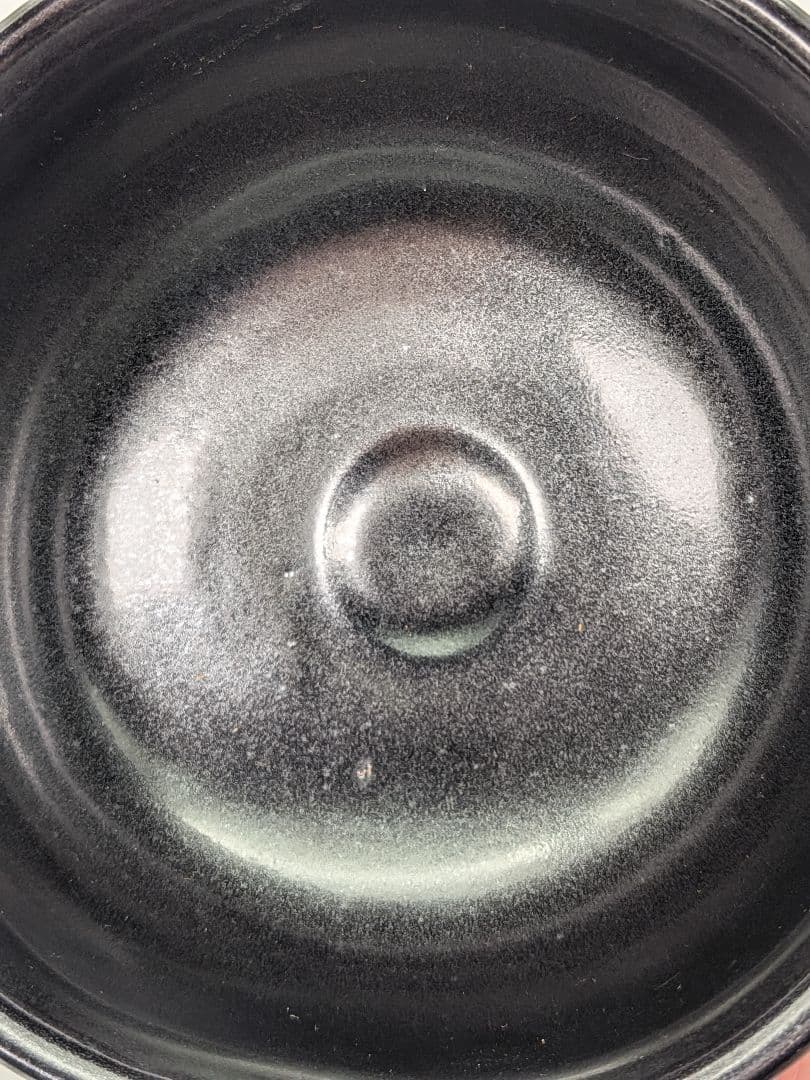
Mizuno Juzan's chawan embodies this principle with uncommon refinement. The upper body carries a deep dark glaze of exceptional quality: not a flat iron-black but a complex, multi-tonal surface that shifts from near-black at the rim to softer teal-grey and graphite in the body, with subtle metallic shimmer across its expanse — a field of depth that rewards sustained looking. Below and to one side, the glaze withdraws at a sweeping diagonal, revealing a broad panel of pale, crackled Shino-influenced white glaze. On this lighter ground, painterly blue-grey botanical forms — flowers, leaves, branches — are rendered with the ease of a brushstroke rather than the precision of a design. The crackle pattern across the white panel adds its own layer of time: fine-line reticulation that reads as both aging and intention.
The saffron-yellow tomobuno cloth enclosed in the box is itself a considered choice. In traditional tea culture, the color and material of the cloth wrapping a utensil communicates aesthetic sensibility. Saffron — warm, ceremonial, aged — against the cool dark surface of the bowl creates a resonance that extends the object's aesthetic field beyond the ceramic itself.
Poetic Line: "Where the dark meets the pale, the bowl becomes a shoreline — and what is waiting arrives."
🔹 [ DEEP-DIVE COMMENTARY ]
Kuro-Oribe (黒織部) is the most theatrically composed of the Oribe ceramic substyles, defined by the deliberate division of the surface into a dark-glazed zone (typically a dense iron-black or dark iron glaze) and a lighter zone that may carry Shino-style glazing, incised decoration, iron-pigment painting, or unglazed clay. This division is typically diagonal, asymmetric, and gestural — suggesting movement rather than geometry.
The Oribe tradition originates in the kilns of Mino Province (present-day Gifu Prefecture) and surrounding Seto area (Aichi Prefecture), which were producing Oribe-style wares from the late Momoyama period (late 16th century) onward. Mizuno Juzan's work continues this regional lineage, working within the Seto ceramic tradition that produced some of Japan's most historically significant tea wares alongside Oribe, Shino, Ki-Seto, and Setoguro.
The Shino-style crackled white glaze panel on this bowl deserves specific attention. Shino glaze — originally a thick, feldspathic, off-white glaze developed in Mino — became a key aesthetic partner to the dark Oribe glazes in the two-zone compositions that define classic Kuro-Oribe. The crackle (kannyu, 貫入) that develops as Shino cools is not a defect but a structural characteristic: the glaze contracts at a different rate than the clay body, producing the fine-line network that tea aestheticians have long regarded as a dimension of beauty — the material's own record of having passed through fire.
For collectors, a Kuro-Oribe chawan with full tomobako, tomobuno, and confirmed kiln seal by an identified studio potter represents a direct acquisition from the living Mino ceramic tradition — one of the most historically important and internationally recognized regional ceramic lineages in Japan. Mizuno Juzan's work achieves the Oribe aesthetic's central ambition: a bowl that surprises, then rewards deeper looking, then becomes indispensable.
🔹 [ 日本語解説 ]
■ 基本情報
作家:水野寿山(「壽山」陶印確認)
技法:黒織部(鉄釉暗色部+志野風白貫入釉パネル+鉄絵草花文)
年代:平成期(推定1990〜2000年代)
産地:瀬戸・美濃系(愛知・岐阜地方)
寸法:口径12.7cm、高台径5.5cm、高さ7.1cm、重量315g
付属:合箱(作家箱書・朱印)、合布(山吹色)
状態:良好(欠け・ニュウ・金継ぎなし;釉薬変化は技法の意図によるもの)
■ 文化・芸術的解説
桃山の茶人・古田織部は、茶碗が「何を言えるか」を根本から問い直した人物です。利休が一色の静けさを好んだのに対し、織部は一つの器の上に複数の表情を対峙させることで、見る者に驚きと発見を与えることを選びました。黒織部の核心にあるのは、この対角線的な分割——暗と明、釉薬と素地、制御と解放の境界線——です。
水野寿山の黒織部茶盌は、この原則を高い品質で体現しています。上半部の暗い釉薬は単純な鉄黒ではなく、見る角度と光によって深みが変わる複合的な表面を持ちます——漆黒から炭灰色、金属的な青みのある光沢まで、その内部は豊かに変化します。そして大きな対角線で釉薬が退くと、幅広い志野風の白い貫入釉パネルが現れ、その上に筆書きの草花文が描かれています。白地に広がる細かい貫入の網目は、火を通った器が時間とともに示す固有の記録——美術的には「美」の次元として評価される痕跡です。
合布の山吹色も見逃せません。茶道具の布は、単なる保護材ではなく、その色と素材で美意識を表現します。暖かな山吹色が冷ややかな暗色の碗と呼応するとき、審美の場は碗の外にまで広がります。
■ 深掘り解説
黒織部は美濃地方(岐阜県)と瀬戸地方(愛知県)の窯で桃山末期から生産され続けてきた様式で、暗色の鉄釉部と白系の志野釉部(または無釉部)の対角線的な構成を基本とします。その分割は幾何学的ではなく、動きを示す身振りとして描かれます。
水野寿山は、瀬戸・美濃の陶芸的系譜に連なる現代の陶工です。「壽山」の陶印が示す通り、本作は真正な帰属を持つ作品として、コレクションに確かな根拠を与えてくれます。
志野釉の貫入パネルに特に注目すべきです。志野釉は、美濃で生まれた厚く白い長石釉で、黒織部の暗色釉と組み合わせることで二面構成の古典的な形式を生み出してきました。貫入(kannyu)は、釉薬と素地が冷却時に異なる収縮率を持つことで生じる細線の網目です。これは欠陥ではなく、火を通った物体が持つ時間の刻印——日本の茶の美学が長く「美の次元」として評価してきた現象です。
合箱・合布・陶印・作家名が揃ったこの黒織部茶盌は、織部の美学の核心的な目標を達成しています:驚かせ、深く見るほどに報い、手放しがたくなる一碗。
🔹 [ SHIPPING & PACKAGING ]
• Dispatch: Within 1-6 business days
• Carrier: Japan Post EMS / UPS (with tracking)
• Packaging: Carefully wrapped with protective materials
🔹 [ BASIC DETAILS ]
• Artist: Mizuno Juzan (水野寿山), with 壽山 kiln seal (confirmed in source documentation)
• Technique: Kuro-Oribe (黒織部) — dark iron glaze over upper body with diagonal crackled Shino-style panel featuring painted floral/botanical decoration
• Era: Heisei period (estimated 1990s–2000s)
• Origin: Seto / Mino ceramic tradition, Aichi / Gifu region, Japan
• Dimensions: Mouth diameter approx. 12.7 cm, Foot diameter approx. 5.5 cm, Height approx. 7.1 cm, Weight approx. 315 g
• Box: Original tomobako (合箱) with brushed artist calligraphy and red seal; saffron-yellow tomobuno (合布) cloth included
• Condition: Excellent — no chips, cracks, or repairs; glaze variation is intentional and characteristic of the tradition
🔹 [ CULTURAL & ARTISTIC INSIGHT ]
The great Momoyama-era tea master Furuta Oribe did not merely modify how tea was practiced — he redefined what a tea bowl could say. Where Rikyu's aesthetic preferred the mute and singular, Oribe embraced the spectacular encounter between two or more surface identities on a single vessel. The defining visual move of Oribe ceramic — a diagonal axis dividing dark glaze from unpainted or differently-glazed clay — breaks every expectation of symmetry and instead stages a drama of contrast.
Mizuno Juzan's chawan embodies this principle with uncommon refinement. The upper body carries a deep dark glaze of exceptional quality: not a flat iron-black but a complex, multi-tonal surface that shifts from near-black at the rim to softer teal-grey and graphite in the body, with subtle metallic shimmer across its expanse — a field of depth that rewards sustained looking. Below and to one side, the glaze withdraws at a sweeping diagonal, revealing a broad panel of pale, crackled Shino-influenced white glaze. On this lighter ground, painterly blue-grey botanical forms — flowers, leaves, branches — are rendered with the ease of a brushstroke rather than the precision of a design. The crackle pattern across the white panel adds its own layer of time: fine-line reticulation that reads as both aging and intention.
The saffron-yellow tomobuno cloth enclosed in the box is itself a considered choice. In traditional tea culture, the color and material of the cloth wrapping a utensil communicates aesthetic sensibility. Saffron — warm, ceremonial, aged — against the cool dark surface of the bowl creates a resonance that extends the object's aesthetic field beyond the ceramic itself.
Poetic Line: "Where the dark meets the pale, the bowl becomes a shoreline — and what is waiting arrives."
🔹 [ DEEP-DIVE COMMENTARY ]
Kuro-Oribe (黒織部) is the most theatrically composed of the Oribe ceramic substyles, defined by the deliberate division of the surface into a dark-glazed zone (typically a dense iron-black or dark iron glaze) and a lighter zone that may carry Shino-style glazing, incised decoration, iron-pigment painting, or unglazed clay. This division is typically diagonal, asymmetric, and gestural — suggesting movement rather than geometry.
The Oribe tradition originates in the kilns of Mino Province (present-day Gifu Prefecture) and surrounding Seto area (Aichi Prefecture), which were producing Oribe-style wares from the late Momoyama period (late 16th century) onward. Mizuno Juzan's work continues this regional lineage, working within the Seto ceramic tradition that produced some of Japan's most historically significant tea wares alongside Oribe, Shino, Ki-Seto, and Setoguro.
The Shino-style crackled white glaze panel on this bowl deserves specific attention. Shino glaze — originally a thick, feldspathic, off-white glaze developed in Mino — became a key aesthetic partner to the dark Oribe glazes in the two-zone compositions that define classic Kuro-Oribe. The crackle (kannyu, 貫入) that develops as Shino cools is not a defect but a structural characteristic: the glaze contracts at a different rate than the clay body, producing the fine-line network that tea aestheticians have long regarded as a dimension of beauty — the material's own record of having passed through fire.
For collectors, a Kuro-Oribe chawan with full tomobako, tomobuno, and confirmed kiln seal by an identified studio potter represents a direct acquisition from the living Mino ceramic tradition — one of the most historically important and internationally recognized regional ceramic lineages in Japan. Mizuno Juzan's work achieves the Oribe aesthetic's central ambition: a bowl that surprises, then rewards deeper looking, then becomes indispensable.
🔹 [ 日本語解説 ]
■ 基本情報
作家:水野寿山(「壽山」陶印確認)
技法:黒織部(鉄釉暗色部+志野風白貫入釉パネル+鉄絵草花文)
年代:平成期(推定1990〜2000年代)
産地:瀬戸・美濃系(愛知・岐阜地方)
寸法:口径12.7cm、高台径5.5cm、高さ7.1cm、重量315g
付属:合箱(作家箱書・朱印)、合布(山吹色)
状態:良好(欠け・ニュウ・金継ぎなし;釉薬変化は技法の意図によるもの)
■ 文化・芸術的解説
桃山の茶人・古田織部は、茶碗が「何を言えるか」を根本から問い直した人物です。利休が一色の静けさを好んだのに対し、織部は一つの器の上に複数の表情を対峙させることで、見る者に驚きと発見を与えることを選びました。黒織部の核心にあるのは、この対角線的な分割——暗と明、釉薬と素地、制御と解放の境界線——です。
水野寿山の黒織部茶盌は、この原則を高い品質で体現しています。上半部の暗い釉薬は単純な鉄黒ではなく、見る角度と光によって深みが変わる複合的な表面を持ちます——漆黒から炭灰色、金属的な青みのある光沢まで、その内部は豊かに変化します。そして大きな対角線で釉薬が退くと、幅広い志野風の白い貫入釉パネルが現れ、その上に筆書きの草花文が描かれています。白地に広がる細かい貫入の網目は、火を通った器が時間とともに示す固有の記録——美術的には「美」の次元として評価される痕跡です。
合布の山吹色も見逃せません。茶道具の布は、単なる保護材ではなく、その色と素材で美意識を表現します。暖かな山吹色が冷ややかな暗色の碗と呼応するとき、審美の場は碗の外にまで広がります。
■ 深掘り解説
黒織部は美濃地方(岐阜県)と瀬戸地方(愛知県)の窯で桃山末期から生産され続けてきた様式で、暗色の鉄釉部と白系の志野釉部(または無釉部)の対角線的な構成を基本とします。その分割は幾何学的ではなく、動きを示す身振りとして描かれます。
水野寿山は、瀬戸・美濃の陶芸的系譜に連なる現代の陶工です。「壽山」の陶印が示す通り、本作は真正な帰属を持つ作品として、コレクションに確かな根拠を与えてくれます。
志野釉の貫入パネルに特に注目すべきです。志野釉は、美濃で生まれた厚く白い長石釉で、黒織部の暗色釉と組み合わせることで二面構成の古典的な形式を生み出してきました。貫入(kannyu)は、釉薬と素地が冷却時に異なる収縮率を持つことで生じる細線の網目です。これは欠陥ではなく、火を通った物体が持つ時間の刻印——日本の茶の美学が長く「美の次元」として評価してきた現象です。
合箱・合布・陶印・作家名が揃ったこの黒織部茶盌は、織部の美学の核心的な目標を達成しています:驚かせ、深く見るほどに報い、手放しがたくなる一碗。
🔹 [ SHIPPING & PACKAGING ]
• Dispatch: Within 1-6 business days
• Carrier: Japan Post EMS / UPS (with tracking)
• Packaging: Carefully wrapped with protective materials
Quantity
Couldn't load pickup availability
Low stock: 1 left
View full details