1
/
of
15
Kitamura Soshin — Matsu Maki-e Natsume Tea Caddy, Full-Body Pine Forest with Gold Nashiji Interior
Kitamura Soshin — Matsu Maki-e Natsume Tea Caddy, Full-Body Pine Forest with Gold Nashiji Interior
Regular price
Dhs. 4,413.00 AED
Regular price
Sale price
Dhs. 4,413.00 AED
Taxes included.
Shipping calculated at checkout.
A pine forest rendered in lacquer — not as landscape but as atmosphere. Every surface carries the weight of its making.
🔹 [ Cultural & Artistic Insight ]
Kitamura Soshin is a lacquer artist whose work operates at the threshold between craft and painting. This natsume is among the most labor-intensive forms a lacquer artist can undertake: full-body maki-e, where the decoration wraps continuously around the entire vessel with no bare ground remaining. The pine forest motif — matsu — is not merely decorative. In Japanese visual culture, the pine carries connotations of endurance, continuity, and the passage of time measured not in years but in centuries.
The exterior employs multiple maki-e techniques in concert. Taka-maki-e (raised maki-e) gives dimensional presence to the foreground pines, their trunks and branches lifting from the surface in sculpted relief. Togidashi-maki-e (burnished maki-e) recedes into the middle distance, where pine needles dissolve into atmospheric haze. At the base, waves and cloud formations create a ground plane that situates the forest between sea and sky — a compositional structure drawn from classical Yamato-e painting traditions.
The interior reveals gold nashiji — pear-skin ground — where irregularly shaped gold flakes are suspended in translucent lacquer. This finishing technique requires multiple coats of urushi over the gold, each polished to bring the flakes into partial visibility. The result is a surface that appears to glow from within, as if light has been sealed into the vessel.
🔹 [ Deep-Dive Commentary ]
The density of work on this natsume is immediately apparent. The pine forest wraps without interruption — lid, body, and foot ring unified in a single continuous scene. The transition from lid to body is seamless; the composition was conceived as a whole, not as two separate surfaces.
In the taka-maki-e passages, individual pine needles are articulated in fine gold lines, clustered in naturalistic groupings that thin toward the branch tips. The bark texture on the trunks shows deliberate variation — rougher at the base, smoother as the eye travels upward. This is not pattern; it is observation translated into lacquer.
The lower register introduces waves rendered in rhythmic, curving gold lines — a visual bass note beneath the vertical thrust of the trees. Clouds drift between the trunks in togidashi technique, their edges soft and indeterminate. The overall effect is cinematic: a forest at the edge of the sea, seen through mist, at no particular hour.
The nashiji interior is executed with precision. The gold flakes are distributed evenly, their density consistent from rim to base. When the lid is lifted, this interior catches ambient light and returns it — a private moment of illumination that the tea practitioner alone witnesses.
[ JAPANESE DESCRIPTION / 日本語解説 ]
北村宗辰作、松蒔絵内梨地棗。全面に松林を蒔絵で展開した、極めて手間のかかる仕事である。高蒔絵で前景の松を立体的に表し、研出蒔絵で中景を霞ませ、波と雲で下部に空間の奥行きを生む。一つの器に複数の蒔絵技法が共存し、それぞれが風景の異なる距離感を担っている。
内部は金梨地仕上げ。不揃いの金粉片が透漆の中に封じ込められ、蓋を開けた瞬間に内側から光が立ち上がる。この光景は点前の中で茶人だけが目にするものであり、外からは見えない贅沢である。
松は日本美術において永続と不変の象徴であり、この棗はその象徴性を器の全面に宿している。美術館収蔵に値する漆芸作品。
🔹 [ BASIC DETAILS ]
- **Dimensions:** H 7.2 cm × Diameter 7.0 cm
- **Material:** Wood core with full-body maki-e lacquer exterior, gold nashiji interior
- **Techniques:** Taka-maki-e (raised), togidashi-maki-e (burnished), iro-maki-e, nashiji
- **Period:** Showa–Heisei
- **Condition:** Excellent — lacquer surfaces intact, gold nashiji bright, no chips or wear
🔹 [ Includes ]
- Natsume (tea caddy) with lid
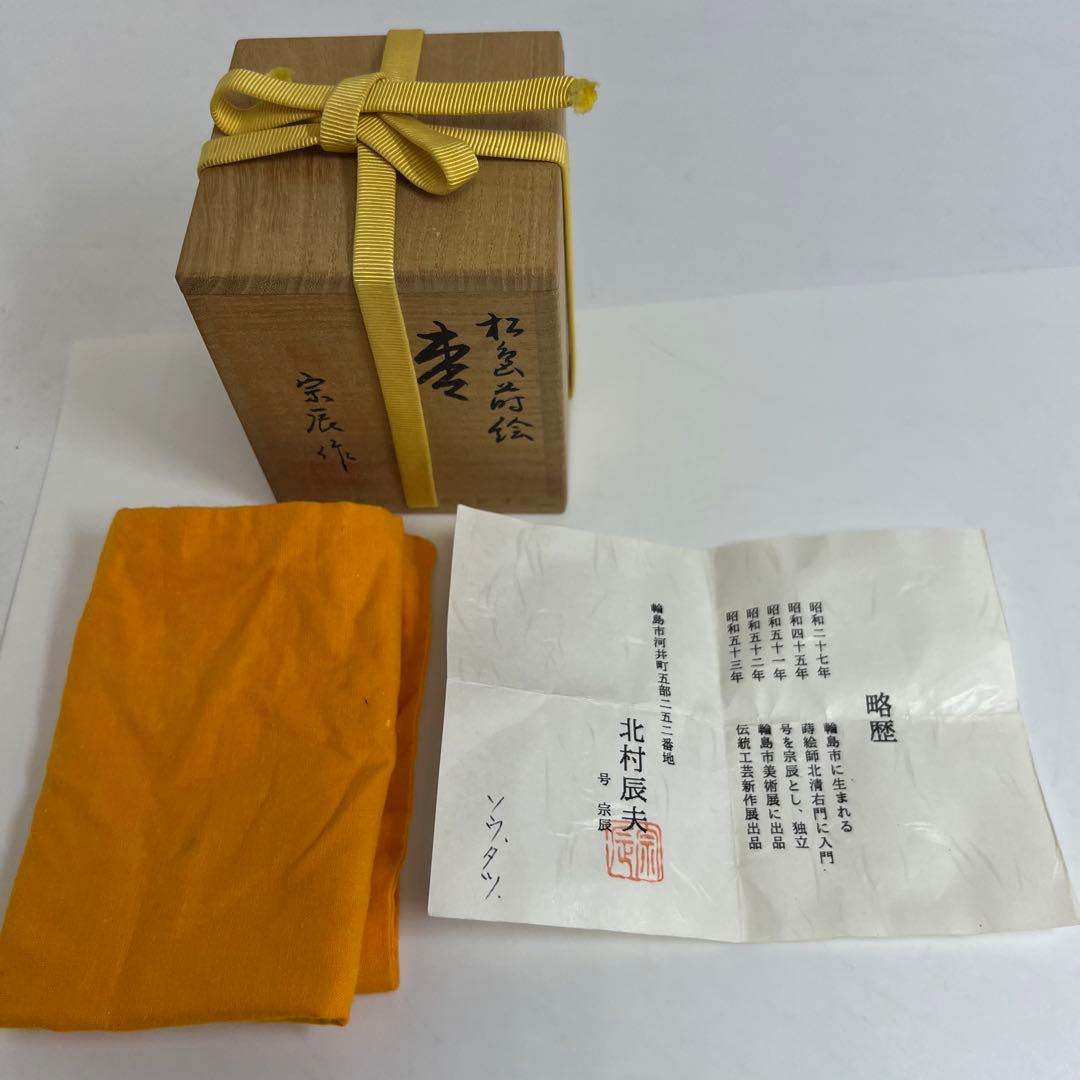
- Signed storage box
🔹 [ SHIPPING & PACKAGING ]
• Dispatch: Within 1-6 business days
• Carrier: Japan Post EMS / UPS (with tracking)
• Packaging: Carefully wrapped with protective materials
🔹 [ Cultural & Artistic Insight ]
Kitamura Soshin is a lacquer artist whose work operates at the threshold between craft and painting. This natsume is among the most labor-intensive forms a lacquer artist can undertake: full-body maki-e, where the decoration wraps continuously around the entire vessel with no bare ground remaining. The pine forest motif — matsu — is not merely decorative. In Japanese visual culture, the pine carries connotations of endurance, continuity, and the passage of time measured not in years but in centuries.
The exterior employs multiple maki-e techniques in concert. Taka-maki-e (raised maki-e) gives dimensional presence to the foreground pines, their trunks and branches lifting from the surface in sculpted relief. Togidashi-maki-e (burnished maki-e) recedes into the middle distance, where pine needles dissolve into atmospheric haze. At the base, waves and cloud formations create a ground plane that situates the forest between sea and sky — a compositional structure drawn from classical Yamato-e painting traditions.
The interior reveals gold nashiji — pear-skin ground — where irregularly shaped gold flakes are suspended in translucent lacquer. This finishing technique requires multiple coats of urushi over the gold, each polished to bring the flakes into partial visibility. The result is a surface that appears to glow from within, as if light has been sealed into the vessel.
🔹 [ Deep-Dive Commentary ]
The density of work on this natsume is immediately apparent. The pine forest wraps without interruption — lid, body, and foot ring unified in a single continuous scene. The transition from lid to body is seamless; the composition was conceived as a whole, not as two separate surfaces.
In the taka-maki-e passages, individual pine needles are articulated in fine gold lines, clustered in naturalistic groupings that thin toward the branch tips. The bark texture on the trunks shows deliberate variation — rougher at the base, smoother as the eye travels upward. This is not pattern; it is observation translated into lacquer.
The lower register introduces waves rendered in rhythmic, curving gold lines — a visual bass note beneath the vertical thrust of the trees. Clouds drift between the trunks in togidashi technique, their edges soft and indeterminate. The overall effect is cinematic: a forest at the edge of the sea, seen through mist, at no particular hour.
The nashiji interior is executed with precision. The gold flakes are distributed evenly, their density consistent from rim to base. When the lid is lifted, this interior catches ambient light and returns it — a private moment of illumination that the tea practitioner alone witnesses.
[ JAPANESE DESCRIPTION / 日本語解説 ]
北村宗辰作、松蒔絵内梨地棗。全面に松林を蒔絵で展開した、極めて手間のかかる仕事である。高蒔絵で前景の松を立体的に表し、研出蒔絵で中景を霞ませ、波と雲で下部に空間の奥行きを生む。一つの器に複数の蒔絵技法が共存し、それぞれが風景の異なる距離感を担っている。
内部は金梨地仕上げ。不揃いの金粉片が透漆の中に封じ込められ、蓋を開けた瞬間に内側から光が立ち上がる。この光景は点前の中で茶人だけが目にするものであり、外からは見えない贅沢である。
松は日本美術において永続と不変の象徴であり、この棗はその象徴性を器の全面に宿している。美術館収蔵に値する漆芸作品。
🔹 [ BASIC DETAILS ]
- **Dimensions:** H 7.2 cm × Diameter 7.0 cm
- **Material:** Wood core with full-body maki-e lacquer exterior, gold nashiji interior
- **Techniques:** Taka-maki-e (raised), togidashi-maki-e (burnished), iro-maki-e, nashiji
- **Period:** Showa–Heisei
- **Condition:** Excellent — lacquer surfaces intact, gold nashiji bright, no chips or wear
🔹 [ Includes ]
- Natsume (tea caddy) with lid
- Signed storage box
🔹 [ SHIPPING & PACKAGING ]
• Dispatch: Within 1-6 business days
• Carrier: Japan Post EMS / UPS (with tracking)
• Packaging: Carefully wrapped with protective materials
Quantity
Couldn't load pickup availability
Low stock: 1 left
View full details