1
/
of
10
Kinrande Pheasant Kogo Incense Box by Tezuka Daiji — Momoyama-gama Kutani Style with Tomobako
Kinrande Pheasant Kogo Incense Box by Tezuka Daiji — Momoyama-gama Kutani Style with Tomobako
Regular price
Dhs. 1,076.00 AED
Regular price
Sale price
Dhs. 1,076.00 AED
Taxes included.
Shipping calculated at checkout.
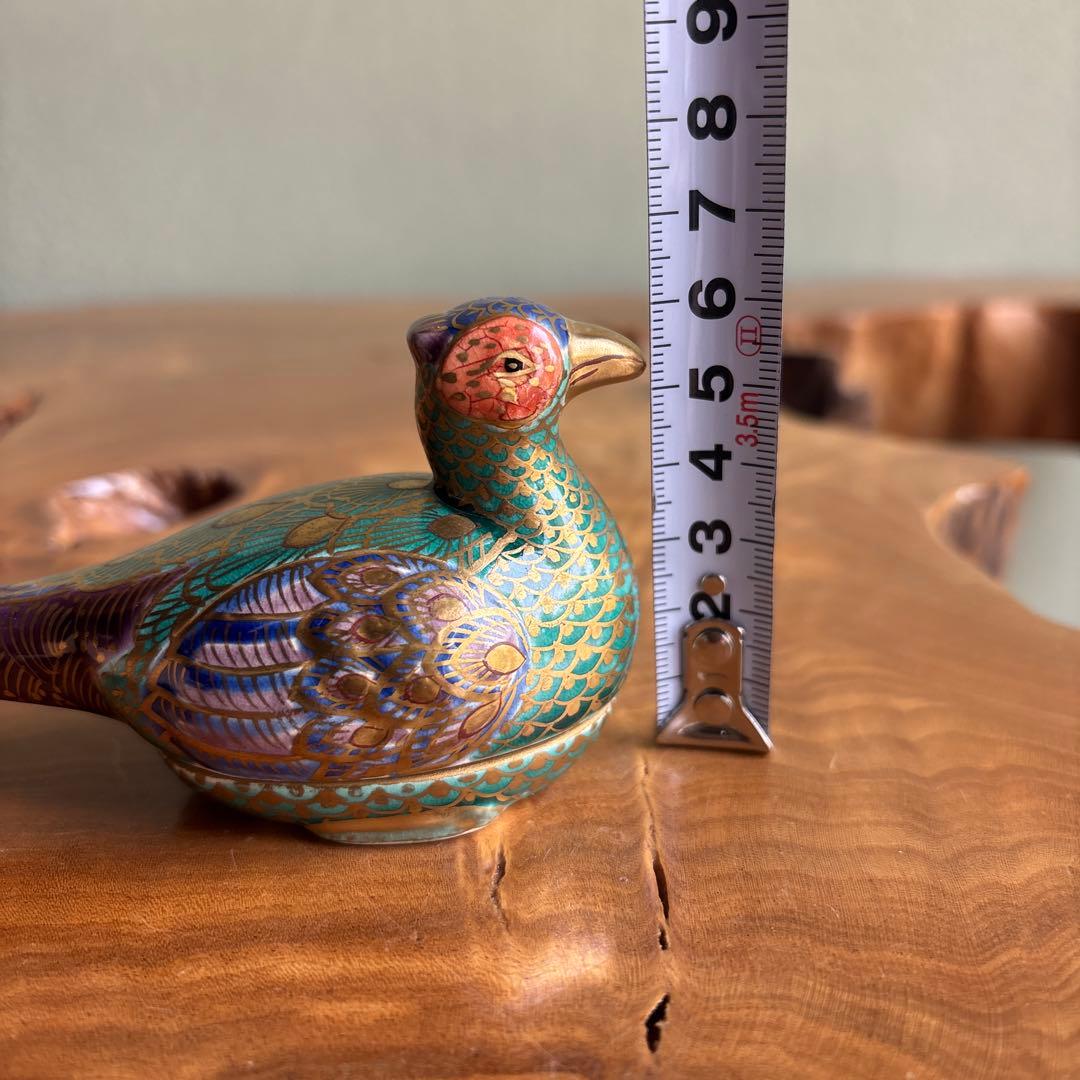
Experience Authentic Japanese Ceramic Art with this Kinrande Pheasant Kogo. This Japanese Incense Box serves as a Kutani Style Ceramic and Sculpture-Form Kogo, featuring Kinrande Gold Enamel and Tezuka Daiji Pottery—a must-have for any Japanese Art Collector seeking Momoyama-gama Ceramic Work and Pheasant Figurine Kogo.
🔹 [ BASIC DETAILS ]
• Artist: Tezuka Daiji (手塚大示), Momoyama-gama (桃山窯)
• Technique: Kinrande (金襴手) — overglaze polychrome enamels with gilt gold ground, figurative sculptural form
• Era: Late Showa to Heisei period (est. 1980s–2000s)
• Origin: Kutani-style tradition, Japan
• Dimensions: approx. Height 7 cm, Length 14 cm, Width 7 cm (hand-formed; slight asymmetry is inherent)
• Box: Tomobako (共箱) — original signed paulownia wood box inscribed 金襴手 雉香合 / 大示 with artist seal
• Condition: No cracks or chips. Minor light staining to exterior of the wooden box only — object itself is in fine condition.
🔹 [ CULTURAL & ARTISTIC INSIGHT ]
The kogo — a small lidded vessel for holding incense during the tea ceremony — is among the most intimate objects in the chanoyu tradition. Its scale demands the greatest concentration of artisanal intention: every centimeter must carry presence.
Tezuka Daiji of Momoyama-gama worked within the kinrande idiom, a style introduced to Japan through Chinese export porcelain of the Jiajing–Wanli era and thoroughly absorbed into Kutani ware's visual language by the Edo period. Kinrande is defined by its sumptuous ground: dense gold enamel applied over the fired glaze, upon which overglaze pigments in deep cobalt, viridian green, iron red, and aubergine are layered to create what the Japanese call "gorgeous quietness" — karei naru shizukesa.
In this piece, the pheasant (kiji, 雉) — Japan's national bird and a symbol of courage, fidelity, and the beauty of the natural world — has been rendered as the vessel itself. The body of the bird is the container; the neck and head form the handle-finial of the lid. The seam where lid meets base traces the pheasant's underbelly, nearly invisible at rest. This is the potter's first intelligence: the object conceals its function inside its form.
The surface carries a layered program of scales (uroko), feather plumes, and circular medallions in teal and gold across the breast; cobalt-banded wing primaries; maroon-gold striations through the elongated tail; and a red-wattled face with a gilt beak. The palette is not decorative in the Western sense — it describes a living bird, feather by feather, through the grammar of kinrande.
POETIC LINE: "The bird holds stillness inside itself — open it, and the scent of cedar and ceremony rises like mountain fog at first light."
🔹 [ DEEP-DIVE COMMENTARY ]
Kinrande (金襴手, literally "gold brocade hand") is one of the most demanding techniques in the Kutani repertoire. The name derives from the visual resemblance of the finished surface to kinran — the gold-thread silk brocade used in temple vestments and the fukusa cloth of the tea ceremony. To achieve the effect, the potter fires a base glaze, then applies overglaze enamels in multiple sessions, with the gold layer requiring a separate low-temperature firing in a muffle kiln. Each firing risks the previous layers. A single piece may pass through the kiln four or five times.
Momoyama-gama, the atelier associated with Tezuka Daiji, continues a lineage of Kutani-style production that emphasizes figurative and decorative forms oriented toward the tea ceremony arts. The name "Momoyama" is itself a declaration of aesthetic allegiance: the Momoyama period (1568–1603), under the patronage of Toyotomi Hideyoshi, was the era when Japanese craft luxury reached its first great synthesis — when the tea ceremony, lacquer arts, textile weaving, and ceramic production were simultaneously at their most theatrically brilliant. To name a kiln after this era is to claim membership in that tradition.
The pheasant kogo belongs to a category of figurative kogo that became popular in the Edo period alongside the formalization of chaji (formal tea gatherings). Such sculptural incense containers were considered appropriate for shozari (formal, thick-tea presentations), where the kogo would be placed on the tatami to be examined by guests before the ceremony began. The choice of the pheasant — a bird that appears in the Man'yoshu, Japan's oldest poetry anthology, and in Shinto iconography as the messenger of Amaterasu — made it a motif with layered meaning: natural beauty, ceremonial propriety, and divine intermediacy.
For collectors, this piece offers the convergence of several values: certified attribution through the tomobako with artist's hand-inscription and seal; the chromatic intensity of authentic kinrande polychrome; sculptural ambition in a traditionally minimal format; and the thematic resonance of the kiji as both national symbol and tea ceremony motif. It is an object whose function generates its meaning — it holds what cannot be seen, and opens to release what cannot be held.
🔹 [ JAPANESE DESCRIPTION / 日本語解説 ]
【基本詳細】
• 作家:手塚大示(桃山窯)
• 技法:金襴手(きんらんで)—本焼き釉上に色絵顔料と金彩を重ね焼きした、九谷焼の華麗な装飾技法
• 年代:昭和後期〜平成(推定1980年代〜2000年代)
• 産地:九谷系(日本)
• 寸法:高さ約7cm、全長約14cm、幅約7cm(手作り成形のため若干の個体差あり)
• 箱:共箱(桐箱)——「金襴手 雉香合 大示」と墨書・落款入り
• 状態:ヒビ・カケなし。箱蓋に薄いシミが見られますが、香合本体は良好な状態です。
【文化・芸術的考察】
香合とは、茶の湯において炉や風炉に薫べる香を入れるための小さな蓋物です。その極小のスケールこそが、作家の意図の密度を最大限に問うもの——一センチたりとも、無為に存在することが許されない器です。
手塚大示が拠る金襴手とは、中国・明代の嘉靖・万暦期の輸出磁器を淵源とし、江戸期の九谷焼に深く吸収された装飾様式です。本焼き釉上に金彩を敷き、その上に深い瑠璃・緑・鉄赤・紫などの上絵顔料を幾重にも重ねることで、日本が「華麗なる静けさ」と呼ぶ独特の美を生み出します。窯に何度も入れるその工程は、前の仕事を常にリスクにさらし続けます。
本作において雉は、容れ物そのものです。鳥の胴体が香合の器体となり、首と頭部が蓋の摘みを成す。蓋と身の継ぎ目は、鳥の腹を静かにひとまわりする——。それが作家の第一の知性:形のなかに機能を隠す、という意志です。
胸から腹にかけての青緑金の鱗紋、翼の藍色の風切羽、長い尾羽に流れる赤褐色と金の縞、赤い肉垂と金の嘴——この色彩の設計は装飾ではなく、金襴手の文法で羽毛ひとつひとつを語る、生きた鳥の記述です。
詩的一句:「鳥は静けさをその内側に持っている——蓋を開ければ、杉と点前の香りが夜明けの山霧のように立ち昇る。」
【深層解説】
金襴手は九谷焼の技法のなかでも最も難度が高い部類に属します。本焼き釉上に色絵を施し、さらに金彩を別焼き(低温マッフル窯)するため、一点に四〜五回の窯入れを要することも珍しくありません。各焼成は前工程のリスクを孕み、金彩の発色と下絵の保全を同時に成立させることが作家の技量を問います。
桃山窯という窯名は、ひとつの美学的宣言です。豊臣秀吉の庇護のもと、茶の湯・漆芸・織物・陶芸が同時に絶頂を迎えた桃山時代(1568〜1603年)——その名を窯に冠することは、その連続した伝統の中に自らを置くという意思表明にほかなりません。
雉の香合は、江戸中期以降、茶事の「正式炭手前」における香合として定着した写し物の系譜にあります。雉は『万葉集』や神道における天照大神の使者として知られ、自然の美・礼節・神的な仲介という多層の意味を持つ鳥。茶席に置かれるとき、その小さな器は単なる香の容れ物であることを超え、客が座した畳の上で静かに観察に値する一品になります。
コレクターにとって本作の価値は複層的です。作家直筆墨書・落款入り共箱による帰属証明、金襴手五色の発色の充実、香合という制約形式における彫刻的達成、そして雉という主題が持つ茶道的・神話的共鳴——これは、機能がそのまま意味を生成する器です。見えないものを入れ、持てないものを放つ。
🔹 [ SHIPPING & PACKAGING ]
• Dispatch: Within 1-6 business days
• Carrier: Japan Post EMS / UPS (with tracking)
• Packaging: Carefully wrapped with protective materials
🔹 [ BASIC DETAILS ]
• Artist: Tezuka Daiji (手塚大示), Momoyama-gama (桃山窯)
• Technique: Kinrande (金襴手) — overglaze polychrome enamels with gilt gold ground, figurative sculptural form
• Era: Late Showa to Heisei period (est. 1980s–2000s)
• Origin: Kutani-style tradition, Japan
• Dimensions: approx. Height 7 cm, Length 14 cm, Width 7 cm (hand-formed; slight asymmetry is inherent)
• Box: Tomobako (共箱) — original signed paulownia wood box inscribed 金襴手 雉香合 / 大示 with artist seal
• Condition: No cracks or chips. Minor light staining to exterior of the wooden box only — object itself is in fine condition.
🔹 [ CULTURAL & ARTISTIC INSIGHT ]
The kogo — a small lidded vessel for holding incense during the tea ceremony — is among the most intimate objects in the chanoyu tradition. Its scale demands the greatest concentration of artisanal intention: every centimeter must carry presence.
Tezuka Daiji of Momoyama-gama worked within the kinrande idiom, a style introduced to Japan through Chinese export porcelain of the Jiajing–Wanli era and thoroughly absorbed into Kutani ware's visual language by the Edo period. Kinrande is defined by its sumptuous ground: dense gold enamel applied over the fired glaze, upon which overglaze pigments in deep cobalt, viridian green, iron red, and aubergine are layered to create what the Japanese call "gorgeous quietness" — karei naru shizukesa.
In this piece, the pheasant (kiji, 雉) — Japan's national bird and a symbol of courage, fidelity, and the beauty of the natural world — has been rendered as the vessel itself. The body of the bird is the container; the neck and head form the handle-finial of the lid. The seam where lid meets base traces the pheasant's underbelly, nearly invisible at rest. This is the potter's first intelligence: the object conceals its function inside its form.
The surface carries a layered program of scales (uroko), feather plumes, and circular medallions in teal and gold across the breast; cobalt-banded wing primaries; maroon-gold striations through the elongated tail; and a red-wattled face with a gilt beak. The palette is not decorative in the Western sense — it describes a living bird, feather by feather, through the grammar of kinrande.
POETIC LINE: "The bird holds stillness inside itself — open it, and the scent of cedar and ceremony rises like mountain fog at first light."
🔹 [ DEEP-DIVE COMMENTARY ]
Kinrande (金襴手, literally "gold brocade hand") is one of the most demanding techniques in the Kutani repertoire. The name derives from the visual resemblance of the finished surface to kinran — the gold-thread silk brocade used in temple vestments and the fukusa cloth of the tea ceremony. To achieve the effect, the potter fires a base glaze, then applies overglaze enamels in multiple sessions, with the gold layer requiring a separate low-temperature firing in a muffle kiln. Each firing risks the previous layers. A single piece may pass through the kiln four or five times.
Momoyama-gama, the atelier associated with Tezuka Daiji, continues a lineage of Kutani-style production that emphasizes figurative and decorative forms oriented toward the tea ceremony arts. The name "Momoyama" is itself a declaration of aesthetic allegiance: the Momoyama period (1568–1603), under the patronage of Toyotomi Hideyoshi, was the era when Japanese craft luxury reached its first great synthesis — when the tea ceremony, lacquer arts, textile weaving, and ceramic production were simultaneously at their most theatrically brilliant. To name a kiln after this era is to claim membership in that tradition.
The pheasant kogo belongs to a category of figurative kogo that became popular in the Edo period alongside the formalization of chaji (formal tea gatherings). Such sculptural incense containers were considered appropriate for shozari (formal, thick-tea presentations), where the kogo would be placed on the tatami to be examined by guests before the ceremony began. The choice of the pheasant — a bird that appears in the Man'yoshu, Japan's oldest poetry anthology, and in Shinto iconography as the messenger of Amaterasu — made it a motif with layered meaning: natural beauty, ceremonial propriety, and divine intermediacy.
For collectors, this piece offers the convergence of several values: certified attribution through the tomobako with artist's hand-inscription and seal; the chromatic intensity of authentic kinrande polychrome; sculptural ambition in a traditionally minimal format; and the thematic resonance of the kiji as both national symbol and tea ceremony motif. It is an object whose function generates its meaning — it holds what cannot be seen, and opens to release what cannot be held.
🔹 [ JAPANESE DESCRIPTION / 日本語解説 ]
【基本詳細】
• 作家:手塚大示(桃山窯)
• 技法:金襴手(きんらんで)—本焼き釉上に色絵顔料と金彩を重ね焼きした、九谷焼の華麗な装飾技法
• 年代:昭和後期〜平成(推定1980年代〜2000年代)
• 産地:九谷系(日本)
• 寸法:高さ約7cm、全長約14cm、幅約7cm(手作り成形のため若干の個体差あり)
• 箱:共箱(桐箱)——「金襴手 雉香合 大示」と墨書・落款入り
• 状態:ヒビ・カケなし。箱蓋に薄いシミが見られますが、香合本体は良好な状態です。
【文化・芸術的考察】
香合とは、茶の湯において炉や風炉に薫べる香を入れるための小さな蓋物です。その極小のスケールこそが、作家の意図の密度を最大限に問うもの——一センチたりとも、無為に存在することが許されない器です。
手塚大示が拠る金襴手とは、中国・明代の嘉靖・万暦期の輸出磁器を淵源とし、江戸期の九谷焼に深く吸収された装飾様式です。本焼き釉上に金彩を敷き、その上に深い瑠璃・緑・鉄赤・紫などの上絵顔料を幾重にも重ねることで、日本が「華麗なる静けさ」と呼ぶ独特の美を生み出します。窯に何度も入れるその工程は、前の仕事を常にリスクにさらし続けます。
本作において雉は、容れ物そのものです。鳥の胴体が香合の器体となり、首と頭部が蓋の摘みを成す。蓋と身の継ぎ目は、鳥の腹を静かにひとまわりする——。それが作家の第一の知性:形のなかに機能を隠す、という意志です。
胸から腹にかけての青緑金の鱗紋、翼の藍色の風切羽、長い尾羽に流れる赤褐色と金の縞、赤い肉垂と金の嘴——この色彩の設計は装飾ではなく、金襴手の文法で羽毛ひとつひとつを語る、生きた鳥の記述です。
詩的一句:「鳥は静けさをその内側に持っている——蓋を開ければ、杉と点前の香りが夜明けの山霧のように立ち昇る。」
【深層解説】
金襴手は九谷焼の技法のなかでも最も難度が高い部類に属します。本焼き釉上に色絵を施し、さらに金彩を別焼き(低温マッフル窯)するため、一点に四〜五回の窯入れを要することも珍しくありません。各焼成は前工程のリスクを孕み、金彩の発色と下絵の保全を同時に成立させることが作家の技量を問います。
桃山窯という窯名は、ひとつの美学的宣言です。豊臣秀吉の庇護のもと、茶の湯・漆芸・織物・陶芸が同時に絶頂を迎えた桃山時代(1568〜1603年)——その名を窯に冠することは、その連続した伝統の中に自らを置くという意思表明にほかなりません。
雉の香合は、江戸中期以降、茶事の「正式炭手前」における香合として定着した写し物の系譜にあります。雉は『万葉集』や神道における天照大神の使者として知られ、自然の美・礼節・神的な仲介という多層の意味を持つ鳥。茶席に置かれるとき、その小さな器は単なる香の容れ物であることを超え、客が座した畳の上で静かに観察に値する一品になります。
コレクターにとって本作の価値は複層的です。作家直筆墨書・落款入り共箱による帰属証明、金襴手五色の発色の充実、香合という制約形式における彫刻的達成、そして雉という主題が持つ茶道的・神話的共鳴——これは、機能がそのまま意味を生成する器です。見えないものを入れ、持てないものを放つ。
🔹 [ SHIPPING & PACKAGING ]
• Dispatch: Within 1-6 business days
• Carrier: Japan Post EMS / UPS (with tracking)
• Packaging: Carefully wrapped with protective materials
Quantity
Couldn't load pickup availability
Low stock: 1 left
View full details