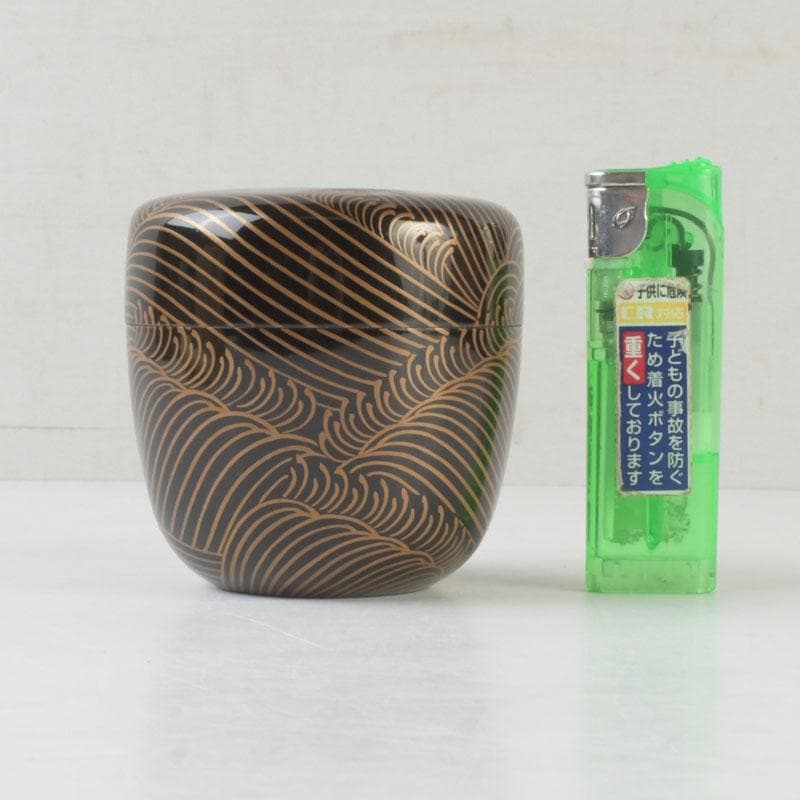
🔹 [ Cultural & Artistic Insight ] On a ground of deep black urushi, waves move. Not crashing, not still — perpetually arriving. Gold lines trace each cresting arc with the precision of a craftsman who understood that beauty in tea ceremony must be earned through restraint, not display.
This is the work of Sasaki Sosho, a lacquer artist working in the Heian (Kyoto) tradition. The seigaiha — the ancient wave pattern, named for the scales of a mythical sea creature — covers the entire surface of the natsume in continuous, interlocking arcs rendered in fine gold maki-e. From the domed lid to the belly of the caddy, the ocean moves without interruption. The lines are calibrated, almost meditative in their regularity, yet the pattern breathes with quiet energy.
The form itself is classic o-natsume: generous and rounded, with a fitted lid that seats without tension. The piece rests comfortably in the palm — 7cm tall, 7.4cm wide, 83g of considered weight.
---
WHAT THE INSCRIPTION MEANS
A kakitsuke — a written inscription on a wooden box — is not a signature of ownership. It is an act of cultural endorsement.
This natsume carries the kakitsuke of Hisada Jingyusai (久田宗也, 尋牛斎), the twelfth-generation head of the Ura Senke branch known as Hisada-ke — one of the Seven Associate Houses (Shichijiike) of Omotesenke, the oldest and most formal lineage of the Japanese tea ceremony. Jingyusai was a figure of exceptional authority in the chado world of the twentieth century. His name on a box is not decoration. It is a formal statement: this object is worthy of use in serious tea practice.
For collectors of Japanese tea art, a kakitsuke from a tea master of this standing transforms a fine lacquerwork piece into a certified utensil — one with documented provenance reaching into the heart of Kyoto's living tea tradition.
---
CULTURAL INSIGHT: SEIGAIHA AND THE GRAMMAR OF WAVE
🔹 [ Deep-Dive Commentary ] The seigaiha pattern has been used in Japanese court dress, ceramics, lacquerwork, and textile for over a thousand years. Its name references the gagaku court dance "Seigaiha" — a composition of Chinese origin that entered the Japanese imperial repertoire in the Nara period (710–794). Each overlapping arc represents a wave, a fish scale, or a feather of the mythical bird after which the dance is named, depending on the era and the interpreter.
In tea ceremony, the pattern carries associations with: - Eternity and the ceaselessness of time (the waves do not end) - Purity and auspiciousness (water cleanses, waves renew) - The courtly heritage of chado — a reminder that tea has roots in imperial culture before it became the practice of merchants and samurai
When Sasaki Sosho chose to cover this natsume entirely in seigaiha — not as accent, but as totality — he was making a statement about completeness. The object does not gesture toward the sea. It becomes the sea.
---
CONDITION
Very good condition. The lacquer surface shows strong, consistent gloss with no visible chips or cracks. The wave lines are sharp and uninterrupted throughout. The lid fits cleanly. Original wooden tomobako (fitted storage box) with clear maker's inscription and seal. Silk shifuku (protective pouch) included.
---
DIMENSIONS
Height: approx. 7 cm / 2.8 in Diameter: approx. 7.4 cm / 2.9 in Weight: approx. 83 g / 2.9 oz
🔹 [ SHIPPING & PACKAGING ] • Dispatch: Within 1-6 business days • Carrier: Japan Post EMS / UPS (with tracking) • Packaging: Carefully wrapped with protective materials