1
/
of
10
Japanese Hanging Scroll Bijinga Beauty Tsuge Suiho — Standing Figure with Plum Blossom, Signed, Tomobako
Japanese Hanging Scroll Bijinga Beauty Tsuge Suiho — Standing Figure with Plum Blossom, Signed, Tomobako
Regular price
Dhs. 690.00 AED
Regular price
Sale price
Dhs. 690.00 AED
Taxes included.
Shipping calculated at checkout.
She does not look at the viewer. She never has.
🔹 [ BASIC DETAILS ]
• Artist: Tsuge Suiho
• Origin: Japan
• Material: Silk / Mineral Pigment / Gofun / Brocade
• Motif: Standing Beauty with Plum Blossom
• Era: 1900s
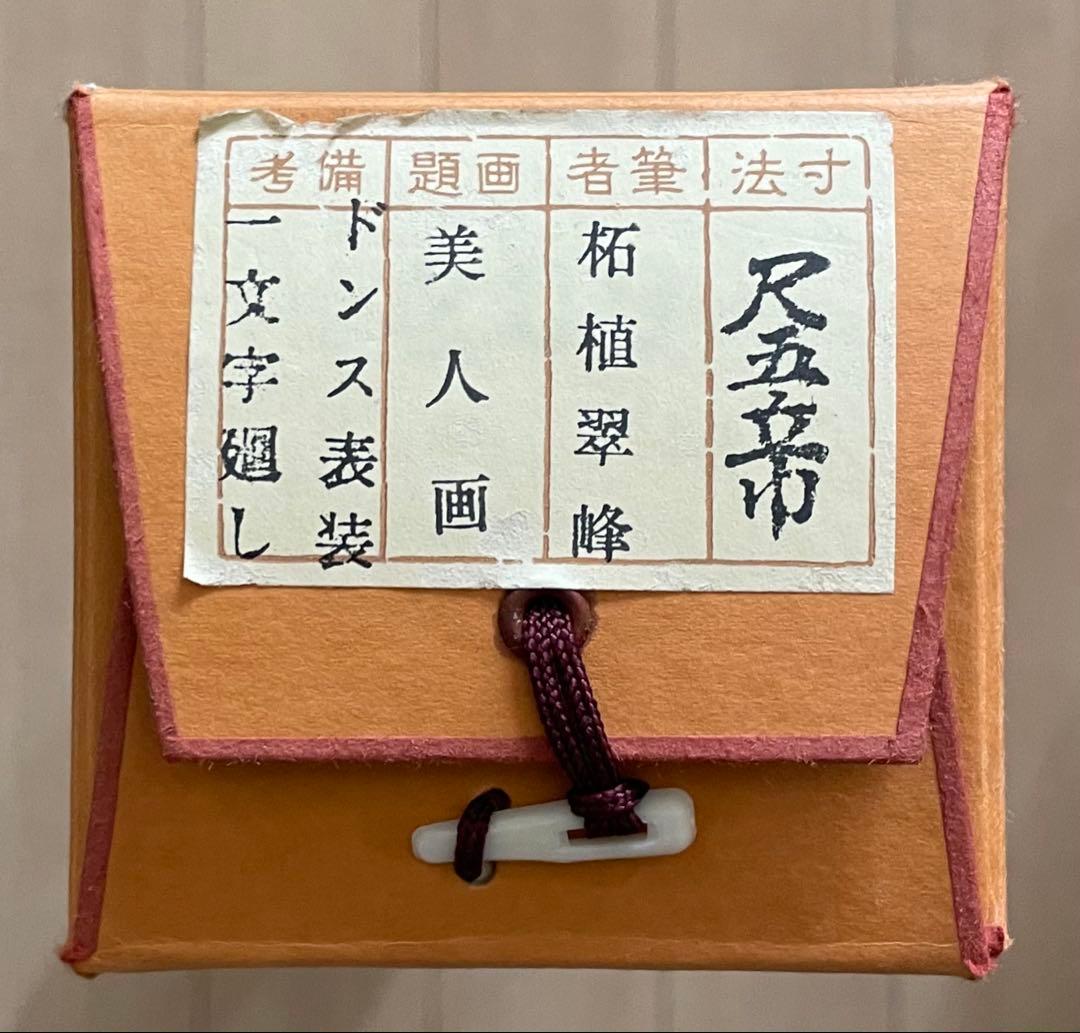
• Box: Tomobako (artist's wooden presentation box)
• Condition: Good, carefully inspected
🔹 [ Cultural & Artistic Insight ]
Head tilted, sleeve drawn close, the woman in Tsuge Suiho's scroll stands beneath a plum branch as though caught mid-thought — arrested in a moment that belongs entirely to herself. The composition refuses drama. It offers presence instead: the weight of a gray-mauve kimono layered over a golden obi, the pale blossoms above rendered in ink wash and white pigment, the quiet of early spring held in silk.
This is bijinga as it was practiced before the word became costume — a form of portraiture concerned less with beauty as surface than with interiority as subject.
---
Phase B — Basic Details
• Format: Kakejiku (hanging scroll), silk painting with mineral pigments
• Image dimensions: approx. 197.5 cm (H) x 60.2 cm (W)
• Subject: Standing beauty (tachisugata bijin) with plum blossom branch
• Kimono: Gray-mauve ground with circular mon and floral scattered motifs; gold hexagonal obi with peony arabesque
• Technique: Silk ground (kinu-hon), mineral pigment (iwa-enogu), white pigment (gofun) for skin and blossoms, ink wash for branch
• Signature: "Suiho" in brush, red seal lower right
• Provenance: Tomobako (original artist's wooden box) and career document (rireki-sho) included
• Condition: Color retention excellent; pigments vivid; silk and mounting in good overall order
• Mounting: Deep green patterned brocade with small foliate repeat; traditional roller fittings
---
Phase C — Cultural Insight
Bijinga, or "pictures of beautiful women," occupies a distinct lineage within Japanese painting — one that runs from ukiyo-e woodblock prints through the modern Nihonga tradition. What separates the finest examples from decorative production is precisely the quality that Suiho demonstrates here: the figure is not displayed. She inhabits.
The plum blossom motif carries specific resonance. Blooming before the snow has fully cleared, ume (plum) symbolizes perseverance, quiet courage, and the threshold between endurance and renewal. Placing a standing beauty beneath this branch is a compositional argument — the woman and the season share a register of feeling that resists easy naming.
The gray-mauve kimono is itself a statement of painterly sophistication. Subdued grounds demand precision in value relationships; the artist cannot rely on color contrast to carry the form. Here, the gradations in the robe's folds, the orange lining glimpsed at sleeve and collar, and the warm gold of the obi are calibrated with care that shows training in classical Nihonga methods.
🔹 [ Deep-Dive Commentary ]
---
Phase D — Deep-Dive Commentary
Tsuge Suiho (柘植翠峰) worked within the mid-twentieth century Nihonga tradition, a period when bijinga painters faced competing pressures: the inheritance of classical form on one side, the modernizing influence of Western academic painting on the other. The artists who navigated this tension successfully did so by returning to fundamentals — brushwork, pigment handling, compositional rhythm.
The figure in this scroll demonstrates that grounding. The tachisugata (standing posture) format has a long precedent in Japanese painting, from Heian court imagery through the Kano and Tosa schools. Suiho's handling is neither archaic nor self-consciously modern: the outline is confident, the internal modeling restrained, the negative space allowed to breathe.
The tomobako is signed and sealed by the artist, establishing direct provenance. The accompanying career document (rireki-sho) provides biographical and exhibition context — useful for collectors who value documented lineage alongside aesthetic quality.
For those furnishing a tokonoma (alcove) or seeking a scroll that carries seasonal meaning, this work is well-suited to late winter through early spring display — the natural calendar for ume imagery in Japanese aesthetic practice.
---
【日本語解説】
柘植翠峰筆による絹本着色の美人画掛軸です。灰紫色地の着物に金地亀甲牡丹唐草文の帯を締めた立姿の女性が、枝を斜めに張る梅の下に佇む構図。袖口を手で押さえ、首をわずかに傾けた内向きの仕草が、静かな品格を醸し出しています。胡粉による白梅の描写は繊細で、彩色全体の発色は良好。共箱・経歴書付きで来歴が明確な一幅です。
掛軸サイズ: 縦約197.5cm x 横約60.2cm
状態: 良好(色彩鮮明、表具に大きなダメージなし)
付属品: 共箱、経歴書
---
🔹 [ 日本語解説 ]
梅の枝の下に立つ女性を描いた絹本着色の掛軸。灰紫色の着物と金地の帯の色彩バランスが美しく、胡粉による白梅の描写も丁寧。共箱・経歴書付きで来歴明確な一幅。
🔹 [ SHIPPING & PACKAGING ]
• Dispatch: Within 1-6 business days
• Carrier: Japan Post EMS / UPS (with tracking)
• Packaging: Carefully wrapped with protective materials
🔹 [ BASIC DETAILS ]
• Artist: Tsuge Suiho
• Origin: Japan
• Material: Silk / Mineral Pigment / Gofun / Brocade
• Motif: Standing Beauty with Plum Blossom
• Era: 1900s
• Box: Tomobako (artist's wooden presentation box)
• Condition: Good, carefully inspected
🔹 [ Cultural & Artistic Insight ]
Head tilted, sleeve drawn close, the woman in Tsuge Suiho's scroll stands beneath a plum branch as though caught mid-thought — arrested in a moment that belongs entirely to herself. The composition refuses drama. It offers presence instead: the weight of a gray-mauve kimono layered over a golden obi, the pale blossoms above rendered in ink wash and white pigment, the quiet of early spring held in silk.
This is bijinga as it was practiced before the word became costume — a form of portraiture concerned less with beauty as surface than with interiority as subject.
---
Phase B — Basic Details
• Format: Kakejiku (hanging scroll), silk painting with mineral pigments
• Image dimensions: approx. 197.5 cm (H) x 60.2 cm (W)
• Subject: Standing beauty (tachisugata bijin) with plum blossom branch
• Kimono: Gray-mauve ground with circular mon and floral scattered motifs; gold hexagonal obi with peony arabesque
• Technique: Silk ground (kinu-hon), mineral pigment (iwa-enogu), white pigment (gofun) for skin and blossoms, ink wash for branch
• Signature: "Suiho" in brush, red seal lower right
• Provenance: Tomobako (original artist's wooden box) and career document (rireki-sho) included
• Condition: Color retention excellent; pigments vivid; silk and mounting in good overall order
• Mounting: Deep green patterned brocade with small foliate repeat; traditional roller fittings
---
Phase C — Cultural Insight
Bijinga, or "pictures of beautiful women," occupies a distinct lineage within Japanese painting — one that runs from ukiyo-e woodblock prints through the modern Nihonga tradition. What separates the finest examples from decorative production is precisely the quality that Suiho demonstrates here: the figure is not displayed. She inhabits.
The plum blossom motif carries specific resonance. Blooming before the snow has fully cleared, ume (plum) symbolizes perseverance, quiet courage, and the threshold between endurance and renewal. Placing a standing beauty beneath this branch is a compositional argument — the woman and the season share a register of feeling that resists easy naming.
The gray-mauve kimono is itself a statement of painterly sophistication. Subdued grounds demand precision in value relationships; the artist cannot rely on color contrast to carry the form. Here, the gradations in the robe's folds, the orange lining glimpsed at sleeve and collar, and the warm gold of the obi are calibrated with care that shows training in classical Nihonga methods.
🔹 [ Deep-Dive Commentary ]
---
Phase D — Deep-Dive Commentary
Tsuge Suiho (柘植翠峰) worked within the mid-twentieth century Nihonga tradition, a period when bijinga painters faced competing pressures: the inheritance of classical form on one side, the modernizing influence of Western academic painting on the other. The artists who navigated this tension successfully did so by returning to fundamentals — brushwork, pigment handling, compositional rhythm.
The figure in this scroll demonstrates that grounding. The tachisugata (standing posture) format has a long precedent in Japanese painting, from Heian court imagery through the Kano and Tosa schools. Suiho's handling is neither archaic nor self-consciously modern: the outline is confident, the internal modeling restrained, the negative space allowed to breathe.
The tomobako is signed and sealed by the artist, establishing direct provenance. The accompanying career document (rireki-sho) provides biographical and exhibition context — useful for collectors who value documented lineage alongside aesthetic quality.
For those furnishing a tokonoma (alcove) or seeking a scroll that carries seasonal meaning, this work is well-suited to late winter through early spring display — the natural calendar for ume imagery in Japanese aesthetic practice.
---
【日本語解説】
柘植翠峰筆による絹本着色の美人画掛軸です。灰紫色地の着物に金地亀甲牡丹唐草文の帯を締めた立姿の女性が、枝を斜めに張る梅の下に佇む構図。袖口を手で押さえ、首をわずかに傾けた内向きの仕草が、静かな品格を醸し出しています。胡粉による白梅の描写は繊細で、彩色全体の発色は良好。共箱・経歴書付きで来歴が明確な一幅です。
掛軸サイズ: 縦約197.5cm x 横約60.2cm
状態: 良好(色彩鮮明、表具に大きなダメージなし)
付属品: 共箱、経歴書
---
🔹 [ 日本語解説 ]
梅の枝の下に立つ女性を描いた絹本着色の掛軸。灰紫色の着物と金地の帯の色彩バランスが美しく、胡粉による白梅の描写も丁寧。共箱・経歴書付きで来歴明確な一幅。
🔹 [ SHIPPING & PACKAGING ]
• Dispatch: Within 1-6 business days
• Carrier: Japan Post EMS / UPS (with tracking)
• Packaging: Carefully wrapped with protective materials
Quantity
Couldn't load pickup availability
Out of stock
View full details