1
/
of
6
Hanging Scroll Matsuoka Eikyu Early Spring Pine Landscape Signed Tomobako Taisho Showa Yamato-e Nihonga Kakejiku
Hanging Scroll Matsuoka Eikyu Early Spring Pine Landscape Signed Tomobako Taisho Showa Yamato-e Nihonga Kakejiku
Regular price
Dhs. 950.00 AED
Regular price
Sale price
Dhs. 950.00 AED
Taxes included.
Shipping calculated at checkout.
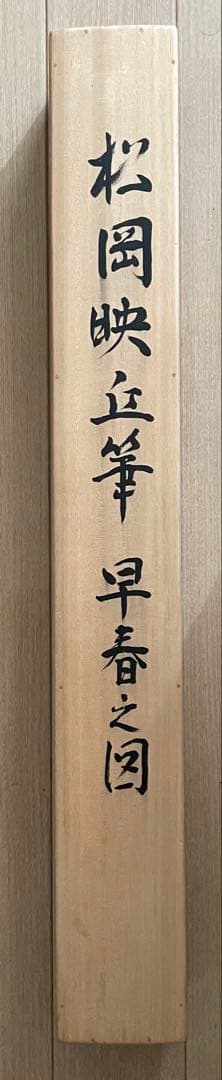
A hanging scroll painted by Matsuoka Eikyu (1881-1938), founder of the Shinko Yamato-e Kai and one of the defining figures of early twentieth-century Nihonga. Titled Soshun no Zu (Early Spring), the work carries his signature and seal in the lower register, and arrives in its original tomobako (signed paulownia box) with the artist's inscription.
🔹 [ BASIC DETAILS ]
• Artist: Matsuoka Eikyu
• Origin: Japan
• Material: Silk / Mineral Pigment / Paper
• Motif: Early Spring Pine and Mist Landscape
• Era: 1920s
• Box: Tomobako (artist's wooden presentation box)
• Condition: Good, carefully inspected
🔹 [ Cultural & Artistic Insight ]
Eikyu studied under Hashimoto Gaho and trained in classical Yamato-e, later teaching at the Tokyo School of Fine Arts alongside Yokoyama Taikan and Shimomura Kanzan. His works are held in the Yamatane Museum of Art and the Tokyo National Museum. This scroll reflects the quiet discipline of his mature period: the revival of courtly Yamato-e technique filtered through a modern sensibility.
🔹 [ CULTURAL & ARTISTIC INSIGHT ]
Early spring in the Japanese painting tradition is never loud. It arrives as mist lifting from distant ridges, as the first warmth resting on pine needles still cold from winter. Eikyu understood this threshold intimately. The composition reads as two breaths: a foreground of densely painted matsu (pine) rising from the lower edge, and a far horizon of blue-grey mountains dissolving into ochre morning haze. Between them, almost invisible, a flock of birds crosses the empty middle ground, marking scale and silence at once.
The pine is rendered with the measured authority of the Yamato-e lineage, each cluster of needles built up in layered mineral green over an undertone of indigo. The trunk carries the tsuketate brushwork Eikyu inherited from his Kano-trained master, confident strokes that describe bark and weight without outline. Against this solidity, the distant landscape is handled in tarashikomi, pooled washes of pale blue and warm sepia allowed to bleed into the silk while still damp, producing the atmospheric softness for which early spring in the Japanese mountains is known.
Eikyu's role in modern Japanese art history is often under-recognised outside Japan. As founder of the Shinko Yamato-e Kai in 1921, he led a movement to re-examine the classical narrative painting tradition of the Heian and Kamakura periods, and his students included Yamaguchi Hoshun and Takahashi Shuka. This scroll belongs to that project: a contemporary landscape that speaks through the vocabulary of a thousand-year tradition.
🔹 [ DEEP-DIVE COMMENTARY ]
The tomobako is signed and sealed by the artist, the cords intact, the paulownia aged to the pale honey tone that only decades of storage produce. The scroll itself is mounted in a restrained blue-grey patterned silk brocade (ichimonji and chuberi), chosen to recede behind the painting rather than compete with it. The jikusaki (roller ends) are lacquered wood in a deep oxblood tone, and the hanging cords remain supple.
The silk shows the honest patina of a work carefully kept for roughly a century: minor toning at the margins, a few faint foxing points typical of the period, no structural damage, no repair to the painted surface. The pigments remain vivid: the malachite green of the pine, the ultramarine of the distant ridge, the faint cinnabar of the artist's seal.
🔹 [ Deep-Dive Commentary ]
This is a scroll for the first alcove viewing of the year, traditionally hung from late January through the opening days of March, when early spring is still a promise rather than a fact. It is equally at home in a modern interior where a single wall of quiet intensity is wanted. Density of intention, cultural weight, and the presence of a named master painter.
🔹 [ DIMENSIONS ]
• Full scroll: approx. 192 cm (H) x 60.4 cm (W)
• Silk painting with mineral pigments on silk
• Original signed paulownia tomobako included
🔹 [ CONDITION ]
Good antique condition consistent with age. Light toning and minor foxing on the margins. Painted surface bright and intact. Mounting solid, cords supple. Tomobako sound with artist's inscription legible. Please review all photographs as part of the description.
🔹 [ ABOUT THE ARTIST ]
Matsuoka Eikyu (1881-1938) was born in Hyogo Prefecture and studied under Hashimoto Gaho, one of the last great masters of the Kano school. He became professor at the Tokyo School of Fine Arts (now Tokyo University of the Arts) and founded the Shinko Yamato-e Kai, a movement that revitalised classical Japanese narrative painting in the early twentieth century. His works are held in the Yamatane Museum of Art, the Tokyo National Museum, and major private collections.
🔹 [ 日本語説明 ]
新興大和絵会の創始者・松岡映丘(1881-1938)筆、絹本着色の掛軸「早春之図」。共箱(共紐)付き。橋本雅邦に師事し、東京美術学校教授として活躍した映丘は、横山大観・下村観山と同時代を生き、山種美術館や東京国立博物館にも作品が収蔵されている近代日本画の重要作家です。
画面は前景に力強い松の大樹を据え、中景の余白に小さな鳥影を置き、遠景には朝霞に包まれた青い山並みを配しています。松葉は群青を下地に緑青を重ねる大和絵伝統の技法で描かれ、遠山はたらし込みによる柔らかな滲みで早春の大気を表しています。落款・印章は画面左下に明瞭。共箱の桐材は経年により飴色に変化し、紐も健全です。
額装仕立ては青灰色の雲文様裂地で、軸先は朱漆塗り。絹本には経年相応の薄い焼けと軽微な点シミが見られますが、画面本体は鮮やかな発色を保ち、補彩・修復の痕跡はありません。一月下旬から三月初旬の初春の床の間に、あるいは一枚の掛軸で部屋全体の気配を整えたい現代的な空間に。帝室技芸員系譜に連なる一幅です。
🔹 [ 日本語解説 ]
新興大和絵会の創始者・松岡映丘(1881-1938)による絹本着色の掛軸。朝霞に沈む遠山と、力強い前景の松樹で早春の静謐な気配を描いた一幅。落款・印章明瞭、共箱(共紐)付。
🔹 [ SHIPPING & PACKAGING ]
• Dispatch: Within 1-6 business days
• Carrier: Japan Post EMS / UPS (with tracking)
• Packaging: Carefully wrapped with protective materials
🔹 [ BASIC DETAILS ]
• Artist: Matsuoka Eikyu
• Origin: Japan
• Material: Silk / Mineral Pigment / Paper
• Motif: Early Spring Pine and Mist Landscape
• Era: 1920s
• Box: Tomobako (artist's wooden presentation box)
• Condition: Good, carefully inspected
🔹 [ Cultural & Artistic Insight ]
Eikyu studied under Hashimoto Gaho and trained in classical Yamato-e, later teaching at the Tokyo School of Fine Arts alongside Yokoyama Taikan and Shimomura Kanzan. His works are held in the Yamatane Museum of Art and the Tokyo National Museum. This scroll reflects the quiet discipline of his mature period: the revival of courtly Yamato-e technique filtered through a modern sensibility.
🔹 [ CULTURAL & ARTISTIC INSIGHT ]
Early spring in the Japanese painting tradition is never loud. It arrives as mist lifting from distant ridges, as the first warmth resting on pine needles still cold from winter. Eikyu understood this threshold intimately. The composition reads as two breaths: a foreground of densely painted matsu (pine) rising from the lower edge, and a far horizon of blue-grey mountains dissolving into ochre morning haze. Between them, almost invisible, a flock of birds crosses the empty middle ground, marking scale and silence at once.
The pine is rendered with the measured authority of the Yamato-e lineage, each cluster of needles built up in layered mineral green over an undertone of indigo. The trunk carries the tsuketate brushwork Eikyu inherited from his Kano-trained master, confident strokes that describe bark and weight without outline. Against this solidity, the distant landscape is handled in tarashikomi, pooled washes of pale blue and warm sepia allowed to bleed into the silk while still damp, producing the atmospheric softness for which early spring in the Japanese mountains is known.
Eikyu's role in modern Japanese art history is often under-recognised outside Japan. As founder of the Shinko Yamato-e Kai in 1921, he led a movement to re-examine the classical narrative painting tradition of the Heian and Kamakura periods, and his students included Yamaguchi Hoshun and Takahashi Shuka. This scroll belongs to that project: a contemporary landscape that speaks through the vocabulary of a thousand-year tradition.
🔹 [ DEEP-DIVE COMMENTARY ]
The tomobako is signed and sealed by the artist, the cords intact, the paulownia aged to the pale honey tone that only decades of storage produce. The scroll itself is mounted in a restrained blue-grey patterned silk brocade (ichimonji and chuberi), chosen to recede behind the painting rather than compete with it. The jikusaki (roller ends) are lacquered wood in a deep oxblood tone, and the hanging cords remain supple.
The silk shows the honest patina of a work carefully kept for roughly a century: minor toning at the margins, a few faint foxing points typical of the period, no structural damage, no repair to the painted surface. The pigments remain vivid: the malachite green of the pine, the ultramarine of the distant ridge, the faint cinnabar of the artist's seal.
🔹 [ Deep-Dive Commentary ]
This is a scroll for the first alcove viewing of the year, traditionally hung from late January through the opening days of March, when early spring is still a promise rather than a fact. It is equally at home in a modern interior where a single wall of quiet intensity is wanted. Density of intention, cultural weight, and the presence of a named master painter.
🔹 [ DIMENSIONS ]
• Full scroll: approx. 192 cm (H) x 60.4 cm (W)
• Silk painting with mineral pigments on silk
• Original signed paulownia tomobako included
🔹 [ CONDITION ]
Good antique condition consistent with age. Light toning and minor foxing on the margins. Painted surface bright and intact. Mounting solid, cords supple. Tomobako sound with artist's inscription legible. Please review all photographs as part of the description.
🔹 [ ABOUT THE ARTIST ]
Matsuoka Eikyu (1881-1938) was born in Hyogo Prefecture and studied under Hashimoto Gaho, one of the last great masters of the Kano school. He became professor at the Tokyo School of Fine Arts (now Tokyo University of the Arts) and founded the Shinko Yamato-e Kai, a movement that revitalised classical Japanese narrative painting in the early twentieth century. His works are held in the Yamatane Museum of Art, the Tokyo National Museum, and major private collections.
🔹 [ 日本語説明 ]
新興大和絵会の創始者・松岡映丘(1881-1938)筆、絹本着色の掛軸「早春之図」。共箱(共紐)付き。橋本雅邦に師事し、東京美術学校教授として活躍した映丘は、横山大観・下村観山と同時代を生き、山種美術館や東京国立博物館にも作品が収蔵されている近代日本画の重要作家です。
画面は前景に力強い松の大樹を据え、中景の余白に小さな鳥影を置き、遠景には朝霞に包まれた青い山並みを配しています。松葉は群青を下地に緑青を重ねる大和絵伝統の技法で描かれ、遠山はたらし込みによる柔らかな滲みで早春の大気を表しています。落款・印章は画面左下に明瞭。共箱の桐材は経年により飴色に変化し、紐も健全です。
額装仕立ては青灰色の雲文様裂地で、軸先は朱漆塗り。絹本には経年相応の薄い焼けと軽微な点シミが見られますが、画面本体は鮮やかな発色を保ち、補彩・修復の痕跡はありません。一月下旬から三月初旬の初春の床の間に、あるいは一枚の掛軸で部屋全体の気配を整えたい現代的な空間に。帝室技芸員系譜に連なる一幅です。
🔹 [ 日本語解説 ]
新興大和絵会の創始者・松岡映丘(1881-1938)による絹本着色の掛軸。朝霞に沈む遠山と、力強い前景の松樹で早春の静謐な気配を描いた一幅。落款・印章明瞭、共箱(共紐)付。
🔹 [ SHIPPING & PACKAGING ]
• Dispatch: Within 1-6 business days
• Carrier: Japan Post EMS / UPS (with tracking)
• Packaging: Carefully wrapped with protective materials
Quantity
Couldn't load pickup availability
Low stock: 1 left
View full details