1
/
of
10
Hagi Ware Tea Bowl by Notomi Uun — Daikasan Kiln, Crackle Glaze Chawan with Signed Box
Hagi Ware Tea Bowl by Notomi Uun — Daikasan Kiln, Crackle Glaze Chawan with Signed Box
Regular price
Dhs. 871.00 AED
Regular price
Sale price
Dhs. 871.00 AED
Taxes included.
Shipping calculated at checkout.
Experience Authentic Japan Art with this Hagi Ware Tea Bowl. This Japanese Tea Ceremony Bowl serves as a Wabi Sabi Chawan and Matcha Bowl Gift, featuring Crackle Glaze Pottery and Signed Wooden Box—a must-have for any Art Collector seeking Antique Hagi Ceramics from a Daikasan Kiln Master with Milky White Glaze and Kuchiben Iron Rim.
🔹 [ BASIC DETAILS ]
• Artist: Notomi Uun (納富鳥雲), Daikasan Kiln (大華山窯), Hagi ware tradition
• Technique: Hagi ware (萩焼) — milky white feldspathic glaze over iron-rich Mishima clay; pronounced kan'nyu (貫入) crackle network; kuchiben iron-red rim effect; partially glazed exterior revealing warm clay tones
• Era: Late Showa to Heisei period (c. 1980s–2000s)
• Origin: Hagi, Yamaguchi Prefecture, Japan
• Dimensions: Mouth diameter approx. 8.5 cm, Height approx. 13.5 cm
• Box: Original signed wooden box (tomobako) and signed bookmark (shiori) included; yellow cloth also included
• Condition: No cracks or chips; excellent overall condition
🔹 [ CULTURAL & ARTISTIC INSIGHT ]
Hagi ware (萩焼) occupies the second position in Japan's most celebrated tea ceramics ranking — "ichi-Raku, ni-Hagi, san-Karatsu" — a hierarchy established by the tea masters of the Momoyama period and maintained by every generation of chado practitioners since. What elevates Hagi to this exalted place is not merely technical mastery but a particular quality of presence: the glaze softens, breathes, and transforms over decades of use in a process called "Hagi no nanabake" — the seven changes of Hagi — as tea seeps slowly through the glaze's crackle network, staining the clay beneath in warm amber and ochre tones that no other ware can replicate.
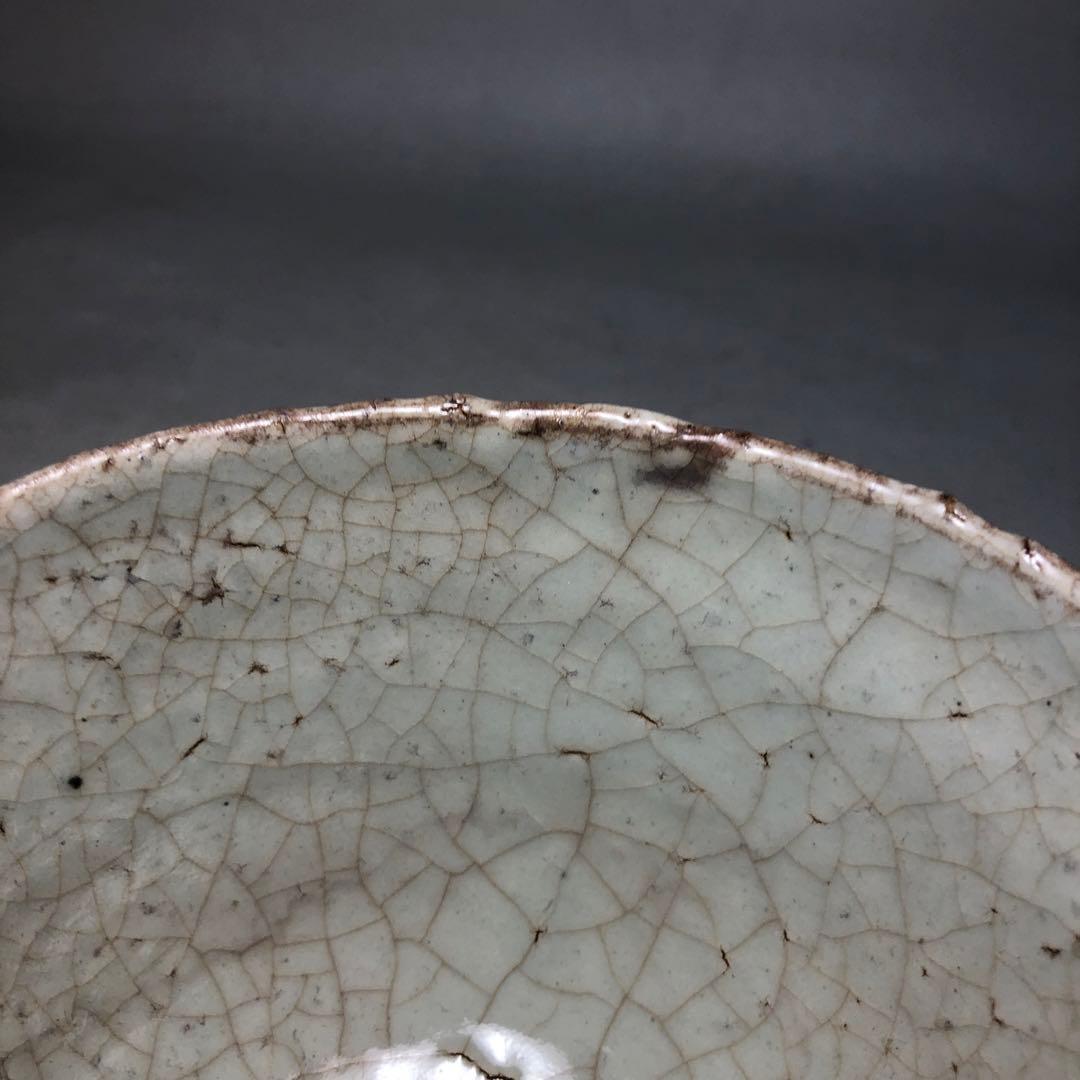
This bowl by Notomi Uun of Daikasan kiln exemplifies the tradition at its most assured. The images reveal a tall, slightly funnel-shaped form — a futokoro (deep chest) profile prized for keeping matcha warm and for the elegant arc of the whisk. The milky white glaze on the interior cascades into the crackle with extraordinary density, covering every centimetre in a fine network of brown-stained fissures that reads simultaneously as geological map and silk mesh. The exterior shifts to a warmer lavender-grey, the glaze thinning and gathering in complex ways as it descends toward the unglazed lower body and foot ring. At the rim, the iron-rich clay body asserts itself in a characteristic kuchiben (口辺) iron-red line that frames the form like a brushstroke.
Poetic line: "The crackle glaze holds forty seasons — each tea a passage, each mark a memory that deepens and endures."
🔹 [ DEEP-DIVE COMMENTARY ]
Hagi ware originated in the early seventeenth century when the Mori clan of Nagato Province (now Yamaguchi Prefecture) brought Korean potters — particularly the brothers Yi Sukwang and Yi Kyung — to establish kilns near Hagi castle town. The Korean heritage remains visible in Hagi's aesthetic DNA: the generous forms, the soft feldspathic glaze, the deliberate embrace of irregularity and asymmetry all echo the Joseon-dynasty tradition that Japanese tea masters found so deeply compatible with wabi sensibility.
The defining glaze chemistry of Hagi ware relies on a feldspathic base (often including local Daido stone) applied over a clay body rich in iron and coarse mineral particles. Fired at approximately 1200–1250 °C in reduction atmosphere, the glaze develops a semi-opaque milky character. The critical phenomenon — kan'nyu (貫入) — arises from the differential thermal contraction between glaze and clay body as the kiln cools: the glaze contracts faster, cracking into the fine network that is Hagi's visual signature. Over years of use, tea's tannins permeate these fissures and react with the iron clay, producing the prized "seven changes" of colour transformation.
Daikasan kiln, operating in the Hagi tradition, has maintained commitment to these classical parameters while integrating the refined sensibility of the modern chado aesthetic. Notomi Uun's work is characterised by a generous, body-conscious form that fits naturally in both hands — the practical ergonomics of the chawan inseparable from its philosophical function as the vessel that mediates between host and guest.
For the collector, a tall Hagi chawan in excellent condition with complete tomobako provenance represents a sound acquisition in the mid-tier of the market. The piece is usable — it can be brought into active tea practice — and will deepen in beauty with each use, making it genuinely rare among antique ceramics: an object that improves in the hands of its owner.
🔹 [ SHIPPING & PACKAGING ]
• Dispatch: Within 1-6 business days
• Carrier: Japan Post EMS / UPS (with tracking)
• Packaging: Carefully wrapped with protective materials
🔹 [ 日本語解説 ]
【詳細スペック】
・作家:納富鳥雲(大華山窯)
・技法:萩焼 — 長石釉の乳白色地に深い貫入、口辺鉄分発色(口辺)、外面は灰紫色を帯びた景色
・年代:昭和後期〜平成(1980〜2000年代)
・産地:山口県萩市
・寸法:口径約8.5cm、高さ約13.5cm
・付属:共箱(作家銘)・栞・黄布付き
・状態:割れ・欠け等なし。良好
【文化・芸術的解説】
萩焼は「一楽二萩三唐津」と称される茶道具の位列において、二番目に置かれる格調高い焼き物である。その真骨頂は「萩の七化け」と呼ばれる変容の美学にある。釉薬の貫入に茶の渋が染み込み、長い年月をかけて景色が深まってゆく——これは萩焼だけが持つ固有の時間性であり、使うことで育てる陶器という概念の極致である。
本作・納富鳥雲(大華山窯)の茶碗は、そうした萩焼の本質を正攻法で体現している。やや筒形(ふところが深い)の形は、懐が深く、点てた薄茶が冷めにくい実用的な美しさを持つ。内面の乳白色釉は密な貫入を全面に展開し、地図のような、あるいは細かな絹の網目のような景色を作り出す。外面は藤灰色に移ろい、下方では素地の鉄分が温かみある土色として顔を出す。口辺には典型的な鉄分発色が施されており、茶碗全体を引き締めている。
詩的一言:「貫入には四十の季節が宿る——一服ごとに通路が開かれ、時間の記憶が深まってゆく。」
【上級コレクター向け解説】
萩焼の起源は十七世紀初頭、毛利氏が李朝陶工を招いて萩城下に窯を開いたことに始まる。その朝鮮陶磁のDNAは、萩焼の大らかな器形、柔らかな長石釉、非対称への許容に今なお息づいている。
貫入(kan'nyu)は釉薬と素地の熱収縮差から生まれ、そこに茶のタンニンが浸透することで「七化け」の変容が始まる。大華山窯は萩焼の伝統的技法を守りながら、現代の茶の湯の感性にも応える器形を追求している。納富鳥雲の作品は、両手に収まるふところの深さと、日常的な使用に耐える堅牢さを兼ね備えている。
共箱・栞が揃った完全伝世の状態で、かつ茶会で実際に使用できる良質なコンディションは、萩焼の中堅市場において確かな価値を持つ一点である。使うたびに景色が深まるという、他の陶芸では得られない体験がここにある。
🔹 [ BASIC DETAILS ]
• Artist: Notomi Uun (納富鳥雲), Daikasan Kiln (大華山窯), Hagi ware tradition
• Technique: Hagi ware (萩焼) — milky white feldspathic glaze over iron-rich Mishima clay; pronounced kan'nyu (貫入) crackle network; kuchiben iron-red rim effect; partially glazed exterior revealing warm clay tones
• Era: Late Showa to Heisei period (c. 1980s–2000s)
• Origin: Hagi, Yamaguchi Prefecture, Japan
• Dimensions: Mouth diameter approx. 8.5 cm, Height approx. 13.5 cm
• Box: Original signed wooden box (tomobako) and signed bookmark (shiori) included; yellow cloth also included
• Condition: No cracks or chips; excellent overall condition
🔹 [ CULTURAL & ARTISTIC INSIGHT ]
Hagi ware (萩焼) occupies the second position in Japan's most celebrated tea ceramics ranking — "ichi-Raku, ni-Hagi, san-Karatsu" — a hierarchy established by the tea masters of the Momoyama period and maintained by every generation of chado practitioners since. What elevates Hagi to this exalted place is not merely technical mastery but a particular quality of presence: the glaze softens, breathes, and transforms over decades of use in a process called "Hagi no nanabake" — the seven changes of Hagi — as tea seeps slowly through the glaze's crackle network, staining the clay beneath in warm amber and ochre tones that no other ware can replicate.
This bowl by Notomi Uun of Daikasan kiln exemplifies the tradition at its most assured. The images reveal a tall, slightly funnel-shaped form — a futokoro (deep chest) profile prized for keeping matcha warm and for the elegant arc of the whisk. The milky white glaze on the interior cascades into the crackle with extraordinary density, covering every centimetre in a fine network of brown-stained fissures that reads simultaneously as geological map and silk mesh. The exterior shifts to a warmer lavender-grey, the glaze thinning and gathering in complex ways as it descends toward the unglazed lower body and foot ring. At the rim, the iron-rich clay body asserts itself in a characteristic kuchiben (口辺) iron-red line that frames the form like a brushstroke.
Poetic line: "The crackle glaze holds forty seasons — each tea a passage, each mark a memory that deepens and endures."
🔹 [ DEEP-DIVE COMMENTARY ]
Hagi ware originated in the early seventeenth century when the Mori clan of Nagato Province (now Yamaguchi Prefecture) brought Korean potters — particularly the brothers Yi Sukwang and Yi Kyung — to establish kilns near Hagi castle town. The Korean heritage remains visible in Hagi's aesthetic DNA: the generous forms, the soft feldspathic glaze, the deliberate embrace of irregularity and asymmetry all echo the Joseon-dynasty tradition that Japanese tea masters found so deeply compatible with wabi sensibility.
The defining glaze chemistry of Hagi ware relies on a feldspathic base (often including local Daido stone) applied over a clay body rich in iron and coarse mineral particles. Fired at approximately 1200–1250 °C in reduction atmosphere, the glaze develops a semi-opaque milky character. The critical phenomenon — kan'nyu (貫入) — arises from the differential thermal contraction between glaze and clay body as the kiln cools: the glaze contracts faster, cracking into the fine network that is Hagi's visual signature. Over years of use, tea's tannins permeate these fissures and react with the iron clay, producing the prized "seven changes" of colour transformation.
Daikasan kiln, operating in the Hagi tradition, has maintained commitment to these classical parameters while integrating the refined sensibility of the modern chado aesthetic. Notomi Uun's work is characterised by a generous, body-conscious form that fits naturally in both hands — the practical ergonomics of the chawan inseparable from its philosophical function as the vessel that mediates between host and guest.
For the collector, a tall Hagi chawan in excellent condition with complete tomobako provenance represents a sound acquisition in the mid-tier of the market. The piece is usable — it can be brought into active tea practice — and will deepen in beauty with each use, making it genuinely rare among antique ceramics: an object that improves in the hands of its owner.
🔹 [ SHIPPING & PACKAGING ]
• Dispatch: Within 1-6 business days
• Carrier: Japan Post EMS / UPS (with tracking)
• Packaging: Carefully wrapped with protective materials
🔹 [ 日本語解説 ]
【詳細スペック】
・作家:納富鳥雲(大華山窯)
・技法:萩焼 — 長石釉の乳白色地に深い貫入、口辺鉄分発色(口辺)、外面は灰紫色を帯びた景色
・年代:昭和後期〜平成(1980〜2000年代)
・産地:山口県萩市
・寸法:口径約8.5cm、高さ約13.5cm
・付属:共箱(作家銘)・栞・黄布付き
・状態:割れ・欠け等なし。良好
【文化・芸術的解説】
萩焼は「一楽二萩三唐津」と称される茶道具の位列において、二番目に置かれる格調高い焼き物である。その真骨頂は「萩の七化け」と呼ばれる変容の美学にある。釉薬の貫入に茶の渋が染み込み、長い年月をかけて景色が深まってゆく——これは萩焼だけが持つ固有の時間性であり、使うことで育てる陶器という概念の極致である。
本作・納富鳥雲(大華山窯)の茶碗は、そうした萩焼の本質を正攻法で体現している。やや筒形(ふところが深い)の形は、懐が深く、点てた薄茶が冷めにくい実用的な美しさを持つ。内面の乳白色釉は密な貫入を全面に展開し、地図のような、あるいは細かな絹の網目のような景色を作り出す。外面は藤灰色に移ろい、下方では素地の鉄分が温かみある土色として顔を出す。口辺には典型的な鉄分発色が施されており、茶碗全体を引き締めている。
詩的一言:「貫入には四十の季節が宿る——一服ごとに通路が開かれ、時間の記憶が深まってゆく。」
【上級コレクター向け解説】
萩焼の起源は十七世紀初頭、毛利氏が李朝陶工を招いて萩城下に窯を開いたことに始まる。その朝鮮陶磁のDNAは、萩焼の大らかな器形、柔らかな長石釉、非対称への許容に今なお息づいている。
貫入(kan'nyu)は釉薬と素地の熱収縮差から生まれ、そこに茶のタンニンが浸透することで「七化け」の変容が始まる。大華山窯は萩焼の伝統的技法を守りながら、現代の茶の湯の感性にも応える器形を追求している。納富鳥雲の作品は、両手に収まるふところの深さと、日常的な使用に耐える堅牢さを兼ね備えている。
共箱・栞が揃った完全伝世の状態で、かつ茶会で実際に使用できる良質なコンディションは、萩焼の中堅市場において確かな価値を持つ一点である。使うたびに景色が深まるという、他の陶芸では得られない体験がここにある。
Quantity
Couldn't load pickup availability
Low stock: 1 left
View full details