1
/
of
9
Hagi Ware Ox Year Incense Container by Studio Artist with Original Box
Hagi Ware Ox Year Incense Container by Studio Artist with Original Box
Regular price
Dhs. 475.00 AED
Regular price
Sale price
Dhs. 475.00 AED
Taxes included.
Shipping calculated at checkout.
A compact vessel shaped as the ox of the zodiac cycle — the blush-mauve Hagi glaze pooling into the carved hide, the conical hat atop its back a single deliberate gesture. This is a kogo made for the tea ceremony, carrying the cultural weight of a year's turning and the handwork of a named maker.
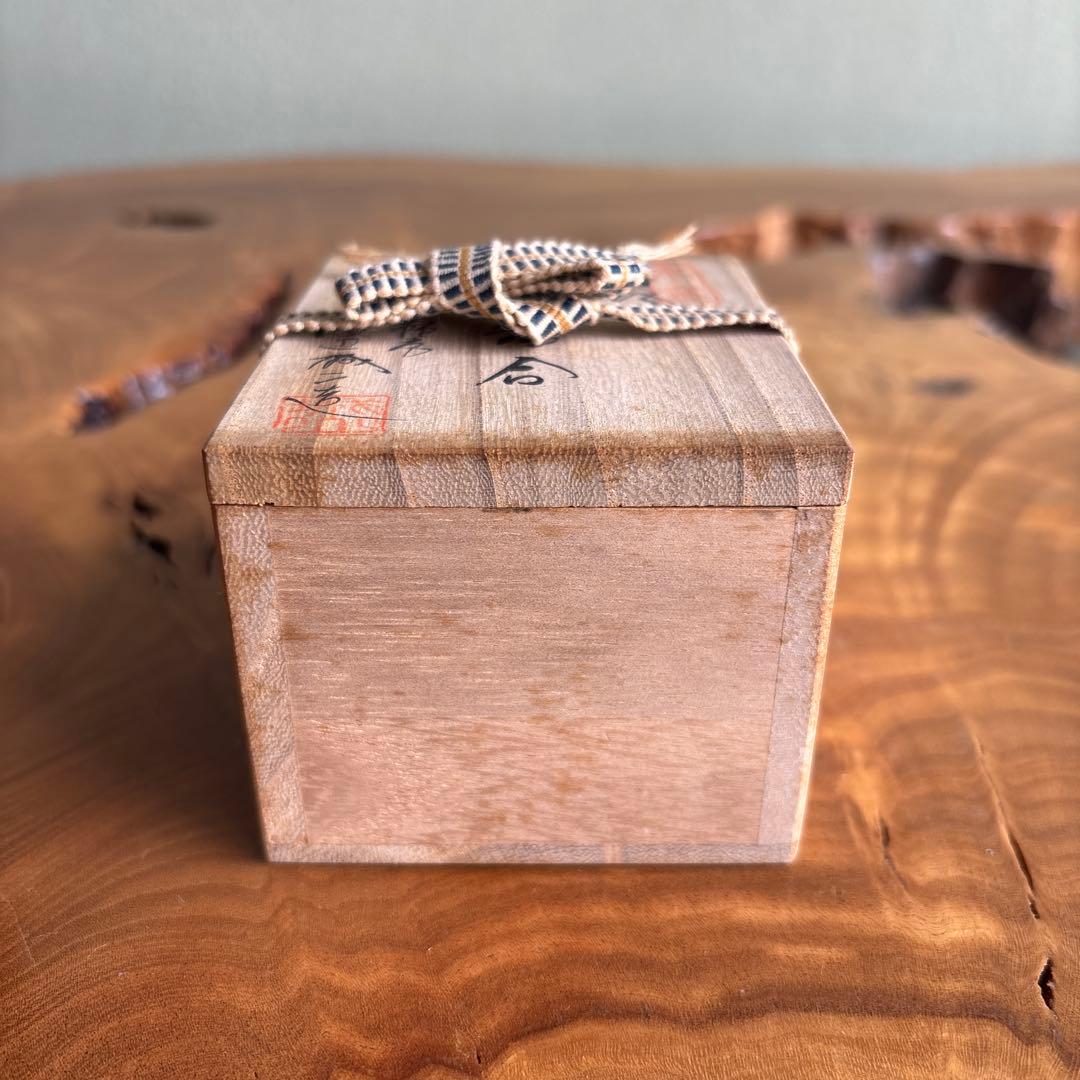
This Hagi ware kogo (incense container) was fashioned in the form of the ushi (ox), one of the twelve zodiac animals that structure Japanese time. The piece presents a soft pink-beige ground with the characteristic crackle glaze (kannyu) that defines Hagi's aesthetic — small fissures that deepen with each use, each tea gathering recorded in the clay itself. The ox form is sculpted in low relief: heavy shoulders, a woven hat suggesting a working animal at rest beneath rain, the body rounded into the shape of the vessel's lid. The fit of lid to base is close and considered. Provenance is confirmed by the signed wooden tomobako.
Hagi ware originates on the western tip of Honshu, in what is now Yamaguchi Prefecture. Its clay body — characteristically porous, warm in tone — was first fired under Korean potters brought to Japan in the sixteenth century by the feudal lord Mori Terumoto. The tradition persists in direct lineage to the present day. Zodiac-themed vessels (eto mono) were made to mark the new year in the tea room — the host selecting a kogo whose form resonated with the coming cycle. An ox-year piece thus carries both a moment in time and the slow geology of a fired earth.
For those who engage with the tea ceremony, this piece functions as chado-gu of quiet specificity: a kogo whose form speaks to wabi, whose material speaks to Hagi, whose occasion speaks to eto. For those who collect outside the ceremony context, it holds as a sculptural object — the warmth of the glaze, the precision of the zodiac motif, the signed box completing its identity.
Hagi ware is known to stain with use, deepening in character over time (yake). The crackle surface is intentional and considered a mark of the tradition's authenticity, not a defect. The wooden box shows age-related staining (shimi) consistent with storage; the vessel itself presents cleanly.
【日本語説明】
萩焼の干支香合(丑年)です。作家物で共箱付き。直径約6.7cm、高さ約3.5cm。丑の形を象った小ぶりな香合で、ピンクベージュ色の萩釉に貫入が入り、蓋に丑の造形が施されています。茶道具として使用可能な状態です。箱にシミがありますが、本体は良好です。
🔹 [ SHIPPING & PACKAGING ]
• Dispatch: Within 1-6 business days
• Carrier: Japan Post EMS / UPS (with tracking)
• Packaging: Carefully wrapped with protective materials
This Hagi ware kogo (incense container) was fashioned in the form of the ushi (ox), one of the twelve zodiac animals that structure Japanese time. The piece presents a soft pink-beige ground with the characteristic crackle glaze (kannyu) that defines Hagi's aesthetic — small fissures that deepen with each use, each tea gathering recorded in the clay itself. The ox form is sculpted in low relief: heavy shoulders, a woven hat suggesting a working animal at rest beneath rain, the body rounded into the shape of the vessel's lid. The fit of lid to base is close and considered. Provenance is confirmed by the signed wooden tomobako.
Hagi ware originates on the western tip of Honshu, in what is now Yamaguchi Prefecture. Its clay body — characteristically porous, warm in tone — was first fired under Korean potters brought to Japan in the sixteenth century by the feudal lord Mori Terumoto. The tradition persists in direct lineage to the present day. Zodiac-themed vessels (eto mono) were made to mark the new year in the tea room — the host selecting a kogo whose form resonated with the coming cycle. An ox-year piece thus carries both a moment in time and the slow geology of a fired earth.
For those who engage with the tea ceremony, this piece functions as chado-gu of quiet specificity: a kogo whose form speaks to wabi, whose material speaks to Hagi, whose occasion speaks to eto. For those who collect outside the ceremony context, it holds as a sculptural object — the warmth of the glaze, the precision of the zodiac motif, the signed box completing its identity.
Hagi ware is known to stain with use, deepening in character over time (yake). The crackle surface is intentional and considered a mark of the tradition's authenticity, not a defect. The wooden box shows age-related staining (shimi) consistent with storage; the vessel itself presents cleanly.
【日本語説明】
萩焼の干支香合(丑年)です。作家物で共箱付き。直径約6.7cm、高さ約3.5cm。丑の形を象った小ぶりな香合で、ピンクベージュ色の萩釉に貫入が入り、蓋に丑の造形が施されています。茶道具として使用可能な状態です。箱にシミがありますが、本体は良好です。
🔹 [ SHIPPING & PACKAGING ]
• Dispatch: Within 1-6 business days
• Carrier: Japan Post EMS / UPS (with tracking)
• Packaging: Carefully wrapped with protective materials
Quantity
Couldn't load pickup availability
Low stock: 1 left
View full details