1
/
of
20
Hagi Ware Matcha Tea Bowl by Eikyu Shosai — Unused with Original Signed Box
Hagi Ware Matcha Tea Bowl by Eikyu Shosai — Unused with Original Signed Box
Regular price
Dhs. 791.00 AED
Regular price
Sale price
Dhs. 791.00 AED
Taxes included.
Shipping calculated at checkout.
Experience Authentic Japan Art with this Hagi Ware Tea Bowl. This Japanese Matcha Bowl serves as a Traditional Tea Ceremony Bowl and Wabi Sabi Pottery, featuring Hagi Yaki Ceramic and Milky White Glaze—a must-have for any Art Collector seeking Japanese Studio Pottery, Handmade Ceramic Bowl, or Vintage Japan Teabowl in the Eikyu Shosai style.
🔹 [ BASIC DETAILS ]
• Artist: Eikyu Shōsai (永久勝斎) — established Hagi-yaki studio master
• Technique: Traditional Hagi-yaki wheel-thrown form; biwa-iro (loquat-colored) clay body with creamy milky-white brush-mark glaze (hakeme)
• Era: 2000s – 2010s (contemporary traditional)
• Origin: Hagi, Yamaguchi Prefecture, Japan
• Dimensions: Height approx. 8.5 cm, Diameter approx. 9 cm
• Weight: approx. 315 g
• Box: Original signed wooden box (tomobako) included
• Condition: Unused, stored; no chips, no cracks, no repair
🔹 [ CULTURAL & ARTISTIC INSIGHT ]
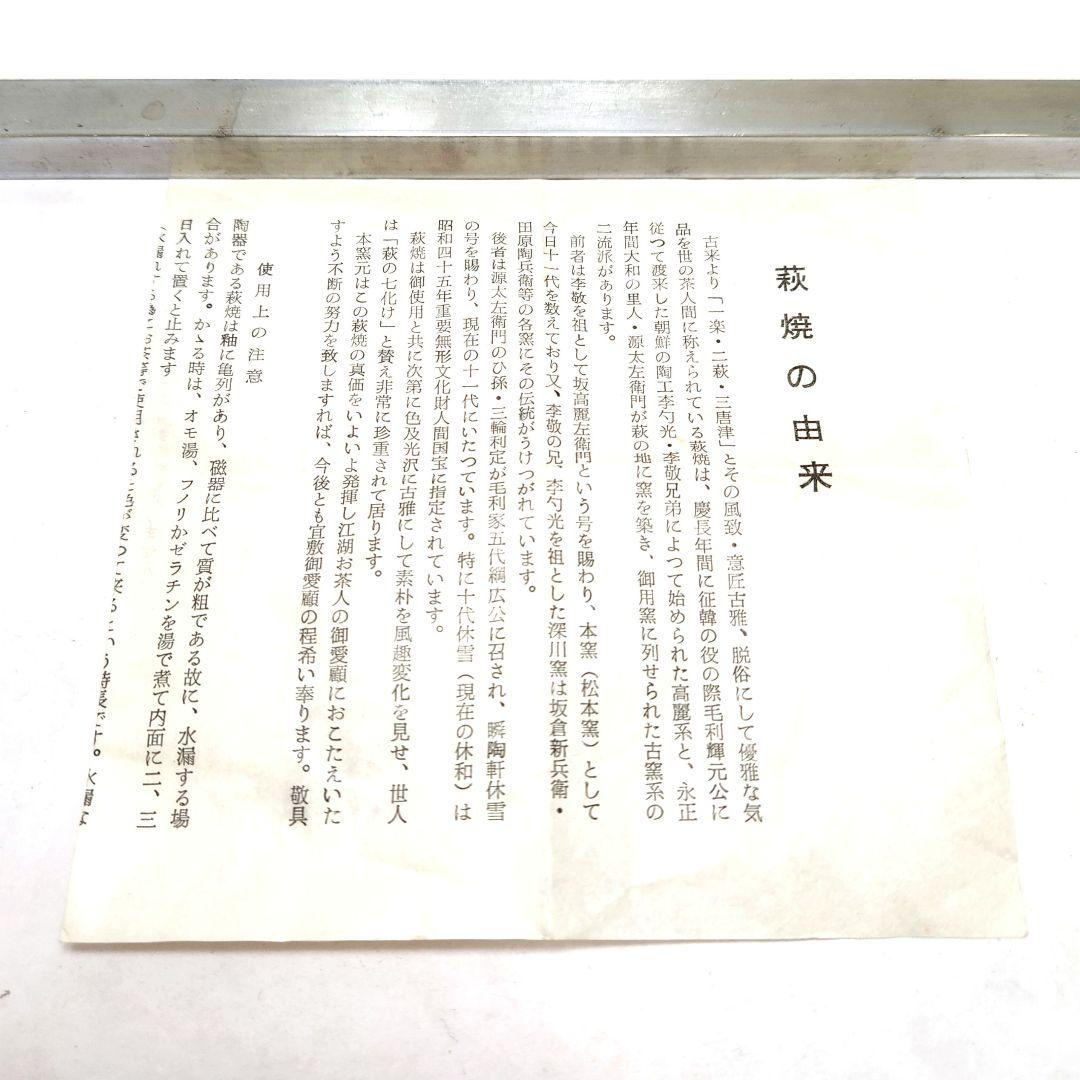
Hagi-yaki occupies a singular place in the canon of Japanese ceramics. Originating in the early Edo period under the patronage of the Mōri clan of Nagato Province, it was carried to Japan by Korean potters following Toyotomi Hideyoshi's campaigns on the peninsula — a lineage that infuses every Hagi bowl with historical weight that spans oceans and centuries.
The hallmark of Hagi is its distinctive clay body: coarse, loquat-toned earth from the Hagi coastal region, fired at relatively low temperatures to remain slightly porous. This porosity is not a flaw but an intentional design — over years of use, the bowl absorbs tea, its invisible capillaries staining the glaze from within. The Japanese call this yoyaku, the slow awakening of the vessel. Collectors speak of "the seven disguises of Hagi" (Hagi no Shichiba-ke), referring to the way the bowl transforms in color and texture over a lifetime of service at the tea table.
On this bowl, Eikyu Shōsai draws the glaze in hakeme (brush-mark) passages — fluid strokes of creamy white milk-glaze laid over the warm biwa-iro body. Where the glaze thickens, it pools into soft off-white; where it thins, the warm loquat earth breathes through. The result is a landscape rather than a surface: quiet, layered, never quite the same under morning light as it is at dusk.
Poetic Line: "The glaze does not cover the earth — it converses with it, a slow whitening, like snow that never quite falls."
🔹 [ DEEP-DIVE COMMENTARY ]
Hagi-yaki belongs to a family of wares collectively revered in the tea world through the old maxim: "Ichi-Raku, Ni-Hagi, San-Karatsu" — first Raku, second Hagi, third Karatsu. This ranking, attributed to the great tea master Sen no Rikyū's tradition, reflects not merely aesthetic preference but a philosophy of functional beauty: that the bowl must serve the moment of tea-drinking with humility, warmth, and a presence that does not compete with the tea itself.
The body of a Hagi tea bowl is typically composed of a blend of Mishima clay (daikoku-tsuchi) and local Hagi earth, sometimes mixed with coarse sand or shell-grog to achieve the characteristically warm, rough texture. The low-fire reduction atmosphere encourages the development of the biwa-iro orange-pink ground, while the feldspathic glaze — often derived from a mixture of local feldspar, ash, and limestone — develops the signature crazing (kairagiku) that allows the slow color transformation with use.
Eikyu Shōsai works within this classical lineage while expressing a refined restraint in form. The bowl's moderate dimensions — 8.5 cm height, 9 cm mouth — sit comfortably in the hands for standard matcha preparation, proportioned neither too wide for koicha nor too narrow for thin usucha. The shared wooden box (tomobako), inscribed and sealed by the artist, is not merely a container but an authentication document — part of the object's provenance chain.
For the serious collector, an unused Hagi bowl by a named studio artist with tomobako represents a threshold object: one that has not yet begun its transformation. It is a bowl in potential — waiting for the first whisking, the first absorbed drop of tea, the first invisible breath of the kiln's legacy continuing through use. To own it unused is to hold the story at its opening line.
In the contemporary Hagi lineage, artists such as Eikyu Shōsai carry forward a technique unchanged in its essentials since the Momoyama period, while bringing an individual hand to the glaze composition and surface gesture. This continuity — the sense that one is handling the same tradition that moved through Koraizaemon, Saka Kōraizaemon, and the great Miwa family — gives Hagi its undiminished gravity in any serious collection of Japanese ceramic art.
🔹 [ JAPANESE DESCRIPTION / 日本語解説 ]
■ 基本情報
• 作家:永久勝斎(萩焼 伝統窯元系統)
• 技法:ロクロ成形・刷毛目調白濁釉 枇杷色素地
• 年代:2000年代〜2010年代(現代作)
• 産地:山口県萩市
• 寸法:高さ約8.5cm、口径約9cm 重量約315g
• 共箱:あり(作家銘入り)
• 状態:未使用保管品。傷・欠け・金継ぎの類なし
■ 文化・美術的解説
萩焼は、桃山時代末期に朝鮮の陶工たちが伝えた技法を基盤とし、毛利家の庇護のもとで独自の美を確立した日本を代表する茶陶の一つです。「一楽・二萩・三唐津」という茶道における格付けが示すように、萩焼は千利休以来の侘びの精神と最も親和性が高い焼き物として、長く茶人に愛されてきました。
本作は、萩特有の枇杷色の土肌に白濁した刷毛目釉を重ね、釉薬の厚みによって生まれる白の濃淡が穏やかな景色をつくり出しています。萩の素地は微細な気孔を持ち、使い込むうちに茶を吸い込み釉が変化していく「萩の七化け」として知られる現象が生じます。未使用の状態で手にすることは、その変化の物語の冒頭を所蔵することにほかなりません。
■ 深層解説
萩焼の土は、大道土(萩の地元粘土)に粗い砂や貝殻砂を混ぜ合わせた独特の配合で、低温還元焼成によって枇杷色の地肌を発現させます。長石・灰・石灰を主体とする白釉は焼成後に細かな貫入(かいらぎ)を生じ、使用とともに茶の色素がその亀裂に浸み込むことで器が育っていきます。
永久勝斎は、桃山以来の古典的な萩焼の様式を踏まえながら、独自の手仕事によって刷毛目の流れに静けさと緊張感を与えています。高さ8.5cm・口径9cmという寸法は、濃茶・薄茶いずれにも対応できる標準的な抹茶碗の比例を保っています。共箱は作家自身が箱書きを施した真筆証明であり、コレクションの来歴を支える重要な付属品です。本作は、萩焼の歴史が生きたまま収蔵されうる一椀です。
🔹 [ SHIPPING & PACKAGING ]
• Dispatch: Within 1-6 business days
• Carrier: Japan Post EMS / UPS (with tracking)
• Packaging: Carefully wrapped with protective materials
🔹 [ BASIC DETAILS ]
• Artist: Eikyu Shōsai (永久勝斎) — established Hagi-yaki studio master
• Technique: Traditional Hagi-yaki wheel-thrown form; biwa-iro (loquat-colored) clay body with creamy milky-white brush-mark glaze (hakeme)
• Era: 2000s – 2010s (contemporary traditional)
• Origin: Hagi, Yamaguchi Prefecture, Japan
• Dimensions: Height approx. 8.5 cm, Diameter approx. 9 cm
• Weight: approx. 315 g
• Box: Original signed wooden box (tomobako) included
• Condition: Unused, stored; no chips, no cracks, no repair
🔹 [ CULTURAL & ARTISTIC INSIGHT ]
Hagi-yaki occupies a singular place in the canon of Japanese ceramics. Originating in the early Edo period under the patronage of the Mōri clan of Nagato Province, it was carried to Japan by Korean potters following Toyotomi Hideyoshi's campaigns on the peninsula — a lineage that infuses every Hagi bowl with historical weight that spans oceans and centuries.
The hallmark of Hagi is its distinctive clay body: coarse, loquat-toned earth from the Hagi coastal region, fired at relatively low temperatures to remain slightly porous. This porosity is not a flaw but an intentional design — over years of use, the bowl absorbs tea, its invisible capillaries staining the glaze from within. The Japanese call this yoyaku, the slow awakening of the vessel. Collectors speak of "the seven disguises of Hagi" (Hagi no Shichiba-ke), referring to the way the bowl transforms in color and texture over a lifetime of service at the tea table.
On this bowl, Eikyu Shōsai draws the glaze in hakeme (brush-mark) passages — fluid strokes of creamy white milk-glaze laid over the warm biwa-iro body. Where the glaze thickens, it pools into soft off-white; where it thins, the warm loquat earth breathes through. The result is a landscape rather than a surface: quiet, layered, never quite the same under morning light as it is at dusk.
Poetic Line: "The glaze does not cover the earth — it converses with it, a slow whitening, like snow that never quite falls."
🔹 [ DEEP-DIVE COMMENTARY ]
Hagi-yaki belongs to a family of wares collectively revered in the tea world through the old maxim: "Ichi-Raku, Ni-Hagi, San-Karatsu" — first Raku, second Hagi, third Karatsu. This ranking, attributed to the great tea master Sen no Rikyū's tradition, reflects not merely aesthetic preference but a philosophy of functional beauty: that the bowl must serve the moment of tea-drinking with humility, warmth, and a presence that does not compete with the tea itself.
The body of a Hagi tea bowl is typically composed of a blend of Mishima clay (daikoku-tsuchi) and local Hagi earth, sometimes mixed with coarse sand or shell-grog to achieve the characteristically warm, rough texture. The low-fire reduction atmosphere encourages the development of the biwa-iro orange-pink ground, while the feldspathic glaze — often derived from a mixture of local feldspar, ash, and limestone — develops the signature crazing (kairagiku) that allows the slow color transformation with use.
Eikyu Shōsai works within this classical lineage while expressing a refined restraint in form. The bowl's moderate dimensions — 8.5 cm height, 9 cm mouth — sit comfortably in the hands for standard matcha preparation, proportioned neither too wide for koicha nor too narrow for thin usucha. The shared wooden box (tomobako), inscribed and sealed by the artist, is not merely a container but an authentication document — part of the object's provenance chain.
For the serious collector, an unused Hagi bowl by a named studio artist with tomobako represents a threshold object: one that has not yet begun its transformation. It is a bowl in potential — waiting for the first whisking, the first absorbed drop of tea, the first invisible breath of the kiln's legacy continuing through use. To own it unused is to hold the story at its opening line.
In the contemporary Hagi lineage, artists such as Eikyu Shōsai carry forward a technique unchanged in its essentials since the Momoyama period, while bringing an individual hand to the glaze composition and surface gesture. This continuity — the sense that one is handling the same tradition that moved through Koraizaemon, Saka Kōraizaemon, and the great Miwa family — gives Hagi its undiminished gravity in any serious collection of Japanese ceramic art.
🔹 [ JAPANESE DESCRIPTION / 日本語解説 ]
■ 基本情報
• 作家:永久勝斎(萩焼 伝統窯元系統)
• 技法:ロクロ成形・刷毛目調白濁釉 枇杷色素地
• 年代:2000年代〜2010年代(現代作)
• 産地:山口県萩市
• 寸法:高さ約8.5cm、口径約9cm 重量約315g
• 共箱:あり(作家銘入り)
• 状態:未使用保管品。傷・欠け・金継ぎの類なし
■ 文化・美術的解説
萩焼は、桃山時代末期に朝鮮の陶工たちが伝えた技法を基盤とし、毛利家の庇護のもとで独自の美を確立した日本を代表する茶陶の一つです。「一楽・二萩・三唐津」という茶道における格付けが示すように、萩焼は千利休以来の侘びの精神と最も親和性が高い焼き物として、長く茶人に愛されてきました。
本作は、萩特有の枇杷色の土肌に白濁した刷毛目釉を重ね、釉薬の厚みによって生まれる白の濃淡が穏やかな景色をつくり出しています。萩の素地は微細な気孔を持ち、使い込むうちに茶を吸い込み釉が変化していく「萩の七化け」として知られる現象が生じます。未使用の状態で手にすることは、その変化の物語の冒頭を所蔵することにほかなりません。
■ 深層解説
萩焼の土は、大道土(萩の地元粘土)に粗い砂や貝殻砂を混ぜ合わせた独特の配合で、低温還元焼成によって枇杷色の地肌を発現させます。長石・灰・石灰を主体とする白釉は焼成後に細かな貫入(かいらぎ)を生じ、使用とともに茶の色素がその亀裂に浸み込むことで器が育っていきます。
永久勝斎は、桃山以来の古典的な萩焼の様式を踏まえながら、独自の手仕事によって刷毛目の流れに静けさと緊張感を与えています。高さ8.5cm・口径9cmという寸法は、濃茶・薄茶いずれにも対応できる標準的な抹茶碗の比例を保っています。共箱は作家自身が箱書きを施した真筆証明であり、コレクションの来歴を支える重要な付属品です。本作は、萩焼の歴史が生きたまま収蔵されうる一椀です。
🔹 [ SHIPPING & PACKAGING ]
• Dispatch: Within 1-6 business days
• Carrier: Japan Post EMS / UPS (with tracking)
• Packaging: Carefully wrapped with protective materials
Quantity
Couldn't load pickup availability
Low stock: 1 left
View full details