1
/
of
8
Hagi Ware Matcha Bowl by Nakamura Shodo — Ohon-de Blush Glaze, Signed Wooden Box
Hagi Ware Matcha Bowl by Nakamura Shodo — Ohon-de Blush Glaze, Signed Wooden Box
Regular price
Dhs. 494.00 AED
Regular price
Sale price
Dhs. 494.00 AED
Taxes included.
Shipping calculated at checkout.
Experience Authentic Japan Art with this Hagi Ware Matcha Bowl. This Japanese Tea Ceremony Bowl serves as a Wabi Sabi Pottery piece and Signed Ceramic Art, featuring Ohon-de Blush Glaze and Feldspathic Hagi Glaze—a must-have for any Art Collector seeking Nakamura Shodo Pottery, Handmade Stoneware Bowl, or a Japanese Ceramic Gift with a Kiln-Signed Wooden Box.
🔹 [ BASIC DETAILS ]
• Artist: Nakamura Shodo (中村松堂)
• Technique: Traditional Hagi-yaki (萩焼) — feldspathic white glaze over coarse Mishima clay; ohon-de (御本手) flame-blush markings
• Era: Late Showa – Heisei period (estimated 1980s–2000s)
• Origin: Hagi, Yamaguchi Prefecture, Japan
• Dimensions: Diameter approx. 14 cm, Height approx. 7.5 cm
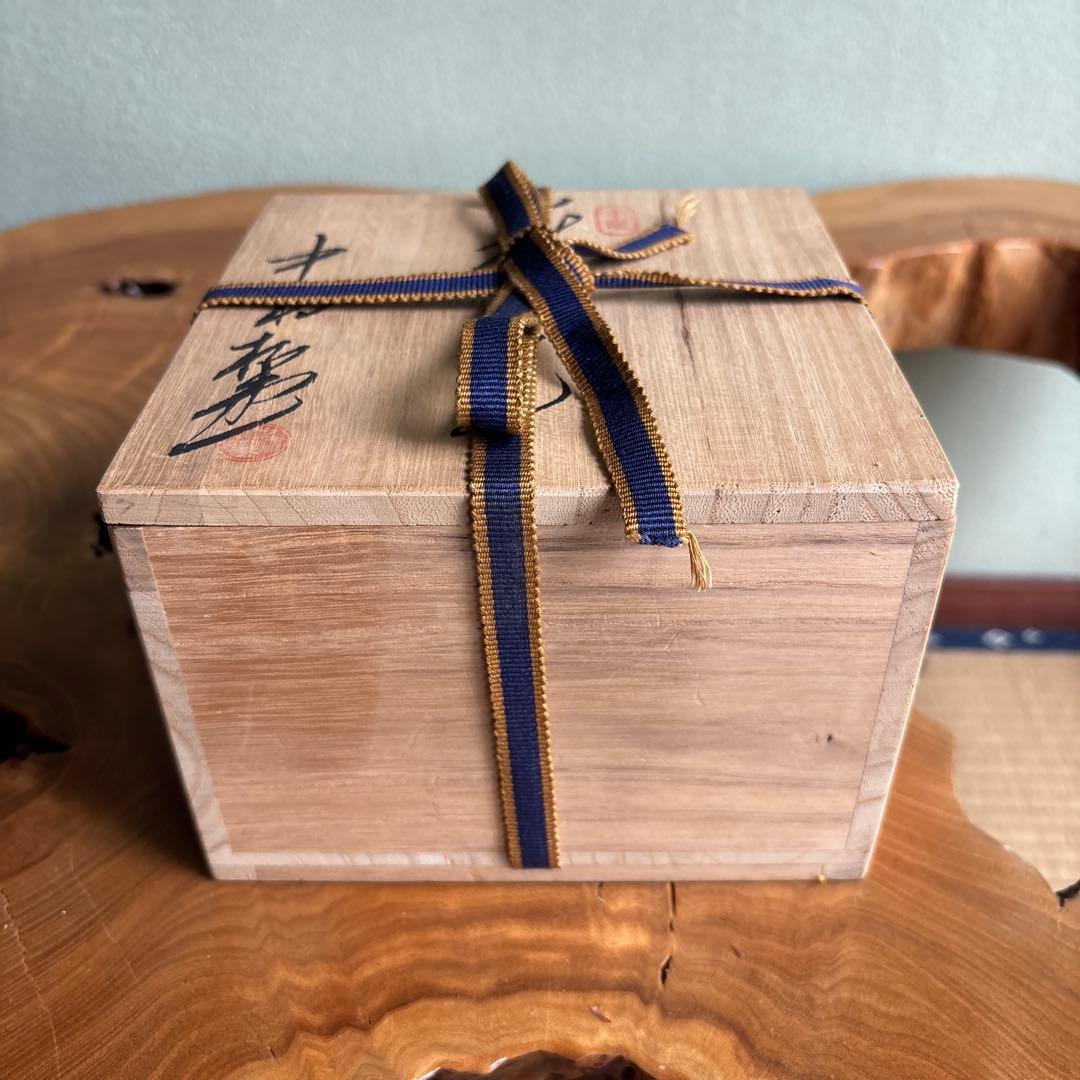
• Box: Tomobako (共箱) — original signed wooden box with brushwork inscription and red artist seal
• Condition: Excellent — no chips, no cracks, no repairs
🔹 [ CULTURAL & ARTISTIC INSIGHT ]
Hagi ware is one of Japan's most revered tea ceramics, traditionally ranked second only to Raku in the classic tea master's hierarchy — "first Raku, second Hagi, third Karatsu." Born from the kilns of Hagi domain in present-day Yamaguchi Prefecture, it was first fired by Korean potters brought to Japan after the 16th-century invasions, and its lineage has continued unbroken for over four centuries.
This bowl by Nakamura Shodo (中村松堂) exemplifies the quiet dignity that defines fine Hagi work. The feldspathic glaze — milky pale gray at the rim, warming toward the exposed clay at the foot — carries the characteristic kannyu (貫入), a fine network of hairline crazing that opens further with each use. Hagi ware is said to "change" over time (七化け, nana-bake — the seven transformations), absorbing tea and deepening in patina as the crazing accepts pigment. A bowl used for decades becomes a living record of ceremony.
The ohon-de (御本手) markings — soft coral-salmon blushes that emerge where iron in the clay body migrated toward the surface during firing — give this piece its warmth and individuality. No two Hagi bowls carry the same pattern of blush; these are the fingerprints of the flame.
The open, generous form — wide at the mouth, pulling inward to a modest low foot ring of bare terracotta — is precisely calibrated for the whisking of matcha. The hand can cup the bowl fully; the weight settles naturally. To hold it is to understand why tea masters have prized Hagi for centuries.
Poetic Line: "The pale glaze holds the memory of ash and fire — a winter morning caught in clay, waiting to be warmed again."
🔹 [ DEEP-DIVE COMMENTARY ]
Hagi-yaki (萩焼) is defined by its use of coarse, iron-rich local clay from the Hagi region of Yamaguchi, combined with a high-feldspar, low-silica glaze that fires to a characteristically soft, semi-matte surface. The glaze is applied thickly and contracts differently from the clay body during cooling, producing the trademark kannyu crazing. Over years of tea use, this crazing fills gradually with tannins and minerals from the tea, causing the "seven transformations" (七化け) — a prized quality that makes each Hagi bowl a document of its own use history.
Nakamura Shodo worked within the established Hagi tradition, producing work of restrained classical form. His tomobako (signed wooden box) accompanies this piece, which in Japanese ceramic practice is not mere packaging but authentication — the box lid bears the piece's name in brushwork ("萩茶碗") and the artist's seal, establishing provenance for collectors and future generations.
The ohon-de phenomenon (御本手、literally "honorable original hand") refers to the blush markings caused by iron migration during the wood-fire or gas kiln reduction atmosphere. They are unpredictable and unrepeatable, valued precisely because they cannot be engineered — only coaxed by the fire. In tea ceremony practice (chado), a bowl with distinctive ohon-de markings is said to have strong "face" (顔), meaning it holds the viewer's attention in the concentrated stillness of the tearoom.
For the contemporary collector, this bowl occupies a meaningful position: it is a genuine authenticated work by a named artist, in the classic Hagi tradition, with a signed wooden box and dimensions (14 cm diameter, 7.5 cm height) that are ideally proportioned for both practical matcha use and display. The absence of any damage elevates its functional appeal. It bridges daily practice and collection — it can be used, displayed, and passed on.
🔹 [ 日本語解説 ]
【基本情報】
• 作家:中村松堂
• 技法:萩焼/長石質の白釉、御本手の緋色
• 年代:昭和後期〜平成期(推定)
• 産地:山口県萩市
• 寸法:口径 約14cm、高さ 約7.5cm
• 付属:共箱(作家直筆銘・印あり)
• 状態:良好。ヒビなし、カケなし、修繕跡なし
【文化的・美術的解説】
萩焼は、茶陶の世界で「一楽・二萩・三唐津」と格付けされてきた、日本を代表する茶碗の産地です。山口県萩市に根ざした長石質の釉薬は、焼成後に土との収縮差から生まれる貫入(細かいひび割れ)を持ち、使い込むほどに茶の色が沁み込んで深い表情へと変化してゆきます。これを「七化け」と呼び、萩焼の最も愛された特質のひとつとされています。
本作は中村松堂による端正な萩茶碗。内外ともに淡い灰白色の釉に覆われ、御本手の緋色が散点する姿は、炎の気まぐれが産んだ唯一無二の景色です。高台には萩の土の地肌が露わになり、温かみのある朱橙色が土の素直さを伝えています。
口径14cmの開いた形は、抹茶を点てる動作に自然に応え、手のひら全体で包み込めるその重さと温度は、点前の静けさに寄り添うように設計されています。
【深掘り解説】
萩焼の土は、山口県萩地方に産する鉄分を含んだ粗目の地元土を用い、長石を多く含む釉薬と組み合わせることで独特の柔らかな質感が生まれます。焼成時の収縮差によって生じる貫入は、使用を重ねるごとに茶渋や鉱物を取り込み、器そのものが時間の堆積を映す「育つ器」となります。
御本手とは、還元炎焼成において粘土中の鉄分が表面に浮き上がり、緋色の斑点や滲みとなって現れる現象です。その出方は一切制御できず、炎だけが決定します。茶道の世界では、この景色の強い茶碗は「顔がある」と言われ、茶席の静けさの中でもひとつの存在感を放ちます。
共箱は単なる梱包材ではなく、中村松堂が「萩茶碗」と自ら筆記し、印を据えた鑑定書であり、作品の同定・出所証明として機能します。コレクターにとって共箱付きであることは、将来的な売買・鑑定においても価値を支える重要な要素です。
状態は極めて良好。実際の抹茶碗として使用しながら、コレクションの一点として飾ることもできる、現代の茶の湯愛好者にとって理想的な入口となる一碗です。
🔹 [ SHIPPING & PACKAGING ]
• Dispatch: Within 1-6 business days
• Carrier: Japan Post EMS / UPS (with tracking)
• Packaging: Carefully wrapped with protective materials
🔹 [ BASIC DETAILS ]
• Artist: Nakamura Shodo (中村松堂)
• Technique: Traditional Hagi-yaki (萩焼) — feldspathic white glaze over coarse Mishima clay; ohon-de (御本手) flame-blush markings
• Era: Late Showa – Heisei period (estimated 1980s–2000s)
• Origin: Hagi, Yamaguchi Prefecture, Japan
• Dimensions: Diameter approx. 14 cm, Height approx. 7.5 cm
• Box: Tomobako (共箱) — original signed wooden box with brushwork inscription and red artist seal
• Condition: Excellent — no chips, no cracks, no repairs
🔹 [ CULTURAL & ARTISTIC INSIGHT ]
Hagi ware is one of Japan's most revered tea ceramics, traditionally ranked second only to Raku in the classic tea master's hierarchy — "first Raku, second Hagi, third Karatsu." Born from the kilns of Hagi domain in present-day Yamaguchi Prefecture, it was first fired by Korean potters brought to Japan after the 16th-century invasions, and its lineage has continued unbroken for over four centuries.
This bowl by Nakamura Shodo (中村松堂) exemplifies the quiet dignity that defines fine Hagi work. The feldspathic glaze — milky pale gray at the rim, warming toward the exposed clay at the foot — carries the characteristic kannyu (貫入), a fine network of hairline crazing that opens further with each use. Hagi ware is said to "change" over time (七化け, nana-bake — the seven transformations), absorbing tea and deepening in patina as the crazing accepts pigment. A bowl used for decades becomes a living record of ceremony.
The ohon-de (御本手) markings — soft coral-salmon blushes that emerge where iron in the clay body migrated toward the surface during firing — give this piece its warmth and individuality. No two Hagi bowls carry the same pattern of blush; these are the fingerprints of the flame.
The open, generous form — wide at the mouth, pulling inward to a modest low foot ring of bare terracotta — is precisely calibrated for the whisking of matcha. The hand can cup the bowl fully; the weight settles naturally. To hold it is to understand why tea masters have prized Hagi for centuries.
Poetic Line: "The pale glaze holds the memory of ash and fire — a winter morning caught in clay, waiting to be warmed again."
🔹 [ DEEP-DIVE COMMENTARY ]
Hagi-yaki (萩焼) is defined by its use of coarse, iron-rich local clay from the Hagi region of Yamaguchi, combined with a high-feldspar, low-silica glaze that fires to a characteristically soft, semi-matte surface. The glaze is applied thickly and contracts differently from the clay body during cooling, producing the trademark kannyu crazing. Over years of tea use, this crazing fills gradually with tannins and minerals from the tea, causing the "seven transformations" (七化け) — a prized quality that makes each Hagi bowl a document of its own use history.
Nakamura Shodo worked within the established Hagi tradition, producing work of restrained classical form. His tomobako (signed wooden box) accompanies this piece, which in Japanese ceramic practice is not mere packaging but authentication — the box lid bears the piece's name in brushwork ("萩茶碗") and the artist's seal, establishing provenance for collectors and future generations.
The ohon-de phenomenon (御本手、literally "honorable original hand") refers to the blush markings caused by iron migration during the wood-fire or gas kiln reduction atmosphere. They are unpredictable and unrepeatable, valued precisely because they cannot be engineered — only coaxed by the fire. In tea ceremony practice (chado), a bowl with distinctive ohon-de markings is said to have strong "face" (顔), meaning it holds the viewer's attention in the concentrated stillness of the tearoom.
For the contemporary collector, this bowl occupies a meaningful position: it is a genuine authenticated work by a named artist, in the classic Hagi tradition, with a signed wooden box and dimensions (14 cm diameter, 7.5 cm height) that are ideally proportioned for both practical matcha use and display. The absence of any damage elevates its functional appeal. It bridges daily practice and collection — it can be used, displayed, and passed on.
🔹 [ 日本語解説 ]
【基本情報】
• 作家:中村松堂
• 技法:萩焼/長石質の白釉、御本手の緋色
• 年代:昭和後期〜平成期(推定)
• 産地:山口県萩市
• 寸法:口径 約14cm、高さ 約7.5cm
• 付属:共箱(作家直筆銘・印あり)
• 状態:良好。ヒビなし、カケなし、修繕跡なし
【文化的・美術的解説】
萩焼は、茶陶の世界で「一楽・二萩・三唐津」と格付けされてきた、日本を代表する茶碗の産地です。山口県萩市に根ざした長石質の釉薬は、焼成後に土との収縮差から生まれる貫入(細かいひび割れ)を持ち、使い込むほどに茶の色が沁み込んで深い表情へと変化してゆきます。これを「七化け」と呼び、萩焼の最も愛された特質のひとつとされています。
本作は中村松堂による端正な萩茶碗。内外ともに淡い灰白色の釉に覆われ、御本手の緋色が散点する姿は、炎の気まぐれが産んだ唯一無二の景色です。高台には萩の土の地肌が露わになり、温かみのある朱橙色が土の素直さを伝えています。
口径14cmの開いた形は、抹茶を点てる動作に自然に応え、手のひら全体で包み込めるその重さと温度は、点前の静けさに寄り添うように設計されています。
【深掘り解説】
萩焼の土は、山口県萩地方に産する鉄分を含んだ粗目の地元土を用い、長石を多く含む釉薬と組み合わせることで独特の柔らかな質感が生まれます。焼成時の収縮差によって生じる貫入は、使用を重ねるごとに茶渋や鉱物を取り込み、器そのものが時間の堆積を映す「育つ器」となります。
御本手とは、還元炎焼成において粘土中の鉄分が表面に浮き上がり、緋色の斑点や滲みとなって現れる現象です。その出方は一切制御できず、炎だけが決定します。茶道の世界では、この景色の強い茶碗は「顔がある」と言われ、茶席の静けさの中でもひとつの存在感を放ちます。
共箱は単なる梱包材ではなく、中村松堂が「萩茶碗」と自ら筆記し、印を据えた鑑定書であり、作品の同定・出所証明として機能します。コレクターにとって共箱付きであることは、将来的な売買・鑑定においても価値を支える重要な要素です。
状態は極めて良好。実際の抹茶碗として使用しながら、コレクションの一点として飾ることもできる、現代の茶の湯愛好者にとって理想的な入口となる一碗です。
🔹 [ SHIPPING & PACKAGING ]
• Dispatch: Within 1-6 business days
• Carrier: Japan Post EMS / UPS (with tracking)
• Packaging: Carefully wrapped with protective materials
Quantity
Couldn't load pickup availability
Low stock: 1 left
View full details