1
/
of
14
Hagi Chawan by Tsuno Seiun, Seiun-gama — Unused, with Tomobako and Shifuku
Hagi Chawan by Tsuno Seiun, Seiun-gama — Unused, with Tomobako and Shifuku
Regular price
Dhs. 1,082.00 AED
Regular price
Sale price
Dhs. 1,082.00 AED
Taxes included.
Shipping calculated at checkout.
Hagi ware has its own theory of time.
The clay remembers. The glaze moves. The bowl that arrives in your hands is not the bowl that will exist in ten years — and that is precisely why it is made.
This chawan was formed at Seiun-gama (栖雲窯) in Hagi, Yamaguchi Prefecture, by Tsuno Seiun (都野栖雲). The kiln's name — Seiun, dwelling clouds — names something in the work itself: a quality of suspension, of surface caught between settling and drifting. The glaze on this bowl does not cover the clay so much as it rests on it. Feldspathic white pools across the shoulder and upper body, breaking at the mid-wall to expose the warm amber of raw Hagi clay beneath. The two materials do not compete. They describe each other.
Hagi ware stands apart within Japan's ceramic canon because it was placed at the top of the tea master's hierarchy before it fully matured as a tradition. The old ranking — Ichi Raku, Ni Hagi, San Karatsu (一楽二萩三唐津) — was not an aesthetic preference. It was a judgment about material philosophy. Hagi clay, drawn from the Mitsunaga and Abu deposits of Yamaguchi, is coarse-grained and porous in a way that no finishing can fully close. The bowl breathes. It receives. Over years of use, the tea itself enters the body of the ware, shifting the glaze color from within, altering the surface in ways the potter does not control and cannot predict. This process is called nanabake — the seven transformations — and it is considered among the highest expressions of wabi aesthetics that a ceramic object can undergo.
This piece arrives unused (未使用, mishiyō). The glaze is intact. The kannyu — the fine network of crazing already visible across the interior surface — has not yet deepened under the influence of tea. The ochre warmth pooling beneath the milky white has not yet shifted. The bowl is, in the precise sense, waiting. The first bowl of matcha will begin something that continues for the rest of its life.
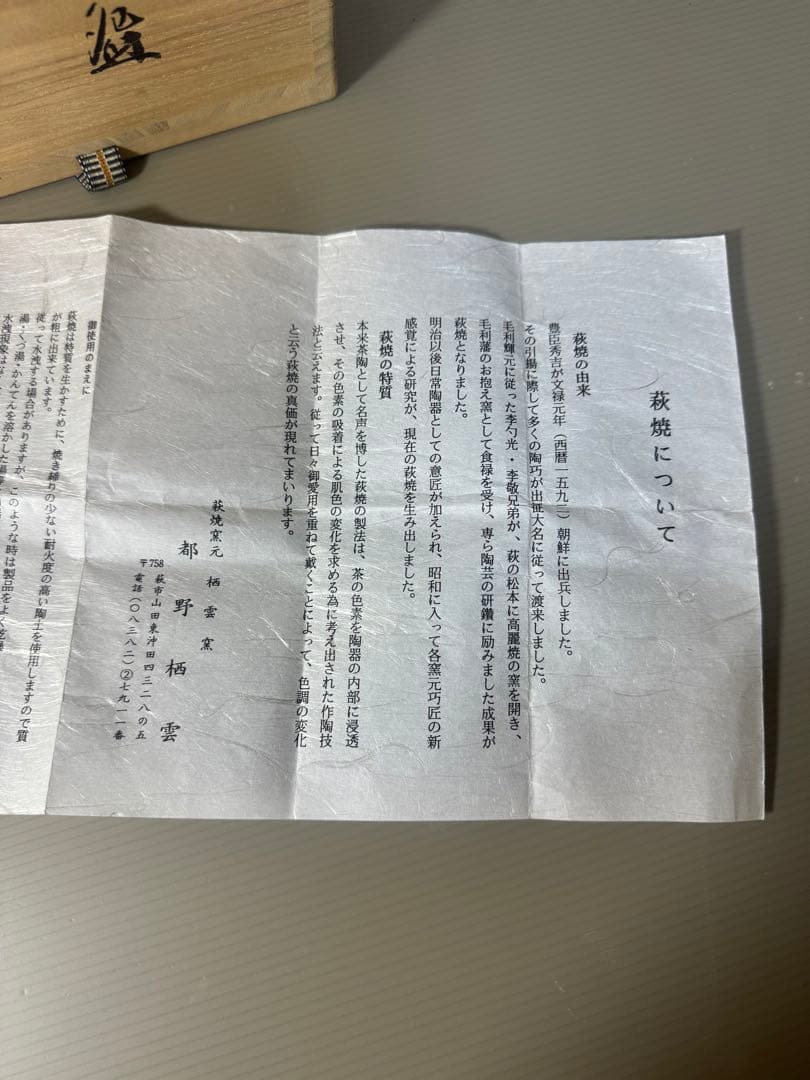
The tomobako (桐箱, paulownia wood box) is inscribed in the artist's own hand: 萩 茶盌 栖雲. The inscription is not description — it is signature, and it binds this object to a specific hand, a specific kiln, a specific understanding of what Hagi ware is asked to do. The tomobako is structural: it regulates humidity, protects the form during storage, and carries the chain of provenance forward.
The shifuku — the drawstring silk pouch — deserves its own attention. In the grammar of the tea ceremony, shifuku are not packaging. They are indicators of a bowl's standing within the practice. A chawan accompanied by a shifuku has been considered, handled, and dressed for ceremony. The fabric of this shifuku is a deep indigo field flecked with silver-grey, gathered with a braided purple cord. It was made for this bowl. The fit is deliberate.
The form itself is wide and open — a koicha bowl, suited to the thick tea of formal gatherings. The mouth opens generously. The foot ring is low and compact. Held, the weight distributes evenly across the palm. The irregular, hand-worked rim catches light at different angles depending on how the bowl turns during chakin-sabaki, the cloth-wiping that begins each use.
The interior surface, seen closely, carries the full character of Hagi firing: a warm cream ground, crazing already mapping itself across the glaze in fine lines, and a quality of depth that photographs approximate but do not capture. This is a surface designed to be read at close distance, over steam, in stillness.
No chips. No repairs. No use marks. Condition: mint.
Complete set: chawan, tomobako (signed), shifuku.
---
🔹 [ BASIC DETAILS ]
🔹 [ CULTURAL & ARTISTIC INSIGHT ]
🔹 [ DEEP-DIVE COMMENTARY ]
🔹 [ 日本語解説 ]
萩焼らしい温かみのある白釉が美しく、箱書きと仕服が揃った状態の良い一碗です。未使用のため、これから育てていく楽しみがあります。
🔹 [ SHIPPING & PACKAGING ]
• Dispatch: Within 1-6 business days
• Carrier: Japan Post EMS / UPS (with tracking)
• Packaging: Carefully wrapped with protective materials
The clay remembers. The glaze moves. The bowl that arrives in your hands is not the bowl that will exist in ten years — and that is precisely why it is made.
This chawan was formed at Seiun-gama (栖雲窯) in Hagi, Yamaguchi Prefecture, by Tsuno Seiun (都野栖雲). The kiln's name — Seiun, dwelling clouds — names something in the work itself: a quality of suspension, of surface caught between settling and drifting. The glaze on this bowl does not cover the clay so much as it rests on it. Feldspathic white pools across the shoulder and upper body, breaking at the mid-wall to expose the warm amber of raw Hagi clay beneath. The two materials do not compete. They describe each other.
Hagi ware stands apart within Japan's ceramic canon because it was placed at the top of the tea master's hierarchy before it fully matured as a tradition. The old ranking — Ichi Raku, Ni Hagi, San Karatsu (一楽二萩三唐津) — was not an aesthetic preference. It was a judgment about material philosophy. Hagi clay, drawn from the Mitsunaga and Abu deposits of Yamaguchi, is coarse-grained and porous in a way that no finishing can fully close. The bowl breathes. It receives. Over years of use, the tea itself enters the body of the ware, shifting the glaze color from within, altering the surface in ways the potter does not control and cannot predict. This process is called nanabake — the seven transformations — and it is considered among the highest expressions of wabi aesthetics that a ceramic object can undergo.
This piece arrives unused (未使用, mishiyō). The glaze is intact. The kannyu — the fine network of crazing already visible across the interior surface — has not yet deepened under the influence of tea. The ochre warmth pooling beneath the milky white has not yet shifted. The bowl is, in the precise sense, waiting. The first bowl of matcha will begin something that continues for the rest of its life.
The tomobako (桐箱, paulownia wood box) is inscribed in the artist's own hand: 萩 茶盌 栖雲. The inscription is not description — it is signature, and it binds this object to a specific hand, a specific kiln, a specific understanding of what Hagi ware is asked to do. The tomobako is structural: it regulates humidity, protects the form during storage, and carries the chain of provenance forward.
The shifuku — the drawstring silk pouch — deserves its own attention. In the grammar of the tea ceremony, shifuku are not packaging. They are indicators of a bowl's standing within the practice. A chawan accompanied by a shifuku has been considered, handled, and dressed for ceremony. The fabric of this shifuku is a deep indigo field flecked with silver-grey, gathered with a braided purple cord. It was made for this bowl. The fit is deliberate.
The form itself is wide and open — a koicha bowl, suited to the thick tea of formal gatherings. The mouth opens generously. The foot ring is low and compact. Held, the weight distributes evenly across the palm. The irregular, hand-worked rim catches light at different angles depending on how the bowl turns during chakin-sabaki, the cloth-wiping that begins each use.
The interior surface, seen closely, carries the full character of Hagi firing: a warm cream ground, crazing already mapping itself across the glaze in fine lines, and a quality of depth that photographs approximate but do not capture. This is a surface designed to be read at close distance, over steam, in stillness.
No chips. No repairs. No use marks. Condition: mint.
Complete set: chawan, tomobako (signed), shifuku.
---
🔹 [ BASIC DETAILS ]
🔹 [ CULTURAL & ARTISTIC INSIGHT ]
🔹 [ DEEP-DIVE COMMENTARY ]
🔹 [ 日本語解説 ]
萩焼らしい温かみのある白釉が美しく、箱書きと仕服が揃った状態の良い一碗です。未使用のため、これから育てていく楽しみがあります。
🔹 [ SHIPPING & PACKAGING ]
• Dispatch: Within 1-6 business days
• Carrier: Japan Post EMS / UPS (with tracking)
• Packaging: Carefully wrapped with protective materials
Quantity
Couldn't load pickup availability
Low stock: 1 left
View full details