Iga-Style Wood-Fired Chawan with Ash-Glaze Drips — Japanese Tea Bowl with Protective Wooden Box
Iga-Style Wood-Fired Chawan with Ash-Glaze Drips — Japanese Tea Bowl with Protective Wooden Box
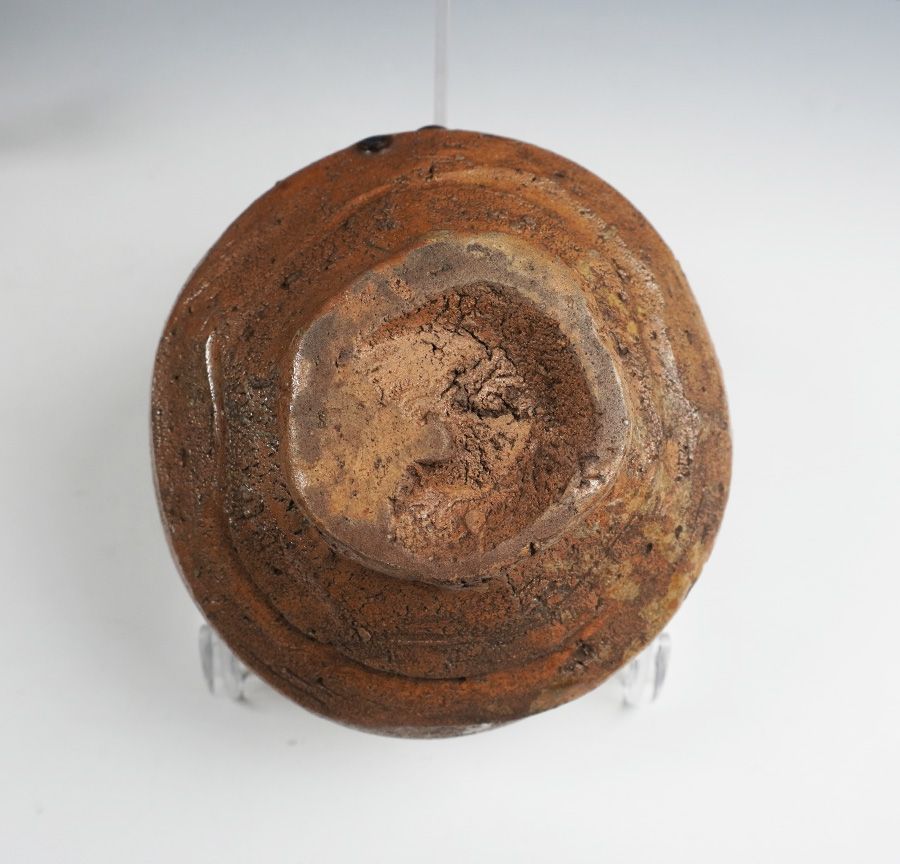
A wood-fired tea bowl in the Iga ceramic tradition, with three vertical bidoro drips of ochre-olive natural ash glaze running down a coarse iron-rich body. The clay surface shows kiln-flash, scorching, and the rough granular texture characteristic of high-temperature wood firing. Likely 20th century, in the style of the Iga kiln lineage. Seller-described as late-Edo-period Ko-Iga; we have not independently verified that attribution.
The accompanying wooden box is explicitly a 用心箱 (yōjin-bako — protective box), made for safekeeping after the fact rather than as the maker's original box. The lid is inscribed "古伊賀 茶盌". By the seller's own description, the box is a later attribution document, not an authentication.
🔹 [ BASIC DETAILS ]
- Form: Chawan (茶碗) — matcha tea bowl, slightly waisted
- Material / Technique: Iron-rich stoneware in the Iga tradition; natural ash-glaze drips (bidoro, ビードロ) from wood-fired kiln; coarse grit and fire-scorch on body
- Likely period: 20th century, in the style of Iga kiln lineage. Seller-described as late-Edo Ko-Iga; not independently authenticated.
- Origin: Iga style, attributed by seller to Iga (present-day Mie Prefecture), Japan
- Dimensions: Height approx. 8.1 cm, Width approx. 12.4 cm
- Box: Yōjin-bako (用心箱) — protective wooden box explicitly described by the seller as a later protective box, not a maker's original. Inscribed 「古伊賀 茶盌」 with seal.
- Condition: Surface consistent with wood-fired Iga-style work; characteristic coarse skin (肌); no chips or structural damage observed.
🔹 [ ABOUT IGA WARE AND THIS PIECE ]
Iga ware (伊賀焼), produced in the Iga region (Mie Prefecture), is one of Japan's classical stoneware traditions, dating to the Heian period. Its most-celebrated phase is the Momoyama through early-Edo era, when tea masters such as Furuta Oribe commissioned Iga pieces precisely for their dramatically deformed forms, white pegmatite-studded bodies, and the cascading emerald-green bidoro drips that resulted from extended anagama firings.
This bowl participates in that lineage but does not, on our reading, show the specific markers of Momoyama through early-Edo Ko-Iga. The body is iron-rich rather than the characteristic white-pegmatite Iga clay; the bidoro is ochre-olive rather than emerald; the form is controlled rather than violently distorted. These are the features that distinguish a 20th-century Iga-style chawan from a 17th-century one — and the difference matters, because the two occupy entirely different valuation bands.
What the piece does show is wood-fired Iga character: kiln-flash and ash deposition consistent with extended wood firing, and a form that sits comfortably in the lineage of Iga tea-bowl making. The bowl is an Iga-style chawan in the tradition the box inscription invokes — not, on our reading, from the era the seller's title claims.
🔹 [ ATTRIBUTION NOTE ]
Independent authentication has not been performed. Attribution rests on the seller's text and a wooden box that the seller themselves designate as a protective box (用心箱), not an original maker's box. Buyers should evaluate the piece against their own attribution criteria.
🔹 [ 日本語解説 ]
素地・釉薬・焼成の景色いずれも、伊賀の系譜の中にある薪窯焼成の特徴を備えています。三本のビードロ垂れと荒い土肌、火色の景色は伊賀の語彙そのもの。ただし、桃山〜江戸初期の「古伊賀」が示すべき白いペグマタイト粒(石はぜ)、エメラルドグリーンの強烈なビードロ、織部好みの破調の歪み、これらは確認できません。私たちの読みでは、二十世紀の伊賀(または伊賀風)の手取り作品と判断します。
付属の用心箱は、出品者自身が「用心箱」と明記しているとおり、共箱ではなく後年に当てがわれた保護箱です。蓋には「古伊賀 茶盌」の墨書がありますが、作者の自筆ではなく、後の所有者による帰属記述と扱います。出品者の「江戸後期 古伊賀」記載は独立には検証していません。
🔹 [ SHIPPING & PACKAGING ]
- Dispatch: Within 1–6 business days
- Carrier: Japan Post EMS / UPS (with tracking)
- Packaging: Carefully wrapped with protective materials
Couldn't load pickup availability
Low stock: 1 left
View full details