1
/
of
8
E-Shino Matcha Bowl by Sato Kazuko — Fujigama Kiln, Iron-Painted Chawan with Tomobako
E-Shino Matcha Bowl by Sato Kazuko — Fujigama Kiln, Iron-Painted Chawan with Tomobako
Regular price
Dhs. 494.00 AED
Regular price
Sale price
Dhs. 494.00 AED
Taxes included.
Shipping calculated at checkout.
Experience Authentic Japan Art with this E-Shino Matcha Bowl. This Shino Ware Chawan serves as a Japanese Tea Bowl and Iron Painted Ceramic, featuring Mino Ware Pottery and Wabi Sabi Tea Ceremony Bowl—a must-have for any Art Collector. Crafted at Fujigama Kiln by Sato Kazuko, this E-Shino Ceramic Gift and Handmade Japanese Pottery piece embodies the quiet grace of Traditional Tea Ceremony Art.
🔹 [ BASIC DETAILS ]
• Artist: Sato Kazuko (佐藤和子), Fujigama Kiln (不二窯)
• Technique: E-Shino (絵志野) — iron-oxide painted decoration over white Shino glaze
• Era: Post-1990s (contemporary studio ceramics)
• Origin: Mino ware tradition, Japan
• Dimensions: Diameter approx. 11.5 cm, Height approx. 8.3 cm
• Box: Tomobako (共箱) — original signed wooden box inscribed "志野" (Shino) with artist seal
• Condition: Excellent — no chips, no cracks, no repairs
🔹 [ CULTURAL & ARTISTIC INSIGHT ]
Shino ware (志野焼) holds a singular place in the history of Japanese ceramics — it is celebrated as the first Japanese pottery to achieve a thick, milky-white glaze, born in the Mino kilns of Gifu Prefecture during the Momoyama period (late 16th century). E-Shino, the painted variant, layers iron-oxide motifs beneath or within this white feldspar glaze, creating a dialogue between the painted mark and the glaze's luminous opacity.
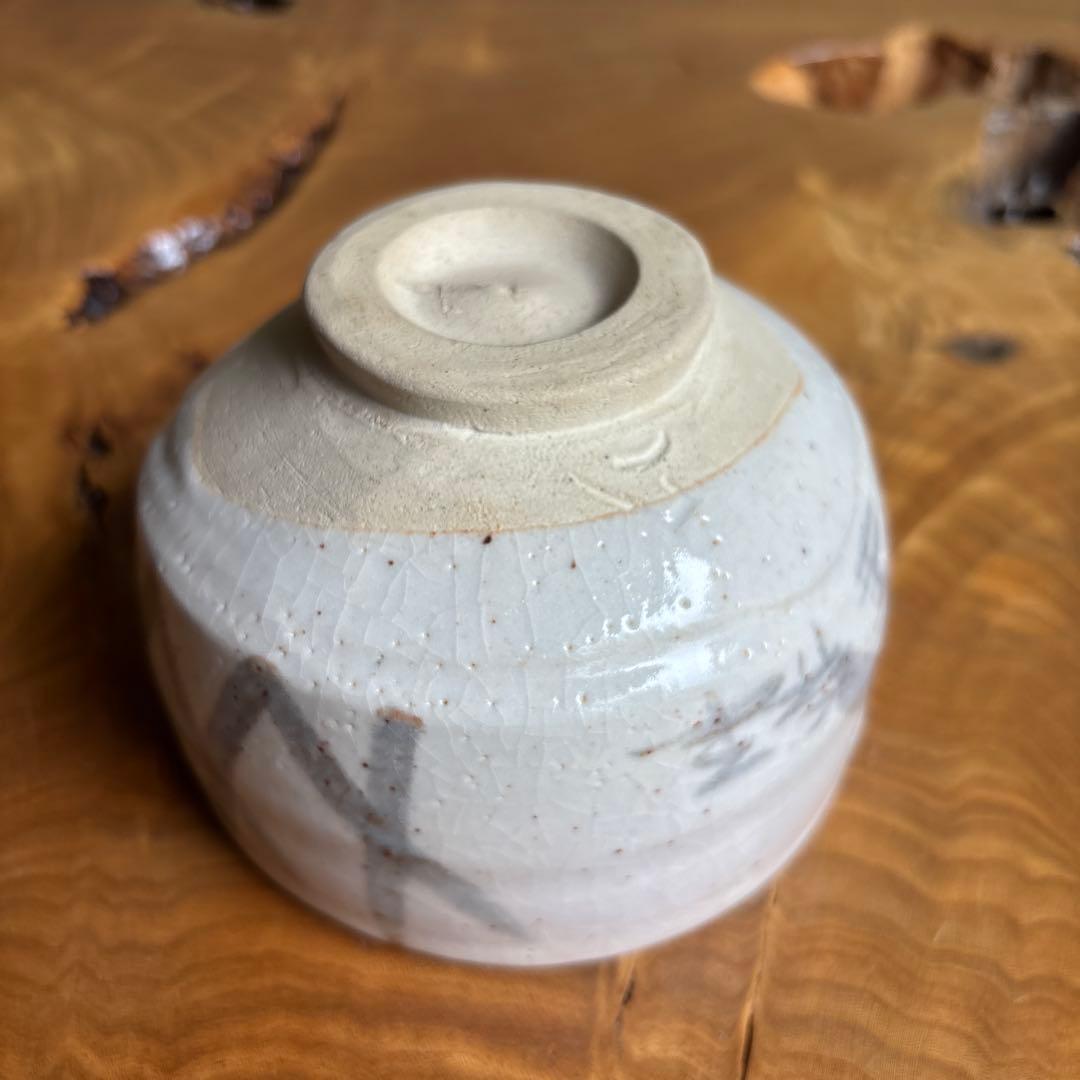
Sato Kazuko's chawan presents two distinct painted compositions on opposing faces: one side bears expressive calligraphic strokes in iron-brown — brushwork that evokes the character "美" (beauty) or the branching limbs of a winter pine — while the reverse displays a bold lattice (kōshi 格子) pattern rendered in both iron-brown and soft blue-grey. This dual-face design is characteristic of playful, skilled e-shino composition: the bowl becomes a small theatre in the hand, offering a new landscape with each rotation during temae (点前), the choreography of tea preparation.
The glaze surface shows the hallmark Shino qualities: fine, all-over crazing (kannyu 貫入), a warm off-white ground punctuated by subtle iron freckles, and the characteristic soft sheen that diffuses light rather than reflecting it. The rim carries the faintest orange-blush where the glaze thins — a phenomenon called hi-iro (火色), the fire's own signature.
POETIC LINE: "Iron traces cross white silence — two faces of the same morning, both true."
🔹 [ DEEP-DIVE COMMENTARY ]
Shino ware emerged in Mino Province (present-day Gifu Prefecture) under the influence of tea master Furuta Oribe and the aesthetics of Sen no Rikyū's wabi-cha philosophy. Unlike the sleek, dark glazes of Karatsu or the celadon refinement of Kyoto wares, Shino was deliberately imperfect — thick, textured, and warmly opaque. The key technical achievement was the formulation of a high-feldspar glaze (chōseki 長石) fired at approximately 1230–1280°C in a reduction-oxidation cycle that produced the signature milky-white surface.
E-Shino (絵志野) specifically refers to pieces decorated with iron-pigment painting (oni-ita 鬼板, a high-iron clay body used as underglaze paint) applied before the white glaze coating. During firing, the iron oxide burns to a warm rust-brown or charcoal grey depending on kiln atmosphere and glaze thickness above it — which is why Sato Kazuko's painted strokes appear in that distinctive warm-brown and slate-grey dual tone visible in this bowl.
The fine crazing (kannyu) across the entire glaze surface is not a flaw but a desirable quality in Shino appreciation — over years of use in tea ceremony, the crazes absorb residual matcha, water, and the oils from the user's hands, developing a patina called yo-hen (窯変余薫) or simply "tea stain beauty," which deepens the bowl's visual complexity and personalises it to its keeper.
Sato Kazuko working under the Fujigama kiln name follows a post-war tradition of studio potters who revived and reinterpreted classical Mino techniques outside the larger commercial kiln systems. The tomobako (共箱) — the original signed wooden storage box — is inscribed with "志野" on the lid and bears the artist's seal on the side, confirming attribution and adding collectible and provenance value that is essential in the Japanese ceramics market.
For collectors entering the Shino ware canon, a signed contemporary e-shino chawan with tomobako at this price point represents an accessible and authentic entry — genuine technique, genuine lineage, no restoration.
🔹 [ 日本語解説 ]
【基本情報】
• 作家:佐藤和子(不二窯)
• 技法:絵志野 — 鉄絵具による上絵付け、白志野釉
• 年代:現代作(1990年代以降)
• 産地:美濃焼(岐阜県)伝統
• 寸法:口径 約11.5cm、高さ 約8.3cm
• 箱:共箱(蓋表「志野」墨書、側面作者落款・朱印)
• 状態:良好 — ヒビ・カケ・修理痕なし
【景色と美的鑑賞】
志野焼は桃山時代に美濃の窯場で生まれた、日本初の白釉陶器として知られます。絵志野はその志野焼の中でも、鉄絵具(鬼板)で文様を描いた後に白志野釉をかけて焼き締める技法で、絵付けと釉薬の対話が最大の見どころです。
佐藤和子のこの茶碗は、対をなす二つの絵付けを持っています。一方の面には「美」の字あるいは枯れ松の枝を思わせる伸びやかな鉄絵の書画、もう一方の面には鉄褐色と青灰色の太い格子文様。点前の中で茶碗をまわすたびに異なる景色が現れ、一碗にして二つの世界を宿す、絵志野ならではの構成です。
釉薬の表情も見事です。細かな貫入が全面に走り、口縁に近いところでは釉薬が薄くなって淡い緋色(火色)が現れています。この火色こそ窯の息吹であり、焼成の痕跡そのものです。
詩的一言:「鉄の線が白い静寂を渡る — 同じ朝の、二つの真実。」
【深掘り解説】
志野焼の釉薬は長石を主成分とし、1230〜1280°C前後で焼成されます。絵志野の鉄絵は釉薬の下に描かれ、焼成中の窯変によって温かな鉄錆色や炭青灰色に変化します。佐藤和子の作に見られる二色の鉄絵の発色は、釉薬の厚みと窯の雰囲気の微妙な差から生まれる自然の変化です。
全面に走る貫入は欠点ではなく、志野焼鑑賞における重要な要素です。茶の湯に使い込むほど貫入に茶渋が入り、独自の景色が育つ「育てる器」であることが、志野焼が茶人に愛される所以です。
不二窯・佐藤和子は、戦後の美濃陶芸復興期に活動した女性陶芸家で、古典的な志野の技法を現代的な感覚で再解釈しています。共箱(蓋表「志野」墨書・作者印)付きで、真作の保証と収蔵価値を兼ね備えます。志野焼入門にも、既存コレクションの充実にも適した、誠実な一碗です。
🔹 [ SHIPPING & PACKAGING ]
• Dispatch: Within 1-6 business days
• Carrier: Japan Post EMS / UPS (with tracking)
• Packaging: Carefully wrapped with protective materials
🔹 [ BASIC DETAILS ]
• Artist: Sato Kazuko (佐藤和子), Fujigama Kiln (不二窯)
• Technique: E-Shino (絵志野) — iron-oxide painted decoration over white Shino glaze
• Era: Post-1990s (contemporary studio ceramics)
• Origin: Mino ware tradition, Japan
• Dimensions: Diameter approx. 11.5 cm, Height approx. 8.3 cm
• Box: Tomobako (共箱) — original signed wooden box inscribed "志野" (Shino) with artist seal
• Condition: Excellent — no chips, no cracks, no repairs
🔹 [ CULTURAL & ARTISTIC INSIGHT ]
Shino ware (志野焼) holds a singular place in the history of Japanese ceramics — it is celebrated as the first Japanese pottery to achieve a thick, milky-white glaze, born in the Mino kilns of Gifu Prefecture during the Momoyama period (late 16th century). E-Shino, the painted variant, layers iron-oxide motifs beneath or within this white feldspar glaze, creating a dialogue between the painted mark and the glaze's luminous opacity.
Sato Kazuko's chawan presents two distinct painted compositions on opposing faces: one side bears expressive calligraphic strokes in iron-brown — brushwork that evokes the character "美" (beauty) or the branching limbs of a winter pine — while the reverse displays a bold lattice (kōshi 格子) pattern rendered in both iron-brown and soft blue-grey. This dual-face design is characteristic of playful, skilled e-shino composition: the bowl becomes a small theatre in the hand, offering a new landscape with each rotation during temae (点前), the choreography of tea preparation.
The glaze surface shows the hallmark Shino qualities: fine, all-over crazing (kannyu 貫入), a warm off-white ground punctuated by subtle iron freckles, and the characteristic soft sheen that diffuses light rather than reflecting it. The rim carries the faintest orange-blush where the glaze thins — a phenomenon called hi-iro (火色), the fire's own signature.
POETIC LINE: "Iron traces cross white silence — two faces of the same morning, both true."
🔹 [ DEEP-DIVE COMMENTARY ]
Shino ware emerged in Mino Province (present-day Gifu Prefecture) under the influence of tea master Furuta Oribe and the aesthetics of Sen no Rikyū's wabi-cha philosophy. Unlike the sleek, dark glazes of Karatsu or the celadon refinement of Kyoto wares, Shino was deliberately imperfect — thick, textured, and warmly opaque. The key technical achievement was the formulation of a high-feldspar glaze (chōseki 長石) fired at approximately 1230–1280°C in a reduction-oxidation cycle that produced the signature milky-white surface.
E-Shino (絵志野) specifically refers to pieces decorated with iron-pigment painting (oni-ita 鬼板, a high-iron clay body used as underglaze paint) applied before the white glaze coating. During firing, the iron oxide burns to a warm rust-brown or charcoal grey depending on kiln atmosphere and glaze thickness above it — which is why Sato Kazuko's painted strokes appear in that distinctive warm-brown and slate-grey dual tone visible in this bowl.
The fine crazing (kannyu) across the entire glaze surface is not a flaw but a desirable quality in Shino appreciation — over years of use in tea ceremony, the crazes absorb residual matcha, water, and the oils from the user's hands, developing a patina called yo-hen (窯変余薫) or simply "tea stain beauty," which deepens the bowl's visual complexity and personalises it to its keeper.
Sato Kazuko working under the Fujigama kiln name follows a post-war tradition of studio potters who revived and reinterpreted classical Mino techniques outside the larger commercial kiln systems. The tomobako (共箱) — the original signed wooden storage box — is inscribed with "志野" on the lid and bears the artist's seal on the side, confirming attribution and adding collectible and provenance value that is essential in the Japanese ceramics market.
For collectors entering the Shino ware canon, a signed contemporary e-shino chawan with tomobako at this price point represents an accessible and authentic entry — genuine technique, genuine lineage, no restoration.
🔹 [ 日本語解説 ]
【基本情報】
• 作家:佐藤和子(不二窯)
• 技法:絵志野 — 鉄絵具による上絵付け、白志野釉
• 年代:現代作(1990年代以降)
• 産地:美濃焼(岐阜県)伝統
• 寸法:口径 約11.5cm、高さ 約8.3cm
• 箱:共箱(蓋表「志野」墨書、側面作者落款・朱印)
• 状態:良好 — ヒビ・カケ・修理痕なし
【景色と美的鑑賞】
志野焼は桃山時代に美濃の窯場で生まれた、日本初の白釉陶器として知られます。絵志野はその志野焼の中でも、鉄絵具(鬼板)で文様を描いた後に白志野釉をかけて焼き締める技法で、絵付けと釉薬の対話が最大の見どころです。
佐藤和子のこの茶碗は、対をなす二つの絵付けを持っています。一方の面には「美」の字あるいは枯れ松の枝を思わせる伸びやかな鉄絵の書画、もう一方の面には鉄褐色と青灰色の太い格子文様。点前の中で茶碗をまわすたびに異なる景色が現れ、一碗にして二つの世界を宿す、絵志野ならではの構成です。
釉薬の表情も見事です。細かな貫入が全面に走り、口縁に近いところでは釉薬が薄くなって淡い緋色(火色)が現れています。この火色こそ窯の息吹であり、焼成の痕跡そのものです。
詩的一言:「鉄の線が白い静寂を渡る — 同じ朝の、二つの真実。」
【深掘り解説】
志野焼の釉薬は長石を主成分とし、1230〜1280°C前後で焼成されます。絵志野の鉄絵は釉薬の下に描かれ、焼成中の窯変によって温かな鉄錆色や炭青灰色に変化します。佐藤和子の作に見られる二色の鉄絵の発色は、釉薬の厚みと窯の雰囲気の微妙な差から生まれる自然の変化です。
全面に走る貫入は欠点ではなく、志野焼鑑賞における重要な要素です。茶の湯に使い込むほど貫入に茶渋が入り、独自の景色が育つ「育てる器」であることが、志野焼が茶人に愛される所以です。
不二窯・佐藤和子は、戦後の美濃陶芸復興期に活動した女性陶芸家で、古典的な志野の技法を現代的な感覚で再解釈しています。共箱(蓋表「志野」墨書・作者印)付きで、真作の保証と収蔵価値を兼ね備えます。志野焼入門にも、既存コレクションの充実にも適した、誠実な一碗です。
🔹 [ SHIPPING & PACKAGING ]
• Dispatch: Within 1-6 business days
• Carrier: Japan Post EMS / UPS (with tracking)
• Packaging: Carefully wrapped with protective materials
Quantity
Couldn't load pickup availability
Low stock: 1 left
View full details