1
/
of
6
E-Oribe Hira Chawan Japanese Matcha Tea Bowl — Iron Brush Reed Motif, Green Copper Glaze, Mino Ware Studio Pottery
E-Oribe Hira Chawan Japanese Matcha Tea Bowl — Iron Brush Reed Motif, Green Copper Glaze, Mino Ware Studio Pottery
Regular price
Dhs. 611.00 AED
Regular price
Sale price
Dhs. 611.00 AED
Taxes included.
Shipping calculated at checkout.
Experience Authentic Japan Art with this E-Oribe Hira Chawan Tea Bowl. This Japanese Matcha Tea Bowl serves as a Mino Ware Studio Pottery piece and Oribe Green Glaze Ceramic, featuring Iron Brush Reed Motif and Kakewake Glaze Division—a must-have for any Art Collector seeking Japanese Tea Ceremony Bowl, Wabi Sabi Ceramic Art, Handmade Oribe Pottery, Hand Painted Iron Oxide Brushwork, and Flat Chawan Ceramic Art.
🔹 [ BASIC DETAILS ]
• Artist: Unknown studio artist (作家物 / signed studio work)
• Technique: E-Oribe (絵織部) — iron-oxide brushwork (tetsu-e) on unglazed clay ground with partial green copper glaze (kakewake / glaze division)
• Era: Before 2007 (estimated mid-to-late Showa or early Heisei period)
• Origin: Mino ware tradition, Japan (美濃焼)
• Dimensions: Diameter approx. 14.2 cm, Height approx. 5.5 cm
• Box: No signed wooden box included
• Condition: Excellent — no chips, no cracks, no repairs
🔹 [ CULTURAL & ARTISTIC INSIGHT ]
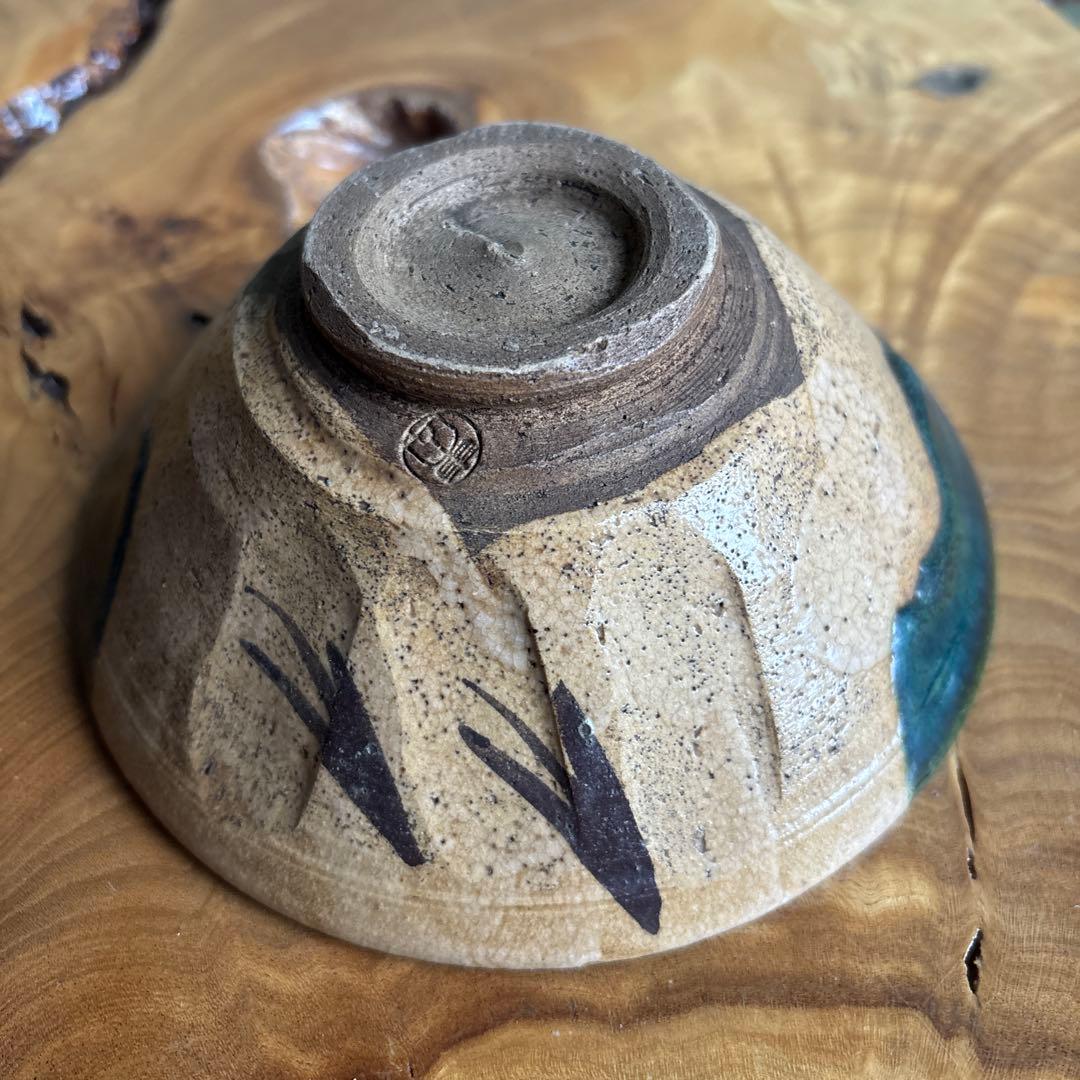
The moment you lift this bowl, the landscape comes alive. On the exterior, bold iron-oxide strokes rise like river reeds from the warm ochre clay — gestural, unhurried, alive with the breath of the brush. A sweep of deep forest-green oribe glaze descends from the rim in an asymmetric cascade, the classic kakewake (掛け分け) division that defines the e-oribe aesthetic: controlled wildness, the beauty of contrast in a single vessel.
Turn the bowl. The opposite face carries the same reed motif from a different angle — angular grass blades cut across the clay with calligraphic freedom. Here the green glaze appears only as a crescent at the rim edge, reinforcing the deliberate asymmetry that makes each viewing angle its own discovery.
Look inside. The interior reveals the raw clay body in its most intimate state — a pale natural ground with subtle crazing and the faint spiral echo of the potter's hand at center. Deep blue-green pools of oribe glaze arc at the rim's interior, flooding inward like water meeting shore. The juxtaposition of warm, unglazed earth against vivid copper-green is the soul of oribe ceramics: presence through contrast, richness through restraint.
POETIC LINE: "Green sweeps the rim like moss on a still river — and beneath it, the reed stands unhurried in warm clay light."
🔹 [ DEEP-DIVE COMMENTARY ]
Oribe ware (織部焼) was born in the kilns of Mino province in the late sixteenth and early seventeenth centuries, shaped by the radical aesthetic vision of tea master Furuta Oribe (古田織部, 1544–1615). A student of Sen no Rikyu, Oribe redirected the wabi ideal toward a new kind of bold dynamism — asymmetry, vivid color, geometric and pictorial painted motifs that broke decisively with the austere simplicity his teacher had defined.
E-Oribe (絵織部) is one of several oribe sub-types and is distinguished by its iron-oxide (tetsu-e / 鉄絵) underglaze painting applied directly to the raw clay ground before firing. The motifs — grasses, reeds, pine needles, geometric patterns — are executed with swift, expressive brushwork, then a copper-green glaze (rokushō-yu / 緑青釉) is poured or brushed over selected areas, most characteristically in the kakewake (掛け分け) "divided glaze" composition that allows stark contrast between the painted clay and the vivid glaze zones.
The hira-chawan (平茶碗 / flat tea bowl) form is the vehicle of summer — its shallow, wide profile allows the prepared matcha to cool gently, making it the preferred vessel for the warmer months of the tea calendar. In this piece, the wide, stable form and the low foot ring give the bowl a grounded, unhurried presence entirely in keeping with the spirit of chado (茶道, the Way of Tea).
For collectors, a well-executed e-oribe hira-chawan of this character — with lively tetsu-e brushwork, a genuine kakewake composition, and clean, damage-free condition — represents direct access to one of Japan's most historically significant ceramic traditions. The Mino kilns shaped the aesthetics of the Japanese tea ceremony for four centuries, and e-oribe remains their most expressive, most collected voice.
Contemporary studio potters working in the Mino tradition continue to explore the e-oribe vocabulary, and this piece reflects that living lineage: not a reproduction, but a studio artist's fluent engagement with forms and techniques that have been refined over generations.
🔹 [ 日本語解説 ]
【 詳細スペック 】
・作家:作家物(詳細不明)
・技法:絵織部 — 鉄絵による刷毛描きと緑釉(掛け分け)
・年代:2007年以前(昭和後期〜平成初期と推定)
・産地:美濃焼(岐阜県)
・寸法:直径 約14.2cm、高さ 約5.5cm
・共箱:なし
・状態:良好 — ヒビ・カケなし
【 文化的・芸術的考察 】
この茶碗を手に取る瞬間、景色が動き出す。外側には鉄絵の筆が、温かみのある黄土色の土肌から葦のように立ち上がり、迷いなく、息遣いとともに空気を切る。深い翠色の織部釉が口縁から非対称に流れ落ち、絵織部の本質である「掛け分け」の構図を作り出す——制御された野性、一器に宿る対比の美。
反対側を見れば、同じ葦の文様が異なる角度から描かれている。角張った草の葉が書の自由さをもって土を横切り、口縁にだけわずかな緑釉の三日月が残る。意図された非対称が、どの角度から見ても新鮮な発見をもたらす。
内側を覗けば、素地の土肌がそのまま現れる——ほのかな貫入を帯びた自然な地色と、中央に残る轆轤目の円弧。口縁の内側には深い青緑の釉が二つの弧を描いて溜まり、水が岸辺に触れるように内側へ広がる。温かい無釉の大地と鮮やかな銅緑釉の対比——それが織部焼の魂である。
【 深掘り解説 】
織部焼は十六世紀末から十七世紀初頭、美濃の窯で生まれた。茶人・古田織部(1544〜1615年)の美意識によって形作られ、師・千利休の侘び寂びを継承しながらも、より大胆で動的な方向へと発展させた。非対称、鮮色、幾何文や絵画的な文様——これらはすべて、利休が定めた静寂の美学との意識的な対話であった。
絵織部は織部焼の主要な様式のひとつであり、焼成前の素地に直接鉄絵具で文様を描き、一部に緑青釉(掛け分け)を施す技法を特徴とする。葦、松葉、幾何文など、モチーフは素早く表情豊かな筆致で描かれ、焼き上がりの偶然性をも景色として取り込む。
平茶碗は夏の器である。浅くて広い形状が抹茶をゆるやかに冷まし、茶道の季節のしきたりの中で夏の代表的な茶碗として用いられてきた。低い高台と安定した底部は、茶を点てる手の動きを静かに支える。
コレクターにとって、このような絵織部の平茶碗——鉄絵の筆遣いが生き、掛け分けの構図が明快で、ヒビも直しもない良好な状態——は、日本陶芸の最も重要な伝統への直接的なアクセスを意味する。美濃の窯は四世紀にわたって日本の茶の湯の美意識を形成してきた。その生きた声が、絵織部である。
🔹 [ SHIPPING & PACKAGING ]
• Dispatch: Within 1-6 business days
• Carrier: Japan Post EMS / UPS (with tracking)
• Packaging: Carefully wrapped with protective materials
🔹 [ BASIC DETAILS ]
• Artist: Unknown studio artist (作家物 / signed studio work)
• Technique: E-Oribe (絵織部) — iron-oxide brushwork (tetsu-e) on unglazed clay ground with partial green copper glaze (kakewake / glaze division)
• Era: Before 2007 (estimated mid-to-late Showa or early Heisei period)
• Origin: Mino ware tradition, Japan (美濃焼)
• Dimensions: Diameter approx. 14.2 cm, Height approx. 5.5 cm
• Box: No signed wooden box included
• Condition: Excellent — no chips, no cracks, no repairs
🔹 [ CULTURAL & ARTISTIC INSIGHT ]
The moment you lift this bowl, the landscape comes alive. On the exterior, bold iron-oxide strokes rise like river reeds from the warm ochre clay — gestural, unhurried, alive with the breath of the brush. A sweep of deep forest-green oribe glaze descends from the rim in an asymmetric cascade, the classic kakewake (掛け分け) division that defines the e-oribe aesthetic: controlled wildness, the beauty of contrast in a single vessel.
Turn the bowl. The opposite face carries the same reed motif from a different angle — angular grass blades cut across the clay with calligraphic freedom. Here the green glaze appears only as a crescent at the rim edge, reinforcing the deliberate asymmetry that makes each viewing angle its own discovery.
Look inside. The interior reveals the raw clay body in its most intimate state — a pale natural ground with subtle crazing and the faint spiral echo of the potter's hand at center. Deep blue-green pools of oribe glaze arc at the rim's interior, flooding inward like water meeting shore. The juxtaposition of warm, unglazed earth against vivid copper-green is the soul of oribe ceramics: presence through contrast, richness through restraint.
POETIC LINE: "Green sweeps the rim like moss on a still river — and beneath it, the reed stands unhurried in warm clay light."
🔹 [ DEEP-DIVE COMMENTARY ]
Oribe ware (織部焼) was born in the kilns of Mino province in the late sixteenth and early seventeenth centuries, shaped by the radical aesthetic vision of tea master Furuta Oribe (古田織部, 1544–1615). A student of Sen no Rikyu, Oribe redirected the wabi ideal toward a new kind of bold dynamism — asymmetry, vivid color, geometric and pictorial painted motifs that broke decisively with the austere simplicity his teacher had defined.
E-Oribe (絵織部) is one of several oribe sub-types and is distinguished by its iron-oxide (tetsu-e / 鉄絵) underglaze painting applied directly to the raw clay ground before firing. The motifs — grasses, reeds, pine needles, geometric patterns — are executed with swift, expressive brushwork, then a copper-green glaze (rokushō-yu / 緑青釉) is poured or brushed over selected areas, most characteristically in the kakewake (掛け分け) "divided glaze" composition that allows stark contrast between the painted clay and the vivid glaze zones.
The hira-chawan (平茶碗 / flat tea bowl) form is the vehicle of summer — its shallow, wide profile allows the prepared matcha to cool gently, making it the preferred vessel for the warmer months of the tea calendar. In this piece, the wide, stable form and the low foot ring give the bowl a grounded, unhurried presence entirely in keeping with the spirit of chado (茶道, the Way of Tea).
For collectors, a well-executed e-oribe hira-chawan of this character — with lively tetsu-e brushwork, a genuine kakewake composition, and clean, damage-free condition — represents direct access to one of Japan's most historically significant ceramic traditions. The Mino kilns shaped the aesthetics of the Japanese tea ceremony for four centuries, and e-oribe remains their most expressive, most collected voice.
Contemporary studio potters working in the Mino tradition continue to explore the e-oribe vocabulary, and this piece reflects that living lineage: not a reproduction, but a studio artist's fluent engagement with forms and techniques that have been refined over generations.
🔹 [ 日本語解説 ]
【 詳細スペック 】
・作家:作家物(詳細不明)
・技法:絵織部 — 鉄絵による刷毛描きと緑釉(掛け分け)
・年代:2007年以前(昭和後期〜平成初期と推定)
・産地:美濃焼(岐阜県)
・寸法:直径 約14.2cm、高さ 約5.5cm
・共箱:なし
・状態:良好 — ヒビ・カケなし
【 文化的・芸術的考察 】
この茶碗を手に取る瞬間、景色が動き出す。外側には鉄絵の筆が、温かみのある黄土色の土肌から葦のように立ち上がり、迷いなく、息遣いとともに空気を切る。深い翠色の織部釉が口縁から非対称に流れ落ち、絵織部の本質である「掛け分け」の構図を作り出す——制御された野性、一器に宿る対比の美。
反対側を見れば、同じ葦の文様が異なる角度から描かれている。角張った草の葉が書の自由さをもって土を横切り、口縁にだけわずかな緑釉の三日月が残る。意図された非対称が、どの角度から見ても新鮮な発見をもたらす。
内側を覗けば、素地の土肌がそのまま現れる——ほのかな貫入を帯びた自然な地色と、中央に残る轆轤目の円弧。口縁の内側には深い青緑の釉が二つの弧を描いて溜まり、水が岸辺に触れるように内側へ広がる。温かい無釉の大地と鮮やかな銅緑釉の対比——それが織部焼の魂である。
【 深掘り解説 】
織部焼は十六世紀末から十七世紀初頭、美濃の窯で生まれた。茶人・古田織部(1544〜1615年)の美意識によって形作られ、師・千利休の侘び寂びを継承しながらも、より大胆で動的な方向へと発展させた。非対称、鮮色、幾何文や絵画的な文様——これらはすべて、利休が定めた静寂の美学との意識的な対話であった。
絵織部は織部焼の主要な様式のひとつであり、焼成前の素地に直接鉄絵具で文様を描き、一部に緑青釉(掛け分け)を施す技法を特徴とする。葦、松葉、幾何文など、モチーフは素早く表情豊かな筆致で描かれ、焼き上がりの偶然性をも景色として取り込む。
平茶碗は夏の器である。浅くて広い形状が抹茶をゆるやかに冷まし、茶道の季節のしきたりの中で夏の代表的な茶碗として用いられてきた。低い高台と安定した底部は、茶を点てる手の動きを静かに支える。
コレクターにとって、このような絵織部の平茶碗——鉄絵の筆遣いが生き、掛け分けの構図が明快で、ヒビも直しもない良好な状態——は、日本陶芸の最も重要な伝統への直接的なアクセスを意味する。美濃の窯は四世紀にわたって日本の茶の湯の美意識を形成してきた。その生きた声が、絵織部である。
🔹 [ SHIPPING & PACKAGING ]
• Dispatch: Within 1-6 business days
• Carrier: Japan Post EMS / UPS (with tracking)
• Packaging: Carefully wrapped with protective materials
Quantity
Couldn't load pickup availability
Out of stock
View full details