1
/
of
10
E-Karatsu Style Tea Bowl by Suda Shoho — Iron Reed Motif, Signed Box, Kyoto Ware Masterwork
E-Karatsu Style Tea Bowl by Suda Shoho — Iron Reed Motif, Signed Box, Kyoto Ware Masterwork
Regular price
Dhs. 1,439.00 AED
Regular price
Sale price
Dhs. 1,439.00 AED
Taxes included.
Shipping calculated at checkout.
Experience Authentic Japan Art with this E-Karatsu Style Tea Bowl. This Kyoto Ware Chawan serves as a Japanese Tea Ceremony Bowl and Signed Artist Pottery, featuring Iron Glaze Reed Motif and Wabi Sabi Aesthetic—a must-have for any Art Collector seeking Antique Japanese Ceramics with Original Wooden Box and Karatsu Clay Exposed Foot.
🔹 [ BASIC DETAILS ]
• Artist: Suda Shoho (須田祥豊, 1885–1974) — Kyoto ware master; received the art name "Shoho" from Urasenke Grand Master Tantansai (1925) and the studio name "Jyosetsuan" from Daitokuji 488th abbot Enzan Den'i in the same year
• Technique: E-Karatsu style (絵唐津写) — iron-oxide reed brushwork over feldspathic grey-green glaze with glaze-resist kakiwake panels revealing warm terracotta clay body
• Era: Taisho to early Showa period (c. 1920s–1940s)
• Origin: Kyoto, Japan (Kyoyaki tradition)
• Dimensions: Mouth diameter approx. 12.3 × 13 cm, Height approx. 8 cm, Foot diameter approx. 5.3 cm
• Box: Original signed wooden box (tomobako) with original cloth (tomobuno) included; box shows adhesive repair
• Condition: No notable chips or cracks on the bowl itself; tomobako has minor adhesive repair
🔹 [ CULTURAL & ARTISTIC INSIGHT ]
Karatsu ware (唐津焼) holds a singular place in the history of Japanese tea ceramics. Since the Momoyama period, the wabi masters of the Chado world — from Sen no Rikyu onward — prized Karatsu bowls above almost all others, ranking them in the legendary sequence "ichi-Raku, ni-Hagi, san-Karatsu" (first Raku, second Hagi, third Karatsu). The E-Karatsu sub-style, characterized by spontaneous iron-oxide brushwork applied beneath the translucent feldspathic glaze, became an especially sought-after expression of rustic directness. A single reed, a blade of grass, or a sparse autumn branch — the motif is always reduced to its essential energy, never decorative for its own sake.
Suda Shoho devoted his career to the faithful re-creation — or rather, a deeply personal reimagining — of such classical kiln traditions. Working in Kyoto, he absorbed the full vocabulary of Japanese and Korean ceramics and then subjected each form to his own refined sensibility. The accolade from Tantansai, one of the most discerning tea masters of the twentieth century, was not honorary: it was a recognition of genuine mastery.
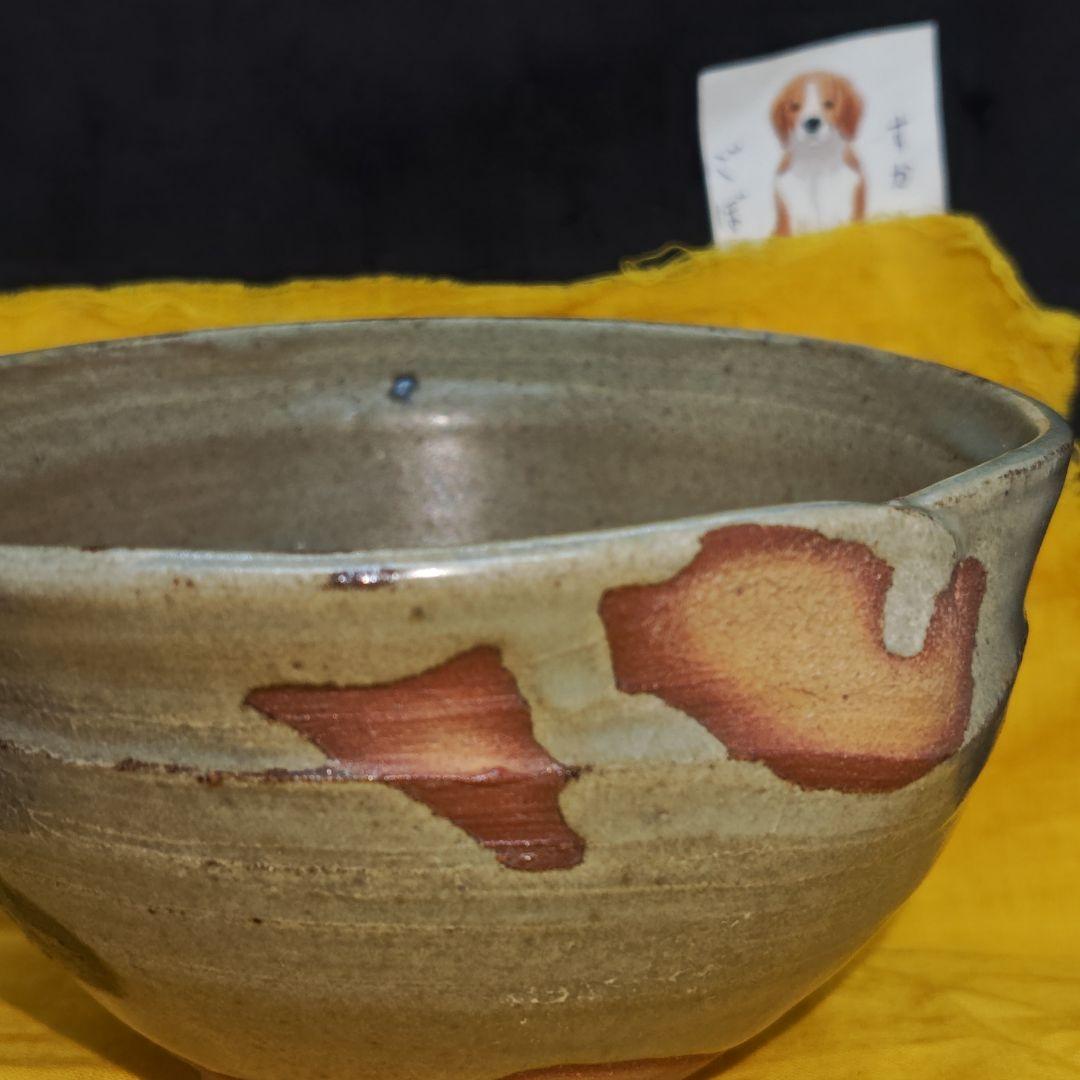
The images reveal the bowl's extraordinary presence. On the principal face, a single bold reed is swept in iron oxide with the kind of brushwork that only a completely unhesitating hand can produce. The background glaze — a cool, slightly matt feldspathic grey-green — has broken away in large kakiwake panels on the reverse and sides, exposing the warm sandy Karatsu clay body beneath in flowing, cloud-like forms. This interplay of glaze and raw clay is the visual heart of classical E-Karatsu: not accident, but controlled spontaneity. The interior shows a fine crackle network across a quieter ash-grey field, interrupted by a single dramatic window of exposed clay near the centre — a landscape within a landscape. The foot ring is unglazed, exhibiting the distinctive grained texture of Karatsu stone-ware clay.
Poetic line: "A single reed brushed in iron — the wind it remembers is ancient, the silence it carries, present."
🔹 [ DEEP-DIVE COMMENTARY ]
E-Karatsu (絵唐津) is one of the most revered sub-categories of Karatsu ware, originating in the kilns of the Saga and Nagasaki regions of northern Kyushu from the late sixteenth century. The defining characteristic is iron-brown brushwork — typically depicting plants, grasses, reeds, or abstract calligraphic forms — applied directly onto the unfired clay body before the feldspathic glaze is poured. When fired at high stoneware temperatures (approximately 1250–1280 °C), the iron saturates and darkens against the translucent glaze, achieving a depth and spontaneity impossible to contrive.
Kyoyaki (京焼), the Kyoto ceramic tradition to which Suda Shoho belonged, has historically functioned as a sophisticated interpreter of regional kiln styles. Rather than simply copying, the Kyoto tradition demands a degree of aesthetic refinement and technical virtuosity that transcends the original model. Shoho's bowls in the Karatsu manner are thus something more than "copies" (写 / utsushi): they are dialogues across geography and time, bringing the roughness of northern Kyushu clay into conversation with the elevated taste of the Kyoto tea world.
The glaze-resist phenomenon visible on this bowl — where the feldspathic glaze has deliberately been withheld or drawn back to expose the warm clay body in large irregular zones — is known as kakiwake (掻き分け) or nagashigake in certain traditions. In E-Karatsu, this technique creates the dramatic two-tone landscape effect that connoisseurs have prized for four centuries. On this bowl, the interplay between the cool grey-green glaze and the terracotta clay is both bold and harmoniously resolved.
Suda Shoho's seals appear on the inner foot ring (kōdai uchi), confirming authenticity. The tomobako is inscribed in the artist's own hand, and the tomobuno (original cloth) completes the traditional presentation. Such a complete provenance set — bowl, signed box, and cloth — is increasingly rare in the market and significantly elevates the scholarly and collecting value of the piece.
For the advanced collector of chado wares or Meiji–Showa Kyoto ceramics, this bowl represents a compelling acquisition: a technically accomplished work by a master whose name carries the endorsement of two of the most authoritative figures in twentieth-century Japanese cultural life.
🔹 [ SHIPPING & PACKAGING ]
• Dispatch: Within 1-6 business days
• Carrier: Japan Post EMS / UPS (with tracking)
• Packaging: Carefully wrapped with protective materials
🔹 [ 日本語解説 ]
【詳細スペック】
・作家:須田祥豊(1885〜1974年)— 京焼の名手。大正14年、裏千家淡々斎より「祥豊」の号、同年大徳寺四八八世円山伝衣師より「如拙庵」の号を授けられた。
・技法:絵唐津写 — 鉄釉による葦文を長石釉の灰緑色地の上に描き、掻き分けにより温かみある唐津土の素地を大胆に露出させる。
・年代:大正〜昭和初期(1920〜1940年代頃)
・産地:京都(京焼)
・寸法:口径約12.3×13cm、高さ約8cm、高台径約5.3cm
・付属:共箱(作家自筆)・共布付き。共箱に接着補修あり。
・状態:茶碗本体に目立った傷・欠けなし
【文化・芸術的解説】
唐津焼は、桃山時代以来「一楽二萩三唐津」と称されるほど茶の湯の世界で格別の地位を占めてきた。その中でも絵唐津は、長石釉の下地に鉄釉で植物や葦などを自在に描く技法で知られ、侘びの美学と直結する表現として古来から珍重されてきた。一本の葦、一筆の草 — モチーフは常に余白に還元され、装飾ではなく存在感そのものを語る。
須田祥豊は京焼の枠組みのなかで、日本・朝鮮陶磁の写しの名手として一家を成した。淡々斎から号を授けられたことは単なる名誉称号ではなく、二十世紀の茶道を代表する審美眼による真の評価であった。
本作の正面には、一切の迷いを感じさせない鉄釉一筆の葦が描かれている。背面から側面にかけては掻き分けにより長石釉が大きく剥ぎ取られ、温かみある唐津の土肌が雲のように浮かび上がる。内面には細かな貫入が走り、中央付近に劇的な素地の景色が現れる。高台は土見せの露胎で、縮緬高台に祥豊の陶印が捺される。
詩的一言:「鉄で描かれた一本の葦 — その風は古く、その静寂は今ここにある。」
【上級コレクター向け解説】
絵唐津は十六世紀末、九州北部の諸窯を発祥とし、鉄釉文様を素地に描いてから長石釉を掛け流す製法で独自の表情を生む。京焼は地方窯の様式を高度に咀嚼・昇華させる伝統をもち、祥豊の唐津写作品は単なる模倣を超えて、北九州の野趣と京都茶の湯の洗練とが拮抗する新たな地平を示す。
掻き分けによる釉薬と素地の二色対比は、四世紀にわたって茶人に愛されてきた絵唐津の視覚的核心である。本作では灰緑色の長石釉と赤茶の唐津土が大胆かつ調和的に共存し、格調高い景色を形成している。
共箱(作家自筆銘)・共布が揃った完全な伝世の姿は市場でも稀少であり、学術的・収集的価値を大きく高める。明治〜昭和の京焼コレクターや茶道具愛好家にとって、説得力のある一点である。
🔹 [ BASIC DETAILS ]
• Artist: Suda Shoho (須田祥豊, 1885–1974) — Kyoto ware master; received the art name "Shoho" from Urasenke Grand Master Tantansai (1925) and the studio name "Jyosetsuan" from Daitokuji 488th abbot Enzan Den'i in the same year
• Technique: E-Karatsu style (絵唐津写) — iron-oxide reed brushwork over feldspathic grey-green glaze with glaze-resist kakiwake panels revealing warm terracotta clay body
• Era: Taisho to early Showa period (c. 1920s–1940s)
• Origin: Kyoto, Japan (Kyoyaki tradition)
• Dimensions: Mouth diameter approx. 12.3 × 13 cm, Height approx. 8 cm, Foot diameter approx. 5.3 cm
• Box: Original signed wooden box (tomobako) with original cloth (tomobuno) included; box shows adhesive repair
• Condition: No notable chips or cracks on the bowl itself; tomobako has minor adhesive repair
🔹 [ CULTURAL & ARTISTIC INSIGHT ]
Karatsu ware (唐津焼) holds a singular place in the history of Japanese tea ceramics. Since the Momoyama period, the wabi masters of the Chado world — from Sen no Rikyu onward — prized Karatsu bowls above almost all others, ranking them in the legendary sequence "ichi-Raku, ni-Hagi, san-Karatsu" (first Raku, second Hagi, third Karatsu). The E-Karatsu sub-style, characterized by spontaneous iron-oxide brushwork applied beneath the translucent feldspathic glaze, became an especially sought-after expression of rustic directness. A single reed, a blade of grass, or a sparse autumn branch — the motif is always reduced to its essential energy, never decorative for its own sake.
Suda Shoho devoted his career to the faithful re-creation — or rather, a deeply personal reimagining — of such classical kiln traditions. Working in Kyoto, he absorbed the full vocabulary of Japanese and Korean ceramics and then subjected each form to his own refined sensibility. The accolade from Tantansai, one of the most discerning tea masters of the twentieth century, was not honorary: it was a recognition of genuine mastery.
The images reveal the bowl's extraordinary presence. On the principal face, a single bold reed is swept in iron oxide with the kind of brushwork that only a completely unhesitating hand can produce. The background glaze — a cool, slightly matt feldspathic grey-green — has broken away in large kakiwake panels on the reverse and sides, exposing the warm sandy Karatsu clay body beneath in flowing, cloud-like forms. This interplay of glaze and raw clay is the visual heart of classical E-Karatsu: not accident, but controlled spontaneity. The interior shows a fine crackle network across a quieter ash-grey field, interrupted by a single dramatic window of exposed clay near the centre — a landscape within a landscape. The foot ring is unglazed, exhibiting the distinctive grained texture of Karatsu stone-ware clay.
Poetic line: "A single reed brushed in iron — the wind it remembers is ancient, the silence it carries, present."
🔹 [ DEEP-DIVE COMMENTARY ]
E-Karatsu (絵唐津) is one of the most revered sub-categories of Karatsu ware, originating in the kilns of the Saga and Nagasaki regions of northern Kyushu from the late sixteenth century. The defining characteristic is iron-brown brushwork — typically depicting plants, grasses, reeds, or abstract calligraphic forms — applied directly onto the unfired clay body before the feldspathic glaze is poured. When fired at high stoneware temperatures (approximately 1250–1280 °C), the iron saturates and darkens against the translucent glaze, achieving a depth and spontaneity impossible to contrive.
Kyoyaki (京焼), the Kyoto ceramic tradition to which Suda Shoho belonged, has historically functioned as a sophisticated interpreter of regional kiln styles. Rather than simply copying, the Kyoto tradition demands a degree of aesthetic refinement and technical virtuosity that transcends the original model. Shoho's bowls in the Karatsu manner are thus something more than "copies" (写 / utsushi): they are dialogues across geography and time, bringing the roughness of northern Kyushu clay into conversation with the elevated taste of the Kyoto tea world.
The glaze-resist phenomenon visible on this bowl — where the feldspathic glaze has deliberately been withheld or drawn back to expose the warm clay body in large irregular zones — is known as kakiwake (掻き分け) or nagashigake in certain traditions. In E-Karatsu, this technique creates the dramatic two-tone landscape effect that connoisseurs have prized for four centuries. On this bowl, the interplay between the cool grey-green glaze and the terracotta clay is both bold and harmoniously resolved.
Suda Shoho's seals appear on the inner foot ring (kōdai uchi), confirming authenticity. The tomobako is inscribed in the artist's own hand, and the tomobuno (original cloth) completes the traditional presentation. Such a complete provenance set — bowl, signed box, and cloth — is increasingly rare in the market and significantly elevates the scholarly and collecting value of the piece.
For the advanced collector of chado wares or Meiji–Showa Kyoto ceramics, this bowl represents a compelling acquisition: a technically accomplished work by a master whose name carries the endorsement of two of the most authoritative figures in twentieth-century Japanese cultural life.
🔹 [ SHIPPING & PACKAGING ]
• Dispatch: Within 1-6 business days
• Carrier: Japan Post EMS / UPS (with tracking)
• Packaging: Carefully wrapped with protective materials
🔹 [ 日本語解説 ]
【詳細スペック】
・作家:須田祥豊(1885〜1974年)— 京焼の名手。大正14年、裏千家淡々斎より「祥豊」の号、同年大徳寺四八八世円山伝衣師より「如拙庵」の号を授けられた。
・技法:絵唐津写 — 鉄釉による葦文を長石釉の灰緑色地の上に描き、掻き分けにより温かみある唐津土の素地を大胆に露出させる。
・年代:大正〜昭和初期(1920〜1940年代頃)
・産地:京都(京焼)
・寸法:口径約12.3×13cm、高さ約8cm、高台径約5.3cm
・付属:共箱(作家自筆)・共布付き。共箱に接着補修あり。
・状態:茶碗本体に目立った傷・欠けなし
【文化・芸術的解説】
唐津焼は、桃山時代以来「一楽二萩三唐津」と称されるほど茶の湯の世界で格別の地位を占めてきた。その中でも絵唐津は、長石釉の下地に鉄釉で植物や葦などを自在に描く技法で知られ、侘びの美学と直結する表現として古来から珍重されてきた。一本の葦、一筆の草 — モチーフは常に余白に還元され、装飾ではなく存在感そのものを語る。
須田祥豊は京焼の枠組みのなかで、日本・朝鮮陶磁の写しの名手として一家を成した。淡々斎から号を授けられたことは単なる名誉称号ではなく、二十世紀の茶道を代表する審美眼による真の評価であった。
本作の正面には、一切の迷いを感じさせない鉄釉一筆の葦が描かれている。背面から側面にかけては掻き分けにより長石釉が大きく剥ぎ取られ、温かみある唐津の土肌が雲のように浮かび上がる。内面には細かな貫入が走り、中央付近に劇的な素地の景色が現れる。高台は土見せの露胎で、縮緬高台に祥豊の陶印が捺される。
詩的一言:「鉄で描かれた一本の葦 — その風は古く、その静寂は今ここにある。」
【上級コレクター向け解説】
絵唐津は十六世紀末、九州北部の諸窯を発祥とし、鉄釉文様を素地に描いてから長石釉を掛け流す製法で独自の表情を生む。京焼は地方窯の様式を高度に咀嚼・昇華させる伝統をもち、祥豊の唐津写作品は単なる模倣を超えて、北九州の野趣と京都茶の湯の洗練とが拮抗する新たな地平を示す。
掻き分けによる釉薬と素地の二色対比は、四世紀にわたって茶人に愛されてきた絵唐津の視覚的核心である。本作では灰緑色の長石釉と赤茶の唐津土が大胆かつ調和的に共存し、格調高い景色を形成している。
共箱(作家自筆銘)・共布が揃った完全な伝世の姿は市場でも稀少であり、学術的・収集的価値を大きく高める。明治〜昭和の京焼コレクターや茶道具愛好家にとって、説得力のある一点である。
Quantity
Couldn't load pickup availability
Low stock: 1 left
View full details