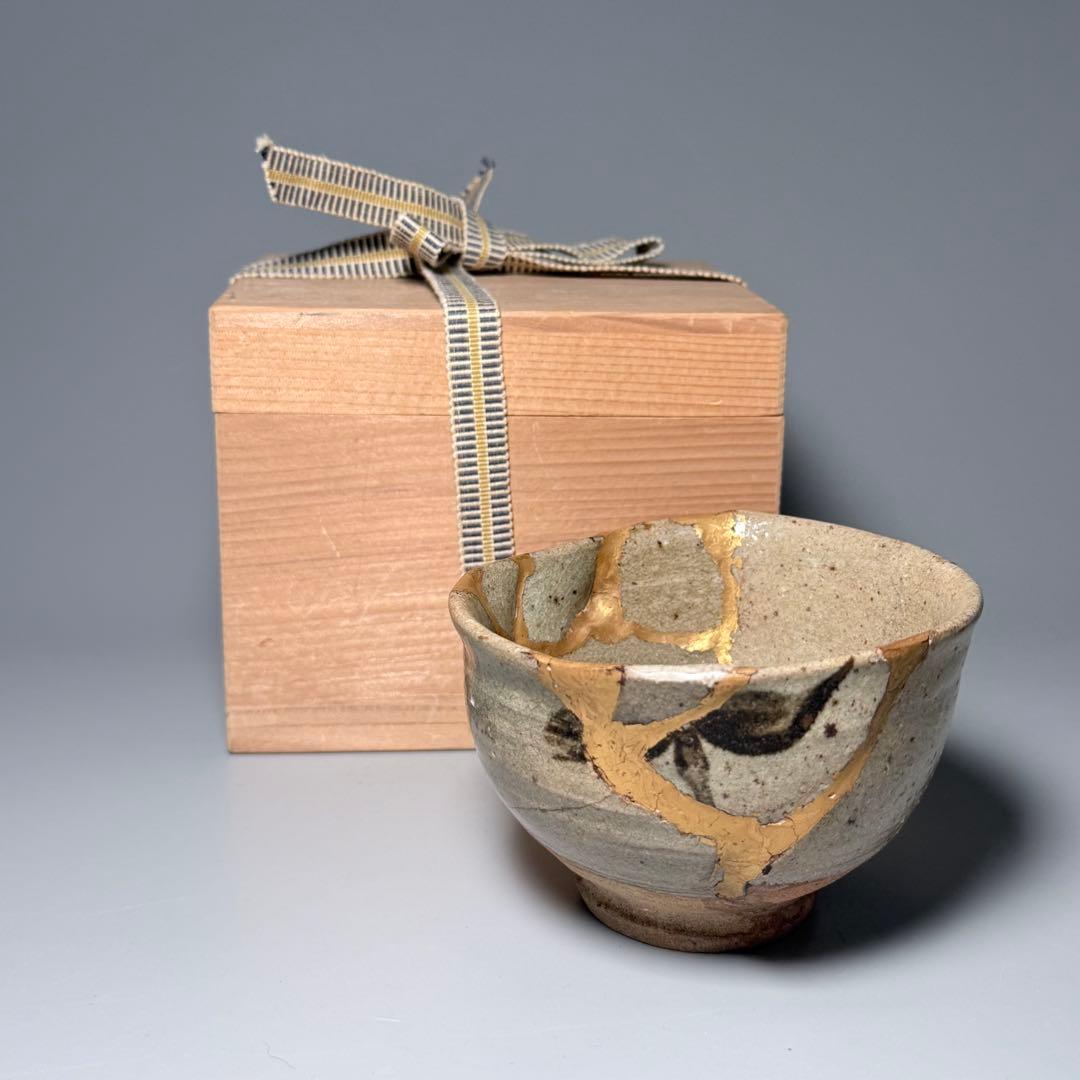
E-Karatsu (絵唐津) is the painted voice of the Karatsu tradition — iron-oxide brushwork applied to the raw clay before glazing, then sealed beneath a thin feldspathic wash. The motif dissolves into the body rather than sitting on top of it. That quality of restraint — image and clay becoming inseparable — is what made Karatsu the dominant tea ceramic of the Momoyama period.
This chawan was made in that moment. Momoyama into early Edo: the era of Sen no Rikyū's final teachings, of Furuta Oribe reshaping the tea world after him, of Korean potters settled in Saga province giving the kilns at Karatsu their structural vocabulary. The brushwork here — bold, immediate, a sweeping dark motif across the ash-grey body — carries exactly that hand. Not decorative. Intentional.
The bowl has lived four centuries. It broke. It was repaired.
The kintsugi here is extensive — gold seams traverse the upper body, cross the rim, and open into a wide golden delta across the interior floor. This is not a hairline. It is a full record of fracture and reconstitution, and it is honest. In the wabi-sabi framework that Rikyū himself codified, such repair is not remediation — it is the moment the object becomes aware of itself. The break is part of the story.
But this piece goes further. Within the gold lacquer, the restorer drew floral motifs — delicate, deliberate forms inscribed into the kintsugi itself. The repair became a second surface. The painter who first touched the clay with iron-oxide and the hand that held the lacquer brush centuries later are now in dialogue across the same object. Two authorships. One vessel.
The close-up image reveals this clearly: the gold is not plain. It is inhabited.
The clay is the characteristic Karatsu body — coarse, warm, sand-specked, unglazed at the foot in the Korean-influenced tradition. The feldspathic glaze pools subtly, greying toward ash at the shoulder. The form itself has the irregular vitality of hand-throwing under minimal correction: the rim is alive, the walls breathe.
Condition is consistent with its age. The kintsugi repair is extensive and fully consolidated; the gold seams are stable. This is a bowl that has been held, broken, cherished, and restored — not once but across generations. It comes with its original tomobako (共箱, fitted wooden storage box), an important element of Japanese ceramic provenance, and is said to originate from an iemoto collection — the inner circle of a tea school lineage.
Supplied by a licensed antique dealer (古美術商免許 #911100009525).
Dimensions: diameter approx. 10.6 cm × height 7 cm.
For collectors who understand that condition and presence are not the same thing.
🔹 [ SHIPPING & PACKAGING ] • Dispatch: Within 1-6 business days • Carrier: Japan Post EMS / UPS (with tracking) • Packaging: Carefully wrapped with protective materials