1
/
of
10
Chashaku Tea Scoop | Hakuun (White Cloud) | Kobayashi Taigen Inscription | Daitoku-ji Obaiin Abbot | Kisen Carver | Unused with Tomobako
Chashaku Tea Scoop | Hakuun (White Cloud) | Kobayashi Taigen Inscription | Daitoku-ji Obaiin Abbot | Kisen Carver | Unused with Tomobako
Regular price
Dhs. 1,399.00 AED
Regular price
Sale price
Dhs. 1,399.00 AED
Taxes included.
Shipping calculated at checkout.
Hakuun — White Cloud.
🔹 [ BASIC DETAILS ]
• Artist: Kisen (carver) / Kobayashi Taigen (Daitoku-ji Obaiin abbot inscription)
• Origin: Kyoto, Japan
• Material: Bamboo
• Motif: Hakuun (White Cloud — Zen symbol of non-attachment and freedom)
• Era: 2000_2009
• Box: Tomobako (artist's wooden presentation box)
• Condition: Good, carefully inspected
🔹 [ Cultural & Artistic Insight ]
A Zen name given to a tea scoop. In Zen teaching, the white cloud does not cling to the mountain. It rises. It drifts. It vanishes without grasping. To name a chashaku Hakuun is to remind the host: hold the ceremony lightly.
This tea scoop was carved by Kisen and inscribed by Venerable Kobayashi Taigen (1938–2024), the late abbot of Obaiin — a sub-temple of Daitoku-ji in Kyoto, the great Rinzai Zen complex that has stood at the center of Japanese tea culture for six centuries.
The connection between Daitoku-ji and chanoyu is inseparable from the name Sen no Rikyu. It was here that Rikyu studied under the Zen abbot Kokei Sochin. It was here, at Obaiin, that the intellectual and spiritual foundations of wabi-cha were quietly forged. When Rikyu was ordered to death by Toyotomi Hideyoshi in 1591, Daitoku-ji became the site of his memorial. The weight of that history does not leave these grounds.
Abbot Taigen was among the most respected Zen masters of the modern era — a calligrapher, poet, and teacher whose brushwork carried the directness of Rinzai transmission. His inscription on the inner lid of the tomobako box reads:
嬉撰作 銘白雲 茶叟太玄五
"Carved by Kisen — Named Hakuun — Taigen of Tea, the Fifth"
The scoop itself is carved from fine bamboo in a slender, restrained form — long and thin, with a shallow, quietly curved scoop. The bamboo is warm ivory-gold in tone, smooth and undisturbed. The carving shows complete confidence: nothing removed that should not be, nothing added.
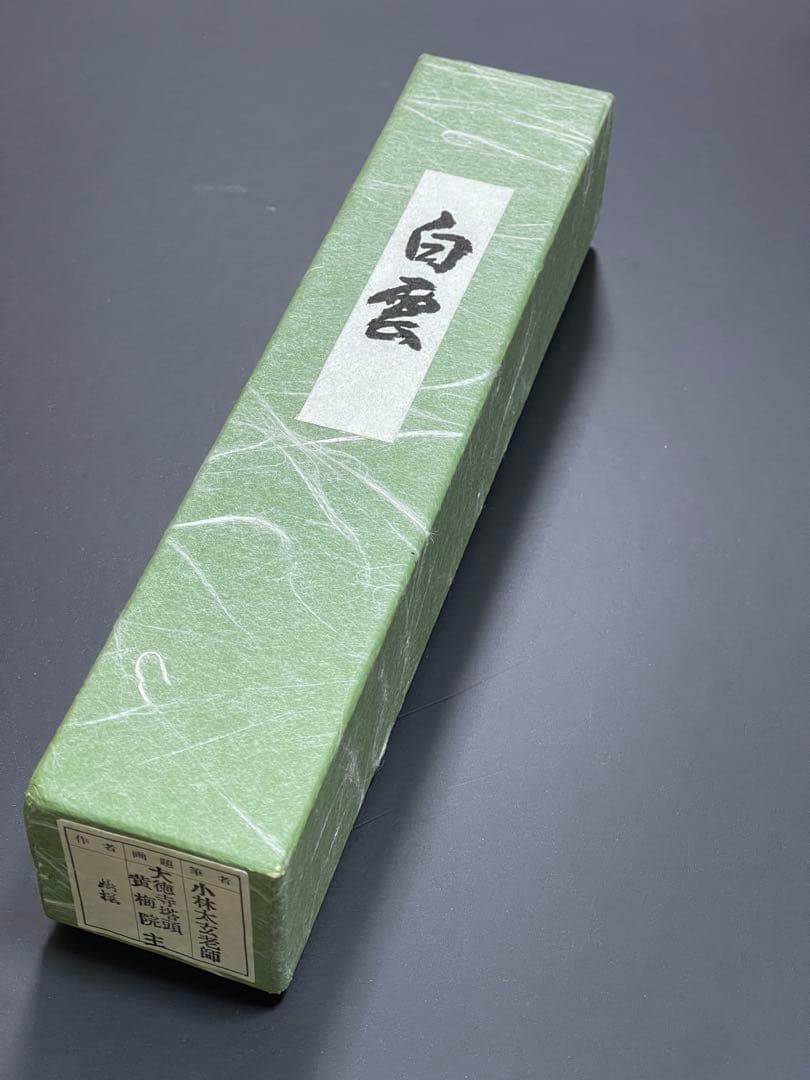
The tubular case bears the inscription Hakuun in bold brushwork alongside Kisen's signature. The outer box — a pale celadon green with the characters 白雲 — completes a presentation of rare coherence: carver, abbot, bamboo, name, and box all in full accord.
This piece is unused. It has not been brought to ceremony. That is its condition, and it is also its invitation.
────────────────────────
[ DETAILS ]
• Chashaku (tea scoop): approx. 18 cm
• Bamboo case: approx. 21.5 cm
• Material: Bamboo, wood (tomobako)
• Inscription: Kobayashi Taigen, Abbot of Obaiin, Daitoku-ji (Kyoto)
• Carver: Kisen
• Condition: Unused, mint. No chips, cracks, or discoloration.
• Provenance: With original tomobako (signed wooden box) and outer paper sleeve box
────────────────────────
🔹 [ Deep-Dive Commentary ]
[ CULTURAL & ARTISTIC INSIGHT ]
Daitoku-ji is not simply a temple. It is a condensed history of Japanese aesthetic thought. Its sub-temples — Kōtōin, Zuihōin, Gyokurinin, and Obaiin among them — each preserve distinct lineages of garden design, tea practice, and calligraphy. Obaiin, founded in the Momoyama period, carries a particularly intimate connection to the tea tradition of Rikyu's circle.
Kobayashi Taigen served as abbot of Obaiin for decades, engaging with the cultural world not through institution but through direct transmission — brush to paper, teacher to student. His Zen calligraphy — characterized by decisive strokes and charged white space — became one of the defining visual voices of Rinzai Zen in the late 20th and early 21st centuries. He passed away in 2024.
A chashaku bearing his inscription is not a decorative object. It is a document of transmission.
In the tea gathering, the chashaku is the last instrument to move before the matcha meets the bowl. That moment — the scoop lifted, the green powder released — is held in the name the master gave it. Hakuun rises. And dissolves.
────────────────────────
[ DEEP-DIVE COMMENTARY ]
The naming convention for chashaku follows a precise cultural grammar. A name (mei) given by a Zen abbot or tea master elevates the object from craft to artifact. The name does not describe the scoop — it creates a field of meaning the practitioner enters each time the scoop is used.
Hakuun — 白雲 — appears in Zen literature from the Tang Dynasty onward. Layman Pang's verse, the poems of Dogen, the recorded sayings of Rinzai masters: the white cloud is a recurring image of non-attachment. It does not stay. That is precisely its quality.
For the collector, this piece occupies a specific position: it is inscribed by one of the last great Rinzai abbots to have bridged the classical and contemporary eras, made by a carver (Kisen) whose restraint matches the weight of the inscription, and preserved in complete, unused condition with full provenance documentation.
It will not be easy to find its equal.
────────────────────────
🔹 [ 日本語解説 ]
銘「白雲」。大徳寺塔頭・黄梅院住職、小林太玄老師(1938-2024)の揮毫による茶杓です。
白雲とは、山に留まらず、風に従い、跡を残さず消えゆく雲のこと。禅において非執着の象徴として古来より詠まれてきた言葉です。その名を茶杓に与えた老師の意図は、茶席において道具を軽やかに扱うことへの示唆でしょう。
大徳寺は、千利休が禅を学んだ地であり、侘び茶の精神が培われた場所です。黄梅院はその塔頭のひとつとして桃山時代から続く、茶道と禅の交差点に位置します。
共箱内蓋裏には老師自筆で「嬉撰作 銘白雲 茶叟太玄五」と記されています。嬉撰氏による作で、竹筒にも「白雲」「嬉撰作」の銘が入ります。外箱は薄青磁色の紙箱。
未使用品。茶席に出されることなく、箱の中で静かに時を過ごしてきた一品です。
🔹 [ SHIPPING & PACKAGING ]
• Dispatch: Within 1-6 business days
• Carrier: Japan Post EMS / UPS (with tracking)
• Packaging: Carefully wrapped with protective materials
🔹 [ BASIC DETAILS ]
• Artist: Kisen (carver) / Kobayashi Taigen (Daitoku-ji Obaiin abbot inscription)
• Origin: Kyoto, Japan
• Material: Bamboo
• Motif: Hakuun (White Cloud — Zen symbol of non-attachment and freedom)
• Era: 2000_2009
• Box: Tomobako (artist's wooden presentation box)
• Condition: Good, carefully inspected
🔹 [ Cultural & Artistic Insight ]
A Zen name given to a tea scoop. In Zen teaching, the white cloud does not cling to the mountain. It rises. It drifts. It vanishes without grasping. To name a chashaku Hakuun is to remind the host: hold the ceremony lightly.
This tea scoop was carved by Kisen and inscribed by Venerable Kobayashi Taigen (1938–2024), the late abbot of Obaiin — a sub-temple of Daitoku-ji in Kyoto, the great Rinzai Zen complex that has stood at the center of Japanese tea culture for six centuries.
The connection between Daitoku-ji and chanoyu is inseparable from the name Sen no Rikyu. It was here that Rikyu studied under the Zen abbot Kokei Sochin. It was here, at Obaiin, that the intellectual and spiritual foundations of wabi-cha were quietly forged. When Rikyu was ordered to death by Toyotomi Hideyoshi in 1591, Daitoku-ji became the site of his memorial. The weight of that history does not leave these grounds.
Abbot Taigen was among the most respected Zen masters of the modern era — a calligrapher, poet, and teacher whose brushwork carried the directness of Rinzai transmission. His inscription on the inner lid of the tomobako box reads:
嬉撰作 銘白雲 茶叟太玄五
"Carved by Kisen — Named Hakuun — Taigen of Tea, the Fifth"
The scoop itself is carved from fine bamboo in a slender, restrained form — long and thin, with a shallow, quietly curved scoop. The bamboo is warm ivory-gold in tone, smooth and undisturbed. The carving shows complete confidence: nothing removed that should not be, nothing added.
The tubular case bears the inscription Hakuun in bold brushwork alongside Kisen's signature. The outer box — a pale celadon green with the characters 白雲 — completes a presentation of rare coherence: carver, abbot, bamboo, name, and box all in full accord.
This piece is unused. It has not been brought to ceremony. That is its condition, and it is also its invitation.
────────────────────────
[ DETAILS ]
• Chashaku (tea scoop): approx. 18 cm
• Bamboo case: approx. 21.5 cm
• Material: Bamboo, wood (tomobako)
• Inscription: Kobayashi Taigen, Abbot of Obaiin, Daitoku-ji (Kyoto)
• Carver: Kisen
• Condition: Unused, mint. No chips, cracks, or discoloration.
• Provenance: With original tomobako (signed wooden box) and outer paper sleeve box
────────────────────────
🔹 [ Deep-Dive Commentary ]
[ CULTURAL & ARTISTIC INSIGHT ]
Daitoku-ji is not simply a temple. It is a condensed history of Japanese aesthetic thought. Its sub-temples — Kōtōin, Zuihōin, Gyokurinin, and Obaiin among them — each preserve distinct lineages of garden design, tea practice, and calligraphy. Obaiin, founded in the Momoyama period, carries a particularly intimate connection to the tea tradition of Rikyu's circle.
Kobayashi Taigen served as abbot of Obaiin for decades, engaging with the cultural world not through institution but through direct transmission — brush to paper, teacher to student. His Zen calligraphy — characterized by decisive strokes and charged white space — became one of the defining visual voices of Rinzai Zen in the late 20th and early 21st centuries. He passed away in 2024.
A chashaku bearing his inscription is not a decorative object. It is a document of transmission.
In the tea gathering, the chashaku is the last instrument to move before the matcha meets the bowl. That moment — the scoop lifted, the green powder released — is held in the name the master gave it. Hakuun rises. And dissolves.
────────────────────────
[ DEEP-DIVE COMMENTARY ]
The naming convention for chashaku follows a precise cultural grammar. A name (mei) given by a Zen abbot or tea master elevates the object from craft to artifact. The name does not describe the scoop — it creates a field of meaning the practitioner enters each time the scoop is used.
Hakuun — 白雲 — appears in Zen literature from the Tang Dynasty onward. Layman Pang's verse, the poems of Dogen, the recorded sayings of Rinzai masters: the white cloud is a recurring image of non-attachment. It does not stay. That is precisely its quality.
For the collector, this piece occupies a specific position: it is inscribed by one of the last great Rinzai abbots to have bridged the classical and contemporary eras, made by a carver (Kisen) whose restraint matches the weight of the inscription, and preserved in complete, unused condition with full provenance documentation.
It will not be easy to find its equal.
────────────────────────
🔹 [ 日本語解説 ]
銘「白雲」。大徳寺塔頭・黄梅院住職、小林太玄老師(1938-2024)の揮毫による茶杓です。
白雲とは、山に留まらず、風に従い、跡を残さず消えゆく雲のこと。禅において非執着の象徴として古来より詠まれてきた言葉です。その名を茶杓に与えた老師の意図は、茶席において道具を軽やかに扱うことへの示唆でしょう。
大徳寺は、千利休が禅を学んだ地であり、侘び茶の精神が培われた場所です。黄梅院はその塔頭のひとつとして桃山時代から続く、茶道と禅の交差点に位置します。
共箱内蓋裏には老師自筆で「嬉撰作 銘白雲 茶叟太玄五」と記されています。嬉撰氏による作で、竹筒にも「白雲」「嬉撰作」の銘が入ります。外箱は薄青磁色の紙箱。
未使用品。茶席に出されることなく、箱の中で静かに時を過ごしてきた一品です。
🔹 [ SHIPPING & PACKAGING ]
• Dispatch: Within 1-6 business days
• Carrier: Japan Post EMS / UPS (with tracking)
• Packaging: Carefully wrapped with protective materials
Quantity
Couldn't load pickup availability
Low stock: 1 left
View full details