1
/
of
8
Celadon Tenmoku Chawan by Kaneno Kouga — Onomichi Arijin Kiln Jade Green Tea Bowl
Celadon Tenmoku Chawan by Kaneno Kouga — Onomichi Arijin Kiln Jade Green Tea Bowl
Regular price
Dhs. 735.00 AED
Regular price
Sale price
Dhs. 735.00 AED
Taxes included.
Shipping calculated at checkout.
Kaneno Kouga fired this chawan at the Arijin kiln in Onomichi, and the jade came from the kiln rather than from intention. That is the nature of seiji celadon: the green is a consequence of iron oxide meeting reduction atmosphere at the moment of transformation. The potter establishes the conditions. The fire makes the decision. What arrives in the hands of the person who eventually holds this tenmoku-form chawan is not a color chosen but a color earned.
For those searching for a Japanese celadon chawan, a seiji tenmoku tea bowl, a celadon crackle glaze chawan, Kaneno Kouga ceramics, or an Onomichi kiln tea bowl: the form here is worth attending to before the glaze. The tenmoku shape — conical body, flared rim — carries the authority of a lineage that runs from Song Dynasty China through the tea masters of the Muromachi period to the contemporary kilns that continue to understand the form's proportions as a living inheritance. Kaneno Kouga's celadon tenmoku deepens that inheritance with carved floral and leaf patterns visible beneath the glaze at angle of light.
The crackle — kannyu — is not imperfection. It is the glaze's record of its own cooling: a map of the moment the kiln closed and the object became itself.
[ BASIC DETAILS ]
• Maker: Kaneno Kouga (金野光賀造), Onomichi Arijin Kiln
• Technique: Seiji celadon with carved relief decoration, natural crackle
• Form: Tenmoku chawan (conical tea bowl with flared rim)
• Condition: Excellent
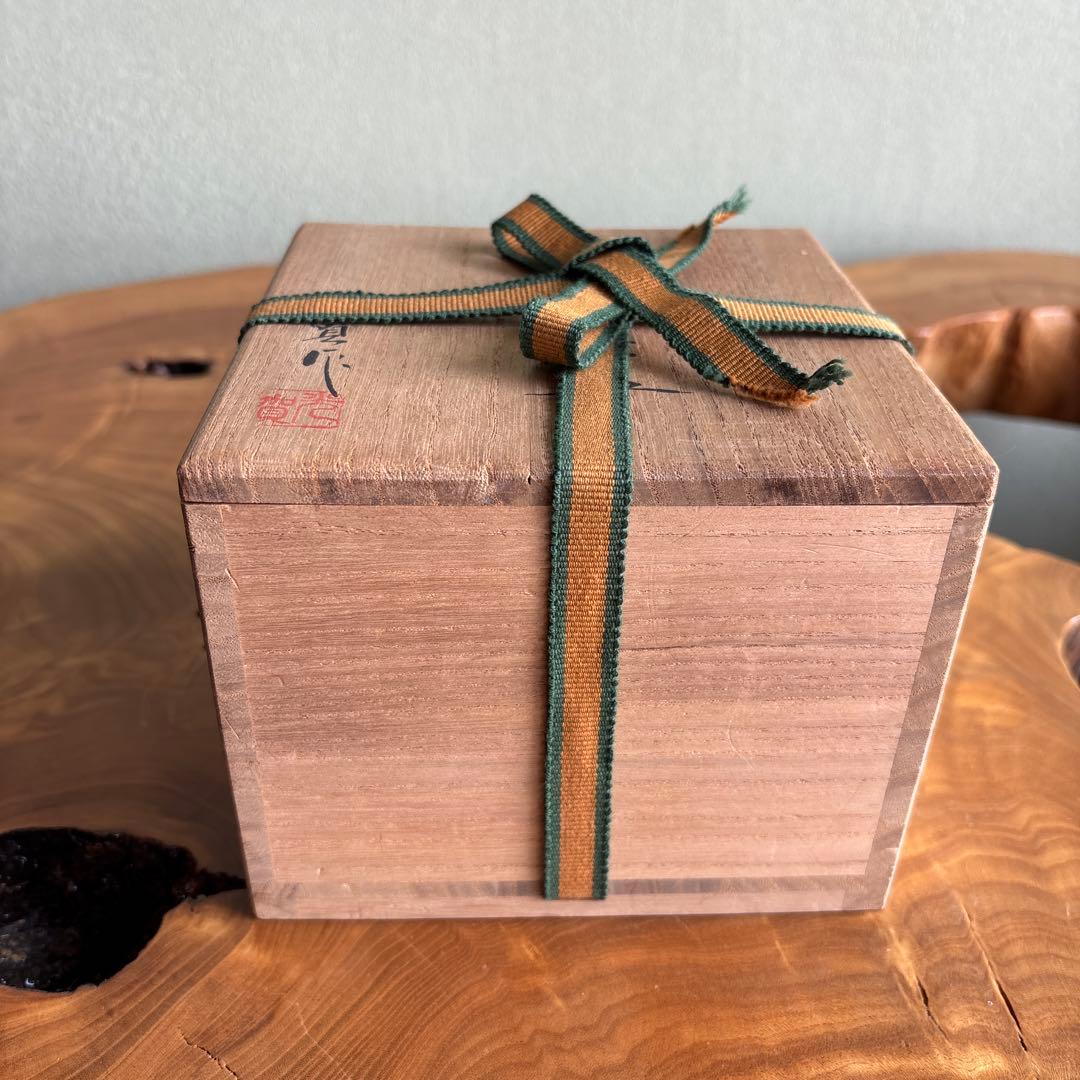
• Includes: Tomobako (artist-signed wooden box) with red seals
[ CULTURAL INSIGHT ]
Onomic — on the Hiroshima coast, facing the Seto Inland Sea — has a quieter place in Japan's ceramic geography than Arita, Mino, or Bizen. The Arijin kiln exists within that quietness. Kaneno Kouga's celadon practice is not oriented toward the competitive craft exhibition circuit but toward the tea room, where a bowl's quality is assessed through use, through the light of a particular afternoon, through the way a specific tea looks inside a specific glaze. The tenmoku form in seiji — unusual, because the historical tenmoku aesthetic was associated with dark, iron-rich glazes — creates a productive dissonance: a familiar silhouette inhabited by an unexpected coolness.
[ DEEP-DIVE ]
The tenmoku form takes its name from the Tianmu Mountains of Zhejiang Province, China, where Japanese Buddhist monks studying at Song Dynasty monasteries first encountered the distinctive dark-glazed bowls used for tea. When they brought both the tea practice and the ceramic forms back to Japan in the Kamakura period, they established an aesthetic that would shape Japanese tea culture for the following eight centuries. The form itself — wide at the rim, constricting sharply toward a small foot ring — produces a particular relationship between the tea and the person drinking it: the bowl opens toward the drinker, the surface of the tea visible, the color of the interior present. In Kaneno Kouga's seiji version, that interior is jade green, crackled, alive with the evidence of fire.
---
【日本語説明】
尾道・有神窯の金野光賀による、青磁天目茶碗。深みのある翡翠色の青磁釉に、釉下に浮かぶ草花の陰刻文様が光の角度によって静かに現れます。全体に広がる貫入(かんにゅう)が景色を作り、天目形の端正なシルエットに静けさを与えています。赤い落款入りの共箱付き。
🔹 [ SHIPPING & PACKAGING ]
• Dispatch: Within 1-6 business days
• Carrier: Japan Post EMS / UPS (with tracking)
• Packaging: Carefully wrapped with protective materials
For those searching for a Japanese celadon chawan, a seiji tenmoku tea bowl, a celadon crackle glaze chawan, Kaneno Kouga ceramics, or an Onomichi kiln tea bowl: the form here is worth attending to before the glaze. The tenmoku shape — conical body, flared rim — carries the authority of a lineage that runs from Song Dynasty China through the tea masters of the Muromachi period to the contemporary kilns that continue to understand the form's proportions as a living inheritance. Kaneno Kouga's celadon tenmoku deepens that inheritance with carved floral and leaf patterns visible beneath the glaze at angle of light.
The crackle — kannyu — is not imperfection. It is the glaze's record of its own cooling: a map of the moment the kiln closed and the object became itself.
[ BASIC DETAILS ]
• Maker: Kaneno Kouga (金野光賀造), Onomichi Arijin Kiln
• Technique: Seiji celadon with carved relief decoration, natural crackle
• Form: Tenmoku chawan (conical tea bowl with flared rim)
• Condition: Excellent
• Includes: Tomobako (artist-signed wooden box) with red seals
[ CULTURAL INSIGHT ]
Onomic — on the Hiroshima coast, facing the Seto Inland Sea — has a quieter place in Japan's ceramic geography than Arita, Mino, or Bizen. The Arijin kiln exists within that quietness. Kaneno Kouga's celadon practice is not oriented toward the competitive craft exhibition circuit but toward the tea room, where a bowl's quality is assessed through use, through the light of a particular afternoon, through the way a specific tea looks inside a specific glaze. The tenmoku form in seiji — unusual, because the historical tenmoku aesthetic was associated with dark, iron-rich glazes — creates a productive dissonance: a familiar silhouette inhabited by an unexpected coolness.
[ DEEP-DIVE ]
The tenmoku form takes its name from the Tianmu Mountains of Zhejiang Province, China, where Japanese Buddhist monks studying at Song Dynasty monasteries first encountered the distinctive dark-glazed bowls used for tea. When they brought both the tea practice and the ceramic forms back to Japan in the Kamakura period, they established an aesthetic that would shape Japanese tea culture for the following eight centuries. The form itself — wide at the rim, constricting sharply toward a small foot ring — produces a particular relationship between the tea and the person drinking it: the bowl opens toward the drinker, the surface of the tea visible, the color of the interior present. In Kaneno Kouga's seiji version, that interior is jade green, crackled, alive with the evidence of fire.
---
【日本語説明】
尾道・有神窯の金野光賀による、青磁天目茶碗。深みのある翡翠色の青磁釉に、釉下に浮かぶ草花の陰刻文様が光の角度によって静かに現れます。全体に広がる貫入(かんにゅう)が景色を作り、天目形の端正なシルエットに静けさを与えています。赤い落款入りの共箱付き。
🔹 [ SHIPPING & PACKAGING ]
• Dispatch: Within 1-6 business days
• Carrier: Japan Post EMS / UPS (with tracking)
• Packaging: Carefully wrapped with protective materials
Quantity
Couldn't load pickup availability
Low stock: 1 left
View full details