1
/
of
8
Celadon Crackle Tea Bowl – Kobayashi Kazuma – Seiji Kannyu Chawan – Japan
Celadon Crackle Tea Bowl – Kobayashi Kazuma – Seiji Kannyu Chawan – Japan
Regular price
Dhs. 684.00 AED
Regular price
Sale price
Dhs. 684.00 AED
Taxes included.
Shipping calculated at checkout.
🔹 [ GOLDEN-RATIO HOOK ]
A celadon tea bowl by Kobayashi Kazuma, rendered in deep jade-green seiji glaze with bold crackle patterning across every surface. This Japanese celadon chawan carries the weight of Song-dynasty lineage filtered through contemporary authorship — a matcha tea bowl where each kannyu fissure maps the cooling memory of the kiln. Handmade ceramic art for the tea ceremony collector who recognizes presence over ornament.
🔹 [ BASIC DETAILS ]
• Artist: Kobayashi Kazuma (小林和馬)
• Technique: Seiji (celadon) glaze with prominent kannyu (crackle) on stoneware, wheel-thrown
• Era: 2010s–2020s (contemporary)
• Origin: Japan
• Dimensions: Diameter approx. 13.3 cm × Height approx. 7.5 cm
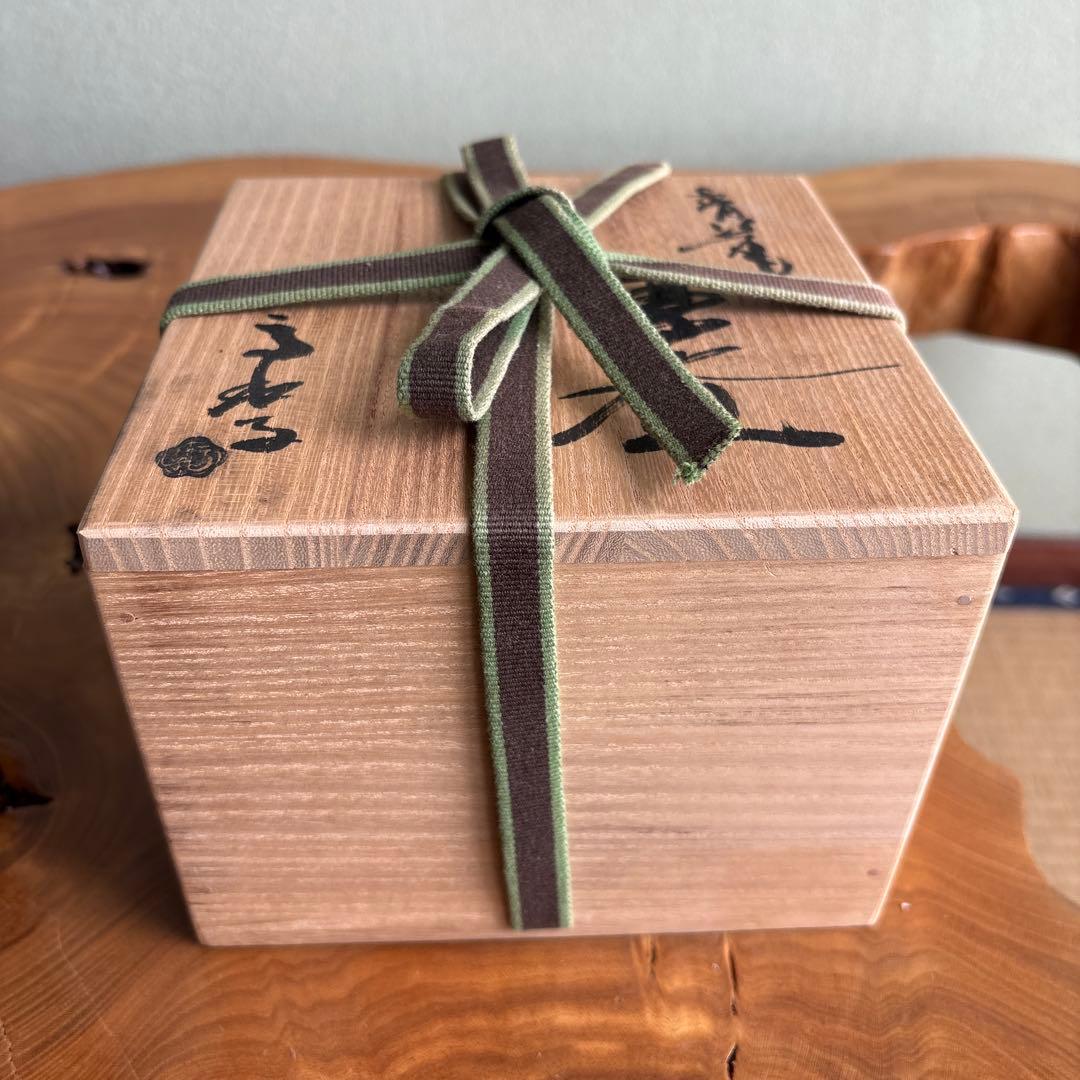
• Box: Tomobako (artist-signed wooden box) inscribed "青磁 茶碗 和馬" with artist's red seal (kao)
• Condition: Excellent — no chips, cracks, or repairs; glaze pristine throughout
🔹 [ CULTURAL & ARTISTIC INSIGHT ]
Celadon — seiji (青磁) — arrived in Japan through centuries of dialogue with Chinese and Korean kiln traditions. The jade-green glaze, achieved through iron oxide reduction firing, has been pursued by East Asian potters for over a millennium. What distinguishes Kobayashi's interpretation is the deliberate prominence of kannyu: the crackle network is not incidental but compositional. The fissures are large-scale and deeply dimensional, creating a topography across the bowl's surface that shifts under changing light.
The form is generous — a wide-mouthed hirawan shape that presents matcha as a broad green field, amplifying the visual dialogue between tea and glaze.
*The crackle holds no fracture. Only the kiln's last breath, crystallized.*
🔹 [ DEEP-DIVE COMMENTARY ]
The glaze achieves a saturated teal-green that deepens toward the lower walls where thickness accumulates, transitioning to a subtle grey-green where it thins near the rim. This gradient is not applied but emerged — the result of gravity and viscosity during firing. The interior shows the same bold crackle network, with the tea pool at center appearing slightly darker where glaze depth is greatest.
The foot ring (kōdai) is left unglazed, revealing a warm terracotta-brown clay body with fine grain. The transition from glazed body to exposed clay is clean and deliberate, with a distinctive V-shaped boundary on the underside. Kobayashi's impressed seal mark (陶印) sits just above the foot — small, precise, and legible.
The tomobako is inscribed in confident calligraphy: "青磁" (celadon) in the upper right, "茶碗" (tea bowl) center, and the artist's name "和馬" with red seal at lower left. The box is secured with a woven olive-brown silk cord (sanada-himo).
This bowl sits at the intersection of Chinese celadon reverence and Japanese tea sensibility — the crackle that Chinese potters once considered a flaw, Japanese aesthetics elevated to the central expression.
🔹 [ SHIPPING & PACKAGING ]
• Dispatch: Within 1-6 business days
• Carrier: Japan Post EMS / UPS (with tracking)
• Packaging: Carefully wrapped with protective materials
🔹 [ JAPANESE DESCRIPTION / 日本語解説 ]
小林和馬作の青磁茶碗です。深い翡翠色の青磁釉が碗全体を覆い、大胆な貫入(かんにゅう)が表面に走り、窯の中での冷却過程を静かに記録しています。碗の下部では釉薬が厚く溜まり、より深い青緑色を呈し、口縁部に向かって薄く流れグレーグリーンに変化します。この色の推移は意図されたものではなく、重力と釉の粘度が焼成中に生み出した自然の表情です。
高台は無釉で、温かみのあるテラコッタ色の素地が現れ、V字型の釉際が印象的です。高台脇に小林の陶印が押されています。共箱には「青磁 茶碗 和馬」の箱書きと朱印があり、真田紐で結ばれています。
広い口径と穏やかな深さを持つ平碗形で、抹茶を点てた際に翡翠色の釉と茶の緑が響き合う、茶席での視覚的対話を意識した造形です。傷・欠けなく、優れた保存状態です。
A celadon tea bowl by Kobayashi Kazuma, rendered in deep jade-green seiji glaze with bold crackle patterning across every surface. This Japanese celadon chawan carries the weight of Song-dynasty lineage filtered through contemporary authorship — a matcha tea bowl where each kannyu fissure maps the cooling memory of the kiln. Handmade ceramic art for the tea ceremony collector who recognizes presence over ornament.
🔹 [ BASIC DETAILS ]
• Artist: Kobayashi Kazuma (小林和馬)
• Technique: Seiji (celadon) glaze with prominent kannyu (crackle) on stoneware, wheel-thrown
• Era: 2010s–2020s (contemporary)
• Origin: Japan
• Dimensions: Diameter approx. 13.3 cm × Height approx. 7.5 cm
• Box: Tomobako (artist-signed wooden box) inscribed "青磁 茶碗 和馬" with artist's red seal (kao)
• Condition: Excellent — no chips, cracks, or repairs; glaze pristine throughout
🔹 [ CULTURAL & ARTISTIC INSIGHT ]
Celadon — seiji (青磁) — arrived in Japan through centuries of dialogue with Chinese and Korean kiln traditions. The jade-green glaze, achieved through iron oxide reduction firing, has been pursued by East Asian potters for over a millennium. What distinguishes Kobayashi's interpretation is the deliberate prominence of kannyu: the crackle network is not incidental but compositional. The fissures are large-scale and deeply dimensional, creating a topography across the bowl's surface that shifts under changing light.
The form is generous — a wide-mouthed hirawan shape that presents matcha as a broad green field, amplifying the visual dialogue between tea and glaze.
*The crackle holds no fracture. Only the kiln's last breath, crystallized.*
🔹 [ DEEP-DIVE COMMENTARY ]
The glaze achieves a saturated teal-green that deepens toward the lower walls where thickness accumulates, transitioning to a subtle grey-green where it thins near the rim. This gradient is not applied but emerged — the result of gravity and viscosity during firing. The interior shows the same bold crackle network, with the tea pool at center appearing slightly darker where glaze depth is greatest.
The foot ring (kōdai) is left unglazed, revealing a warm terracotta-brown clay body with fine grain. The transition from glazed body to exposed clay is clean and deliberate, with a distinctive V-shaped boundary on the underside. Kobayashi's impressed seal mark (陶印) sits just above the foot — small, precise, and legible.
The tomobako is inscribed in confident calligraphy: "青磁" (celadon) in the upper right, "茶碗" (tea bowl) center, and the artist's name "和馬" with red seal at lower left. The box is secured with a woven olive-brown silk cord (sanada-himo).
This bowl sits at the intersection of Chinese celadon reverence and Japanese tea sensibility — the crackle that Chinese potters once considered a flaw, Japanese aesthetics elevated to the central expression.
🔹 [ SHIPPING & PACKAGING ]
• Dispatch: Within 1-6 business days
• Carrier: Japan Post EMS / UPS (with tracking)
• Packaging: Carefully wrapped with protective materials
🔹 [ JAPANESE DESCRIPTION / 日本語解説 ]
小林和馬作の青磁茶碗です。深い翡翠色の青磁釉が碗全体を覆い、大胆な貫入(かんにゅう)が表面に走り、窯の中での冷却過程を静かに記録しています。碗の下部では釉薬が厚く溜まり、より深い青緑色を呈し、口縁部に向かって薄く流れグレーグリーンに変化します。この色の推移は意図されたものではなく、重力と釉の粘度が焼成中に生み出した自然の表情です。
高台は無釉で、温かみのあるテラコッタ色の素地が現れ、V字型の釉際が印象的です。高台脇に小林の陶印が押されています。共箱には「青磁 茶碗 和馬」の箱書きと朱印があり、真田紐で結ばれています。
広い口径と穏やかな深さを持つ平碗形で、抹茶を点てた際に翡翠色の釉と茶の緑が響き合う、茶席での視覚的対話を意識した造形です。傷・欠けなく、優れた保存状態です。
Quantity
Couldn't load pickup availability
Out of stock
View full details