1
/
of
9
Black Glaze Matcha Bowl with Gold Silver Lattice by Listed Artist — Signed Tomobako, Japanese Tea Ceremony Chawan
Black Glaze Matcha Bowl with Gold Silver Lattice by Listed Artist — Signed Tomobako, Japanese Tea Ceremony Chawan
Regular price
Dhs. 966.00 AED
Regular price
Sale price
Dhs. 966.00 AED
Taxes included.
Shipping calculated at checkout.
Experience Authentic Japan Art with this Japanese Black Glaze Chawan. This Gold Silver Lattice Tea Bowl serves as a Japanese Tea Ceremony Bowl and Signed Artist Pottery, featuring Kuro Glazed Matcha Bowl and Koshi Mon Geometric Decor—a must-have for any Art Collector. This Black Raku Style Chawan with Tomobako Box carries the presence of Japanese Ceramic Collectible and Hand Thrown Tea Bowl, embodying the depth of Contemporary Japanese Potter and Wabi Sabi Tea Bowl tradition.
🔹 [ BASIC DETAILS ]
• Artist: Listed artist (signature and red seal stamp on tomobako lid; full name in brushwork)
• Technique: Kuro (black) glaze with overglaze gold and silver lattice decoration (koshi-mon); hand-thrown and hand-shaped form
• Era: Likely 1980s–2000s (contemporary studio ceramics period)
• Origin: Japan (studio ceramics tradition, Raku-adjacent aesthetic)
• Dimensions: Diameter approx. 13 cm, Height approx. 9 cm
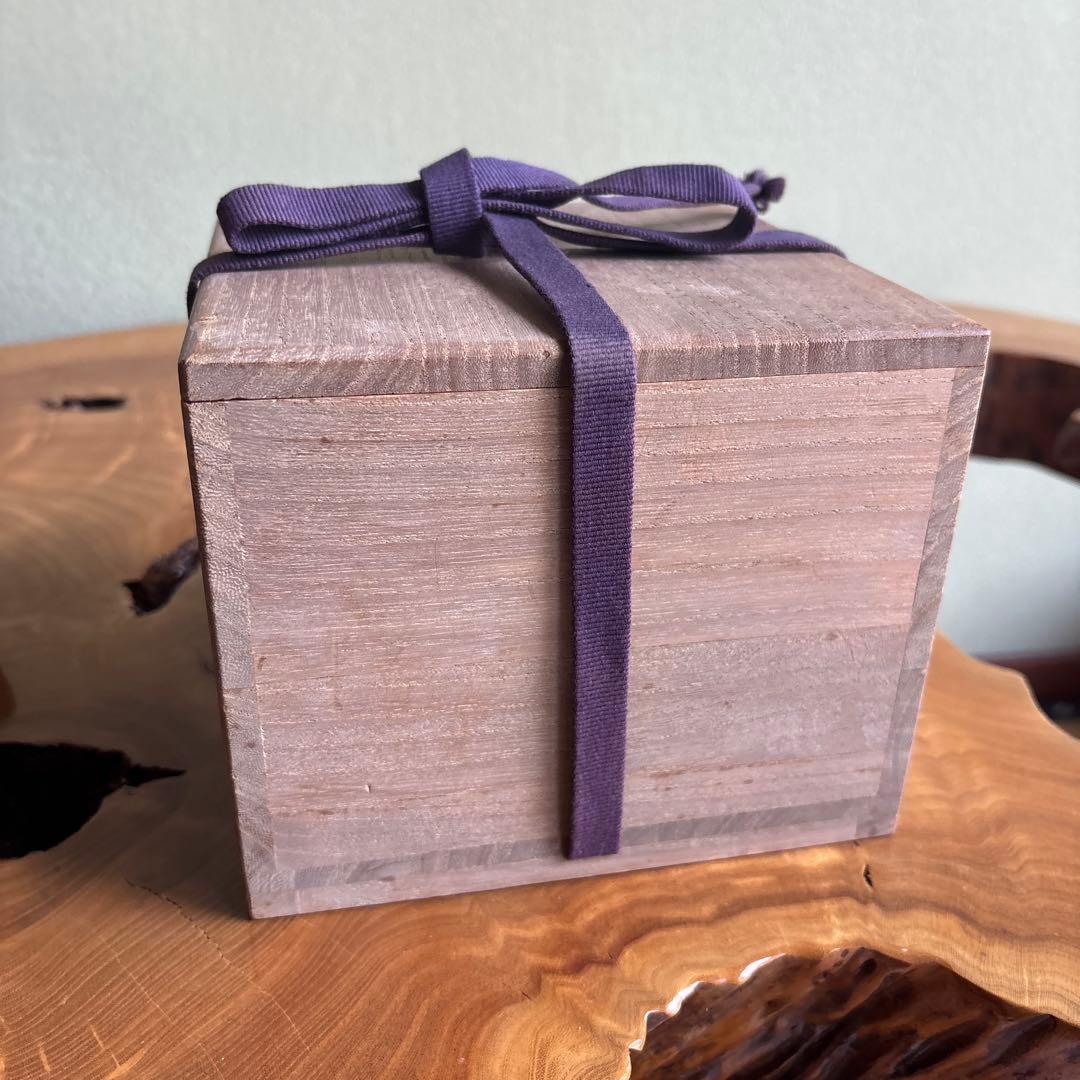
• Box: Original signed wooden tomobako with brushed title 「黒茶碗」, artist signature, and red clay seal
• Condition: Excellent — no chips, cracks, or restoration; glaze surface intact throughout
🔹 [ CULTURAL & ARTISTIC INSIGHT ]
The black chawan occupies a singular place in the history of Japanese ceramics. Since Sen no Rikyu's era, the kuro (black) tea bowl has embodied the philosophy of wabi-cha — a practice that finds the infinite within the compressed and the luminous within the dark. This piece deepens that tradition through an unexpected intervention: a lattice pattern (koshi-mon) executed in silver and gold pigment across the lower body. Where the silver lines intersect, they catch light with a cold clarity; where gold pools beneath and between them, warmth breaks through. The effect is of stars glimpsed through a lattice window at dusk — geometry holding light prisoner, then releasing it.
The form itself speaks in the Raku tradition: wide-mouthed for the easy whisking of matcha, with a low center of gravity that settles the bowl in the palm. The rim undulates slightly, shaped by the hand after throwing, giving each viewing angle a different horizon. The interior — a seamless, mirror-deep black — holds the green foam of whisked tea against absolute darkness, creating the contrast that generations of tea masters have called the most honest conversation between vessel and ceremony.
Poetic Line: 'The lattice holds silver like dew on a gate — and beneath it, gold remembers the sun.'
🔹 [ DEEP-DIVE COMMENTARY ]
The kuro-gusuri (black glaze) tradition in Japanese ceramics draws from multiple tributaries. Raku ware, the most historically prominent, achieves its black through low-fire reduction, pulling carbon into the clay body. But black glazes also appear in Seto (Seto-guro), in Bizen accident surfaces, and in studio ceramics where artists blend iron-saturated glazes with manganese or cobalt to achieve a depth that absorbs light rather than deflects it. This bowl's glaze has the high-sheen quality of a carefully formulated studio kuro — dense, lacquer-like, and without the deliberate pit-marks of hand-pulled Raku.
The overglaze decoration technique applied here — gold and silver pigment drawn in a repeating koshi (lattice) pattern — is rooted in kingin-de (gold-silver painting), a technique with origins in Kyoto's Nishiki weaving tradition translated to ceramic surfaces. The brushwork on this piece is confident and calligraphic: the silver lines are laid quickly, the gold added in pooling accents rather than linear strokes, creating a two-material conversation that gives the pattern dimensionality beyond mere surface decoration.
The choice of koshi-mon (lattice/grid motif) is culturally deliberate. In Japanese art and architecture, the lattice appears in shoji screens, kimono patterns, and temple gates — it is a motif that simultaneously separates and connects, filters and reveals. Applied to a black tea bowl, the lattice transforms the darkness from opacity into depth: something lies behind the grid, the pattern suggests, and the gold confirms it.
For collectors of contemporary Japanese studio ceramics, a signed tomobako is the crucial authenticating document. This box bears both a brushed title (黒茶碗, 'black tea bowl'), the artist's signature in ink, and a red pressed seal — the full triad of authentication that places this work within a lineage of intentional, documented artistic production. Pieces with complete tomobako provenance hold their cultural weight across decades and across borders.
The bowl's proportions — 13 cm diameter, 9 cm height — follow the hirakuchi (wide-mouthed) chawan standard, making it accessible for both matcha practice and display. Its visual drama makes it equally at home as a centerpiece object in contemporary interiors seeking the depth and quietness of Japanese aesthetic philosophy.
🔹 [ 日本語解説 ]
【基本情報】
・作家:落款・印あり(共箱蓋に墨書署名、赤印押し)
・技法:黒釉に金銀彩格子文(こしもん)の上絵付け。轆轤成形後、手整形による非対称の口縁
・年代:昭和後期〜平成期(現代陶芸)と推定
・産地:日本(楽風現代陶芸の流れ)
・寸法:口径 約13cm、高さ 約9cm
・箱:共箱(黒茶碗の墨書題字、作家署名、朱印あり)
・状態:優良。ヒビ・欠け・金継ぎなし
【文化・芸術的解説】
黒茶碗は、日本の陶芸史において特別な地位を占めてきた。千利休が侘び茶の精神を完成させた時代以来、黒い茶碗は「黒釉」というひとつの色の中に、暗闇の中の光、静寂の中の緊張、そして無限の奥行きを宿してきた。
この作品が際立つのは、その黒の深みに「格子文(こしもん)」という装飾が重ねられているからだ。銀彩の線が交差する場所には冷たい輝きが走り、その下から金彩が滲み出る。黄昏時の格子窓から見える星のように、幾何学が光を閉じ込め、そして解き放つ。
口縁は轆轤成形後に手で整えられ、見る角度ごとに異なる稜線を見せる。内側には深い黒釉が均一に広がり、点てられた抹茶の緑を闇に映し出す。これは道具ではなく、対話だ。
詩的一文:「銀は格子に宿り、金は黒の底から記憶として滲む。」
【深掘り解説】
黒釉の技法は、楽焼・瀬戸黒・備前の焼け景色など複数の系譜を持つ。この作品の釉薬は高光沢の均質な黒で、漆のような密度感があり、意図的な炭化ではなく鉄分と他の金属酸化物を調合した現代窯の処方を示している。
金銀彩の格子文は「金銀手」と呼ばれる技法の流れを汲み、京の西陣織の文様感覚を陶器の表面に移植したものだ。銀の線は速い筆捌きで引かれ、金は線ではなく「滲み」として添えられている。これにより、紋様に平面的な単調さではなく、奥行きと生気が生まれた。
格子文という文様は、日本の美術・建築において「仕切りながら繋ぐもの」として繰り返し現れてきた。障子、着物、社寺の建具——格子の向こうには常に何かがあることを示唆する。この黒茶碗において、格子は黒の闇を不透明な壁ではなく、奥行きある空間として読み替えさせる。
共箱は収蔵品としての証明書でもある。「黒茶碗」の題字、署名、朱印の三点が揃っており、現代陶芸作品として完結した出自を持つ。口径13cm・高さ9cmの比較的広口の平鉢型(平口)は抹茶の点て易さを考慮した茶碗としての機能美を持ち、現代インテリアの中でもオブジェとして存在感を放つ。
🔹 [ SHIPPING & PACKAGING ]
• Dispatch: Within 1-6 business days
• Carrier: Japan Post EMS / UPS (with tracking)
• Packaging: Carefully wrapped with protective materials
🔹 [ BASIC DETAILS ]
• Artist: Listed artist (signature and red seal stamp on tomobako lid; full name in brushwork)
• Technique: Kuro (black) glaze with overglaze gold and silver lattice decoration (koshi-mon); hand-thrown and hand-shaped form
• Era: Likely 1980s–2000s (contemporary studio ceramics period)
• Origin: Japan (studio ceramics tradition, Raku-adjacent aesthetic)
• Dimensions: Diameter approx. 13 cm, Height approx. 9 cm
• Box: Original signed wooden tomobako with brushed title 「黒茶碗」, artist signature, and red clay seal
• Condition: Excellent — no chips, cracks, or restoration; glaze surface intact throughout
🔹 [ CULTURAL & ARTISTIC INSIGHT ]
The black chawan occupies a singular place in the history of Japanese ceramics. Since Sen no Rikyu's era, the kuro (black) tea bowl has embodied the philosophy of wabi-cha — a practice that finds the infinite within the compressed and the luminous within the dark. This piece deepens that tradition through an unexpected intervention: a lattice pattern (koshi-mon) executed in silver and gold pigment across the lower body. Where the silver lines intersect, they catch light with a cold clarity; where gold pools beneath and between them, warmth breaks through. The effect is of stars glimpsed through a lattice window at dusk — geometry holding light prisoner, then releasing it.
The form itself speaks in the Raku tradition: wide-mouthed for the easy whisking of matcha, with a low center of gravity that settles the bowl in the palm. The rim undulates slightly, shaped by the hand after throwing, giving each viewing angle a different horizon. The interior — a seamless, mirror-deep black — holds the green foam of whisked tea against absolute darkness, creating the contrast that generations of tea masters have called the most honest conversation between vessel and ceremony.
Poetic Line: 'The lattice holds silver like dew on a gate — and beneath it, gold remembers the sun.'
🔹 [ DEEP-DIVE COMMENTARY ]
The kuro-gusuri (black glaze) tradition in Japanese ceramics draws from multiple tributaries. Raku ware, the most historically prominent, achieves its black through low-fire reduction, pulling carbon into the clay body. But black glazes also appear in Seto (Seto-guro), in Bizen accident surfaces, and in studio ceramics where artists blend iron-saturated glazes with manganese or cobalt to achieve a depth that absorbs light rather than deflects it. This bowl's glaze has the high-sheen quality of a carefully formulated studio kuro — dense, lacquer-like, and without the deliberate pit-marks of hand-pulled Raku.
The overglaze decoration technique applied here — gold and silver pigment drawn in a repeating koshi (lattice) pattern — is rooted in kingin-de (gold-silver painting), a technique with origins in Kyoto's Nishiki weaving tradition translated to ceramic surfaces. The brushwork on this piece is confident and calligraphic: the silver lines are laid quickly, the gold added in pooling accents rather than linear strokes, creating a two-material conversation that gives the pattern dimensionality beyond mere surface decoration.
The choice of koshi-mon (lattice/grid motif) is culturally deliberate. In Japanese art and architecture, the lattice appears in shoji screens, kimono patterns, and temple gates — it is a motif that simultaneously separates and connects, filters and reveals. Applied to a black tea bowl, the lattice transforms the darkness from opacity into depth: something lies behind the grid, the pattern suggests, and the gold confirms it.
For collectors of contemporary Japanese studio ceramics, a signed tomobako is the crucial authenticating document. This box bears both a brushed title (黒茶碗, 'black tea bowl'), the artist's signature in ink, and a red pressed seal — the full triad of authentication that places this work within a lineage of intentional, documented artistic production. Pieces with complete tomobako provenance hold their cultural weight across decades and across borders.
The bowl's proportions — 13 cm diameter, 9 cm height — follow the hirakuchi (wide-mouthed) chawan standard, making it accessible for both matcha practice and display. Its visual drama makes it equally at home as a centerpiece object in contemporary interiors seeking the depth and quietness of Japanese aesthetic philosophy.
🔹 [ 日本語解説 ]
【基本情報】
・作家:落款・印あり(共箱蓋に墨書署名、赤印押し)
・技法:黒釉に金銀彩格子文(こしもん)の上絵付け。轆轤成形後、手整形による非対称の口縁
・年代:昭和後期〜平成期(現代陶芸)と推定
・産地:日本(楽風現代陶芸の流れ)
・寸法:口径 約13cm、高さ 約9cm
・箱:共箱(黒茶碗の墨書題字、作家署名、朱印あり)
・状態:優良。ヒビ・欠け・金継ぎなし
【文化・芸術的解説】
黒茶碗は、日本の陶芸史において特別な地位を占めてきた。千利休が侘び茶の精神を完成させた時代以来、黒い茶碗は「黒釉」というひとつの色の中に、暗闇の中の光、静寂の中の緊張、そして無限の奥行きを宿してきた。
この作品が際立つのは、その黒の深みに「格子文(こしもん)」という装飾が重ねられているからだ。銀彩の線が交差する場所には冷たい輝きが走り、その下から金彩が滲み出る。黄昏時の格子窓から見える星のように、幾何学が光を閉じ込め、そして解き放つ。
口縁は轆轤成形後に手で整えられ、見る角度ごとに異なる稜線を見せる。内側には深い黒釉が均一に広がり、点てられた抹茶の緑を闇に映し出す。これは道具ではなく、対話だ。
詩的一文:「銀は格子に宿り、金は黒の底から記憶として滲む。」
【深掘り解説】
黒釉の技法は、楽焼・瀬戸黒・備前の焼け景色など複数の系譜を持つ。この作品の釉薬は高光沢の均質な黒で、漆のような密度感があり、意図的な炭化ではなく鉄分と他の金属酸化物を調合した現代窯の処方を示している。
金銀彩の格子文は「金銀手」と呼ばれる技法の流れを汲み、京の西陣織の文様感覚を陶器の表面に移植したものだ。銀の線は速い筆捌きで引かれ、金は線ではなく「滲み」として添えられている。これにより、紋様に平面的な単調さではなく、奥行きと生気が生まれた。
格子文という文様は、日本の美術・建築において「仕切りながら繋ぐもの」として繰り返し現れてきた。障子、着物、社寺の建具——格子の向こうには常に何かがあることを示唆する。この黒茶碗において、格子は黒の闇を不透明な壁ではなく、奥行きある空間として読み替えさせる。
共箱は収蔵品としての証明書でもある。「黒茶碗」の題字、署名、朱印の三点が揃っており、現代陶芸作品として完結した出自を持つ。口径13cm・高さ9cmの比較的広口の平鉢型(平口)は抹茶の点て易さを考慮した茶碗としての機能美を持ち、現代インテリアの中でもオブジェとして存在感を放つ。
🔹 [ SHIPPING & PACKAGING ]
• Dispatch: Within 1-6 business days
• Carrier: Japan Post EMS / UPS (with tracking)
• Packaging: Carefully wrapped with protective materials
Quantity
Couldn't load pickup availability
Low stock: 1 left
View full details