1
/
of
11
Bizen Tea Bowl 'Sennen' by Kaneshige Toyo, Living National Treasure, Inscribed by Urasenke Tantansai XIV, Hidasuki Chawan with Original Tomobako
Bizen Tea Bowl 'Sennen' by Kaneshige Toyo, Living National Treasure, Inscribed by Urasenke Tantansai XIV, Hidasuki Chawan with Original Tomobako
Regular price
Dhs. 6,474.00 AED
Regular price
Sale price
Dhs. 6,474.00 AED
Taxes included.
Shipping calculated at checkout.
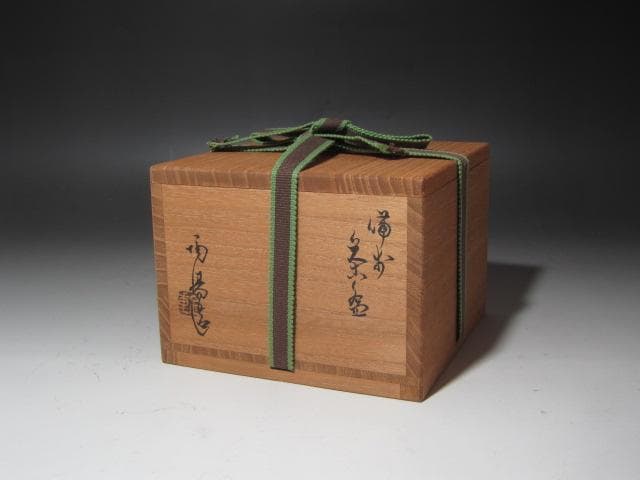
A Bizen chawan by Kaneshige Toyo (1896-1967), designated a Living National Treasure (Important Intangible Cultural Property) in 1956 for Bizen ware. The bowl is titled 'Sennen' (One Thousand Years) and accompanied by an original paulownia tomobako inscribed by Urasenke XIV Grandmaster Tantansai (1893-1964), bearing his kao (cursive monogram).
🔹 [ BASIC DETAILS ]
• Artist: Kaneshige Toyo (Living National Treasure) / Urasenke Tantansai inscription
• Origin: Bizen, Okayama, Japan
• Material: Bizen ware with hidasuki (straw-wrapped firing)
• Motif: Sennen (One Thousand Years)
• Era: 1950s
• Box: Tomobako (artist's wooden presentation box)
• Condition: Good, carefully inspected
🔹 [ Cultural & Artistic Insight ]
The surface carries the full vocabulary of Bizen: a deep ember-red goma run along the rim where wood ash has melted into natural glaze, a darkened passage of yohen (kiln effect) on one face, and the bare iron body of unglazed stoneware descending into a quiet, earth-brown foot. Faint hidasuki lines, left by rice straw wrapped around the bowl during firing, trace the lower body like old thread. No two sides repeat. The bowl was not decorated. It was placed in the anagama and allowed to become itself.
The form is a classic wan-nari chawan, slightly taller than wide, with a gently flared lip and a low, carved kodai. In the hand it holds warmth with the density of iron-rich clay. The interior pools light where the ash has vitrified, and the well retains the soft trace of the tea whisk's path.
Kaneshige Toyo is remembered as the father of modern Bizen. In the early twentieth century Bizen had declined into utilitarian wares; Toyo returned to the Momoyama-period anagama, rebuilt the old kilns of Imbe, and re-taught the clay how to sing. His work is held in the Tokyo National Museum, the Museum of Modern Art (New York), and every serious collection of post-war Japanese ceramics. That a bowl from his hand should be titled 'Sennen' and then sealed by the fourteenth head of Urasenke is not coincidence. It is two masters agreeing on what the object is.
─────────────────────────────
[ CULTURAL & ARTISTIC INSIGHT ]
Bizen is one of the Six Ancient Kilns of Japan (Rokkoyo), with an unbroken tradition reaching back to the Heian and Kamakura periods. Unlike the glazed wares of Seto or Karatsu, Bizen uses no glaze at all. The clay itself — a dense, iron-heavy hiyose dug from the rice fields of Imbe — is fired for ten to fourteen days in a wood-burning anagama at temperatures above 1200°C. Everything the surface becomes is a record of where the pot stood in the kiln, what fell on it, what the flame did on the third night.
By the Meiji period this tradition was nearly lost. Industrial porcelain had taken the market, the old anagama had fallen cold, and Bizen potters were making roof tiles and mortars to survive. Kaneshige Toyo, born into a family of Bizen makers in 1896, refused this drift. He studied the Momoyama-period shards in the fields of Imbe. He rebuilt a traditional anagama with his own hands. He reintroduced the long firings and the straw-wrapping techniques that produced hidasuki. When the Japanese government established the Living National Treasure system in 1955, Toyo was among the first ceramicists named — recognized in 1956 as the holder of Bizen-yaki as Important Intangible Cultural Property. He is universally called the father of modern Bizen, the man who returned the kiln to itself.
The title 'Sennen' — one thousand years — is chosen with care. It refers to the age of the Bizen tradition itself, and to the Buddhist and Taoist sense of permanence that survives through the impermanent. A thousand years of clay, of fire, of ash falling in the same way on the same shoulders. Urasenke XIV Tantansai, grandmaster of the largest tea school in Japan and one of the defining tea figures of the twentieth century, chose to inscribe this particular bowl with that particular word. The brushwork on the box lid is unhurried. The kao beneath is his seal of recognition: this bowl, made by this maker, carries what he considered the thousand years.
[ DEEP-DIVE COMMENTARY ]
Hidasuki — literally 'fire cord' — is one of the signature effects of Bizen. Before firing, the potter wraps the raw clay in lengths of rice straw. During the long firing, the straw burns away, but the potassium and silica in the straw react with the iron in the clay to leave bright scarlet lines on a cream ground — a trace that cannot be drawn, only allowed. On this bowl the hidasuki is restrained, visible as a soft reddening across the lower body, a whisper rather than a statement. This restraint is characteristic of Toyo's mature work: he stopped seeking dramatic hidasuki in the 1950s and began placing bowls deeper in the kiln, where the fire was quieter and the marks more inward.
The upper band shows goma and yohen — sesame-seed ash glaze and kiln transformation. When the anagama is fired at peak temperature, pine ash drifts through the chamber and settles on the shoulders of the pots. Where it lands thickly, it melts into a green-gold vitreous glaze; where it lands lightly, it scatters like sesame seeds. On this bowl the ash has run in vertical lines from the rim, pooling in the throat of the bowl in a darkened, almost liquid passage. This is yohen — 'kiln change' — a category of effect that the Momoyama tea masters considered the highest achievement of unglazed stoneware. It cannot be requested. It can only be received.
The foot ring (kodai) is carved in the archaic manner: low, wide, with a clear central nub (tokin) where the clay was cut from the wheel. On the underside a small kiln mark identifies Toyo's work. Bizen bowls of this generation were fired seated on small wads of clay or shells, and the traces of those contact points — tomebari — appear as three or four small bare spots on the lower body. They are not flaws. They are the bowl's signature in the kiln, the evidence that it stood where it stood.
[ THE BOX — TOMOBAKO & SHOSHI ]
🔹 [ Deep-Dive Commentary ]
The bowl is housed in its original paulownia wood tomobako. The front of the lid is inscribed in black ink: '備前焼茶碗 銘 千年' (Bizen-yaki chawan, mei Sennen — Bizen tea bowl, named Sennen). The reverse of the lid bears the kao (cursive seal-signature) of Urasenke XIV Hounsai Tantansai. The box is tied with its original himo (cord), and the fit between body and lid is tight — a sign the box has not been replaced. A tomobako inscribed by an iemoto (tea school grandmaster) is called a hakogaki, and it functions as the highest form of attribution in the Japanese tea world. It transforms the bowl from a fine ceramic into a recognized tea utensil of the school.
─────────────────────────────
🔹 [ PIECE SUMMARY ]
• Maker: Kaneshige Toyo (1896-1967) — Living National Treasure, Bizen ware (designated 1956)
• Inscribed by: Urasenke XIV Grandmaster Hounsai Tantansai (1893-1964)
• Title: 'Sennen' (千年 / One Thousand Years)
• Form: Wan-nari chawan (rounded tea bowl), wheel-thrown
• Ware: Bizen-yaki, unglazed wood-fired stoneware
• Effects: Hidasuki (straw-mark red), goma (ash), yohen (kiln change)
• Kiln: Anagama, Imbe (Bizen, Okayama)
• Period: circa 1950s
• Condition: Excellent, no chips, no repair, no staining. Foot and body intact.
• Dimensions: approx. 10.8 cm diameter × 7 cm height
• Accompaniments: Original paulownia tomobako with hakogaki by Urasenke XIV Tantansai, original cord
🔹 [ PROVENANCE & AUTHENTICATION ]
• Acquired from a Japanese private collection
• Box-signed (hakogaki) by Urasenke iemoto — the highest tea-world attribution
• Kiln mark on underside consistent with Toyo's documented signatures
• Offered with full package: bowl, box, lid inscription, cord
🔹 [ FOR THE COLLECTOR ]
A bowl by Kaneshige Toyo with an Urasenke iemoto hakogaki is the kind of piece that anchors a collection. Toyo defined modern Bizen; Tantansai defined mid-twentieth-century chanoyu. Together on one object they mark the moment when postwar Japan rediscovered its own ceramic voice through tea. For a serious collector of Japanese ceramics, tea utensils, or Living National Treasure works, this is a centerpiece.
─────────────────────────────
[ 日本語解説 ]
人間国宝 金重陶陽(かねしげ とうよう、1896-1967)作の備前焼茶碗「千年」。共箱の箱書は裏千家十四代 無限斎 淡々斎宗室(1893-1964)の花押入り。
金重陶陽は備前焼中興の祖と称される作家で、1956年に重要無形文化財「備前焼」の保持者(人間国宝)に認定されました。明治以降衰退していた備前焼を、桃山期の古備前を研究することで復興させ、伊部(いんべ)の古窯を自らの手で再構築し、長時間の穴窯焼成と藁による緋襷の技法を蘇らせた人物です。東京国立博物館、ニューヨーク近代美術館をはじめ世界各地の美術館に作品が収蔵されています。
本作は轆轤成形の椀形茶碗で、口縁から垂れる胡麻(ごま)と窯変、胴下部にうっすらと現れる緋襷、高台脇の焼き締まった土味──備前の全ての景色を一碗に宿しています。特に口縁から胴にかけて流れる胡麻の溶けは深く、穴窯の強還元が作り出した窯変の黒み(やきしまり)が片面に広がっています。派手な緋襷ではなく静かな緋色の景色は、陶陽晩年の作風の特徴です。
銘「千年」は、備前の千年の歴史と、無常の中に在る永遠を示すもの。この銘を、二十世紀茶道界を代表する家元である裏千家十四代 淡々斎が共箱に記し、花押を入れているという事実は、本碗が単なる人間国宝作品ではなく、茶の湯の正式な道具として認められた一碗であることを意味します。共箱・箱書・花押・紐すべて揃っており、コレクション級の一碗です。
寸法: 約 直径10.8cm × 高さ7cm / 共箱(桐箱)・淡々斎花押箱書付
─────────────────────────────
🔹 [ 日本語解説 ]
備前焼中興の祖・人間国宝 金重陶陽(1896-1967)作の備前茶碗。銘「千年」、共箱の箱書は裏千家十四代 淡々斎宗室の花押入り。口縁から流れる胡麻と窯変、静かな緋襷、焼き締まった高台──備前の景色を全て備えた一碗。1956年人間国宝認定作家と家元箱書が揃ったコレクション級。
🔹 [ SHIPPING & PACKAGING ]
• Dispatch: Within 1-6 business days
• Carrier: Japan Post EMS / UPS (with tracking)
• Packaging: Carefully wrapped with protective materials
🔹 [ BASIC DETAILS ]
• Artist: Kaneshige Toyo (Living National Treasure) / Urasenke Tantansai inscription
• Origin: Bizen, Okayama, Japan
• Material: Bizen ware with hidasuki (straw-wrapped firing)
• Motif: Sennen (One Thousand Years)
• Era: 1950s
• Box: Tomobako (artist's wooden presentation box)
• Condition: Good, carefully inspected
🔹 [ Cultural & Artistic Insight ]
The surface carries the full vocabulary of Bizen: a deep ember-red goma run along the rim where wood ash has melted into natural glaze, a darkened passage of yohen (kiln effect) on one face, and the bare iron body of unglazed stoneware descending into a quiet, earth-brown foot. Faint hidasuki lines, left by rice straw wrapped around the bowl during firing, trace the lower body like old thread. No two sides repeat. The bowl was not decorated. It was placed in the anagama and allowed to become itself.
The form is a classic wan-nari chawan, slightly taller than wide, with a gently flared lip and a low, carved kodai. In the hand it holds warmth with the density of iron-rich clay. The interior pools light where the ash has vitrified, and the well retains the soft trace of the tea whisk's path.
Kaneshige Toyo is remembered as the father of modern Bizen. In the early twentieth century Bizen had declined into utilitarian wares; Toyo returned to the Momoyama-period anagama, rebuilt the old kilns of Imbe, and re-taught the clay how to sing. His work is held in the Tokyo National Museum, the Museum of Modern Art (New York), and every serious collection of post-war Japanese ceramics. That a bowl from his hand should be titled 'Sennen' and then sealed by the fourteenth head of Urasenke is not coincidence. It is two masters agreeing on what the object is.
─────────────────────────────
[ CULTURAL & ARTISTIC INSIGHT ]
Bizen is one of the Six Ancient Kilns of Japan (Rokkoyo), with an unbroken tradition reaching back to the Heian and Kamakura periods. Unlike the glazed wares of Seto or Karatsu, Bizen uses no glaze at all. The clay itself — a dense, iron-heavy hiyose dug from the rice fields of Imbe — is fired for ten to fourteen days in a wood-burning anagama at temperatures above 1200°C. Everything the surface becomes is a record of where the pot stood in the kiln, what fell on it, what the flame did on the third night.
By the Meiji period this tradition was nearly lost. Industrial porcelain had taken the market, the old anagama had fallen cold, and Bizen potters were making roof tiles and mortars to survive. Kaneshige Toyo, born into a family of Bizen makers in 1896, refused this drift. He studied the Momoyama-period shards in the fields of Imbe. He rebuilt a traditional anagama with his own hands. He reintroduced the long firings and the straw-wrapping techniques that produced hidasuki. When the Japanese government established the Living National Treasure system in 1955, Toyo was among the first ceramicists named — recognized in 1956 as the holder of Bizen-yaki as Important Intangible Cultural Property. He is universally called the father of modern Bizen, the man who returned the kiln to itself.
The title 'Sennen' — one thousand years — is chosen with care. It refers to the age of the Bizen tradition itself, and to the Buddhist and Taoist sense of permanence that survives through the impermanent. A thousand years of clay, of fire, of ash falling in the same way on the same shoulders. Urasenke XIV Tantansai, grandmaster of the largest tea school in Japan and one of the defining tea figures of the twentieth century, chose to inscribe this particular bowl with that particular word. The brushwork on the box lid is unhurried. The kao beneath is his seal of recognition: this bowl, made by this maker, carries what he considered the thousand years.
[ DEEP-DIVE COMMENTARY ]
Hidasuki — literally 'fire cord' — is one of the signature effects of Bizen. Before firing, the potter wraps the raw clay in lengths of rice straw. During the long firing, the straw burns away, but the potassium and silica in the straw react with the iron in the clay to leave bright scarlet lines on a cream ground — a trace that cannot be drawn, only allowed. On this bowl the hidasuki is restrained, visible as a soft reddening across the lower body, a whisper rather than a statement. This restraint is characteristic of Toyo's mature work: he stopped seeking dramatic hidasuki in the 1950s and began placing bowls deeper in the kiln, where the fire was quieter and the marks more inward.
The upper band shows goma and yohen — sesame-seed ash glaze and kiln transformation. When the anagama is fired at peak temperature, pine ash drifts through the chamber and settles on the shoulders of the pots. Where it lands thickly, it melts into a green-gold vitreous glaze; where it lands lightly, it scatters like sesame seeds. On this bowl the ash has run in vertical lines from the rim, pooling in the throat of the bowl in a darkened, almost liquid passage. This is yohen — 'kiln change' — a category of effect that the Momoyama tea masters considered the highest achievement of unglazed stoneware. It cannot be requested. It can only be received.
The foot ring (kodai) is carved in the archaic manner: low, wide, with a clear central nub (tokin) where the clay was cut from the wheel. On the underside a small kiln mark identifies Toyo's work. Bizen bowls of this generation were fired seated on small wads of clay or shells, and the traces of those contact points — tomebari — appear as three or four small bare spots on the lower body. They are not flaws. They are the bowl's signature in the kiln, the evidence that it stood where it stood.
[ THE BOX — TOMOBAKO & SHOSHI ]
🔹 [ Deep-Dive Commentary ]
The bowl is housed in its original paulownia wood tomobako. The front of the lid is inscribed in black ink: '備前焼茶碗 銘 千年' (Bizen-yaki chawan, mei Sennen — Bizen tea bowl, named Sennen). The reverse of the lid bears the kao (cursive seal-signature) of Urasenke XIV Hounsai Tantansai. The box is tied with its original himo (cord), and the fit between body and lid is tight — a sign the box has not been replaced. A tomobako inscribed by an iemoto (tea school grandmaster) is called a hakogaki, and it functions as the highest form of attribution in the Japanese tea world. It transforms the bowl from a fine ceramic into a recognized tea utensil of the school.
─────────────────────────────
🔹 [ PIECE SUMMARY ]
• Maker: Kaneshige Toyo (1896-1967) — Living National Treasure, Bizen ware (designated 1956)
• Inscribed by: Urasenke XIV Grandmaster Hounsai Tantansai (1893-1964)
• Title: 'Sennen' (千年 / One Thousand Years)
• Form: Wan-nari chawan (rounded tea bowl), wheel-thrown
• Ware: Bizen-yaki, unglazed wood-fired stoneware
• Effects: Hidasuki (straw-mark red), goma (ash), yohen (kiln change)
• Kiln: Anagama, Imbe (Bizen, Okayama)
• Period: circa 1950s
• Condition: Excellent, no chips, no repair, no staining. Foot and body intact.
• Dimensions: approx. 10.8 cm diameter × 7 cm height
• Accompaniments: Original paulownia tomobako with hakogaki by Urasenke XIV Tantansai, original cord
🔹 [ PROVENANCE & AUTHENTICATION ]
• Acquired from a Japanese private collection
• Box-signed (hakogaki) by Urasenke iemoto — the highest tea-world attribution
• Kiln mark on underside consistent with Toyo's documented signatures
• Offered with full package: bowl, box, lid inscription, cord
🔹 [ FOR THE COLLECTOR ]
A bowl by Kaneshige Toyo with an Urasenke iemoto hakogaki is the kind of piece that anchors a collection. Toyo defined modern Bizen; Tantansai defined mid-twentieth-century chanoyu. Together on one object they mark the moment when postwar Japan rediscovered its own ceramic voice through tea. For a serious collector of Japanese ceramics, tea utensils, or Living National Treasure works, this is a centerpiece.
─────────────────────────────
[ 日本語解説 ]
人間国宝 金重陶陽(かねしげ とうよう、1896-1967)作の備前焼茶碗「千年」。共箱の箱書は裏千家十四代 無限斎 淡々斎宗室(1893-1964)の花押入り。
金重陶陽は備前焼中興の祖と称される作家で、1956年に重要無形文化財「備前焼」の保持者(人間国宝)に認定されました。明治以降衰退していた備前焼を、桃山期の古備前を研究することで復興させ、伊部(いんべ)の古窯を自らの手で再構築し、長時間の穴窯焼成と藁による緋襷の技法を蘇らせた人物です。東京国立博物館、ニューヨーク近代美術館をはじめ世界各地の美術館に作品が収蔵されています。
本作は轆轤成形の椀形茶碗で、口縁から垂れる胡麻(ごま)と窯変、胴下部にうっすらと現れる緋襷、高台脇の焼き締まった土味──備前の全ての景色を一碗に宿しています。特に口縁から胴にかけて流れる胡麻の溶けは深く、穴窯の強還元が作り出した窯変の黒み(やきしまり)が片面に広がっています。派手な緋襷ではなく静かな緋色の景色は、陶陽晩年の作風の特徴です。
銘「千年」は、備前の千年の歴史と、無常の中に在る永遠を示すもの。この銘を、二十世紀茶道界を代表する家元である裏千家十四代 淡々斎が共箱に記し、花押を入れているという事実は、本碗が単なる人間国宝作品ではなく、茶の湯の正式な道具として認められた一碗であることを意味します。共箱・箱書・花押・紐すべて揃っており、コレクション級の一碗です。
寸法: 約 直径10.8cm × 高さ7cm / 共箱(桐箱)・淡々斎花押箱書付
─────────────────────────────
🔹 [ 日本語解説 ]
備前焼中興の祖・人間国宝 金重陶陽(1896-1967)作の備前茶碗。銘「千年」、共箱の箱書は裏千家十四代 淡々斎宗室の花押入り。口縁から流れる胡麻と窯変、静かな緋襷、焼き締まった高台──備前の景色を全て備えた一碗。1956年人間国宝認定作家と家元箱書が揃ったコレクション級。
🔹 [ SHIPPING & PACKAGING ]
• Dispatch: Within 1-6 business days
• Carrier: Japan Post EMS / UPS (with tracking)
• Packaging: Carefully wrapped with protective materials
Quantity
Couldn't load pickup availability
Low stock: 1 left
View full details