1
/
of
18
Bizen Chawan by Kaneshige Tōkō, 77th Generation Kaneshige Kiln, Full Provenance
Regular price
Dhs. 615.00 AED
Regular price
Sale price
Dhs. 615.00 AED
Taxes included.
Shipping calculated at checkout.
Fire and ash decided the surface. The 77th hand that shaped it understood what the kiln would finish.
🔹 [ Cultural & Artistic Insight ]
The Kaneshige family name in Bizen ware is not merely lineage — it is the central thread of one of Japan's oldest unbroken ceramic traditions. Kaneshige Tōyō (金重陶陽), the family's twentieth-century patriarch, received designation as a Living National Treasure in Bizen ware, the highest recognition the Japanese state extends to a traditional craftsperson. His work defined what Bizen could aspire to in the postwar period, and his family's kiln became the standard against which the ware is measured.
Kaneshige Tōkō (金重陶弘) carries that inheritance as the 77th generation of the Kaneshige kiln tradition — a figure that situates this chawan within a span of continuous practice that long precedes the formalization of Japanese ceramic history. Bizen ware is fired without glaze in wood-burning anagama kilns, and the surfaces are entirely products of atmospheric chemistry: where ash falls becomes goma (sesame seed glaze), where flame moves becomes hi-iro (fire color), where clay and fire exchange in unrepeatable ways becomes yōhen (kiln-change).
This bowl carries both goma and yōhen. The sesame ash deposits accumulate during the multi-day firing, fusing to the clay surface in patterns that no artisan controls at the moment of formation. Yōhen — the broader term for unpredictable kiln atmospheric effects — describes the shifts in iron content, reduction patterns, and surface texture that cannot be willed into existence, only invited.
🔹 [ Deep-Dive Commentary ]
A Bizen chawan asks to be held before it is understood. The weight of unglazed stoneware, the slight roughness of the surface against the palm, the warmth that the clay retains — these are the arguments the bowl makes before any visual assessment begins. At D 13 cm × H 7.3 cm, the proportions place this squarely within the drinking form: wide enough for the whisk to move, deep enough for the tea to hold temperature, balanced enough to be passed.
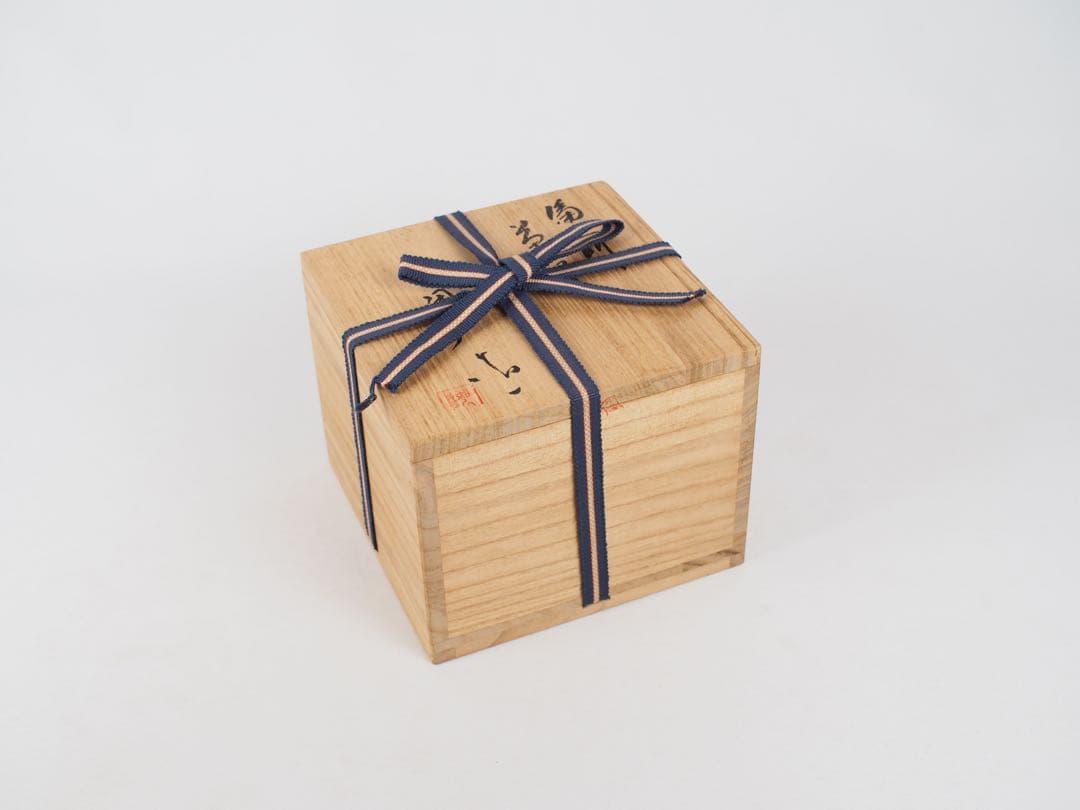
The full provenance set — tomobako with the maker's inscription, shiori (booklet providing the maker's statement or kiln documentation), and tomobukuro (the cloth bag specific to this piece) — is not decorative. For a Kaneshige piece, it is the difference between an object and a document. The 77th generation does not sign carelessly. The box, the cloth, and the booklet together form the record of authorship that the object's surface, by its nature, cannot carry in words.
[ JAPANESE DESCRIPTION / 日本語解説 ]
備前焼・金重利陶苑77代・金重陶弘作の茶碗。共箱・栞・共布の三点が揃う。備前焼は無釉で、窯の中の炎と灰がすべての景色を決める。この茶碗に現れた胡麻と窯変は、職人の意図ではなく窯の意志によるものであり、だからこそ二度と同じものは生まれない。
金重陶陽が人間国宝に指定され、その家系が備前焼の基準となった。陶弘はその77代として、家の名を単なる系譜ではなく現在進行形の実践として継いでいる。共箱の銘・栞の記録・共布の誂えという三点セットは、この茶碗が正式な作品として完全な状態で流通していることの証明。手に持ったときの重さと肌触りが、備前の土と炎が残したすべてを伝える。
🔹 [ BASIC DETAILS ]
- Dimensions: D 13 cm × H 7.3 cm
- Condition: Good; natural goma and yōhen effects throughout; no chips or cracks; consistent with honored use
- Ware: Bizen-yaki (unglazed stoneware, wood-fired anagama kiln)
- Maker: Kaneshige Tōkō / Kaneshige Rōtōen (金重陶弘 / 金重利陶苑), 77th generation
- Surface effects: Goma (sesame ash glaze), yōhen (atmospheric kiln-change)
🔹 [ Includes ]
- Chawan (matcha tea bowl)
- Tomobako (original wooden box with maker's inscription)
- Shiori (maker's booklet / kiln documentation)
- Tomobukuro (original cloth storage bag)
🔹 [ SHIPPING & PACKAGING ]
• Dispatch: Within 1-6 business days
• Carrier: Japan Post EMS / UPS (with tracking)
• Packaging: Carefully wrapped with protective materials
🔹 [ Cultural & Artistic Insight ]
The Kaneshige family name in Bizen ware is not merely lineage — it is the central thread of one of Japan's oldest unbroken ceramic traditions. Kaneshige Tōyō (金重陶陽), the family's twentieth-century patriarch, received designation as a Living National Treasure in Bizen ware, the highest recognition the Japanese state extends to a traditional craftsperson. His work defined what Bizen could aspire to in the postwar period, and his family's kiln became the standard against which the ware is measured.
Kaneshige Tōkō (金重陶弘) carries that inheritance as the 77th generation of the Kaneshige kiln tradition — a figure that situates this chawan within a span of continuous practice that long precedes the formalization of Japanese ceramic history. Bizen ware is fired without glaze in wood-burning anagama kilns, and the surfaces are entirely products of atmospheric chemistry: where ash falls becomes goma (sesame seed glaze), where flame moves becomes hi-iro (fire color), where clay and fire exchange in unrepeatable ways becomes yōhen (kiln-change).
This bowl carries both goma and yōhen. The sesame ash deposits accumulate during the multi-day firing, fusing to the clay surface in patterns that no artisan controls at the moment of formation. Yōhen — the broader term for unpredictable kiln atmospheric effects — describes the shifts in iron content, reduction patterns, and surface texture that cannot be willed into existence, only invited.
🔹 [ Deep-Dive Commentary ]
A Bizen chawan asks to be held before it is understood. The weight of unglazed stoneware, the slight roughness of the surface against the palm, the warmth that the clay retains — these are the arguments the bowl makes before any visual assessment begins. At D 13 cm × H 7.3 cm, the proportions place this squarely within the drinking form: wide enough for the whisk to move, deep enough for the tea to hold temperature, balanced enough to be passed.
The full provenance set — tomobako with the maker's inscription, shiori (booklet providing the maker's statement or kiln documentation), and tomobukuro (the cloth bag specific to this piece) — is not decorative. For a Kaneshige piece, it is the difference between an object and a document. The 77th generation does not sign carelessly. The box, the cloth, and the booklet together form the record of authorship that the object's surface, by its nature, cannot carry in words.
[ JAPANESE DESCRIPTION / 日本語解説 ]
備前焼・金重利陶苑77代・金重陶弘作の茶碗。共箱・栞・共布の三点が揃う。備前焼は無釉で、窯の中の炎と灰がすべての景色を決める。この茶碗に現れた胡麻と窯変は、職人の意図ではなく窯の意志によるものであり、だからこそ二度と同じものは生まれない。
金重陶陽が人間国宝に指定され、その家系が備前焼の基準となった。陶弘はその77代として、家の名を単なる系譜ではなく現在進行形の実践として継いでいる。共箱の銘・栞の記録・共布の誂えという三点セットは、この茶碗が正式な作品として完全な状態で流通していることの証明。手に持ったときの重さと肌触りが、備前の土と炎が残したすべてを伝える。
🔹 [ BASIC DETAILS ]
- Dimensions: D 13 cm × H 7.3 cm
- Condition: Good; natural goma and yōhen effects throughout; no chips or cracks; consistent with honored use
- Ware: Bizen-yaki (unglazed stoneware, wood-fired anagama kiln)
- Maker: Kaneshige Tōkō / Kaneshige Rōtōen (金重陶弘 / 金重利陶苑), 77th generation
- Surface effects: Goma (sesame ash glaze), yōhen (atmospheric kiln-change)
🔹 [ Includes ]
- Chawan (matcha tea bowl)
- Tomobako (original wooden box with maker's inscription)
- Shiori (maker's booklet / kiln documentation)
- Tomobukuro (original cloth storage bag)
🔹 [ SHIPPING & PACKAGING ]
• Dispatch: Within 1-6 business days
• Carrier: Japan Post EMS / UPS (with tracking)
• Packaging: Carefully wrapped with protective materials
Quantity
Couldn't load pickup availability
Low stock: 1 left
View full details