1
/
of
12
Bamboo Tea Scoop 'Tokiwa' by Horinouchi Sokan Kenchusai XII, Omotesenke Choseian Master, Chashaku with Signed Bamboo Tube and Tomobako
Bamboo Tea Scoop 'Tokiwa' by Horinouchi Sokan Kenchusai XII, Omotesenke Choseian Master, Chashaku with Signed Bamboo Tube and Tomobako
Regular price
Dhs. 1,593.00 AED
Regular price
Sale price
Dhs. 1,593.00 AED
Taxes included.
Shipping calculated at checkout.
A bamboo chashaku (tea scoop) carved and named by Horinouchi Sokan, the Twelfth Kenchusai (1919-2022), head of the Choseian line and senior elder of the Omotesenke school of tea.
🔹 [ BASIC DETAILS ]
• Artist: Horinouchi Sokan (Kenchusai XII)
• Origin: Kyoto, Japan
• Material: Bamboo with bamboo tube
• Motif: Tokiwa (Evergreen / Eternal)
• Era: 2000_2009
• Box: Tomobako (artist's wooden presentation box)
• Condition: Good, carefully inspected
🔹 [ Cultural & Artistic Insight ]
The scoop is cut from a single length of aged bamboo, the surface carrying the quiet amber tone that only decades of air and handling bring out. A single node sits low on the shaft, anchoring the form. Above it, the kaisaki (tip) curves forward with a restrained upward lift, ending in a softly cut profile — the silhouette favoured by Omotesenke, where declaration gives way to understatement.
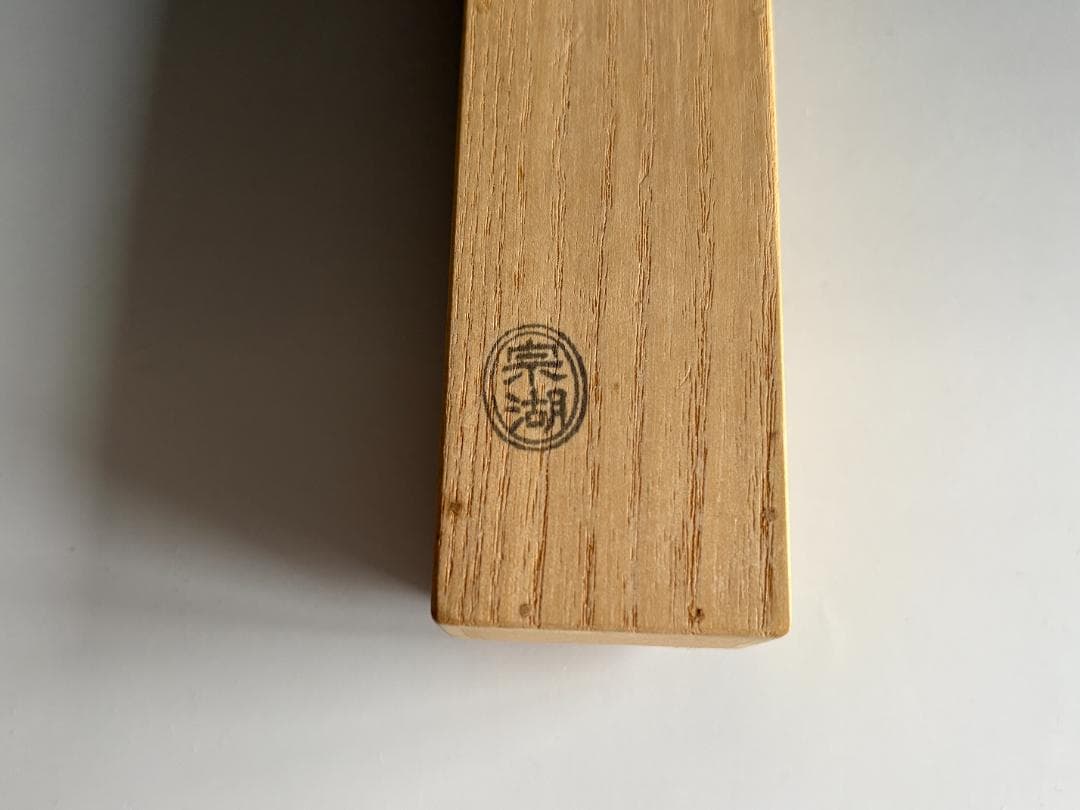
The scoop arrives with its tomozutsu (signed bamboo tube) and kiriwood tomobako, both inscribed by Kenchusai himself: 'Chashaku, mei Tokiwa, Sokan' with his kao (cipher). The box lid carries his seal. Tube, box, and scoop together form a single authored object — the standard of provenance in the chashaku tradition.
- - -
[ CULTURAL & ARTISTIC INSIGHT ]
The Horinouchi family is one of the four senke-shike — the four elder households that have stood beside the Omotesenke iemoto since the seventeenth century. Within those four, Horinouchi has long been regarded as the first among them, serving as the senior advisory line to the grand master. Their residence, Choseian (Hall of Long Life), sits within the Omotesenke compound in Kyoto and remains one of the quiet centres of the school's transmission.
Sokan Kenchusai, the twelfth head, carried this responsibility for more than seven decades. He lived from 1919 to 2022 — a life long enough to pass through the final years of Meiji sensibility, the austerity of war, the postwar revival of tea, and into the present. Few tea masters in any school served so long, and fewer still shaped a house with such steady, unhurried authority.
A chashaku carved and named by such a figure is not a utensil in the ordinary sense. In the chanoyu tradition, a chashaku authored by a tea master is regarded as a direct trace of the maker's hand and mind — the closest object, after calligraphy, to the person himself. The carving records posture; the naming records thought.
The name 'Tokiwa' (常盤) means 'ever-constant,' 'evergreen,' the rock that does not change with the seasons. It is drawn from the classical vocabulary of the pine and the unchanging mountain — an image of continuity across time. For a master born in the early twentieth century and writing this name late in his life, the word carries its full weight: what endures, what is handed on, what does not move.
🔹 [ Deep-Dive Commentary ]
- - -
[ DEEP-DIVE COMMENTARY ]
The shaft is shaped from a single bamboo strip, its surface left with the quiet honey tone of aged susudake-adjacent material. Under room light the grain shows a faint vertical striation — the fibre of the bamboo reading like brushstrokes along the length.
The node (fushi) is set low, closer to the handle end than the tip. This placement is a conscious choice: it lowers the visual centre of gravity, leaves the kaisaki to rise clean and uninterrupted, and gives the hand a stable grip point during use. Omotesenke tradition favours this restrained, upright form over more dramatic curves.
At the kaisaki, the bamboo has been eased into a gentle forward arc and cut with a soft V-profile. The inner surface is polished smooth from the carving blade; the outer edge carries a faint natural patina where handling has darkened the bamboo. Held in the hand, the scoop feels weightless — which is the intention. A chashaku that declares itself is a chashaku that has failed.
The tomozutsu is cut from the same character of bamboo, its surface inscribed in ink with the scoop's designation and the master's signature and kao. The tomobako is kiriwood (paulownia), light and pale, with the lid inscribed and sealed. All three elements — scoop, tube, box — carry the same hand, which is the condition the chanoyu world calls 'kyou-zutsu, kyou-bako' (matched tube, matched box), and which is treated as the baseline of documented provenance.
- - -
[ SPECIFICATIONS ]
• Artist: Horinouchi Sokan, the Twelfth Kenchusai (1919-2022)
• Lineage: Horinouchi family, Choseian, senior elder house of Omotesenke
• Name (mei): Tokiwa (常盤) — 'evergreen, ever-constant'
• Object: Chashaku (tea scoop)
• Material: Bamboo, with bamboo tomozutsu and kiriwood tomobako
• Length: approx. 19.0 cm (7.48 in)
• Provenance: Signed tomozutsu and inscribed/sealed tomobako by the artist
• Origin: Kyoto, Japan
- - -
🔹 [ 日本語解説 ]
表千家四家老の筆頭、長生庵・堀内家十二代 兼中斎 堀内宗完(1919-2022)自作自銘の茶杓、銘「常盤」。共筒・共箱に自筆・花押・印影が揃う伝来品。節は下寄り、櫂先は穏やかに立ち上がる表千家らしい端正な姿で、竹は長い年月を経た飴色を帯びています。銘「常盤」は、松に象徴される変わらぬもの、永遠に受け継がれてゆくものを指す古語。戦前から現代までを生き抜いた茶匠が晩年に記した言葉として、深い含みを持ちます。茶匠自身の手の痕跡が最も直截に残る茶道具であり、書と並んで「人そのものに最も近い物」とされる一器です。
🔹 [ SHIPPING & PACKAGING ]
• Dispatch: Within 1-6 business days
• Carrier: Japan Post EMS / UPS (with tracking)
• Packaging: Carefully wrapped with protective materials
🔹 [ BASIC DETAILS ]
• Artist: Horinouchi Sokan (Kenchusai XII)
• Origin: Kyoto, Japan
• Material: Bamboo with bamboo tube
• Motif: Tokiwa (Evergreen / Eternal)
• Era: 2000_2009
• Box: Tomobako (artist's wooden presentation box)
• Condition: Good, carefully inspected
🔹 [ Cultural & Artistic Insight ]
The scoop is cut from a single length of aged bamboo, the surface carrying the quiet amber tone that only decades of air and handling bring out. A single node sits low on the shaft, anchoring the form. Above it, the kaisaki (tip) curves forward with a restrained upward lift, ending in a softly cut profile — the silhouette favoured by Omotesenke, where declaration gives way to understatement.
The scoop arrives with its tomozutsu (signed bamboo tube) and kiriwood tomobako, both inscribed by Kenchusai himself: 'Chashaku, mei Tokiwa, Sokan' with his kao (cipher). The box lid carries his seal. Tube, box, and scoop together form a single authored object — the standard of provenance in the chashaku tradition.
- - -
[ CULTURAL & ARTISTIC INSIGHT ]
The Horinouchi family is one of the four senke-shike — the four elder households that have stood beside the Omotesenke iemoto since the seventeenth century. Within those four, Horinouchi has long been regarded as the first among them, serving as the senior advisory line to the grand master. Their residence, Choseian (Hall of Long Life), sits within the Omotesenke compound in Kyoto and remains one of the quiet centres of the school's transmission.
Sokan Kenchusai, the twelfth head, carried this responsibility for more than seven decades. He lived from 1919 to 2022 — a life long enough to pass through the final years of Meiji sensibility, the austerity of war, the postwar revival of tea, and into the present. Few tea masters in any school served so long, and fewer still shaped a house with such steady, unhurried authority.
A chashaku carved and named by such a figure is not a utensil in the ordinary sense. In the chanoyu tradition, a chashaku authored by a tea master is regarded as a direct trace of the maker's hand and mind — the closest object, after calligraphy, to the person himself. The carving records posture; the naming records thought.
The name 'Tokiwa' (常盤) means 'ever-constant,' 'evergreen,' the rock that does not change with the seasons. It is drawn from the classical vocabulary of the pine and the unchanging mountain — an image of continuity across time. For a master born in the early twentieth century and writing this name late in his life, the word carries its full weight: what endures, what is handed on, what does not move.
🔹 [ Deep-Dive Commentary ]
- - -
[ DEEP-DIVE COMMENTARY ]
The shaft is shaped from a single bamboo strip, its surface left with the quiet honey tone of aged susudake-adjacent material. Under room light the grain shows a faint vertical striation — the fibre of the bamboo reading like brushstrokes along the length.
The node (fushi) is set low, closer to the handle end than the tip. This placement is a conscious choice: it lowers the visual centre of gravity, leaves the kaisaki to rise clean and uninterrupted, and gives the hand a stable grip point during use. Omotesenke tradition favours this restrained, upright form over more dramatic curves.
At the kaisaki, the bamboo has been eased into a gentle forward arc and cut with a soft V-profile. The inner surface is polished smooth from the carving blade; the outer edge carries a faint natural patina where handling has darkened the bamboo. Held in the hand, the scoop feels weightless — which is the intention. A chashaku that declares itself is a chashaku that has failed.
The tomozutsu is cut from the same character of bamboo, its surface inscribed in ink with the scoop's designation and the master's signature and kao. The tomobako is kiriwood (paulownia), light and pale, with the lid inscribed and sealed. All three elements — scoop, tube, box — carry the same hand, which is the condition the chanoyu world calls 'kyou-zutsu, kyou-bako' (matched tube, matched box), and which is treated as the baseline of documented provenance.
- - -
[ SPECIFICATIONS ]
• Artist: Horinouchi Sokan, the Twelfth Kenchusai (1919-2022)
• Lineage: Horinouchi family, Choseian, senior elder house of Omotesenke
• Name (mei): Tokiwa (常盤) — 'evergreen, ever-constant'
• Object: Chashaku (tea scoop)
• Material: Bamboo, with bamboo tomozutsu and kiriwood tomobako
• Length: approx. 19.0 cm (7.48 in)
• Provenance: Signed tomozutsu and inscribed/sealed tomobako by the artist
• Origin: Kyoto, Japan
- - -
🔹 [ 日本語解説 ]
表千家四家老の筆頭、長生庵・堀内家十二代 兼中斎 堀内宗完(1919-2022)自作自銘の茶杓、銘「常盤」。共筒・共箱に自筆・花押・印影が揃う伝来品。節は下寄り、櫂先は穏やかに立ち上がる表千家らしい端正な姿で、竹は長い年月を経た飴色を帯びています。銘「常盤」は、松に象徴される変わらぬもの、永遠に受け継がれてゆくものを指す古語。戦前から現代までを生き抜いた茶匠が晩年に記した言葉として、深い含みを持ちます。茶匠自身の手の痕跡が最も直截に残る茶道具であり、書と並んで「人そのものに最も近い物」とされる一器です。
🔹 [ SHIPPING & PACKAGING ]
• Dispatch: Within 1-6 business days
• Carrier: Japan Post EMS / UPS (with tracking)
• Packaging: Carefully wrapped with protective materials
Quantity
Couldn't load pickup availability
Low stock: 1 left
View full details