1
/
of
18
Bamboo Chashaku Tea Scoop 'Kame' by Kagebayashi Sohtoku — Daitokuji Toda Jissan Inscription, Shared Tube and Box
Bamboo Chashaku Tea Scoop 'Kame' by Kagebayashi Sohtoku — Daitokuji Toda Jissan Inscription, Shared Tube and Box
Regular price
Dhs. 829.00 AED
Regular price
Sale price
Dhs. 829.00 AED
Taxes included.
Shipping calculated at checkout.
Experience Authentic Japan Art with this Japanese bamboo tea scoop chashaku. This Daitokuji certified tea ceremony utensil serves as a signed bamboo chashaku with calligraphy and auspicious turtle motif chashaku, featuring Toda Jissan authenticated tea scoop and antique Japanese tea ceremony tool—a must-have for any Art Collector seeking handmade Japanese chado collectible and wabi sabi tea ceremony gift.
🔹 [ BASIC DETAILS ]
• Artist: Kagebayashi Sohtoku (影林宗篤)
• Type: Chashaku (tea scoop / 茶杓)
• Mei (Named Piece): 「亀」Kame — Turtle, an auspicious symbol of longevity and good fortune
• Inscription (書付): Toda Jissan (戸田実山), Daitokuji (大徳寺)
• Material: Natural bamboo, hand-carved
• Length: Approx. 18.9 cm / Weight: Approx. 2 g
• Included: Original shared tube (共筒) with calligraphy, original shared wooden box (共箱)
• Condition: Excellent — no chips, cracks, or notable wear; calligraphy on tube clear and intact
🔹 [ CULTURAL & ARTISTIC INSIGHT ]
The chashaku — bamboo tea scoop — occupies a position in the Japanese tea ceremony that far exceeds its modest dimensions. It is the point at which the hand of the maker enters the bowl, the place where intention becomes action. A length of approximately 18.9 cm, shaped by a single cut of bamboo, connects the host to centuries of accumulated practice.
Kagebayashi Sohtoku worked within the disciplined tradition of Daitokuji, the great Rinzai Zen temple complex in Kyoto whose abbots and affiliated masters have shaped the aesthetic sensibility of chado for five hundred years. To receive an inscription (書付, kakitsuke) from Toda Jissan of Daitokuji is not a commercial endorsement — it is an act of cultural authentication, a statement that this object holds a place within a living lineage.
The mei 「亀」— Turtle — is among the most revered of auspicious names (吉祥銘, kissho-mei). In Japanese and broader East Asian tradition, the turtle carries the weight of ten thousand years; it is a vessel of longevity, stability, and patient endurance. When a tea master names a scoop after the turtle, they invite these qualities into the tea room — a quiet declaration that the moment of tea is also a moment of eternity.
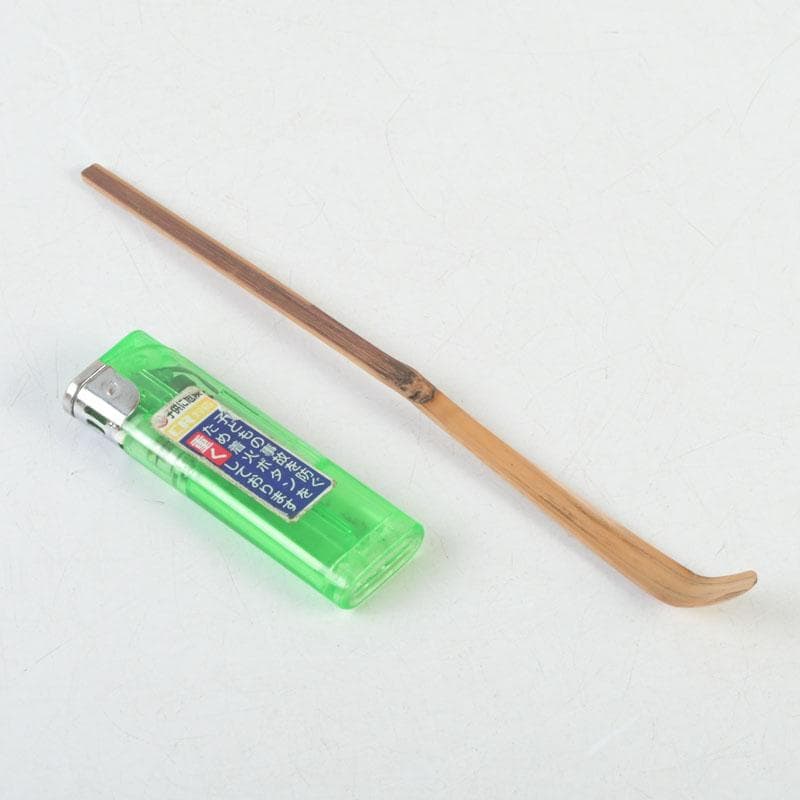
Visually, this chashaku speaks in the language of natural material allowed to reveal itself. The shaft exhibits the characteristic two-toned coloration — pale straw at the handle end deepening through warm amber and honey toward the curved tip — that marks bamboo grown slowly under attentive conditions. The grain lines run long and uninterrupted, the surface carries a low satin polish, and the scooping end curves with the kind of restrained elegance that can only be achieved by a maker who has internalized the form completely.
*The turtle holds still at the water's edge. The tea is scooped. The moment completes itself.*
🔹 [ DEEP-DIVE COMMENTARY ]
The making of a chashaku begins with the selection of the bamboo itself. The bamboo node (fushi) determines the scoop's center of gravity and visual character; its placement is not incidental. Kagebayashi Sohtoku's handling of the node — positioned near the midpoint of the shaft — creates a balanced object that rests naturally in the hand and presents no distraction from the act it performs.
The curved tip (hisaku, 樋先) of this piece is full and smooth, neither over-thinned nor left blunt. Under close examination, the bamboo fibers at the scoop face show the fine compression marks of careful shaping — the maker's presence remains legible in the material. This is the fundamental distinction between a tool and an object of chado: the hand that made it has not been erased.
The shared tube (共筒, tomo-zutsu) carries the calligraphy of Toda Jissan alongside the maker's signature. In the context of Japanese tea utensils, the tube is not mere packaging — it is a second document, a complementary text to the scoop itself. When the tube and scoop remain together across decades, they constitute a unified artifact whose cultural coherence is intact. This piece presents with both tube and box in that complete condition.
Daitokuji's role in chado cannot be overstated. Sen no Rikyu was buried within its precincts; its subtemples have housed successive generations of tea masters. A Daitokuji-affiliated inscription places this chashaku within the most direct genealogy of Japanese tea culture available. Collectors who understand this provenance know that such documentation is increasingly uncommon in the marketplace.
For the serious collector, the auspicious mei 「亀」adds a dimension beyond aesthetics. Named pieces (meimotsu, 名物) accumulate significance through use, through the occasions on which they are brought out, through the stories told around them. A turtle-named scoop is appropriate for any occasion of long-term celebration — a new beginning, a milestone, a gathering that marks the passage of time with gratitude.
🔹 [ 日本語解説 ]
【基本情報】
作者:影林宗篤
品目:茶杓 銘「亀」(吉祥銘)
書付:大徳寺 戸田実山
素材:竹(手削り)
大きさ:長さ約18.9cm 重さ約2g
付属:共筒(書付入り)・共箱
状態:良好。欠損・亀裂なし。筒の墨書も鮮明。
【文化的・美術的解説】
茶杓は、その小さな寸法のうちに茶道の精神を凝縮した道具です。一本の竹から削り出された約18.9cmの佇まいは、作者の手の記憶を宿し、点前のたびに茶室に静かな緊張感をもたらします。
影林宗篤は大徳寺ゆかりの流れの中で仕事をした作家であり、戸田実山師による書付はその系譜の正統性を物語ります。大徳寺は千利休が眠る地であり、日本の茶文化の最も核心的な場所のひとつ。この書付は商業的な認証ではなく、生きた文化の連鎖への参加です。
銘「亀」は吉祥銘の中でも特に格調高いものです。亀は万年の時を生きるとされ、長寿・安泰・静かな持続力の象徴。茶杓にこの銘を与えることは、一服の茶を永遠の時間の中に置く行為です。
茶杓の色調は、柄元の淡い麦わら色から先端の温かみある琥珀色へと自然に変化し、素材そのものが声を持っているかのようです。節の配置、先端の緩やかな反り、磨かれた表面——いずれも長年の鍛練を積んだ手のみが到達できる境地を示しています。
*亀は水辺でじっと佇む。茶が掬われる。その瞬間が完成する。*
【詳細解説】
茶杓制作は竹の選定から始まります。節(ふし)の位置が重心と表情を決定し、影林宗篤はそれを軸の中ほどに置くことで、手に自然に収まる均衡をもたらしています。
先端の樋先は豊かで滑らかな曲線を描き、削りすぎず、また鈍くもない。竹繊維の微細な圧縮痕に作者の存在が刻まれており、これが単なる道具と茶道具の本質的な違いです。
共筒には戸田実山師の墨書と作者の署名が記されています。茶道において筒は単なる収納器ではなく、茶杓と一体をなす文書です。筒と茶杓が数十年を経て揃った状態で伝わることは、文化的な完全性の証です。本品はその完全な姿で現存しています。
大徳寺の書付を持つ茶杓は、現在の市場において稀少な存在です。真剣なコレクターにとって、この来歴の意味は明確です。さらに吉祥銘「亀」は、新たな始まり、節目の祝い、時の流れを感謝とともに刻む席に相応しい銘として、長く愛蔵されるべき一品です。
🔹 [ SHIPPING & PACKAGING ]
• Dispatch: Within 1-6 business days
• Carrier: Japan Post EMS / UPS (with tracking)
• Packaging: Carefully wrapped with protective materials
🔹 [ BASIC DETAILS ]
• Artist: Kagebayashi Sohtoku (影林宗篤)
• Type: Chashaku (tea scoop / 茶杓)
• Mei (Named Piece): 「亀」Kame — Turtle, an auspicious symbol of longevity and good fortune
• Inscription (書付): Toda Jissan (戸田実山), Daitokuji (大徳寺)
• Material: Natural bamboo, hand-carved
• Length: Approx. 18.9 cm / Weight: Approx. 2 g
• Included: Original shared tube (共筒) with calligraphy, original shared wooden box (共箱)
• Condition: Excellent — no chips, cracks, or notable wear; calligraphy on tube clear and intact
🔹 [ CULTURAL & ARTISTIC INSIGHT ]
The chashaku — bamboo tea scoop — occupies a position in the Japanese tea ceremony that far exceeds its modest dimensions. It is the point at which the hand of the maker enters the bowl, the place where intention becomes action. A length of approximately 18.9 cm, shaped by a single cut of bamboo, connects the host to centuries of accumulated practice.
Kagebayashi Sohtoku worked within the disciplined tradition of Daitokuji, the great Rinzai Zen temple complex in Kyoto whose abbots and affiliated masters have shaped the aesthetic sensibility of chado for five hundred years. To receive an inscription (書付, kakitsuke) from Toda Jissan of Daitokuji is not a commercial endorsement — it is an act of cultural authentication, a statement that this object holds a place within a living lineage.
The mei 「亀」— Turtle — is among the most revered of auspicious names (吉祥銘, kissho-mei). In Japanese and broader East Asian tradition, the turtle carries the weight of ten thousand years; it is a vessel of longevity, stability, and patient endurance. When a tea master names a scoop after the turtle, they invite these qualities into the tea room — a quiet declaration that the moment of tea is also a moment of eternity.
Visually, this chashaku speaks in the language of natural material allowed to reveal itself. The shaft exhibits the characteristic two-toned coloration — pale straw at the handle end deepening through warm amber and honey toward the curved tip — that marks bamboo grown slowly under attentive conditions. The grain lines run long and uninterrupted, the surface carries a low satin polish, and the scooping end curves with the kind of restrained elegance that can only be achieved by a maker who has internalized the form completely.
*The turtle holds still at the water's edge. The tea is scooped. The moment completes itself.*
🔹 [ DEEP-DIVE COMMENTARY ]
The making of a chashaku begins with the selection of the bamboo itself. The bamboo node (fushi) determines the scoop's center of gravity and visual character; its placement is not incidental. Kagebayashi Sohtoku's handling of the node — positioned near the midpoint of the shaft — creates a balanced object that rests naturally in the hand and presents no distraction from the act it performs.
The curved tip (hisaku, 樋先) of this piece is full and smooth, neither over-thinned nor left blunt. Under close examination, the bamboo fibers at the scoop face show the fine compression marks of careful shaping — the maker's presence remains legible in the material. This is the fundamental distinction between a tool and an object of chado: the hand that made it has not been erased.
The shared tube (共筒, tomo-zutsu) carries the calligraphy of Toda Jissan alongside the maker's signature. In the context of Japanese tea utensils, the tube is not mere packaging — it is a second document, a complementary text to the scoop itself. When the tube and scoop remain together across decades, they constitute a unified artifact whose cultural coherence is intact. This piece presents with both tube and box in that complete condition.
Daitokuji's role in chado cannot be overstated. Sen no Rikyu was buried within its precincts; its subtemples have housed successive generations of tea masters. A Daitokuji-affiliated inscription places this chashaku within the most direct genealogy of Japanese tea culture available. Collectors who understand this provenance know that such documentation is increasingly uncommon in the marketplace.
For the serious collector, the auspicious mei 「亀」adds a dimension beyond aesthetics. Named pieces (meimotsu, 名物) accumulate significance through use, through the occasions on which they are brought out, through the stories told around them. A turtle-named scoop is appropriate for any occasion of long-term celebration — a new beginning, a milestone, a gathering that marks the passage of time with gratitude.
🔹 [ 日本語解説 ]
【基本情報】
作者:影林宗篤
品目:茶杓 銘「亀」(吉祥銘)
書付:大徳寺 戸田実山
素材:竹(手削り)
大きさ:長さ約18.9cm 重さ約2g
付属:共筒(書付入り)・共箱
状態:良好。欠損・亀裂なし。筒の墨書も鮮明。
【文化的・美術的解説】
茶杓は、その小さな寸法のうちに茶道の精神を凝縮した道具です。一本の竹から削り出された約18.9cmの佇まいは、作者の手の記憶を宿し、点前のたびに茶室に静かな緊張感をもたらします。
影林宗篤は大徳寺ゆかりの流れの中で仕事をした作家であり、戸田実山師による書付はその系譜の正統性を物語ります。大徳寺は千利休が眠る地であり、日本の茶文化の最も核心的な場所のひとつ。この書付は商業的な認証ではなく、生きた文化の連鎖への参加です。
銘「亀」は吉祥銘の中でも特に格調高いものです。亀は万年の時を生きるとされ、長寿・安泰・静かな持続力の象徴。茶杓にこの銘を与えることは、一服の茶を永遠の時間の中に置く行為です。
茶杓の色調は、柄元の淡い麦わら色から先端の温かみある琥珀色へと自然に変化し、素材そのものが声を持っているかのようです。節の配置、先端の緩やかな反り、磨かれた表面——いずれも長年の鍛練を積んだ手のみが到達できる境地を示しています。
*亀は水辺でじっと佇む。茶が掬われる。その瞬間が完成する。*
【詳細解説】
茶杓制作は竹の選定から始まります。節(ふし)の位置が重心と表情を決定し、影林宗篤はそれを軸の中ほどに置くことで、手に自然に収まる均衡をもたらしています。
先端の樋先は豊かで滑らかな曲線を描き、削りすぎず、また鈍くもない。竹繊維の微細な圧縮痕に作者の存在が刻まれており、これが単なる道具と茶道具の本質的な違いです。
共筒には戸田実山師の墨書と作者の署名が記されています。茶道において筒は単なる収納器ではなく、茶杓と一体をなす文書です。筒と茶杓が数十年を経て揃った状態で伝わることは、文化的な完全性の証です。本品はその完全な姿で現存しています。
大徳寺の書付を持つ茶杓は、現在の市場において稀少な存在です。真剣なコレクターにとって、この来歴の意味は明確です。さらに吉祥銘「亀」は、新たな始まり、節目の祝い、時の流れを感謝とともに刻む席に相応しい銘として、長く愛蔵されるべき一品です。
🔹 [ SHIPPING & PACKAGING ]
• Dispatch: Within 1-6 business days
• Carrier: Japan Post EMS / UPS (with tracking)
• Packaging: Carefully wrapped with protective materials
Quantity
Couldn't load pickup availability
Low stock: 1 left
View full details